Archives » 2020 » April

Modern Architecture, St Petersburg

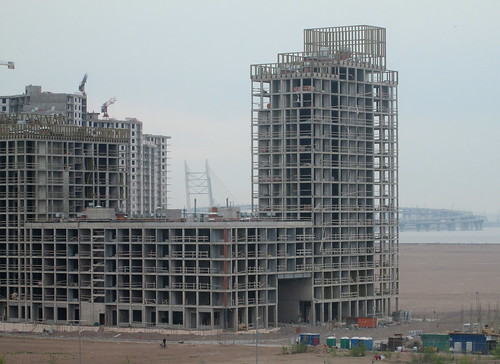
The view from the MS Magellan’s bow in dock at St Petersburg. New building construction with bridge behind:

A Bridge in St Petersburg

The view towards the city. Flats. We were told most Russians live in flats. All sorts of folks in similar flats in the same block. Only the insides would let you know how well off anyone is:-

Flats, St Petersburg

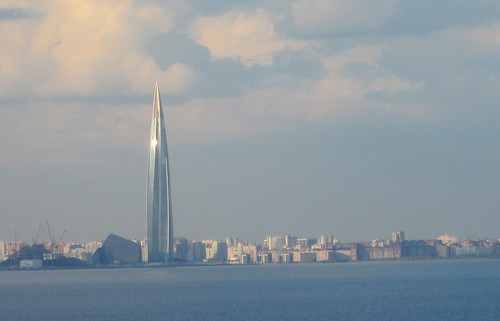
Gazprom Tower:-

Gazprom Tower, St Petersburg

This breaks the height restriction on buidlngs in St Petersburg. They let it go because it was way out of town and, well, Gazprom. Closer view:-

Gazprom Tower, St Petersburg

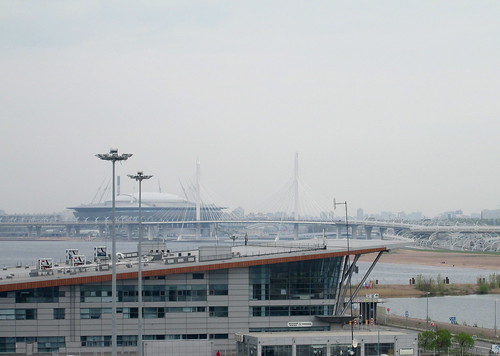
Krestovsky Stadium, or Zenit Arena, home of Zenit St Petersburg FC. This was a venue for games at the 2018 Football World Cup. Modern bridge in front with cruise terminal building in foreground:-

Bridge and St Petersburg Stadium

This was the nearest thing I saw in St Petersburg to an Art Deco building:-

A Decoish Building, St Petersburg

Peter the Great statue, photographed through coach windows so the statue is difficult to make out; a modern building behind.

Peter the Great Statue, in St Petersburg

Snakeskins by Tim Major

Titan Books, 2019, 407 p.

The supposed genesis of the conceit of this novel could have been lifted from John Wyndham’s The Day of the Triffids. In an event called the Fall, one day in 1808 green lights fell through the sky near the village of Ilam in Derbyshire. Unlike in Wyndham’s classic though, nobody was blinded. Instead a change was effected on the people living near where the lights fell. From that point on those few, since dubbed Charmers, on achieving adulthood shed a version of themselves every seven years. These sloughings-off are the Snakeskins of the title, which are identical to the original in every respect including memory, but last only a few minutes before turning to ashes; leaving the Charmer unblemished, younger, and longer lived as a result. Despite being a minority of the population, Charmers, in the guise of the Greater Britain Party, have been in charge of the Government for almost a century. Non-Charmers are second-class citizens at best, resentful of the advantages Charmers have, not least wealth and influence, though they still live and, in the case of one of our viewpoint characters, are schooled, side-by-side. She is Caitlin Hext, at sixteen soon to experience her first shedding. We also see this society through the eyes of Russell Handling, an aide to Government member, Ellis Blackwood, and of Gerry Shafik, an investigative journalist. Handling and Shafik are both non-Charmers.

This Charmers’ Britain is deliberately cut off from the outside world, technically backward. Hence references to Commodore 64s, an Acorn computer, VHS tapes and floppy discs. Yet one character sends a text message. And there is also a comment about an affected American accent. I’d have thought that was not likely to have been heard by the general public if the country’s isolation was as complete as suggested. (While reading it struck me that this book could have been written many years ago as a contemporary piece and only changed slightly for modern consumption after having been dug out of the metaphorical writer’s drawer.)

Caitlin’s Uncle Tobe’s latest shedding (like all such, attended by a Government employee) passes without incident. Caitlin’s, when it comes, provides a surprise. Her Snakeskin does not ‘ash,’ but stays alive. Only days later Uncle Tobe is found dead, a supposed suicide. Russell is contacted by the mysterious Ixion and asked to spy on Blackwood. Gerry begins to investigate the funding of the January care home.

It turns out that not only Caitlin’s but many Snakeskins do not ash, those in Government employ their surviving ones as substitutes in order to function twenty-four hours a day, but others’ – like Caitlin’s offshoot, soon calling herself Kit – are confined to the January care home until they do ash. (Though since the home is to all intents and purposes unregulated, that fate may not be as natural as the authorities pretend it to be.) A thriller plot then ensues with Caitlin helping Kit to escape the home with the aid of unregistered Snakeskins, and Gerry and Russell uncovering the designs Blackwood’s associates have to replace the Prime Minister and anticipate another Fall. The importance of the Hext family to goings-on are also revealed.

The setting-up of the situation is fine and the inter-personal dynamics are reasonably well-handled, those of a character named Dodie’s Snakeskins particularly so, but the text never really convinces as a conspiracy thriller. Moreover, Handling’s amour fou for Blackwood’s wife, Nell, is at best adolescent.

Pedant’s corner:- I read an ARC so some of these may have been changed in the final book. Time interval later count; seven. Otherwise; snuck (too many instances to count; sneaked,) focussed (x2, focused,) “off the edge off the bench” (of the bench,) “the catering company were scheduled” (was scheduled.) “‘What’s kind of trouble is Nell Blackwood in?’” (What kind of trouble.) “She nibbled at a corner of a sandwich” (the sandwich had been mentioned before, there was only one; ‘a corner of the sandwich’, then,) “on the world ‘your’” (on the word ‘your’,) fit (x2, fitted,) focussing (focusing,) sunk (sank.) “‘It was you that I met you in the…’” (It was you that I met in the,) staunch (stanch,) “none of them were experts” (none of them was an expert,) “none of the words were audible” (none … was audible,) “‘I’d be grateful it if you’d answer’” (no ‘it’.)
St Petersburg (iii)

A touch of the new (and temporary) and the old.

Fifa 2018 World Cup fan park:-

FIFA, World Cup 2018 Fan Zone, St Petersburg

Reverse of fan park + canal and bridge:-

A Canal in St Petersburg + FIFA World Cup Fan Zone

Main road aspect:-

St Petersburg, FIFA World Cup Fan Zone

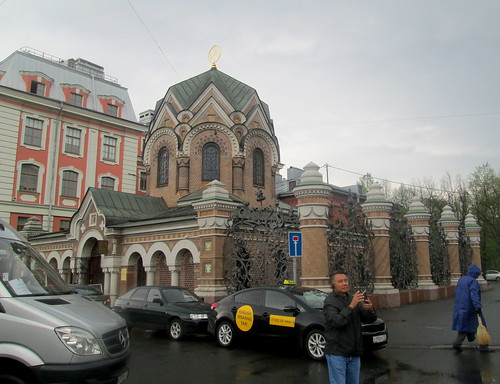
Contrast that with this typically Russian building right beside the fan park:-

Building Opposite Church on the Spilled Blood, St Petersburg

But just over the road from that:-

Church on the Spilled Blood, St Petersburg

The stunning Church of the Saviour on Spilled Blood:-

St Petersburg, Church on the Spilled Blood

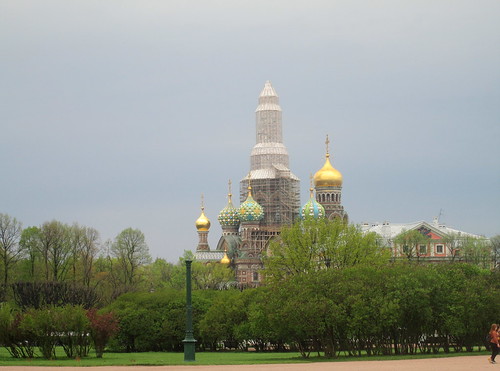
The church’s peculiar name arises because it was built as a memorial over the spot where Tsar Alexander II had been assassinated. Unfortunately it was swathed in scaffolding last May.

Church on the Spilled Blood, St Petersburg, from Field of Mars:-

Church on the Spilled Blood, St Petersburg From Field of Mars

St Petersburg (ii)

A bridge on the Neva (Troitskiy Bridge?):-

St Petersburg, Bridge on River Neva

Sampsoniyevskiy Bridge on Bolshaya Nevka, St Petersburg:-

Bridge on Bolshaya Nevka, St Petersburg,

Building and Sampsoniyevskiy Bridge on Bolshaya Nevka:

Building and Bridge on Bolshaya Nevka,St Petersburg

Weaponry and, below, military vehicles, outside a military museum (of artillery.) Seen through rainy bus windows.
Weaponry, St Petersburg,

Military Vehicles, St Petersburg,

An old sailing ship alongside the Petrovskaya Embankment:-

An Old Sailing Ship, St Petersburg

The same ship from the Kutuzov Embankment across the River Neva. There is what looks to be a mosque in the background here:-

Ferry and Old Sailing Ship, St Petersburg

Ice and Other Stories by Candas Jane Dorsey

PS Publishing, 2018, 316 p.

 Ice and Other Stories  cover

Dorsey has been described as Canada’s Ursula K Le Guin. While her writing is good I wouldn’t go so far as to compare it with Le Guin’s. Overall in these stories I found there is something of a reserved quality to it.

In (Learning About) Machine Sex viewpoint character Angel writes the first computer progamme that can bring you to orgasm, with no need for all that love stuff. Despite also positing the need for human interaction the story presents a pretty bleak view of male sexuality. But that has ever been what it is.
Sleeping in a Box is nominally set on a Moon where everything is expensive and imported from Earth but the story is really about restrictions and how we all have to live with them.
Here Be Dragons is a metaphor for navigating through a life filled with obstacles. A woman exacts a small measure of revenge for the destruction of a domed habitat.
Presented as a historical report, Turtles All the Way Down tells of the development of a new scientific explanation for “reality faults,” cracks where the world opens and closes.
Dvorzjak Symphony is the story of a nightwatchwoman who has a clandestine lover on the premises.
A tale about how little we may know those nearest to us, in Death of a Dream dreams have become almost real places, monitored by the Dream Police. The narrator’s dream daughter is abducted by her ex-husband. Of course she sets out to find her.
The far future narrator of Living in Cities has returned to Earth and is giving to another returnee a tourist guide of the city she has curated.
In Going Home to Baïblanca, described under its title as a homage (femmage?) á Elisabeth Vonarburg, a human-like sea creature rescues a man from drowning only to find he’s not what he seemed.
Mapping sees a man abused in childhood trace patterns on his skin with razor blades before eventually seeing a psychiatrist.
Ice is set in a warmed world where our protagonist goes round blowing up partially drowned skyscrapers while holding the memories of a dream child under the influence of a drug named spike.
The lack of a question mark in the title of How Many Angels Can Dance forces a reading in which an explanation of angels dancing is necessary, which the story then goes on to provide.
Locks has the feel, but not the form, of a fairy story. There is a castle with locked rooms and a guardian, a forest, and someone under an enchantment. All you need really.
Despite its first eleven words Once Upon a Time…. is not a fairy- but instead a cryptic love story, which alludes to faery and metaphor in a meta-fictional commentary on the idea of story.
Blood From a Stone is a fantasy which sees the balance of a mother and her daughter’s isolated existence upset when a male water finder arrives.
In Mom and Mother Teresa the famous nun turns up on our narrator’s mother’s doorstep. Her mother’s Scots Presbyterian childhood, “with its message of duty, sacrifice, and unhappiness” had not been erased by adult years’ attendance at the local United Church but her own parents’ training made her offer the little woman tea and the second most comfortable bed in the house. Mistake. Mother Theresa moves in – complete with twenty-five alphabetically named orphans and a host of homeless folks. There is another twist to come.
In a deep dark winter of ice-fog, shortages – and electric cars – in “…the darkest evening of the year…” a group celebrates midwinter in the old ways, roasting meat, seeking the return of the light and coming together.
Written for Canada Reads 2006, A Trade in Futures reads like a hard-boiled detective story but its narrator is a poet laureate and the client who comes through the door wants his raison d’être to be found again for him. The text does though make the obvious joke about having a poetic licence.
The allusion in the title of Seven in a Boat, No Dog to Jerome K Jerome is somewhat misplaced. There are seven characters, possibly the last North American survivors of an apocalypse – certainly the last with memories of the old days – but there are at least two boats and the tone is not as light as might be expected.
First Contact may be just that but is more likely a metaphoric allusion to the fact that any initial intimate encounter between a woman and a man is laden with unknowabilities. This story is not for those with tender sensibilities as regards frank language and the sexual act.
In Dolly the Dog-Soldier the titular Dolly is part of a pack of uplifted dogs, able to speak and being trained for an assassination mission.
The Food of my People sees a young girl whose father has been badly injured in a rig blow-out taken in by a neighbour, Cubbie, after school. Attempting jigsaws seems to be instrumental in helping her dad recover. Cubbie is fond of home-cooking and there is a Dorsey family recipe for bread pudding at the end of the piece.
End of the Line, or, Desperate Russian Girls Looking for Love is another reflection on story, and on living life on-line beset by email spam.

Pedant’s corner:- I read an Advance Reading Copy (somewhat belatedly) so many of these may have been changed before publication. I note from the cover that the author’s first name – given as Candice on the ARC – has been. Elsewhere; a missing comma before a piece of direct speech (several times,) forbearers, (forebears,) Dvorzjak (okay it’s a character’s name; but the composer’s was spelled Dvořák,) “When I reached to door” (reached the door,) reflexion/reflexions (reflection/reflections) gaffer’s tape (gaffer tape,) Dr Jones’ (Dr Jones’s – used later,) Polariodä camera (Polaroid,) “because of the visor no-one would never see me again” (would ever see me again,) connexion (connection,) focussed (focused,) “heaven forefend” (forfend,) “a tinker’s dam” (damn,) “I took him in his my arms” (Dorsey may have intended this – to represent a disoriented state – but ‘my arms’ would not be such an opaque over-elaboration,) “not just cock into cunt into but into all molecules” (again perhaps intended, but again over-elaborated,) “all the pack are younger than I am” (all the pack is younger,) “ma chou” (even though the person being spoken to was female, the French word chou is masculine in gender; ‘mon chou’. Do Quebecois use “ma chou” in this way?) ambiance (ambience.) In the Story Notes; “this this story” (only one ‘this’ needed.)

The Cruiser Aurora, St Petersburg

The Cruiser Aurora is now the Russian Navy’s Ship No 1. It’s anchored by the Petrogradskaya Naberezhnaya (Petrograd Embankment) on the Bolshaya Nevka River, an offshoot of the River Neva, in St Petersburg. (The embankment link has a cracking aerial photo.)

The cruiser fired the blank shot which signalled the start of the October Revolution in 1917. It was also one of only three Russian ships to survive the Battle of Tsushima in the Russo-Japanese War.

I was really looking forward to seeing it again. I don’t remember the green paint at the waterline from when I visited in the 1960s, but we did hear someone say it had recently been repainted. It’s looking in very good nick.

Stern of Aurora:-

The Cruiser Aurora

Saltire:-

Saltire flown on the Cruiser Aurora

Gangplank and public access. There was a big queue at the ticket gate but we had only a short time at the quay anyway before we had to reboard the coach:-

Gangplank and Cruiser Aurora

Looking towards bow:-

The Cruiser Aurora Looking Sternwards.

View showing bow:-

Aurora

Flag at prow. It looks like a bit like a reconfigured Union Jack. It’s the Jack and fortress flag of the Russian Navy:-

Aurora flag

Aurora memorial stone on the quayside:-

Cruiser Aurora Memorial Stone

The St Petersburg Naval Academy is also on the embankment opposite the Aurora. This statue outside the St Petersburg Naval Academy is of the famous (in Russia) Admiral Pavel Stepanovich Nakhimov, for a further picture on the net see here:-

Statue of Admiral, St Petersburg Naval Academy

Just round the corner on the the Petrovskaya Embankment was this monument to the three-hundredth Anniversary of the Russian Navy. Cruiser Aurora to right and Naval Academy in background in first picture:-

Russian Navy Three-Hundredth Anniversary Monument, St Petersburg

St Petersburg, Russian Navy's Three-Hundredth Anniversary Monument,

THe plaza between it and the Naval Academy had a nice fountain. The lamp standards are a good design too:-

A Fountain, St Petersburg,

Great Patriotic War Remembrance, St Petersburg

I was glad to have gone to St Petersburg in early May. This is the time of year when Russia remembers the great sacrifices it – and the Soviet Union of which it was a part – made during World War 2 (which in Russia is known as the Great Patriotic War.) It is salutary to think that without that sacrifice the war against Germany would have been a much greater struggle for the Western Powers than it was. It is not too great a statement to make that the war in Europe was in fact won by the Soviet Union.

Britain’s contribution to overcoming Nazi Germany is much over-estimated by many in these islands. It really amounted to not losing – or at least not admitting to, and therefore not giving up. From the Normandy landings onwards it was even overshadowed by the US (which of course – British victories at Kohima, Imphal and Burma notwithstanding – won the Pacific War more or less by itself.)

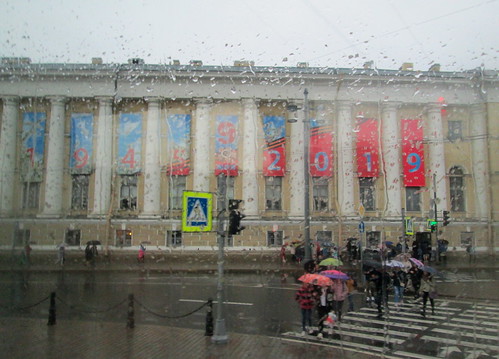
St Petersburg in early May 2019 was covered in banners commemorating the Victory Day in 1945.

1945-2019 Remembrance. (Unfortunately seen through rainy coach windows):-

1945-2019 Remembrance St Petersburg

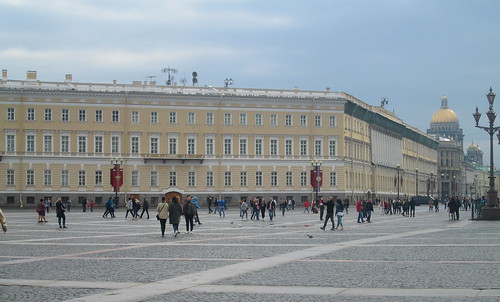
Corner of Palace Square:-

palace , St Petersburg, Russia

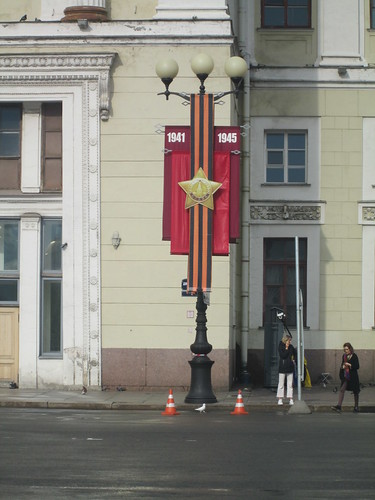
There are 1941-1945 banners in front of this building in Palace Square:-

Palace Square  , banners

Close-up view of banner:-

1941-1945 banner

More banners in Palace Square. (St Isaac’s Cathedral in distance):-

Palace , St Petersburg, Russia

1941-1945 Remembrance Banner, Nevsky Prospekt, St Petersburg:-

1941-1945 Remembrance Banner, Nevsky Prospekt, St Petersburg

Live It Up 65: Leningrad

Well, Leningrad is what St Petersburg (see surrounding posts) was once named – and was so the first time I visited it. And when Billy Joel did.

The song is perhaps a bit too sentimental but also lies in that vein of historiography that was true of the same singer’s We Didn’t Start the Fire.

Billy Joel: Leningrad

St Petersburg Sphinxes and Rostral Towers

There are two Egyptian sphinxes by the banks of the River Neva in St Petersburg. Our tour guide was quite proud of these. They stand on what is known as the Quay of the Sphinxes. It wa sthe first stop on our first tour.

A Sphinx, St Petersburg

Second Sphinx, St Petersburg

Sphinx Ornamentation:-

Sphinx Ornamentation, St Petersburg

The sphinxes are close to the Blagoveshchensky Bridge Over The River Neva:-

Bridge Over The River Neva, St Petersburg,

River Neva Bridge, St Petersburg

Next we stopped to see the Rostral Towers (or Columns) once beacons for St Petersburg’s original port and another symbol of the city:-

Traffic and Rostral Tower, St Petersburg

A Rostral Tower, St Petersburg

St Petersburg (i)

This was the big one. I had been to St Petersburg before – when it was Leningrad, on a school cruise back in the heyday of the Soviet Union when we were shown the bullet holes on buildings’ walls still left over from the siege of the city during the Great Patriotic War (as World War 2 is called in those parts) – but my wife hadn’t, and with her interest in Russian history it was a place she had always wanted to see and was the reason we chose to go on this cruise at all.

The city straddles the River Neva (and a bit beyond) which therefore appears in many of our photographs. It is also home to some magnificent architecture, beautiful palaces from the time of the Tsars (in stark contrast to the conditions in which ordinary folk lived, sometimes ten or more to a room in pre-revolutionary days.)

The Winter Palace, St Petersburg, from across River Neva:-

The Winter Palace, St Petersburg

The Winter Palace is part of the famous Hermitage Museum another part of which – along with a couple of ferries – is seen below:-

The Hermitage Museum, St Petersburg

Other buildings on River Neva frontage-

Frontage, River Neva, St Petersburg

I got a closer view of the Naval Academy:-

Naval Academy, St Petersburg

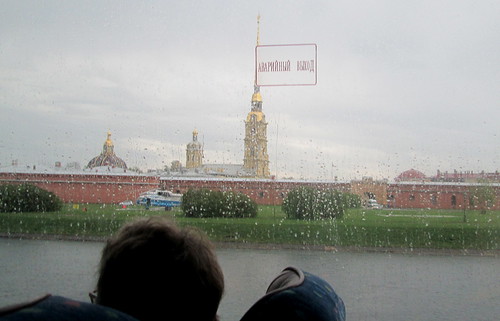
The Peter and Paul Fortress, lies on an island:-

Peter and Paul Fortress, St Petersburg

Closer view seen through rainy coach windows:-

St Petersburg, Peter and Paul Fortress

I couldn’t get far enough back to get all of this building in. In St Petersburg terms it’s fairly unremarkable:-

A Building in St Petersburg

A gilded tower in the city centre. (Note saltire flag in blue on white – St Andrew is Russia’s patron saint as well as Scotland’s, besides other countries.)

A Gilded Tower, St Petersburg

Riverfront builidings and St Isaac’s Cathedral beyond:-

St Isaac's Cathedral,St Petersburg from Across River Neva

free hit counter script