Archives » 2020 » April

Scottish Short Stories Edited by Theodora and J F Hendry

Penguin, 1945, 123 p.

Scottish Short Stories cover

The back cover says this book was mostly edited by Theodora Hendry but she was killed in the London Blitz. The criteria for selection in the volume was Scottish stories with a Scottish setting or else it “would almost certainly have assumed an international aspect.”
The first, The Coasts of Normandy by George Blake, is the story of a tragedy which befell the narrator’s childhood friend and its effect on the child’s mother as reflected through the prism of a chance encounter with a stranger many years later on the coast of Normandy. It takes a slightly circuitous route to its revelation (which the reader intuits well before the narrative gets there) but this allows for such thoughts as, “The simple feel as warmly as the clever and the learned.” Another of its observations is a reminder that, for some soldiers at least, the Great War was not only a horrific trial and ordeal but also an opportunity to remake their lives in its aftermath.
In A Sunday Visit by Colm Brogan two boys are dragged along by their mother to the Mortons’ house, where the family has just suffered a bereavement. Amid all the whispering, the boys are left to their own devices.
A Hike to Balerno by Ronald McDonald Douglas sees two boys on the titular hike, the escapades they get up to, the banter between them, “daft, just plain daft.”
Clay by Lewis Grassic Gibbon is the story of Robert Galt, a man from a chancy background who takes a farm and devotes all his time to it, to the neglect of his wife and his daughter’s prospects.
Beattock for Moffat by R B Cunninghame Graham tells of the last journey of a dying Scot on the train up from London with his cockney wife and his brother come to take him home to die. The author observes of the accomodations married couples make with each other that “usually … good points, seen through prejudice of race, religion, and surroundings, appear … defects,” and refers to the Cockney wife’s reticence being explained by, “the English theory, that unpleasant things should not be mentioned, and that, by this means, they can be kept at bay.” The prose evidences that Scottish authors’ eye for landscape.
In The Sea by Neil M Gunn a twelve-year-old overcomes his fears, staggering through the night down to the harbour to witness the perilous return of his father’s and brother’s boats during a great storm. Here it is seascape (or land-meets-sea-scape) which the descriptive powers bring to life.
J F Hendry’s Chrysalis is a fragment of the childhood of a boy who wants to be good but fears he is bad because he sometimes is too enthusiastic in his activities.
Clock-a-Doodle-Doo by Willa Muir is set in a room full of clocks (all wag-at-the-wa’) which can speak to each other, having theological discussions over whether the Son or Moon is the primum mobile and aspiring to Pure Horological Thought.
Neil Munro’s The Lost Pibroch could be characterised as a Scottish version of the Pied Piper of Hamelin. Two pipers come to Half-Town. After a night of musical vying with the blind piper there he finally plays them the titular pibroch he “got from a man in Moideart.” It has “something of the heart’s longing and the curious chances of life” and sets up a wanderlust in those who hear it.
In The Matinee by Fred Urquhart a fifteen-year-old newly graduated into long trousers reverts to shorts to get into the cinema more cheaply, dragging his younger brother along for corroboration. Engrossed in a film where a factory owner exploiting the workers is presented as virtuous he fails to acknowledge his brother’s increasing personal discomfiture.
Eric Linklater’s Kind Kitty is an old woman who likes a drink, then dies through lack of it a few days after throwing a party for Hogmanay. She inveigles her way into heaven but finds the company there uncongenial, and the beer far too poor.

Pedant’s corner:- a missing full stop, “brigh” (is missing a final ‘t’,) missing commas before pieces of direct speech.

Soprus Cinema, Tallinn

This building in Tallinn looked impressive from this angle:-

Soprus Building, Tallinn

These columns even more so:-

Ornamentation, Soprus Building, Tallinn

On rounding the corner to the entrance I discovered it’s a cinema, Soprus. Pity about the van in front. Nice wee fountain though:-

Soprus Entrance, plus Fountain, Tallinn

The Living Mountain by Nan Shepherd

A Celebration of the Cairngorm Mountains of Scotland

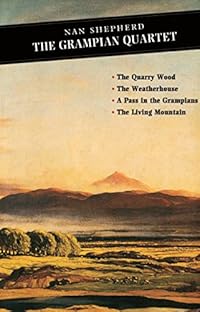
In The Grampian Quartet, Canongate, 1996, 88 p, plus 2 p Author’s Foreword, 1 p Contents and v p Introduction by Roderick Watson.

 The Grampian Quartet cover

One of the hallmarks of Scottish writing (or I should say good Scottish writing) is its facility for landscape description. In The Living Mountain, a non-fiction work of virtually nothing but description, Nan Shepherd elevates this to an outstanding degree. Here is the Cairngorm plateau in all its glory, beauty and menace; its prominences, its rocks, its shifting hues, its changing moods, its sparkling waters, its light and air, its sudden vistas and deceptive perspectives, its capricious – and dangerous – weather, its plants, birds and deer, its people, its effect on the senses, its being. If Shepherd had set out to write a love letter to the Cairngorms she could not have succeeded better. Her immersion in and knowledge of the landscape is profound. That it did not find a publisher on being written towards the end of World War 2 is amazing. It did not see the light of day till Aberdeen University Press published it in 1977. Shepherd’s foreword to that edition refers to the changes that have occurred in the Highlands during the interim. But her feelings about the mountains remained the same. They are where she seemed to be most at home, at one with herself and the world.

Pedant’s corner:- In the Introduction; a closing bracket without a previous opening one. Otherwise; “Its waters are white” (if they were tumbling over rocks, yes; but this is in a passage about clarity. The last thing an utterly transparent medium is is white. You can not see through white. Try looking through a piece of paper,) acclimitisation (acclimatisation,) felspar (feldspar.) “In December an open heather” (in open heather.)

Tim Brooke-Taylor

I was very sad to hear of the death of Tim Brooke-Taylor, especially so since it seems he succumbed to Covid-19.

I suppose most people will remember him from The Goodies (goody, goody, yum-yum.) However, Taylor’s “character” in that series always seemed to me to be composed too much of the upper-class English twit, which did him an injustice.

I first encountered him, though in the radio show I’m Sorry, I’ll Read That Again, (episodes of which are available on the iPlayer) in which he played many parts but most notably for me, Lady Constance de Coverlet, a woman of bountiful proportions the source of many jokes, and perenially man-mad.

One particular memory I have of the character came in the serial “Professor Prune and The Electric Time Trousers” where in one episode the show’s perenially popular dog Spot was carried away in the time trousers along with the Professor. “Come back, Professor,” said Lady Constance. “Come back, Spot.”

“Come back Spot?” came the query, as if mystified by her affection for a dog.

Lady Constance – “I chase anything in trousers.”

Timothy Julian Brooke-Taylor: 17/7/1940 – 12/4/2020. So it goes.

Town Hall, Tallinn, plus Church of St Nicholas

We came upon Tallin’s Town Hall circuitously.

First the spire:-

Town Hall Spire, Tallinn

Then from the square:-

Town Hall and Square, Tallinn

The spire on this church was in a similar style to the Town Hall but its crow-stepped gables look very Scottish:-

Tallinn church, Estonia

Spire of Church of St Nicholas:-

Tallinn Church of St Nicholas Again

The church:-

Square and Church, Tallinn

The onion domes of another church (to right of Church of St Nicholas in the above picture):-

onion domes, Tallinn, Estonia

Church of St Nicholas (reverse angle):-

Tallinn church

Contrast that with more modern life. Naval ships in Tallin harbour. (MS Magellan to left.):-

Naval Ships, Tallinn Harbour

More Tallinn

A beautifully ornamented building in Tallin, Estonia:-

Tallin Architecture

Another:-

building in Tallinn, Estonia

Kulturministerium (Culture Ministry building):-

culture ministry, Tallinn, Estonia

A set of ornate doors:-

painted door, Tallinn, Estonia

Opera and drama building:-

Opera House and Drama Building Tallinn

On his (or her) perch in Tallinn. Street furniture (litter bins anyway) seems to be the same everywhere:-

Perched Gull, Tallinn

Tallinn, Estonia

Fourth stop on the Baltic cruise was Tallinn, the capital of Estonia one of the so-called Baltic States. In modern times it has only been an independent country between the two World Wars and since the collapse of the Soviet Union.

The city centre (well, the old town) was a reasonably short walk from the port past an old bastion:-

Old City Wall Bastion, Tallinn

The streets in the old town retain a traditional feel:-

Street in Tallinn

Tallinn, street, Estonia

(Church of St Nicholas to rear here.)

Street and Church, Tallinn

Thee are views of old city walls:-

Old City Wall, Tallinn

City Wall and Tower, Tallinn

But beyond this gate a more modern city is evident:-

Old and New Tallinn

View through that same gate from the other side:-

Tallinn, Building

And from further away:-

wall + towers , Tallinn, Estonia

Green-roofed building to the right above:-

green roof, Tallinn, Estonia

And its weather vane:-

green roof weather vane, Estonia, Tallinn

The Little Town Where Time Stood Still by Bohumil Hrabal

Abacus, 2011, 173 p, plus x p Introduction by Josef Škvorecký. Translated from the Czech, Mĕstečko, kde se zastavil čas (A Small Town Where Time Has Stopped,) by James Naughton.

 The Little Town Where Time Stood Still cover

It makes sense to publish this story in the same volume as Cutting it Short since it carries on the story of Francin Czilágová and his cousin Uncle Pepin from that tale.

The Little Town Where Time Stood Still has an odd narrative, though, since it starts being narrated by the son of Francin and Anna, describing how, inspired by the tattoos of the working men at the Bridge Inn (where the patrons are much amused by tales of the local priest Dean Spurný lifting his maids up to the ceiling by the leg of the chair they’re sitting on so that their skirts flap round their cheeks) he wished to have a tattoo of a small boat. Mr Alois obliges him but when he finally sees his tattoo it is of a stark naked mermaid. Thereafter the narrator’s own life is as if forgotten and the novel reverts to the life story of his father, Francin, and Uncle Pepin.

By now Francin has swapped his Orion motor-bike for a Škoda 430 car, which, despite it never going wrong, unlike the Orion, he still takes apart every weekend to see why it works so well. Pepin is still riddled with nostalgia for the old Empire and for the pair, “time was slowly standing still while another time, of different people, was out there full of its own élan and new energy and endeavour.”

Details of everyday life fill the pages while wider events take place more or less off stage. The Second World War is almost an incidental occurrence, impinging little on the town even though Pepin gets into a confrontation with Mr Friedrich, in his Reichs uniform, over whether Austrian or German soldiers would win, Pepin insistent that, “Austrian soliders will ever be victorious,” with an almost pantomime exchange of “wills” and “won’ts” kept up between them over the years afterwards. The arrival of Soviet troops is marked by Pepin being involved in a dancing competition with them.

When the brewery is taken over by the workers they agree Francin had been good to them – unlike the chairman – but they explain that made his behaviour worse as it had served to reconcile them to the old regime. The way the brewery is managed from then on is viewed by the text with a critical eye (not the sort of thing to endear Hrabal to the authorities that were) as Francin and Uncle Pepin carry on seeing the world in the same old way. The progress that wasn’t is all but an irrelevance to them as they continue to live in their minds in a town where time stood still.

Except it didn’t. Pepin becomes bed-ridden, and Francin realises, “what a benefit it was for an old person to be able to do things for himself, not to be dependent on people” and on watching a cemetery being torn up that, despite some resistance, “they had succeeded, they had to succeed, in tearing those old times out of the ground.”

Once again the text is sprinkled with Scottish terms; Hogmanay, ploutering, and wee (for small.)

Pedant’s corner:- vicarage (is this the correct word for a priest’s house?) a missing comma before a piece of direct speech, “ammonium” (ammonium carbonate I should think, ie smelling salts,) missus’ (missus’s,) galop (gallop,) bandoleer (bandolier.)

As If We’re Not Suffering Enough

What with no football to fill your Saturday afternoons with dread or joy or … meh.

What with having to stay at home on a beautiful day.

What with wall-to-wall pieces on the TV cobbled from social media feeds or interviewing their so-called “stars”.

What with being depressed enough by the news.

Then after said news on Channel 4 tonight the announcer said next on was a film starring Vera Lynn! We’ll Meet Again, no less.

We’ve now definitely disappeared down a plughole into a bizarre altered reality.

Just to get it straight, guys. We are not in a real war. We’re not in any sort of re-enactment of the 1940s.

The UK is certainly not being led by people with any of the competence of those in the wartime coalition (even if one them was supposed to have “much to be modest about,” a remark belied by his subsequent achievements.)

This is a pandemic – an inevitable pandemic, one that was coming down the line sometime; they always do – for which leaders obsessed with lowering taxes and balancing budgets failed to prepare.

If you want a Second World War analogy, it is those same politicians who occupy the place of the 1930s appeasers of fascism. I hope the public remembers and doesn’t forgive them. History certainly won’t.

Kurhaus, Warnemünde

Not the Kurhaus just off the beach but one more in the town.

(According to Warnemünde‘s Wiki page on which there is a cracking photograph of the building, Kurhaus = Spa House.)

Everything about this building is stunning and screams Deco. Streamlining, rule of three in columns by the door and lower windows, triangular glazed projection, brickwork, canopies, rounded corner.

Kurhaus, Warnemünde

The entrance looks like it could be an Art Deco cinema. Streamlining, rule of three in columns by the door and lower windows, triangular glazed projection, brickwork, canopies, rounded corners:-

Entrance Kurhaus, Warnemünde

Corner View, Kurhaus, Warnemünde

Opposite Corner View, Kurhaus, Warnemünde. Again, as on the beach, Wellenrausch Restaurant and Cafe. Kurhaus. Paulo Scutaro Ristorante. Hellas Greichische Gastlichnet:-

Opposite Corner View, Kurhaus, Warnemünde

Side of Kurhaus. Note lamp standards:-

Side, Kurhaus, Warnemünde

Lamp standard and bandstand to rear of Kurhaus. Also scuplture of female in background:-

Lamp Standard and Bandstand to rear of Kurhaus, Warnemünde

Kurhaus from rear:-

Kurhaus, Warnemünde from Rear

free hit counter script