Archives » 2017 » February

Time Travel, Reviews, Hame and Rebellions

In an article in Saturday’s Guardian review, James Gleick examined the history of the time travel story since H G Wells more or less invented the form in The Time Machine. It was a skate over the subject really and veered into the territory of so-called Alternative History which of course I prefer to name Altered History but worth reading all the same.

In the same section of the paper was a review of Annalena McAfee’s new novel Hame. Many reviews are interesting, some make you think “definitely not”. Very few inspire you to go out and read the book concerned. Stuart Kelly’s did just that, as indeed did his review of Kevin MacNeil’s The Brilliant and Forever which I read a few months ago after also reading the same author’s A Method Actor’s Guide to Jekyll and Hyde due to the same review. McAfee’s Hame sounds intriguing and possibly funny. Definitely one I’ll look for.

I recalled McAfee’s name. She had an article in the Guardian Review some weeks ago which I wished to post about then but at the time could not find on the Guardian website but which now pops up fourth when you search her name there. The article was about the relative importance of Robert Burns and the possible balefulness of his mythologising (Aside. Why does no-one ever question this about Shakespeare?) and the continuing battle over whether Scots is a suitable medium of expression for literature.

My take is if the author wishes to use Scots it is entirely up to her or him. It may reduce the psossible readership but that is a question for author and publisher, not reader. Myself, though not very well versed in it, my mother being the daughter of two English parents, thus hardly a native speaker and unable to expose me to its richness, I do not consider Scots – as some do – as necessarily inferior form to English. It is at times much more pithy.

I have a quibble with McAfee over a detail in that piece, though. She stated that Burns was born “two decades after the failed rebellion against the Union.” While Prince Charles Edward Stuart’s Rebellion of 1745-6 was many things, not least the last flailing gasp of a failed dynasty, and the Battle of Culloden can even be considered as in some way (if you ignore its continuation into Ireland even into the twentieth century and possibly beyond,) the last of the Thirty Years War – though admittedly that was mostly fought out in German territories – it was not primarily against the Union. It was less general then that, more personal.

A Man Lies Dreaming by Lavie Tidhar

Hodder, 2014, 268 p, plus 5 p Historical Notes, 9 p Endnotes and 1p Acknowledgements
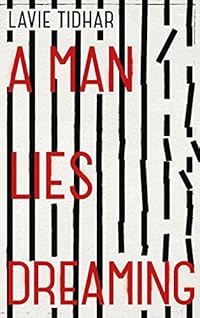
 A Man Lies Dreaming cover

Before we plunge into the first chapter there is a framing device, “In another time and place, a man lies dreaming.” Then we enter the diary, from November 1939, of a private investigator who calls himself Wolf, a refugee to London from Germany after an event he describes as the Fall, before a passage in the third person relating ongoing events not described in Wolf’s diary. It very soon is apparent Wolf is a Nazi. “I don’t work for Jews,” he tells the woman who wishes to be his client. Moreover he once had an affair with his neice, Geli (who killed herself with his gun,) and then took up with “sweet, good-natured” Eva. This, in other words is Adolf Hitler, fallen on hard times. (That name though, does not appear on the page till very late in the book.) The woman is Isabella Rubenstein who wants to know the whereabouts of her sister Judith, supposedly smuggled out of a Germany led by the Communist Ernst Thälmann after the 1933 elections, but since disappeared. Altered history territory, then.

Except, it isn’t. The chapter ends with the framing device and the dreaming man is named as Shomer. The book continues with the noir thriller elements alternating Wolf’s diary entries with third person elements and every so often the framing device being reasserted. In this we learn Shomer was a writer of shund (a kind of pulp fiction) and the place he is dreaming in is Auschwitz, the real Auschwitz. So it appears it is Shomer who is telling Wolf’s tale, an exquisite revenge presumably since he inflicts pain on Wolf through the various beatings he receives throughout the thriller. Shomer also hallucinates a companion, Yenkl, partly, it seems, to give him some comfort.

It can also be considered a kind of revenge by Tidhar, who is an Israeli, and whose maternal grandparents were both Auschwitz survivors. (The rest of their families were not so fortunate.) This is the sort of subject matter which a non-Jew would have to treat with circumspection, if not avoid altogether. Tidhar has more licence in that regard.

Hitler has been treated before in SF of course, but not usually so directly – except perhaps for Fritz Leiber’s short story Catch That Zeppelin! and Norman Spinrad’s The Iron Dream part of which purports to be a novel written by a Hitler who emigrated to the US in 1919. The crazed nature of that narrative is not quite emulated here. If anything Wolf is relatively restrained in his ravings. That may be due to the necessity for a viewpoint character to be, at least, coherent.

An altered history would not be worthy of the name did we not meet the famous within and here – as well as Hitler – we duly encounter Oswald Mosley – soon to be a British Union of Fascists Prime Minister in Wolf’s world – his wife, Diana (Mitford,) and her sister Unity, whom Wolf knows as Valkyrie and has the hots for him. Various other Nazis pepper the plot, Rudolf Hess, Josef Kramer, Ilse Koch, Joseph and Magda Goebbels. Literary Brits pop up including Ian Fleming, Tolkien and Evelyn Waugh. Tidhar’s tendency to gild the lily was exemplified here at a publisher’s party (the publisher concerned had, of course, turned down My Struggle,) when Wolf re-encounters Leni Riefenstahl, now working in the US, and she relates to him a plot – to be written by F Scott Fitzgerald as a sequel to The Great Gatsby – for a projected film starring Humphrey Bogart as Gatsby, owner of a bar in North Africa when Daisy Buchanan walks back into his life. The film is to be called Tangier, though, not Casablanca.

There is, too, a Constable Keech. I wondered mildly if Tidhar was aware of what this word signifies for Scots. For myself, I could not avoid the inference.

A Wilfred Owen reference occurs in Wolf’s Great War reminiscences of being blinded and I must confess I liked the conflation, “It is a truth universally acknowledged, that once a detective acquires two concurrent cases, the two must be in some way related,” but I’m not sure about the odd scene where Wolf dreams he is in what is obviously, to us, Auschwitz. Then again, he tells the Chief Inspector who had interrogated him about the murders of prostitutes outside his office, “‘You Jews spend far too much time in your own imagination.’”

This could have been powerful stuff but there is something unbalanced about it all. The scenes in Auschwitz are compelling (but did they still require Sonderkommando to dig graves after the ovens came into operation?) and moving. However, they occupy far too few pages. It is Wolf’s tale which dominates. And that is too trifling to carry the weight thrust upon it by the overall concept.

Pedant’s corner:- USianisms abound. For a story mainly set in late 1930s London that is an added barrier to suspension of disbelief. We had purse for handbag, down-at-the-heels for down at heel, nightstand for bedside table, inside of for inside, ruckus for racket, nightstick – in the 1930s British policemen had truncheons, whiskey (whisky,) airplanes (aeroplanes,) bums used by an Englishwoman as a term for a ne’erdowell (not a chance,) beat-up (beaten-up,) the car’s hood (the car’s bonnet.)

Otherwise there was maw (it’s a stomach not a mouth,) “‘What are you looking at,’ he said’” (ought to have a question mark after at,) Mosleys’s (x2, the correct Mosleys’ was used once,) “the past was …. threatening to catch up to him” (to catch up with him,) tenements (does London have tenements?) sunk (sank,) “none … were” (none was,) “one table was covered in vegetarian dishes from an Indian-style curry to Italian lasagne and British shepherd’s pie” (lasagne and shepherd’s pie would never be vegetarian in the 1930s,) “and sat two tables away from Goodman. He tried to listen to their conversation” (his conversation surely?) ears perked (ears pricked is more usual.) “Her bosoms were immense” (no-one has more than one bosom.) “They put me in a cell again.” (They’d,) “‘Are you,’ I said,” (question mark, not comma, after “you”, “and he gives him with a cursory glance and his diagnosis,” (and he gives him with a cursory glance his diagnosis,) “before immigration out of Germany became impossible” (you cannot immigrate out of a country,) Goebbels misspelled once as Goebbles, “the back of my hands” (technically that would be backs, then,) detached of space and time (detached from,) a red phone box (what other colour would it be? He wasn’t in Hull,) fireworks (on 22nd November? (They were apparently to celebrate the General Election. Not in Britain.) Mosley declares victory on the stroke of midnight of election day. The votes would not all have been counted by then; probably not till the next day back then. He uses the phrase nineteen hundred hours, a military one, not one a politician would employ when addressing a crowd. His first act as the new Prime Minister is to declare war – because Germany has invaded Poland – then martial law (I doubt that last could have been done so readily.) Imposter (impostor.) Wolf describes Charlie Chaplin as “that vile man,” (his lampooning of Hitler did not come till 1940 in our world and would perhaps not have been necessary in Wolf’s.) “The sound the drawer had made … sounded very loud to him” (“the sound sounded” is inelegant, use a different noun; rattle? scrape? noise?) the limelight (of a spotlight, which could be moved? Limelights were fixed in position,) “he always had much respect for the German soldiers,” (lots of respect,) a row work (a row works,) exodii (used in the context of people making an exodus. Is this an invention by Tidhar?)

More Guggenheim

“Umbrella” feature on the exterior:-
"Umbrella," Guggenheim Museum, Bilbao

Internal structures:-
aGuggenheim 8 inside 1

Internal Structure, Guggenheim Museum, Bilbao

More Interior, Guggenheim Museum, Bilbao

We were told these iron spirals were built in before the roof and walls were put up. As you walk round them the walls bend in and the space around you is changed:-

Guggenheim Museum, Bilbao, First Exhibit

Fountains at the edge of the external plaza:-

Fountains outside,  Guggenheim Museum, Bilbao

Friday on my Mind 147: Put Your Mind at Ease

This is an odd mixture of psychedelia and that USian vocal sound exemplified by The Association. The guitar intro is reminiscent of Paperback Writer and Pleasant Valley Sunday.

Edited to add: a cleaner sounding version than in the clip below is at https://www.youtube.com/watch?v=8DcN39Pc7uQ but I’ve also kept the original so that the following comments make sense.

Despite the hippy gear they still managed to look very USian and clean cut. But that keyboard player was so affected.

The miming in the clip is also pretty bad.

Every Mother’s Son: Put Your Mind at Ease

The Bonniest Companie by Kathleen Jamie

Picador, 2015, 70 p including 1p Notes and Acknowledgements.

The Bonniest Companie cover

This, Jamie’s latest book of poetry, won the Saltire Society Book of the Year Award for 2016.

There are 47 poems here of which only two stretch over 1 page in length. Most take the form, if not the formal structure, of a sonnet, though Soledades has eight lines of what look like prose before opening out in its last three lines. Some are very short indeed. The last, Gale, has only 16 syllables, shorter than a haiku. The longest, Another You, bears out the potency of cheap music, the titular deer in The Hinds are “the bonniest companie”. Ben Lomond refers to the bonny banks in a poem which, like the song containing those lines, is about death and remembrance. 23/9/14 is an injunction to gird up again after the Scottish Independence Referendum. High Water compares ocean tides to an adulterous affair, Scotland’s Splendour scopes out the delights of memories from a book stumbled on in a charity shop, Wings Over Scotland is a litany of the recorded deaths of birds of prey on various landed estates, taken – verbatim it would seem – from the original reports.

The language Jamie uses goes from standard English to various degrees of Scots depending on the poem. Migratory II, (eftir Hölderlin) is the most uncompromisingly Scottish. The prevalence of poems about animals or landscape places Jamie’s poetry firmly within the tradition of Scottish literature.

Pedant’s corner:- midgies (I know Scottish spelling is a moveable feast but midges, please,) “one less left” (“one fewer” sounds more natural to me.)

Guggenheim Museum, Bilbao, Exterior Exhibits

There are external and internal exhibits at the Guggenheim.

The steel spheres are Tall Tree and The Eye by Anish Kapoor. They are surrounded here by FOG, an installation by Fujiko Nakaya. The mist switches on every so often:-

Guggenheim Museum, Bilbao, FOG and Reflections

The giant spider (Maman) protecting her clutch of eggs is by Louise Bourgeois:-
Guggenheim Museum, Bilbao FOG + Spider Sculpture

Salbeko Zubia Bridge, Bilbao, FOG and Spider:-
Salbeko Zubia Bridge, Bilbao, FOG and Spider

Tulips by Jeff Koons:-
Jeff Koons Tulips, Guggenheim Museum, Bilbao

Tulips, Salbeko Zubia Bridge in background:-
Guggenheim Museum, Bilbao + Bridge

Puppy by Jeff Koons. A giant West Highland Terrier covered in flowers. The flowers bloom at different times of the year so the exhibit is always changing. From Museum:-
Jeff Koons Puppy,  Guggenheim Museum, Bilbao

Puppy, museum in background:-
Jeff Koons Puppy, Front

Puppy and museum:-
Guggenheim Museum, Bilbao  and Koons Puppy

Guggenheim Museum, Bilbao

The attraction, for me, of the cruise we decided to take was the opportunity to visit the Guggenheim Museum, Bilbao, whose url I note has a Basque Country (Euskadi) stem.

Designed by Frank Gehry, the museum building is distinctive and idiosyncratic. It has no straight lines in its construction.
This view is from Aretxbaleta Bidea in the hills above the city. The Salbeko Zubia bridge over Ría del Nervión O de Bilbao is in the middleground here in front of the museum:-

Guggenheim Museum, Bilbao from Aretxbaleta Bidea

This model, in the museum shop, bears a resemblance to a ship:-

Model,  Guggenheim Museum, Bilbao

The musuem from road and tramway:-
Guggenheim Museum, Bilbao

Closer view:-
Guggenheim Museum, Bilbao

Moving towards entrance:-
Guggenheim Museum, Bilbao 4

Part of exterior:-
Exterior, Guggenheim Museum, Bilbao

Exterior (other side):-
Guggenheim Museum, Bilbao, Exterior

There was a man in the waterway with a fishing net!:-
Man Clearing Waterway,  Guggenheim Museum, Bilbao

Core Values?

In yesterday’s Guardian G2 there was a wonderful scathing article written by the US born comedian Rich Hall dealing with recent events in his home country.

In it he satirises the US penchant for owning, and using on each other, firearms.

A striking sentence concerns the number of terrorist-related deaths carried out by people from the seven countries subject to the, now legally suspended at least till appeal, ban on entry to the US.

That number?

Zero.

(Though Hall does balance this by saying there have been three – thwarted – attacks using knives.)

I don’t suppose such satirising of what Hall characterises as the US core value of gun crime will change anyone’s mind, though.

Getxo, Port of Bilbao

Getxo is in the Biscay Province of the autonomous region of the Basque Country, in northern Spain. Nowadays it acts as the port for Bilbao. More ships can moor there than can make it up the river to Bilbao itself. The day we were there we took an organised coach-trip into Bilbao to make sure we would see the Guggenheim Museum. The photos I took through the coach windows all have a slight greenish tinge as a result.

There are some fantastic buildings on Getxo sea-front, built, we were told, by English people who came to make their fortunes in the 19th century.

This one had some deco styling:-

aGetxo 2

Impressive building (and hedging):-

aGetxo 3

Deco elements to the chimney stacks here (and some rule of three):-
Sea Front Building, Getxo

Old wall, newer buildings:-
More of Sea-front, Getxo

Curious rounded elements to the left here like car park ramps or fortifications:-
aGetxo 5

They are just balconies, though:-
aGetxo 10

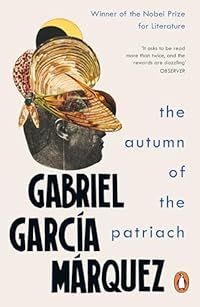
The Autumn of the Patriarch by Gabriel García Márquez

Penguin, 2014, 233 p. Translated from the Spanish El Otoño del Patriarca, 1975, by Gregory Rabassa.

 The Autumn of the Patriarch cover

It would be difficult to review this book without considering its form and structure, which are not for the faint-hearted, demanding concentration from the reader. There are six sections in all and each one consists of but a single long paragraph containing meandering sentences ranging up to several pages or more in length. Indeed the last section had just one sentence stretching over 45 pages. Within these digressive sentences the narrative viewpoint frequently switches back and forth, neither is there dialogue in the conventional sense, only reports of speech – perhaps interspersed with a “general sir”, or other vocative interpolation, to indicate that the preceding phrase is supposed to have been spoken. But for those viewpoint changes (some of which are in the plural) the prose could almost be described as stream of consciousness – or even stream of unconsciousness as one interpretation is that it represents the patriarch’s last thoughts; his life flashing past him as it ebbs away, “he was condemned not to know life except in reverse,” imagining again the events that brought him to his lonely end.

The autumn of the title is the long period of decay during which the (unnamed and, reportedly, absurdly long-lived,) patriarch retreated into solitude and his power rested on his reputation. The litany of atrocities and sexual peccadillos is what you might expect from a man of this sort, though he is portrayed as having an affection for both his mother, Bendicíon Alvarado, and the woman, Leticia Nazareno, he plucked from being a novitiate to share his bed.

The hall of mirrors that is living under a dictatorship is illustrated by lines such as, “We knew no evidence of his death was final, because there was always another truth behind the truth,” and “a lie is more comfortable than doubt, more useful than love, more lasting than truth,” and “the belief that the less people understand the more afraid they’ll be.” These are lessons always needing to be learned it would seem. There is also an odd passage where we are told the patriarch had had “brought from Scotland eighty-two new born bulldogs …evilly taught to kill by a Scottish trainer.” I wondered why Márquez had chosen Scotland; it’s not particularly known for bulldogs.

The Autumn of the Patriarch is an exercise in form and experiment bearing few of the easy consolations of a conventional novel. It’s a tour-de-force certainly, but it’s not one for the casual reader.

A word for the translator, Gregory Rabassa. This must have been a particularly tricky book to translate and he has done a magnificent job. Rabassa was credited by Márquez of making the English translation of One Hundred Years of Solitude superior to the original Spanish. Sadly, he died in June 2016. So it goes.

And a warning for those who wish to avoid the n-word, in which case don’t read the next sentence. The phrase “nigger whorehouse” appears in the text.

Pedant’s corner:- nowthat (now that,) bureaus (I prefer bureaux,) convenience’ sake (convenience’s sake,) insignias (insignia. Is insignias USian?)

free hit counter script