Archives » 2017 » February

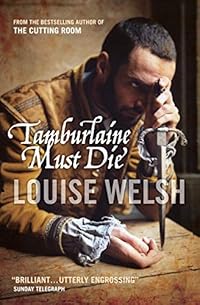
Tamburlaine Must Die by Louise Welsh

Canongate, 2005, 158 p.

 Tamburlaine Must Die cover

This novella is certainly a departure from the genre and style of Welsh’s first book, her novel The Cutting Room, a contemporary (more or less) crime tale set in Glasgow. The time here is London in 1593 and we are reading Christopher Marlowe’s account of his past few days, written in case he does not survive the morrow. Drawn before the Privy Council to answer charges of blasphemy and atheism (someone has been disseminating leaflets of this nature as written by “Tamburlaine” and naturally this is assumed to be Marlowe himself after his success with his play Tamburlaine the Great,) he is set free in order to procure evidence against Sir Walter Raleigh. His efforts in this direction are taken over by his quest to discover the person who had betrayed him; a search in which we are led through the byways, hideaways, stews and fleshpots of Elizabethan London, the politics of power and the drawbacks of having an influential patron.

I must confess I have not read nor seen any of Marlowe’s works – so how well Welsh captures his voice I cannot say, but it was convincing enough. Of course true Elizabethan prose would have been fairly impenetrable to the modern reader in any case so some degree of accommodation is to be expected.

On a second thought this is not actually so much of a leap by Welsh. She is still dealing with intrigue and crime. She has done it well though and is now on my look for list.

Pedant’s corner:- I couldn’t find ambidextor anywhere, on line or off, but its context was as if of people who might play one side against the other; nor could I find cosiner (but it may be a variant of cozener as it was in a list of felons of various sorts.) Otherwise:- wainscoted (wainscotted,) Baynes’ (Baynes’s,) hung (hanged, or was hung Elizabethan usage?) from whence (whence means from where, so from whence can only mean from from where.)

Hal Duncan Takes Flyte

You may remember me mentioning in my review of Kurt Wittig’s The Scottish Tradition in Literature the practice in mediæval Scots poetry of flyting, defined in the Dictionary of the Scots Language as “the action of quarrelling, scolding, or employing abusive language.”

I have come across a magnificent modern example of the form written in up to date Scots by Hal Duncan in response to a poem inspired by the US Presidential inauguration last month by one Joseph Charles MacKenzie (of The Society of Classical Poets, no less) and subsequently published in the Scotsman.

That poem itself requires some comment.

Line 4: “To snatch from a tyrant his ill-gotten power.”
Snatch? It was an election conducted under rules.
A tyrant? The man who was elected under those self-same rules and who conformed to the requirement to relinquish his post after his allotted time? And who walked away with grace? Hardly the actions of a tyrant.

Line 7: “When freedom is threatened by slavery’s chains”
Slavery? As far as I’m aware only black people in the US have ever been subjected to slavery. But of course, the “tyrant” is a black man so he “must” have introduced slavery in reverse. Is that the logic?

Line 8: “And voices are silenced as misery reigns”
Silenced? I don’t recall the Tea Party being less than vocal in their opposition, nor lacking in publicity for it.

Line 9: “We’ll come out for a leader whose courage is true”
Courage? The courage to insult and degrade? I note here his several bankruptcies leaving others to suffer the financial loss he thereby avoided.

Line 10: “Whose virtues are solid and long overdue”
Virtues? Virtues? Blustering, bullying, braggartry? (And that’s only words beginning with b.)

Line 15: “As self-righteous rogues took the opulent office”
This would be that “tyrant” again I suppose.

Line 20: “Ne’er gaining from that which his hands did not make”
His hands never made a single thing in his life.

Line 22: “He’s enriched many cities by factors of ten”
Tell that to Atlantic City.

Lines 25, 26, 27, 28 “True friend of the migrant from both far and near/He welcomes the worthy, but guards our frontier/Lest a murderous horde, for whom hell is the norm/Should threaten our lives and our nation deform”
His actions have done the exact opposite of what these lines claim. He has only reinforced the notion that the US (and hence its allies) are against Islam, thereby only fanning the flames he claims he is trying to douse. Horde is a wildly hyperbolic exaggeration and the lives of US citizens are many times more threatened from those disturbed people who walk into schools armed with automatic weapons than by terrorists from abroad.

I could go on but I’m getting fed up with the quantity of sheer guff in this so-called poem from a so-called poet. Lickspittle is far too mild a term for the sycophancy on display here.

So take a look at Hal Duncan’s flyting riposte; far more eloquent than mine.

Asimov’s Science Fiction Dec 2016

Dell Magazines

Sarah Pinsker’s Guest Editorial That’s Far Out, So You Read it Too? muses on the connections, and the similarities, between SF and music. Robert Silverberg’s Reflections examines the possibility and desirability of resurrecting the Dodo genetically. Peter Heck’s On Books1 discusses novels by Lois McMaster Bujold, Charles Stross, Pierce Brown, Tim Powers, Indra Das and Lavie Tidhar.
In the fiction:-
They All Have One Breath2 by Alexander Jablokov explicitly references E M Forster’s The Machine Stops in a tale of a world taken over by AIs, where all acts of violence have been made impossible.
Empty Shoes by the Lake by Octavia Cade is the tale of two people from a backwoods town; Rafi who gets out, makes pottery and sends his first bowl (cracked) to the other, Becca, who sees visions in the puddles left by the water that seeps out of it.
In HigherWorks3 by Gregory Norman Bossert a black refugee from a US turned to fascism to an almost equally fascistic UK has the knowledge to allow nanotechnology to connect minds together.
The extremely short How the Damned Live On by James Sallis is set on an unspecified island which contains a giant speaking spider which experiences time differently from our human narrator.
The island in The Cold Side of the Island4 by Kali Wallace is somewhere off the north east coast of the US. One day three youngsters find a set of unidentifiable bones in the woods, bones which bind then even though they’ve drifted apart.
Where There is Nothing: There Is God5 by David Erik Nelson features a jobbing actor travelling back in time to 1770 Massachusetts to ply the locals with crystal meth in return for silverware stamped with the mark of Paul Revere.

Pedant’s corner: 1 have showed (shown,) “a team who’s assessing” (a team which is assessing,) “there are a number” (there is a number,) Stross’s (√) yet also Powers’ (be consistent at least.) 2Polykleitos’ (Polykleitos’s.) 3”The couple are” (the couple is,) “a gaggle of girls… stumble” (a gaggle stumbles,) Blue tats’ (Blue tats is a nickname, so is singular; hence Blue tats’s,) “‘a economic refugee’” (even in dialogue that ought to be an economic refugee,) “an photographic print” (a,) “A flock of microdrones spiral” (a flock spirals,) “like a hole in the dancers hair” (dancer’s,) “as she looses the thread” (loses.) 4”Each phalanges” (each phalange, or phalanx,) “a knobby knitted hit” (Hurrah for knitted but the hit should have been a hat.) 5Charles’ (Charles’s,) largess (largesse. Is largess a USian spelling?) James’ (James’s,) maw (it’s a stomach, not a mouth,) “asking ‘Well…’” (no comma preceding the direct speech) “none were drawn” (none was drawn,) Means’ (Means’s.)

Reelin’ In the Years 129: Live Till You Die/Fresh As a Daisy

As I mentioned last week DJ Alan “Fluff” Freeman championed Emitt Rhodes (once of the Merry-Go-Round) when his first solo album came out in 1970, but that still didn’t make for much success in the UK.

On that self-titled LP there’s a strong feel of the Beatles feel to most of Rhodes’s songs, with a hint of Gerry Rafferty in the vocals.

Here are Live Till You Die and the more “pop”py Fresh as a Daisy.

Emitt Rhodes: Live Till You Die

Emitt Rhodes: Fresh as a Daisy

Exo-Planets in Motion

This is stunning. From Astronomy Picture of the Day, 1/2/2107.

A time-lapse video, taken over seven years, of Four Planets Orbiting Star HR 8799. (The system’s central star itself has been occluded to allow the planets to be seen.)

The Game of Kings by Dorothy Dunnett

Cassell, 1962, 541 p. One of the 100 best Scottish Books.

The Game of Kings cover

This novel is set in the times of what the father of the historical novel Sir Walter Scott dubbed the “Rough Wooing” (a phrase Dunnett never uses in the book) which started when Henry VIII of England wished for a marriage between the infant Queen of Scots, Mary, and his son Edward (VI of England) in order to unite the two kingdoms and so prevent any military threat through England’s back door. The Scots, longtime allies of England’s perennial enemy France, were somewhat unwilling to oblige Henry in this regard, and so a series of wars and invasions began, which in the novel are being promulgated in Edward’s name by Lord Seymour, Duke of Somerset, England’s Lord Protector during Edward’s minority.

Our hero is Francis Crawford of Lymond, Master of Culter, a younger son at odds with his older brother, though his mother’s favourite. We find him newly returned to Scotland from enforced exile (not to mention a term as a galley slave,) the leader of a band of border outlaws, the states of both Scotland and England having a price on his head (in particular he is thought to have betrayed Scotland, as a result contributing to the disaster that was the Battle of Solway Moss five years in this story’s past,) as a young red-headed aristocratic lad called Will Scott of Kincurd, heir to Sir Walter Scott of Buccleuch, turns up wishing to join his band.

Lymond is outrageously accomplished, a master swordsman and archer, who litters his speech with Latin epithets and quotations from both French and German, speaks Spanish, has a firm grasp of psychology and can outthink and outdrink anybody – the last being handy when you’re the leader of a band of outlaws. To put it another way, in the words of Chris Tarrant on Tiswas parodying Eamonn Andrews in This is Your Life, he is, “a right clever dick if ever there was one”. He is not unaware of this and neither is Dunnett as at one point she has him say, “‘Nothing arouses suspicion quicker than genuine, all round proficiency.’”

I confess it got a bit wearing in the earlier parts of the book when every mysterious “new” character turned out to be Lymond in some disguise or other (or, in one instance, as an amnesiac.) Whatever, incident is packed on incident, scrape on scrape, as the plot unfolds Lymond’s efforts to uncover the Englishman who might clear his name.

However, Dunnett has, while foregrounding the lives of Lymond and his family, also, almost quietly, ticking away in the background, provided a primer in the politics and strife of the time. This, indeed, is the sort of story nations need periodically to tell themselves so that they keep their histories alive.

And some things never change. An Englishman tells Lymond, “I don’t want to become part of the Holy Roman Empire, and it wouldn’t do Scotland any good either. You’re a threat to three million people out of all proportion to your size. You can’t expect us to leave you alone, to siphon up the dregs of Europe and inject them into our backside.” Substitute EU for Holy Roman Empire and fifty-five for three million and you’ve just about got the present day situation. As a rejoinder Lymond says, “‘You haven’t seen what your late king managed in the way of practical persuasion, with Somerset following ….. abbeys brought to the ground, villages annihilated by the hundred, a nobility decimated, a country brought to poverty which thirty years ago was graced above any other in Europe with the arts of living.” To the suggestions that French domination is inevitable if Mary marries the Dauphin and that the Auld Alliance had done Scotland little good, “‘Look at Flodden,’” Lymond replies, “‘France has too many commitments to spare enough troops to rule Scotland. Good lord, if England can’t do it, then France isn’t likely to.’”

On the subject of patriotism Lymond is scathing. It’s “‘a fine hothouse for maggots. It breeds intolerance; it forces a spindle-legged, spurious riot of colour ….. A man of only moderate powers enjoys the special sanction of purpose, the sense of ceremony, the echo of mysterious, lost and royal things; a trace of the broad, plain childish virtues of myth and legend and ballad…. He wants advancement – what simpler way is there? Patriotism. It’s an opulent word, a mighty key to a royal Cloud-Cuckoo-Land …… a vehicle for shedding boredom and exercising surplus power or surplus talents or surplus money; an immature ignorance which becomes the coin of barter in the markets of power.’” I am with the Lord Advocate, Henry Lauder, who says to Lymond, “‘Preserve us from the honest clod and the ambitious fanatic.’” There are too many of those, in any time.

Dunnett definitely aspires to fine writing. Lymond’s allusions are the least of it. “‘I wish to God,’ said Gideon with mild exasperation, ‘that you’d talk – just once – in prose like other people.’” Many chapter headings refer to obscure moves in chess and the text is littered not only with quotations and epithets but a good dose of uncommonly used or obsolete words (how about aposteme, or concamerate, or escharotic?) but actually not very many Scots ones. When she stops to take breath Dunnett is particularly adept in description of scenery or atmosphere but for me there was not quite enough of that and a bit too much of the swashbuckling derring-do about the project. But her characters are well drawn, the intrigue and politics intricately laid out. It’s a good read if a little over-wordy (but in that it’s not in the class of Sir Walter Scott, novelist.)

Throughout, though, I couldn’t shake off the feeling (and the dénouement only emphasised the thought) that however much Lymond appears to be Dunnett’s vehicle the tale is really that of Will Scott of Kincurd.

Pedant’s corner:- “dead right” (dead is here used in dialogue as an emphasiser to mean completely or absolutely. In the 1400s?) knit (knitted,) vocal chords (it’s cords; vocal cords.) “The progress of Sybilla though a market” (through a market,) “as Flaw Valleys’ near the border” (Flaw Valleys is a farm so, “as Flaw Valleys is near the border”,) “genetically speaking” (in dialogue in the fifteenth century? Imre Festetics was the first to use the term genetic, 300 years later,) Portugese (Portuguese,) peripetia (peripeteia?) Bowes’ (Bowes’s; apart from the one below other names ending in s are rendered …s’s elsewhere,) accolyte (the correct “acolyte” appeared later,) vivesection (vivisection,) Berick (Berwick,) Stokes’ (Stokes’s,) olefactory (olfactory,) insifflating (insufflating?) subsaltive (subsultive?) catachumen (catechumen.)
Leaving Lorient

The main river passing Lorient is Le Blavet which Le Scorff joins just where the Black Watch was moored. There was a windsurfer plying the waters as we set sail:-

Windsurfers, Lorient

Not to mention a yacht and the pilot boat. Again click on pictures to get to video on my flickr:-

Yacht and Pilot boat near Lorient

Town across river from Lorient. Port Louis, I think:-

Town across River from Lorient

Not much distance out to the deep channel for shipping here:-

A Beach at Lorient

Not much spare room this side either:-

Fort at River Mouth, Opposite Lorient

Fort at river mouth:-

River Mouth Fort, Opposite Lorient

Fort and Port Louis:-
Fort at Lorient

Looking back to fort and Lorient:-

Lorient and Fort from Beyond River Mouth

free hit counter script