Archives » 2017 » February

This Year’s BSFA Awards Short Lists

The lists have been published here.

Amazingly, of the best novel list I’ve read four out of the five.

Chris Beckett’s Daughter of Eden, Dave Hutchinson’s Europe in Winter, Tricia Sullivan’s Occupy Me and Nick Wood’s Azanian Bridges.

My review of Europe in Winter hasn’t appeared here yet as it only appeared in Interzone a few months ago.

You may wonder why there is also no review of Azanian Bridges on my blog. Well that’s because I did some proof-reading work on it and that exercise is a little different from reading for review purposes.

The only one I haven’t read is A Closed and Common Orbit by Becky Chambers and I won’t be. I thought her previous novel was godawful. I can’t see her having improved much.

I don’t have such a good strike record on the shorter works of which I’ve read only the two which appeared in Interzone.

Malcolm Devlin The End of Hope Street (Interzone #266)

Jaine Fenn Liberty Bird (Now We Are Ten, NewCon Press)

Una McCormack Taking Flight (Crises and Conflicts, NewCon Press)

Helen Oyeyemi Presence (What is Not Yours is Not Yours, Picador)

Tade Thompson The Apologists (Interzone #266)

Aliya Whiteley The Arrival of Missives (Unsung Stories)

I look forward to reading these when the usual annual booklet arrives.

Vizcaya Transporter Bridge, Getxo

The coach trip to Bilbao had taken us through Getxo itself and given us a brief view of the Vizcaya Transporter Bridge, a UNESCO-listed Industrial Revolution icon, which carries people over the Ria Nervión between Las Arenas and Portugalete. Turning the corner of Getxo promenade takes you onto the riverside with a great view of the bridge:-

Vizcaya Bridge, Getxo

Closer view:-
Vizcaya Bridge, Getxo

I took a couple of videos of the bridge in operation. A gondola slung from the supports is the means of transportation. (Click on the pictures to take you to the videos.)

Vizcaya Transporter Bridge in Operation

Vizcaya Bridge, Getxo in Operation

Compare the Tees Transporter Bridge at Middlesbrough.

End-on view of Vizcaya Bridge from Getxo:-
Vizcaya Bridge, Getxo, End-on

Nice square and fountain as seen in above photo but this time from the bridge ramp:-

Fountain, Getxo

Getxo Monuments

In the afternoon we had a chance to take a walk around Getxo (pronounced Get-zho.)

View from jetty leading out to berthing point. The main part of Getxo itself is to the right here:-
Getxo, Biscay Province, Basque Country, Spain

This is the view off to the left:-
Vista of west Getxo

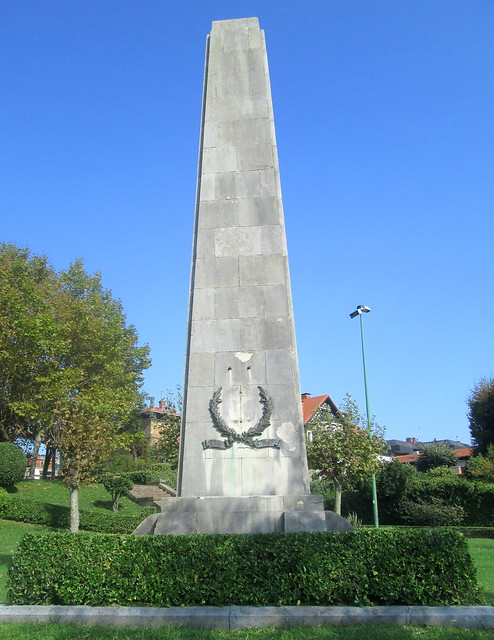
This monument to a 700th anniversary (1248-1948) is mysterious as unfortunately any other wording is no more. It lay near the junction of the main road with the one to the jetty near to the large “English” houses:-

Getxo Memorial

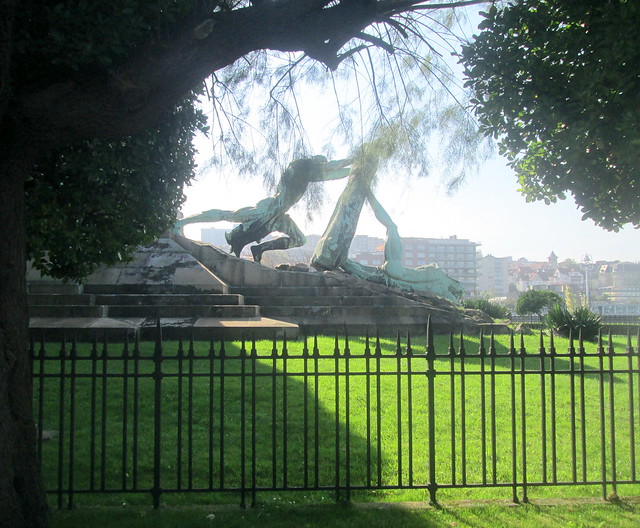
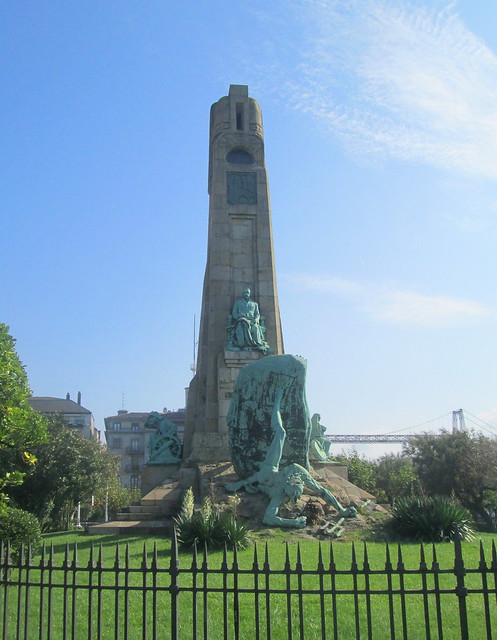
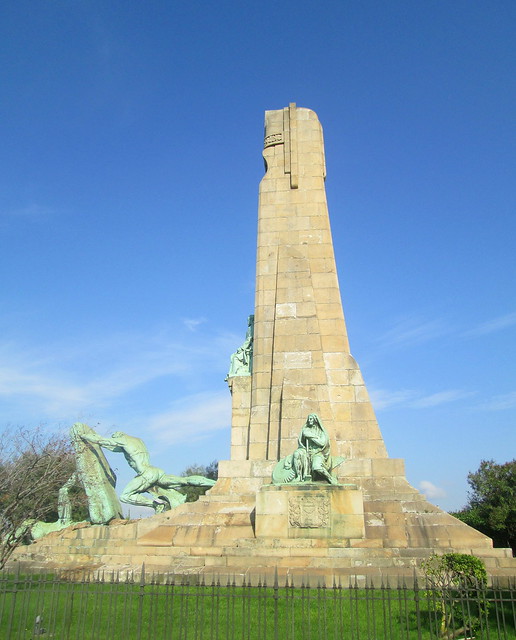
Getxo must have one of the longest promenades I’ve seen. I thought Kirkcaldy’s was long but Getxo’s seemed to last for ages. At the other end of it near where the Ria Bilbao meets the sea proper at Las Arenas was a Monument to Evaristo Churruca. It’s in that monolithic fascist style:-

Monument to Evaristo Churruca 1.

Monument to Evaristo Churruca 2

Getxo, Monument to Evaristo Churruca 3

Monument to Evaristo Churruca 4

Monument to Evaristo Churruca 5

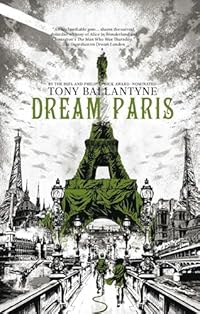
Dream Paris by Tony Ballantyne

Solaris, 2015, 443 p.

 Dream Paris cover

This is the sequel to Ballantyne’s earlier Dream London which I reviewed here. Its first sentence riffs on the famous opening line of William Gibson’s Neuromancer. Ballantyne’s comes closer to making sense though.

Seventeen year-old Anna Sinfield is trying to get her life together in what is left over after the fall of Dream London and the restoration of something like normality. She is given a fortune scroll by Mr Twelvetrees, a man with faceted, insect-like eyes. The scroll reveals she will meet her mother again, whom she had thought dead in Dream London’s demise; but it will be in Dream Paris. Twelvetrees has his own reasons for wishing her to go to there as he is an agent of the British Government. To protect her on the journey she is assigned a bodyguard, Francis, whose backpack trails a wire behind him – Theseus style – so they can find their way back. Both the English Channel and the rivers in Dream France are infested by aquatic dinosaurs and the French distinction between the second person pronouns tu and vous has become highly elaborate with up to 17 degrees of superiority/inferiority capable of being expressed. (Ballantyne’s treatment of this linguistic quirk wasn’t entirely consistent, though.)

There are some longueurs, particularly on Anna’s and Francis’s journey to Paris and even some while they are there. To Anna’s disappointment her mother sends several messages to the effect that she should not come. But Anna has the fortune scroll. She will meet her mother no matter what. And it seems everyone, the revolutionary Committee for Public Safety (a very slight adjustment in title by Ballantyne to the one in our history,) the Prussians who have been at war with Dream France for centuries, the British Government, has their own reasons for finding Anna’s mother.

Francis’s wire (in the Dream World its mechanism becomes apparent) criss-crosses the streets of Paris and provides any British citizens stranded in the Dream World – or indeed anyone else – who wish to do so with the means to find their way (back) to London. It also allows travel in the opposite direction.

In the Dream World the counting/numbering system is peculiar. In Dream London there had been no prime numbers, and mathematicians went mad; here there are no fractions, making shapes and geometry different. The chapters count down in the dream numbering system from Silver then Twenty-three through numbers such as blue and (a feeling of fulfilment) down to Zero. Count-downs are of course a harbinger of a significant event. In this regard mention of an Integer Bomb is a foreshadowing.

Dream Paris suffers from the drawback of most sequels in that the unique nature of its predecessor cannot be repeated. The plot here is not so much one of restoration of the natural order of things as it was in Dream London (even if that wasn’t truly achieved) as that of a thriller; albeit one with elements that verge on being bonkers and a vision of an extremely odd Paris.

Pedant’s corner:- “The sound of violins wove their way..” (the sound wove its way,) a moments rest (moment’s,) “it was important not show any emotion” (not to show,) Mr Twelvetrees’ (x2, Mr Twelvetrees’s,) “I folded up the wallet up” (one “up” is sufficient.) “It fell back onto road,” (onto the road,) “swept away in whirl” (in a whirl,) sat (x2; seated, or sitting,) towns of unspeakably loveliness (unspeakable,) “had a wall around it to” (too,) “I don’t mean like strong like expresso is at home” (one like is enough,) but this gentlemen (gentleman,) Entschuldigen (Entschuldigung,) for hundreds miles (hundreds of miles.) “‘And now I must now report back’” (only one “now” is necessary.) “‘Someone came in rushing in’” (one “in” only,) “from a word written on the side ‘Abattoir’” (is missing a full stop after side,) “‘We are both that same’” (the same,) that that (only one needed,) “that feeling of the meaningless of it all” (meaninglessness,) “that complimented the taste “ (complemented,) “right next me”(to me,) “‘if you wish to continue, than I shall wish you good luck’” (then I shall wish you..) the crowd were (the crowd was, [as found later on the same page,]) placenta (of a fish????) “‘And now the rest of the table were doing the same’” (the rest was….) “I didn’t want it know” (to know,) “‘You think you could you kill your dinner?’” (You think you could kill your dinner,) teeth made for ripping flash (flesh.) Men and woman (women,) the point of infinity were the two sides converged (where the two sides,) miniscule (minuscule.) “At that they all gazed at me open-mouthed at that” (only one “at that” I feel,) “‘I grew up here.Surely’” (is missing the word break,) who knows what he was doing (should be “knew what”; or “is doing”,) “More to the point would have you done otherwise?” (would you have done,) “‘Francis what’s going?’” (what’s going on,) to note the Francis had done (that Francis had,) “‘You don’t see very happy, Anna’” (seem,) a welcoming committee were drawn up (a committee was drawn up,) sipping at glass (at a glass,) “A child. What had happened to their eyes” (its eyes.)

Friday on my Mind 148: Birth

The Peddlers were a frequent sight on UK TV at the back end of the 1960s and very early 1970s but never had much chart success. Birth, from 1969, was their biggest hit.

The piano riff is reminiscent of the one in Elton John’s Border Song which came out in 1970.

The Peddlers: Birth

More Views From Aretxbaleta Bidea, Above Bilbao

From the ridge at Aretxbaleta Bidea looking in the opposite direction to Bilbao you can see right over to the city’s airport – off to the left of this photo of a distant bridge:-

Distant Bridge Near Bilbao

In the park area at the top of the ridge is this sculpture. For obvious reasons it’s called “The Fingerprint” whether officially or informally I don’t know:-

Fingerprint  Sculpture, Aretxbaleta Bidea

Looking towards south Bilbao:-
Towards South Bilbao

Looking towards north Bilbao:-

Towards North Bilbao

Even further north:-
apanorama 7

Art Deco in Bilbao

We didn’t see much Art Deco in Bilbao and the only buildings we did see were through the coach’s windows.

This one had a magnificent tiger-shaped finial. click on photo to get to my flickr and zoom in on the detail:-

Art Deco Building Bilbao

La Equitania is more moderne than deco. Good clock though:-

La Equitania, Bilbao

This one looked decoish from a distance:-
Art Deco Features, Bilbao

The close-up is blurry and with reflections as it was snatched rather than composed:-
Detail of Bilbao Building

Telefonica/Movistar. Art Deco rule of three in corner windows:-
Telefonica/Movistar Bilbao

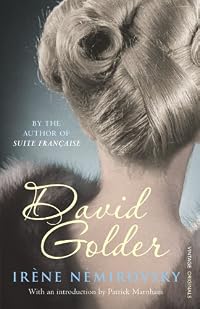
David Golder by Irène Némirovsky

Vintage, 2007, 159 p plus xii p Introduction. Translated from the French (Éditions Bernard Grasset, 1929) by Sandra Smith.

David Golder cover

This was Némirovsky’s second novel and in it she was to some extent finding her feet but it still exhibits some of the concerns and influences which were to dominate her work.

David Golder is a financier born into poverty in the Russian Empire but who now lives in France. He has a wife, Gloria, who, despite him lifting her out of the same poverty as his, wants his money but nothing else, indeed is unsatisfied with all he has provided for her. They have an indulged flibbertigibbet of a daughter, Joyce, who also only sees Golder as a source of funds. The crisis of the book begins when his business partner Simon Marcus – whom Golder is tired of bailing out – commits suicide after Golder refuses to help him out of financial trouble again. There was something about this that somehow brought to mind the beginning of Dickens’s A Christmas Carol. Némirovsky’s intent is very different to that of Dickens, though.

There are some similarities to the work of F Scott Fitzgerald as the book is set in a milieu which presents a far from attractive face. Némirovsky demonstrates well the unthinking lack of proportion which comes with affluence apparently easily gained. Both Gloria and Joyce seem to think Golder has not had to make any effort to garner the largesse they squander so profligately on their gold-digging boyfriends and vacuous pursuits.

For against appearances Golder’s financial times are hard. When he suffers a heart attack his wife conspires with the doctor who attends to conceal it from him so as he will not stop work and the money will continue to flow. His crash comes anyway and wife and daughter both leave him.

In one sense it is not surprising that Némirovsky makes Golder Jewish. It was her inheritance after all and Golder’s family bears some resemblance to hers – though we can assume not the vacuous daughter. In another author’s hands it might have tended only to reinforce the stereotype that many French held of Jews. At the time of writing the Dreyfus Affair, though partially obscured by the legacy of the Great War, still hung over Némirovsky’s adopted country. But Golder has a weak spot, Joyce, whom he continues to indulge even at the risk of his life. We find his driving force towards the end of the book, the crushing poverty and anti-Semitism he had endured in his childhood on the shores of the Black Sea.

David Golder isn’t Némirovsky at her peak but it is still worth reading. Once again it is best to leave the introduction (by Patrick Markham) to the end as it discusses features of the plot and of Golder’s character.

Pedant’s corner:- predelictions (the word is spelled predilections,) “now there’s one enemy less” (“one enemy fewer” sounds more natural to me,) “his entire body felt wracked” (racked, it felt crushed, not wrecked,) “‘Once he’d paid for something, he watches over it,’” (either, “once he’s paid for something”, or else, “he’d watch over it”,) “a newspaper that was laying on the table,” (how can a newspaper lay anything? It was lying on the table,) “in the Ukraine” (in dialogue, but the speaker came from there so most likely would have said “in Ukraine.”)

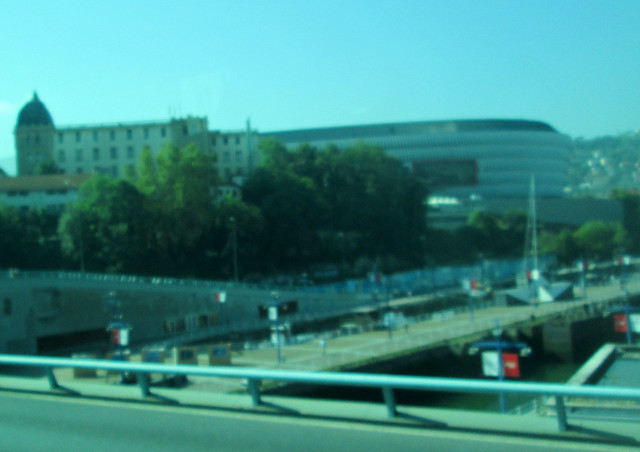
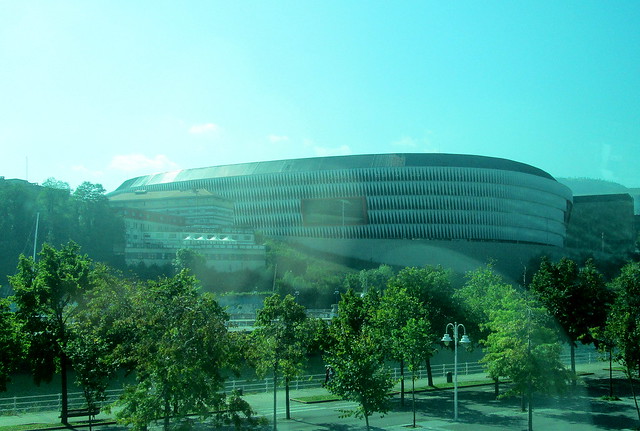
San Mamés Stadium, Bilbao

Home of Athletic Club, commonly known as Athletic Bilbao.

Through coach windows hence blurry:-

San Mamés Stadium, Bilbao

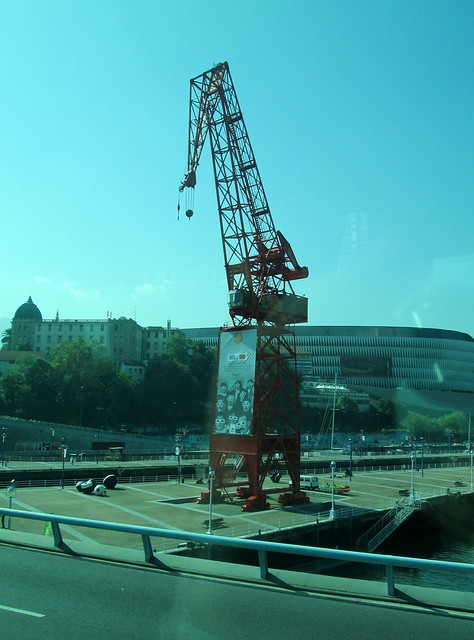
Stadium with crane in foreground:-

San Mamés Stadium and Crane

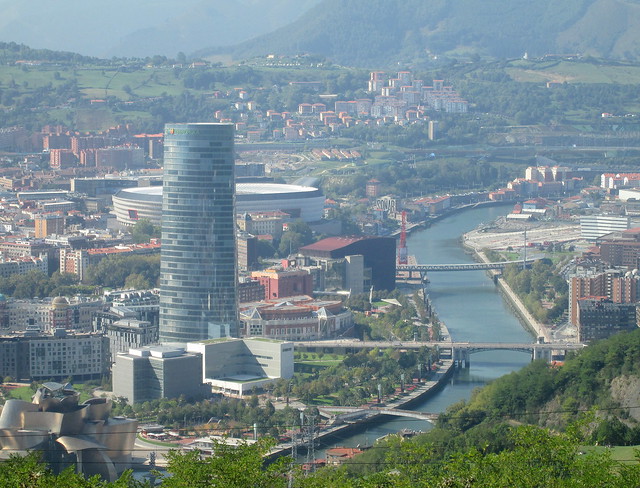
Ría del Nervión O de Bilbao, Telefonica tower to left, San Mamés Stadium behind it:- Bilbao panorama

San Mamés Stadium:-
San Mamés Stadium, Bilbao

Edited to add:- I meant to say the stadium looks a bit like a spaceship has plonked itself down in the middle of the city.

You can find images of the San Mamés here.

Bilbao

Bilbao sits in a bowl of hills with the Ría del Nervión O de Bilbao running through it.

View towards South Bilbao from Aretxbaleta Bidea:-

Towards South Bilbao

Panorama from Aretxbaleta Bidea (stitch of three photos):-
Bilbao from Aretxbaleta Bidea

Bilbao is a stunning city but due to its surrounding hills is very compact.

Buildings across Ría del Nervión O de Bilbao from Guggenheim Museum:-

Buildings across Ría del Nervión O de Bilbao

University Buildings from fountains outside Guggenheim Museum:-Bilbao University

Bilboa Opera House:-
Bilbao Opera House

Mural Under Salbeko Zubia Bridge over Ría del Nervión O de Bilbao:-

Mural Under Salbeko Zubia Bridge over Ría del Nervión O de Bilbao, Bilbao

River view:-
View from Bilbao Bridge

The river loops through the city. Another bridge view:-

Another Bilbao Bridge View

Telefonica tower throuugh trees:-
Telefonica Tower, Bilbao

Telefonica tower:-
Telefonica Tower, Bilbao

free hit counter script