Archives » 2013 » September

Rotating Moon

Since it’s tidally locked to its parent planet people from Earth do not normally see the Moon rotating. However the Lunar Reconnaissance Orbiter (LRO) has built up a series of pictures allowing a video of the rotating Moon to be compiled. This video was Astronomy Picture of the Day for 16/9/13.

It starts with the familiar view from Earth – a side which has an abundance of dark areas known as maria which are relatively low-lying – then the rotation shows the “far” side as much lighter in colour. This lightness is due to lunar highlands.

Biggar War Memorial

Situated prominently at the south end of the High Street in an enclosed space with colourful planting. (In the background to the right here you can see the Deco hairdresser’s I featured in an earlier post.)

Biggar War Memorial

This is a close up. The finial is unusual:-

Biggar War Memorial 2

And this the reverse angle showing a bit of the High Street:-

Biggar War Memorial reverse angle

The coat of arms on this side of the memorial has the wording, “Let the deed skaw.” According to this website that is the motto for Fleming of Clayquhat, Perth. I’m at a loss to know what exactly “skaw” means.

A Double Shadow by Frederick Turner

Sidgwick & Jackson, 1979, 252 p.

A Double Shadow cover

I picked this up at the same time as The Infinite Cage. It’s of similar vintage.

A Double Shadow is Turner’s only SF novel. He was (is?) mainly a poet.

The book is a strange one, discursive and at times dense, quite often telling rather than showing, to the detriment of characterisation. The main body of the novel is set on a terraformed Mars, with its smaller moon Phobos turned into an auxiliary sun. Here, humanity is divided into Normal humans and the Bloods or Cocks among whom there are three sexes (one hermaphroditic.) The set-up before this is strange, though, being a foreword narrated by a man during the time in which the terraforming is taking place who tells us he is the author of the subsequent novel – into which he occasionally interjects his authorial presence.

The internal novel has characters with names like Chrysanthemum, Narcissus, Hermes and Cleopatra but these do not seem to signify anything. As to the plot, at a theatre performance Narcissus is insulted by some remarks about his performance that he and others hear Michael has made to his wife Snow. The upshot is that a “status war” is declared between the two, where they have to go around gathering support to undermine the other’s position. To this end Michael and Snow climb Olympus Mons (here called Nix Olympica, as it used to be before Mariner 9 showed it was a volcano) while Narcissus and Cleopatra cruise the Martian canals. There is a thesis to be written about the attraction SF writers have for both of these endeavours – especially the canals. That notion seems to have become so embedded into the human collective psyche that it must have expression on every possible occasion.*

In the volcano’s caldera Michael and Snow meet the goddesses who rule Mars in the sense of umpires. One of these, Aphrodite, intervenes in the status war to tragic effect.

The final climactic Cockfight is almost literal – the antagonists strap on wings and spurs and hack at each other – and occurs in the Great Canyon of Coprates, more usually known nowadays as Valles Marineris.

File this one under historical curiosity.

*Mea culpa. My first published story The Face of the Waters centred on the construction of such canals and the possibility of climbing the volcano. When I questioned him (apropos his “Plenty” books) on this general need for there to be canals on Mars Colin Greenland said, “It’s the best bit.”

Scotland’s Art Deco Heritage 32: Biggar

Biggar is in Lanarkshire, 11 miles or so south of Lanark, far enough away from a really big town to have retained many of the sorts of shops which have disappeared from many High Streets. Most of them seemed independent/local. Not many chain shops anyway.

I spotted two deco influenced buildings. The first was a hairdresser’s.

Art Deco Shop Biggar

This close up from a different angle shows the detailing. Horizontal lines, angled frontage. Windows have been replaced but not too unsympathetically.

Close up on Deco Hairdresser's, Biggar

The second was an extension to a bank. Well, no longer a bank but instead it houses several small businesses. Nice frieze above the door.

art Deco Style Bank Extension, Biggar

Alloa Athletic 1-2 Dumbarton

SPFL Tier 2, Recreation Park, 14/9/13.

A first away win. Excellent.

We dominated the early proceedings, forcing corners early on and only fell out of it a little towards the latter part of the half. Their goalie was troubled just the once though – by a slightly deflected Chris Turner shot – and Jamie Ewings not at all.

The goal had a touch of flukery about it, the ball came back to Mark Gilhaney after a corner, his shot struck Andy Graham who was still up in the box. He pivoted and slotted it in. The ball was only in play for two more seconds before half-time!

Second half they tried to keep the ball and suck us out but we resisted until we could flow forward. Nevertheless Jamie Ewings had to make a good save. Their equaliser had a similar touch of flukery to our goal, the ball rebounding to their player after the corner came over, with much the same result.

That gave them a bit of confidence and they started to press a bit more. Jamie Ewings had another good save (after an unbelievable point blank one from an offside player) but we continued to look menacing in attack. One great cross from Paul McGinn in particular.

The winner came when Andy Graham was demolished in the box. Scott Agnew buried the penalty.

Alloa ended up running out of ideas and resorted to humping the ball upfield, moving ex-Son Ben Gordon up front from centre half towards the end but really never creating anything.

2-1 but not many clear-cut chances. I’ll take it though.

Pass marks for everybody but Chris Turner wasn’t as effective as usual and could have talked himself into a sending-off. He was subbed, possibly as a precaution. Garry Fleming put himself about to good effect when he came on.

6th! Not bad, and only one point off 2nd.

Periodic Tales by Hugh Aldersey-Williams

The Curious Lives of the Elements, Viking, 2011, 428 p.

The first thing to say is that, despite its title(s), this is not a Chemistry book. In its index there are eight references to Shakespeare (only one fewer than for the chemist Jöns Jacob Berzelius and more than for any individual scientist barring Humphry Davy, Carl Scheele, William Ramsay, Marie Curie and Dmitri Mendeleev) – four to Goethe, three each to Wagner and Van Gogh. Other seemingly unlikely name checks are given to Wilfred Owen and Barbara Hepworth, not to mention Hunter S Thompson’s novel Fear and Loathing in Las Vegas.

What it is, is a book about how Chemistry permeates our lives, not just in the biological sense – for without Chemistry our bodies could not work – but in the cultural sphere, in our day-to-day existence. (There is even a reference to Irn Bru! – in a frankly bizarre context.) As such the book ought to appeal to the general reader rather than just Chemists. But the importance of Chemistry in painting, sculpture, opera, poetry, fiction, even architecture ought not to surprise. As the back of the book reminds us, “Everything is made of them [the elements,] from the furthest reaches of the universe to this book you are holding in your hands, including you.” English words for white (apart from snow) are bound up with the compounds of calcium they embody, marble, alabaster, chalk, ivory, bone, teeth. (I object, here, that the “White Cliffs of Dover” are anything but; unless seen from a distance.) The Latin calx yields the Italian calcio for what Aldersey-Williams calls soccer, perhaps because a goal is scored by the ball crossing a chalked line. The word for railway in nearly every language except English reflects the iron from which it is constructed, chemin de fer, Eisenbahn, ferrovia, vía fería, järnväg, tetsudou. Akin to gold in its chemical unreactivity, the valuation of platinum – the only element first isolated by pre-Columbian Americans – over gold is a cultural choice; not due to rarity but snobbishness.

The book contains photographic illustrations every so often but they can at times be a little indistinct as they are reproduced only in monochrome.

Like his Swedish compatriot Carl Scheele (who has a fair claim to have discovered oxygen) Jöns Jacob Berzelius is all but forgotten – despite pioneering laboratory staples like filter paper and (the now superseded) rubber tubing for connecting laboratory equipment together, first using the words catalysis and protein, inventing chemical symbology and coming up with the idea that elements combined in fixed proportions and hence chemical formulae. If his name had been attached to these as Bunsen’s was to his – admittedly splendid – invention that might not be the case. But it seems the Swedes were/are reticent about blowing their trumpets. Due to their chemists’ wielding of an essential piece of technology – the blow-pipe – no less than seven elements – ytterbium, yttrium, terbium, erbium, holmium, scandium and tantalum – were identified from ores that came from a single mine near the town of Ytterby but there is now no trace of the mine nor is there a visitor’s centre. The Swedes may be missing a trick there.

Discovery of “new” elements has always to an extent depended on available technology. Better furnaces and higher temperatures explain the historical progression of metal extraction through the Bronze and Iron Ages and the isolation of zinc in India by the 13th century, the alkali metals, highly reactive and thus resistant to chemical extraction, were only torn from their compounds by the greater power of electricity – not harnessed till just before 1800 – the spectroscope enabled elements to be inferred from the incursion of additional lines in the resultant spectra, transuranics could only be synthesised when atom–colliding machines became available. New liquefaction techniques allowed William Ramsay in the 1890s to conjure new elements out of thin air. (Well, since it was liquefied, I suppose it was really thick air.) Ramsay populated a whole previously unknown Periodic Table Group, the noble gases – neon et al – using this method.

Aldersey-Williams has a tendency to employ the words light or heavy instead of low/high density respectively and to refer to an element when strictly it is the presence of its compounds, atoms or ions that is under discussion. Plus he infers ozone is bonded in a triangle. Its atoms may be arranged in a triangle but its bonds are not. He also says “sodium is now the colour of the city at night” as well as “our principal means of knowing this element.” My local street may be “lit from above by the sodium lamps,” but these have been largely replaced by the blueish white of mercury vapour lights on main roads.

He has however written an interesting and informative, at times quirky, book.

Friday On My Mind 87: Captain Pugwash

Captain Pugwash was a cartoon precursor to Sir Prancelot (see last week) and featured a similarly bumbling lead character in the shape of the eponymous captain of the ship The Black Pig.

Strictly speaking this isn’t a sixties piece since Captain Pugwash first appeared on television in the 1950s. However my folks didn’t get themselves a television till 1960 so as far as I’m concerned it belongs firmly in the 60s.

There is an urban myth that the cartoon series was a repository of filth/sexual innuendo. This is NOT TRUE.

The cabin boy was called Tom not Roger, there was no seaman Staines and it was Master Mate with an M not a B. The Sunday Correspondent and The Guardian both had to pay libel damages for printing this misconception.

The jaunty signature tune is apparently called The Trumpet Hornpipe.

Captain Pugwash (The Trumpet Hornpipe)

Ian Black

I see Ian Black of Rangers has been banned for three matches (with a further seven suspended till the end of the season.)

Three matches?

For betting against your own team?

It’s hardly draconian. It’s less than you get for kicking somebody.

Doesn’t this just give carte blanche to Scottish footballers to bet when and how they like? If it’s only going to be a three match ban where is the deterrent?

Cranstoun War Memorial

Acording to the Scottish War Memorials Project this is the War Memorial for Cranstoun and Pathhead.

It lies apparently in the middle of nowhere at the junction of the A 68 and A 6093 just north of Pathhead, East Lothian.

Cranstoun War Memorial

The front bears the First World War names. On the sides are the names for WW2.

Cranstoun War Memorial from side.

This side – unusually for a War Memorial – bears the name of a woman, Lucy Walker.

Cranstoun War Memorial Close Up

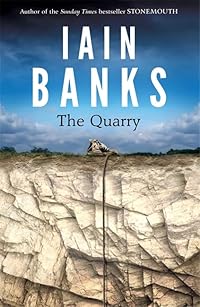
The Quarry by Iain Banks

Little, Brown, 2013, 326 p.

Due to the unusual circumstances surrounding its completion I was a bit reluctant to start reading this book. What if I didn’t like it? What if Banks’s illness made the subject matter just too uncomfortable? What if it had led him to rush things and take his eye understandably off the ball? Happily, none of these fears was realised.

Kit is in his late teens and a compulsive-obsessive with more than a touch of Asperger’s syndrome encapsulated by rituals. To dissolve sugar in his tea he stirs alternately clockwise and anti-clockwise in diminishing numbers of turns; he takes a walk round the garden using a fixed (prime) number of steps, 457 to be precise, up to the wall separating the property from the quarry behind, where there is a convenient step to allow it to be viewed, then back round again.

Kit has been brought up by his father Guy and does not know who his mother is. Guy, though only in his forties, is suffering from cancer and all but bed-ridden. He calls his growths “‘Rupert’, an idea he says he got from the dead playwright Harold Pinter.”* The pair live penuriously in a decaying house and Kit is now effectively in charge of the housekeeping – and Guy.

In the early 90s Guy was one of a group of friends on the local University Media Studies course. While studying they made a series of films trying out or parodying various styles. These friends have all gone their various ways in the intervening years but kept in touch. Now they are gathering together again for the weekend as it may be the last time they can do so before Guy’s cancer kills him.

The other focus of the meeting is to seek a tape, lost somewhere in the house, of one of their films. A tape which contains scenes potentially embarrassing to their adult selves or their employers. This quest gives the title of the book its pun.

Having Kit suffer from Asperger’s is a clever move on Banks’s part as it allows examination of the various ways in which conversations, communication and manipulative behaviours are used in social situations. His closeness to Holly, one of Guy’s circle, gives us a close-up of another of Banks’s strong female characters: yet no-one in this novel is without flaw.

Guy is certainly not going “gentle into that good night.” He has acerbity aplenty, more than enough to prevent him becoming an object of sentimentality.

When Kit reflects that, “Cancer isn’t contagious. You can’t catch it even from your father. It is personalised, your own. Cancer feels like betrayal,” it is tempting to wonder if this is Banks speaking directly to us. But of course everyone’s body betrays them in the end.

This may not be vintage Banks, there is not much of a plot to be sure, but it is a fitting farewell. There is humanity here: if not all of it, enough to be going on with.

(*A pedant believes the playwright who did this was actually Dennis Potter – and also thinks the road named in the book as the M1(M) might be meant to be the A1(M).)

free hit counter script