Archives » 2013 » September

Charlemagne and Roland by Allan Massie

Weidenfeld & Nicolson, 2007, 232 p.

The last in Massie’s Dark Ages trilogy, this is mainly the life story of Roland, nephew of Charlemagne. As in previous instalments we have the interjections and admonitions of the putative narrator, Michael Scott, to his princely charge (the later Holy Roman Emperor Frederick II.) Much less here is made of Scott’s upbringing in the Scottish Border country though there are “editorial” footnotes from Massie himself noting similarities between incidents in Michael Scott’s tale and those of his later compatriot and surnamesake Sir Walter. (The trilogy is meant to be a “found” manuscript which “Massie” has translated from Latin.) Still present, too, are “Scott”’s digressions – at one point a character visits Byzantium, others travel as far as Ethiopia (to collect Roland’s lost wits!) before returning to the German wood where they left him – but the narrative thrust doesn’t falter. The machinations and instabilities of a Dark Ages court are well illustrated.

Since there are precious few historical sources to rely on a novelist has pretty much free reign in describing the times in which the book is set. It will not have been exactly like this but in Charlemagne and Roland Massie has produced as convincing an account as we are likely to get.

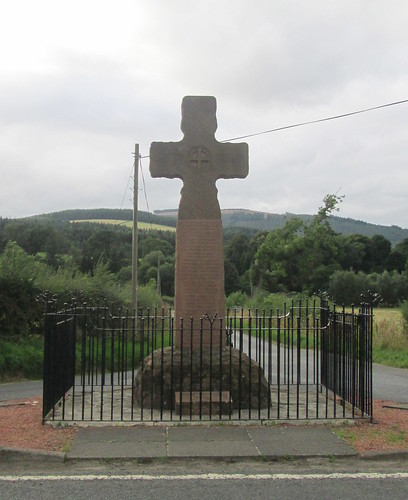
Traquair War Memorial

A traditional Celtic Cross construction but with only a small circle in the stone. Situated at the junction of the B 709 and B 7062 at the edge of Traquair in the Borders; about 7 miles from Peebles.

There seems to be only one name for World War 2 (on the additional plaque at the foot of the cross.)

Traquair War Memorial

Latest Reviews

Interzone 248 (Sep-Oct 2013) with my review of Catherynne M Valente’s Deathless has been out for a few weeks now.

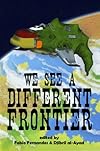
My review of We See a Different Frontier: A Post-colonial Speculative Fiction Anthology for Interzone 249 (Nov-Dec 2013) has been submitted.

Language, Timothy!1

I meant to say when I mentioned the film Austenland that the classification certificate displayed on screen before its start said “Contains one example2 of moderate language.”

I admit I perked up a bit at that as I immediately therefore expected all the rest of the language to be immoderate. That it wasn’t (the extent of the “moderate” language was one “Wankers!” in the whole film!) might help explain my odd sense of dissatisfaction with it.

1This was the catch-phrase retort of the father in the sit-com Sorry! which starred Ronnie Corbett and featured an overbearing mother.

2The noun may have been instance rather than example. Whatever, it implied only one.

Dumbarton 1-2 Livingston

SPFL Tier 2, The Rock, 21/9/13

Not so good. 1-0 up at half time at home you might expect us to go on and win. The Pie and Bovril brigade say Livi changed things at the interval and Ian Murray didn’t – or couldn’t – respond.

Well he’s young. He’ll learn. (I hope.)

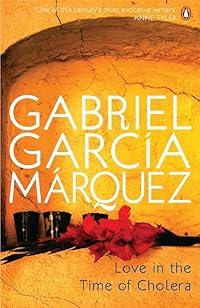
Love in the Time of Cholera by Gabriel García Márquez

Translated from the Spanish El amor en los tiempos del cólera by Edith Grossman.
Penguin, 2007, 348 p. First published by Editorial Oveja Nregra Ltda, Bogota, 1985.

The opening sentence, “It was inevitable: the scent of bitter almonds always reminded him of the fate of unrequited love,” hits us immediately with two of the great triumvirate of literary preoccupations; love and death. (Bitter almonds is the smell of cyanide.) The only one remaining is sex. Sex does come later but not till well into the book.

By this gambit we are invited to believe that the story is to be that of Dr Juliano Urbino de la Calle, who has been called in to certify the death (by suicide) of his friend and chess opponent Jeremiah de Saint-Amour. The main focus of the novel is, however, on Florentino Ariza, who conceived a passion for Dr Urbino’s wife, Fermana Daza, in both their youths, and has maintained it ever since. In some respects this aspect of the novel has echoes in Orhan Pamuk’s similarly obsessed protagonist in The Museum of Innocence.

The action of Love in the Time of Cholera mainly takes place in an unnamed city somewhere on the delta of the River Magdalena on the Caribbean coast of Colombia, though there is a late voyage up and down the river.

The narrative flows between the three main agonists, detailing aspects of their lives in the decades over which the story rummages back and forward. Marquez does nothing so crude as to devote sections to one character, he weaves in and out of the three’s concerns without a break. In the background are other colourful characters but the lives of these people are well-to-do, we see little, if any, of more impoverished inhabitants. Flashes of the history of the country, which has seen several civil wars which were really all one war, appear only in passing, which is, of course, how the well-to-do would have experienced them. Only by inference is the possibility of atrocities hinted at, for example, “For as long as I can remember, they have killed us in the cities with decrees, not with bullets.”

Joseph Conrad (in his pre-novelist incarnation as Joseph T K Korzeniowski) gains a brief mention as being involved in some sort of arms deal.

Interspersed through the novel Marquez gives us some acute aperçus.
“The toilet must have been invented by someone who knew nothing about men.”
“If he had told the truth not … anybody in this whole town would have loved him as much as they did.”
“… too young to know the heart’s memory eliminates the bad and magnifies the good,”
“… nothing in this world was more difficult than love.”
“Always remember that the most important thing in a good marriage is not happiness, but stability.”
“It is incredible how one can be happy for so many years in the midst of so many squabbles, so many problems, damn it, and not really know if it was love or not.”
“But when a woman decides to sleep with a man, there is no wall she will not scale, no fortress she will not destroy, no moral consideration she will not ignore at its very root.”

There was an instance of odd wording in the translation, “for he did compete not out of ambition for the prize, but” surely ought to be either, “for he competed not out of ambition, but…” or “for he did not compete out of ambition, but…”

Love in the Time of Cholera bears the stamp of a novelist who knows the inner workings of the human heart, its constancies (and inconstancies.)

Kirkcaldy Film Festival

It’s the first ever Kirkcaldy Film Festival this weekend and as a result I was at a film premiere yesterday. (The Scottish premiere.)

The red carpet was still outside the Adam Smith Theatre this morning when we went back there for a library book sale.

Red Carpet for Kirkcaldy Film Festival

I assume the carpet will be out the whole weekend. (At least the forecast is not for rain.)

The film, Austenland, wasn’t really my thing, being a romcom based on the works of Jane Austen, but the good lady enjoyed it.

The film’s colour palette was curiously pale, as if filmed through a red absorbing filter, rendering the picture almost shiny at times.

The plot has an Austen obsessed US woman, unlucky in love naturally, deciding to blow her savings on a trip to an Austen themed experience in an English Country House, final ball and all. Cue the usual misconstruings. While it was played a lot for laughs there was a sense of straining for the joke at times. I suppose it was perfectly fine if you like that sort of thing but the best bit was during the end credits where the characters, in period dress, mimed to a rap track (something to do with it being “hot in here, so let’s take off our clothes.”)

Reelin’ In The Years 70: Ace of Wands

Ace of Wands was a children’s TV programme, broadcast by ITV between 1970 and 1972, which had fantasy elements. As well as this, another attraction was the cracking theme tune.

The tune was released as a single, Tarot, and was performed by Andy Bown. There’s some brilliant mellotron in this.

Andy Bown: Tarot

West Linton War Memorial

West Linton is in the former Peeblesshire, now subsumed into the Tweeddale area of the Scottish Borders. The good lady had wanted to visit there as it has a second-hand bookshop (which we found also sells new books.) She bought an illustrated book called Through Merrie England by F L Stevens – illustrations by Francis D Bedford. It was inscribed Ann G Nelson, 1929.

We had a wander round the village after our rummage in the bookshop and I came across the War Memorial.

It is situated in front of a church in a well kept triangle between Lower Green and Main Street, West Linton.

West Linton War Memorial

This close-up shows the cenotaph-like construction.

West LintonWar Memorial Close

Great War (upper) plaque:-

West Linton, War Memorial, WW 1

WW2 (lower) plaque:-
West Linton, War Memorial  WW 2 names

Small Bridge in Biggar

Between the War Memorial and the Art Deco hairdresser’s in Biggar, Lanarkshire (posts passim) there runs a burn.* Over it lies a nice arched bridge.

Small bridge in Biggar

And this is the reverse view:-

Biggar Bridge 2

*For those who may not be familiar with the word, burn is Scots for stream.

free hit counter script