Archives » 2013 » September

FYR Macedonia 1-2 Scotland

FIFA World Cup Qualifier: Europe, Group A, Philip II of Macedonia Arena, Skopje, 10/9/13

Two wins on the road is not to be scoffed at, but we rode our luck in the second half. Overall Matt Gilks had more saves to make than the Macedonian keeper had in the whole game.

Ikechi Anya, though, has a welcome injection of pace and willingness to get forward. His goal was very well taken.

Scotland had much the better of the first half and our failure to score could have come back to haunt us. Macedonia were much more positive in the second half and looking likelier to score just before we did but didn’t let us in the game after that. When the equaliser came it didn’t look likely they could lose. But up stepped Shaun Maloney to do what he’s done for Wigan and usually doesn’t get the opportunity to do for Scotland (because we don’t get free kicks around the area that often.)

If results in other games go against us it may still be we’ll need to beat Croatia – who have second place in the group in the bag anyway – next month to avoid bottom spot.

United Kingdom Pavilion by Night

Another black and white photographic postcard of the Empire Exhibition, Scotland, 1938. The United Kingdom Pavilion.

United Kingdom Pavilion by Night

Flodden

Today is the 500th anniversary of the most disastrous encounter between the forces of Scotland and England in history. (Bigger even than the 9-3 reverse at Wembley only 50 years ago. But that was a mere football match.)

On the 9th Sep 1513 14,000 men died on a battlefield in Northumbria. 10,000 of those were Scots – including most of the Scottish nobility and even the King, James IV, himself, the last British king to die in battle. The Battle of Flodden Field was at one and the same time the biggest clash of arms between the two countries plus it was the last mediæval and first modern battle on British soil. Never again was the longbow to be a major weapon, never before had artillery been employed.

My memories of reading about this were that it was an unnecessary tragedy as James had only invaded Northumbria as a sop to the Auld Alliance between Scotland and France. England’s king, Henry VIII had gone to war with France and Louis XII had appealed to the Scots king. One of the peculiarities of this situation is that James’s wife was Henry’s sister, Margaret. She had apparently asked him merely to “break a lance” to honour his obligations. I doubt that she thought he would not return.

Reading the BBC History magazine a couple of weeks ago it turns out that Henry VIII’s father, Henry VII, aware of his tenuous right to the English throne had foregone the English claim to Scotland and signed the Treaty of Perpetual Peace. Henry VIII had no such inhibitions – or else was eager to bolster his own position – and had recently reasserted England’s overlordship over Scotland. James, then, in effect, had no option but to stand up to Henry.

His initial efforts were successful, taking three castles in short order. He then set up a strong fortified position on Flodden Hill and awaited the English forces. The English commander, Thomas Howard, Earl of Surrey, apparently accepted battle on James’s chosen ground. However, being out of favour with Henry, he was desperate for a victory and instead of attacking at Flodden Hill, he made a flanking manœuvre, interposing his army between the Scots and the border. James was furious at this unchivalric behaviour and had to make a quick redeployment to Branxton Hill instead. Perhaps it was this anger that led to his lack of judgement in the battle. Wikipedia has the details of this dispute over the proposed battleground slightly differently.
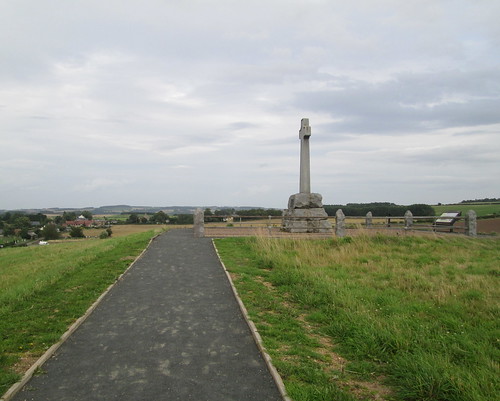
Flodden Memorial from path
Flodden Memorial from path.

Flodden Memorial

The plaque reads, “Flodden 1513. To the Brave of Both Nations.”

The Scots artillery was heavier but more cumbersome and so less effective but at the beginning of the battle the Scots left completely overran the English right (if only!) and retired from the battlefield expecting the rest of the army to achieve overall victory. In the centre, however, things did not go so well. From their position on Branxton Hill the Scots could not see the boggy ground in the declivity between the lines.
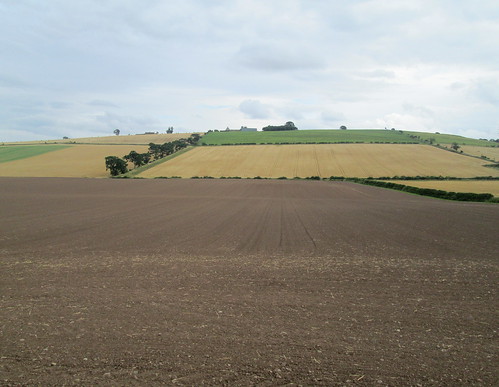
Flodden Memorial. View to Branxton Hill

Flodden Memorial. View to Branxton Hill. From English start line.
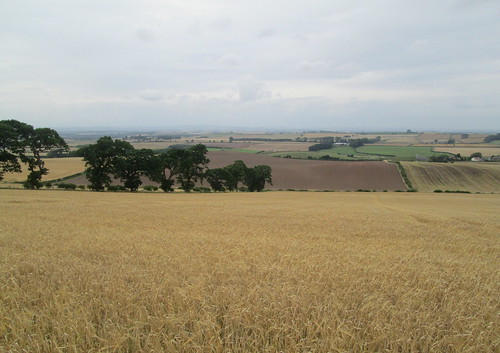
Flodden Memorial from Scottish line

Flodden Memorial from Scottish line. Memorial is just left of centre here.
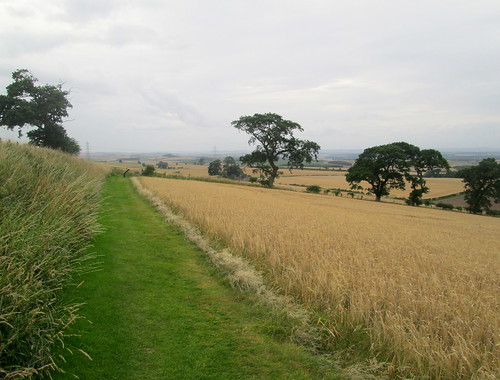
The Scottish Start Line at Flodden
The Scottish start line at Flodden.

The Scots infantry, armed with long pikes, whose efficiency had been proved in European battles, soon lost the essential formation necessary for success as they slipped and slid on the uncertain footing. The pikes also could not be anchored securely due to the underground conditions so were useless defensively. The English infantry, armed with much shorter billhooks, waded in to bloody effect. Dead bodies and blood soon made the conditions even worse.
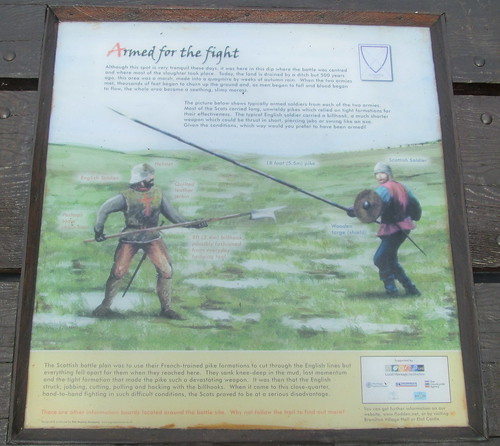
Flodden Information Board

To their credit, as one of the information boards on the Battlefield Trail says, the Scots did not cut and run, but bravely fought on.

The memorial, built in 1910, is inscribed to the brave of both nations. I have been told the only other battle memorial to acknowledge both armies is at Quebec but cannot confirm this.

There is an information centre – in a red telephone booth – in Branxton village. It claims to be the smallest information centre in the world.
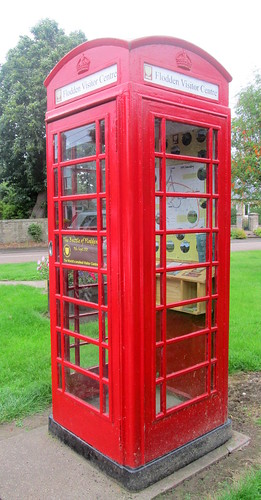
Flodden Information  Centre

James had been making his court and kingdom one of the most cultured in Europe, and Scots into a major European language. That process came to an abrupt end on his death.

The result of the battle at Flodden, the subsequent decline of Scotland’s influence, is probably the main reason why this post is being written in English rather than Scots.

The irony is that, despite the result of the battle, it was not Henry VIII’s descendants that would unify the crowns of Scotland and England and be monarchs of the UK but rather James’s, through his marriage to Margaret, their son James V and granddaughter Mary Queen of Scots, down to her son James VI and I.

The disaster is said to have inspired the traditional Scottish lament for the fallen, Floo’ers o’ the Forest,” sung here as The Flowers o’ the Forest by Isla St Clair.

Serial Delusion South of the Border

In Thursday’s Guardian, Owen Gibson (in an article titled “Dyke sees remedy for Hodgson’s headaches” on page 42 of the print edition) said, “With the odd exception (1990, 1996, 2004) the [England] national side has consistently underperformed since 1966.”

Oh dear. Not again.

Would a more realistic way to look at this statistic not be to suggest that actually in those four years cited (out of a total of 24 opportunities) that the England team actually surpassed itself and otherwise played for the most part as might be expected?

It would only be on those occasions that England failed to qualify for a major championship finals that the team could be said to have “underperformed.”

(On this note it can now be seen that Scotland consistently overperformed on all those occasions between 1970 and 1998 when reaching the finals competition was achieved.)

Scotland 0-2 Belgium

FIFA World Cup Qualifier: Europe, Group A, Hampden Park, 6/9/13.

Nobody really expected Scotland to get a result out of this and so it transpired.

I only saw the highlights and it looked as if Belgium did not have to reach top gear. Even so, Scotland did well to restrict them to as few attempts on goal as they got.

Belgium are an impressive side. Whether they are impressive enough to go all the way in Brazil next year is another matter.

Bottom of the group again. With only two games left we really need a win on Tuesday in Macedonia to have any hope of avoiding that spot at the end of the qualifiers.

Greenlaw War Memorial

Greenlaw is a village in the Scottish Borders just north of Coldstream on the A 697 to Edinburgh. The simple and dignified war memorial is set by the roadside in front of the quite imposing Town Hall.

Greenlaw War Memorial

The Great War names are on the main plaque, World War 2 names are below. If you look closely you can see the wording “The Great Wars” has economically had the “s” added at some point; presumably along with the second plaque.

Greenlaw War Memorial Plaques

Reelin’ In The Years 69: The Adventures of Sir Prancelot


The Adventures of Sir Prancelot
was a cartoon series – each episode lasting only five minutes – first broadcast in 1972, about a bumbling knight who sets out on a crusade and of course gets into scrapes. As I recall it the one who always pulled his irons out of the fire was his minstrel whose voice narrated the episodes.

The minstrel of course played a stringed instrument – from the pictures it may be supposed to be a lute – and Sir Prancelot’s (but also the minstrel’s) theme tune was a belter.

The programme was broadcast at 5.55 pm, just before the early evening news. I can remember rushing home from University in order to catch it. (No iPlayer or DVD box sets in those days. No videos even.)

They don’t make them like that any more, sadly.

Sir Prancelot

Kelso War Memorial

The memorial is sited in a lovely garden hard by the Abbey.

Kelso Abbey + War Memorial

The memorial centres around a pedestal surmounted by a cross. This is flanked by stone walls bearing name panels.

Kelso War Memorial

This aspect faces the road. The pedestal has a figure in a niche and the inscription on the stone is to the Great War.

Kelso War Memorial close

This photo shows the plaques on the inner sides of the walls on which are inscribed the names. The lower plaque on each stone is for World War 2.

Kelso War Memorial Plaques

Lots of Polish soldiers were stationed in Kelso during World War 2 and trained there. This plaque – on the rear wall of the gardens – commemorates three who died in training.

Kelso Polish War Memorial

An accompanying plaque acknowledges the welcome the Polish forces received in the town. I believe they caused quite a stir among the local ladies!

Kelso Polish War Memorial Appreciation

Also at the back of the gardens is this plaque to a soldier from Kelso who won a VC in the Boer War.

Kelso Boer War Memorial

Frederick Pohl

Another of Science Fiction’s prominent authors, Frederick Pohl, has died.

His contribution to the genre started early in its history, mostly pseudonymously at first but later notably in collaboration with C M Kornbluth. His writing career also developed under his own name and he won four Hugo and three Nebula awards overall.

It was not just as a writer that Pohl was important to the field. He was an influential editor of the magazines Galaxy and If in the 1960s and for Bantam Books in the 1970s where he took a punt on Samuel R Delany’s Dhalgren and Joanna Russ’s The Female Man.

Pohl also wrote an autobiographical account of his early years in the SF field and his meetings with the group of SF fans (many of whom were writers) known as “The Futurians” in The Way The Future Was.

In later years he adapted this title to take up blogging, at The Way The Future Blogs, an unfailingly entertaining and informative blog which I shall miss.

Frederik George Pohl, Jr. 26/11/1919-2/9/2013. So it goes.

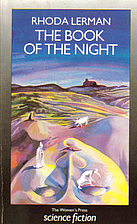
The Book of the Night by Rhoda Lerman

Women’s Press, 1986, 269 p.

Book of the Night cover

A young girl, Celeste, disguised as a boy called CuRoi, is brought by her father to the monastic community on Iona to live her life as a monk. It is Celeste’s viewpoint that carries the novel’s main narrative but this is interspersed with occasional sections told by Generous, one of the monks. Both voices, though, to the syntactically archaic at times have a tendency.

The book also plays tricks with time. Part of the ancillary plot deals with the confrontation between Roman and Celtic Christianity in the 8th century but there are references to the First and Second World Wars, quantum foam, radio, a ferry named the Princess George and the Beatles.

It is not only time that is malleable. So too is matter. Partway through the novel Celeste turns into a cow. A talking, feeling cow, true, but still a cow, with horns, hoofs etc.

The text is also replete with word play. Dense, allusive passages such as, “Michael, Molchu, Mocc-el, Moloch, Melech, King of the Universe, Enoch, eunuch,” or, “an Irish sailor I am, Noe, of the great craft Argo. Noah, Jonah, Iona, I sail with the argot and puns of the Naught to the God Lug of the deluge,” are not uncommon. There is frequent reference to jumping over the moon, animals running away with spoons etc. Indeed Celeste’s last written words, in the book’s final epigram, are, “Hey, diddle diddle.”

But when, “Words collapse, sink, intensify, grow dense. Categories disintegrate. Language trembles. Words remain but the webs of their meanings drift away,” a reader has a devil of a job keeping up.

The idea behind the story, apparently derived from those of Ilya Prigogine (though his Wikipedia entry does not appear to provide support for it) is that matter itself is malleable. The novel’s preamble asserts that, “self-organisation ….. is a property of matter … as if matter has mind, as if the thrust of evolution is will.” In this context the changing of a girl into a cow would not be remarkable. It is doubtful, to me at least, if it is warranted. While it is true that an organism represents a decrease in entropy (at least locally) this is a long way from meaning that the process can be directed.

In this context (and notwithstanding the Women’s Press Science Fiction imprint) the transformation of Celeste into a cow seems to me to belong in the realm of Fantasy rather than Science Fiction.

free hit counter script