Archives » 2020 » June

Vera

So, Vera Lynn has died.

I suppose it’s too much to hope that that will mean the Second World War is finally over and will no longer be invoked by those trying to make some spurious point about contempoorary life. It was 75 years ago after all.

Oh, well.

A flavour of this sentiment colours this Pink Floyd Track from The Final Cut.

Pink Floyd: Vera

Perhaps not, then.

Lynn is repeatedly referred to as the Forces’ Sweetheart but I have it on good authority that isn’t quite true – at least for the rank and file. When she was on tour giving concerts she spent most of her time with officers. As a result, more popular among the ordinary soldier was the much lesser heralded Anne Shelton.

Still, print the legend, eh?

But at least Lynn didn’t forget the Fourteenth Army and actually visited Burma.

Most people – not least the BBC – no doubt opted for We’ll Meet Again to mark her passing. This one’s slightly less sentimental.

Vera Lynn: A Nightingale Sang In Berkeley Square

Vera Margaret Lynch (Vera Lynn;) 20/3/1917 – 18/6/2020. So it goes.

Oresund Bridge

We passed under the Oresund Bridge (Öresund or Øresund Bridge depending on whether you live on the Danish or Swedish side) on the way from Stockholm to Aalborg.

I had thought we would do so when sailing from Copenhagen to Warnemünde but we seemed to turn north out of Copenhagen (I could just about make out the bridge in the southern distance) and then west. At that point we had to go in to dinner so I assumed the ship travelled down the west side of Zealand then instead of passing under the bridge.

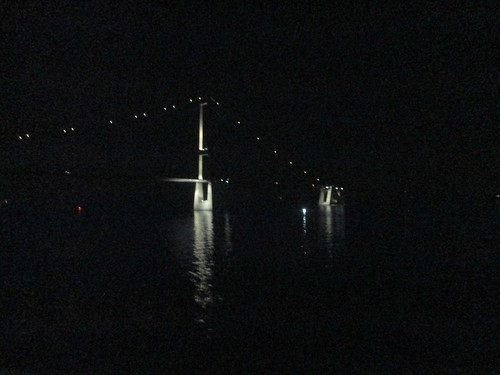
Unfortunately it was about one o’clock in the morning when we passed under the bridge – and dark; so the photos aren’t much cop.

Oresund Bridge by Night

Video. (It was quite windy):-

Oresund Bridge by Night

Closer appraoch:-

Centre, Oresund Bridge

Oresund Bridge Towers

Eastern support tower:-

Oresund Bridge Support Tower

Video. (I don’t know whose the voices are. Other people were also enjoying the experience):-

Oresund Bridge Support Tower

Leaving Aalborg

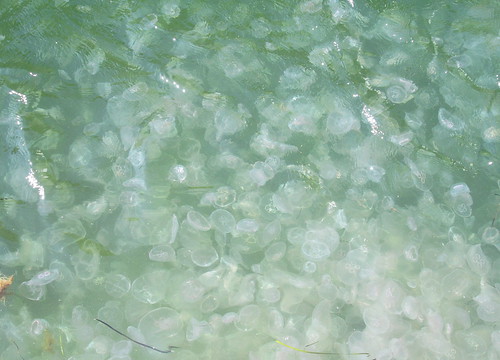
Jellyfish in Limfjord:-

Jellyfish in Limfjord, Aalborg

Jellyfish in Limfjord, Aalborg

The eastern side of Aalborg has some striking modern architecture:-

Aalborg, Modern Building

Modern Architecture, Aalborg

A water-skier was practising in this inlet:-

Aalborg, Modern Architecture

Modern Buildings and older tower:-

Modern Buildings and Tower, Aalborg

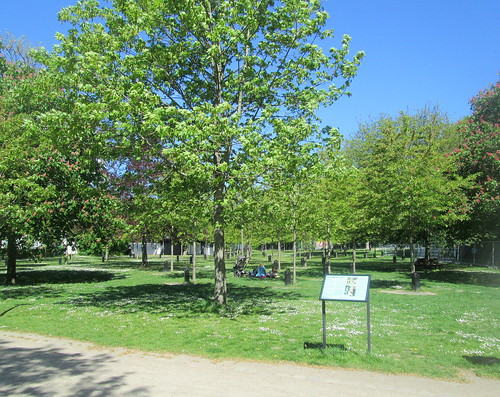
Kildeparken, Aalborg, Denmark

Taking an underpass below the railway we found a nice park in Aalborg: the Kildeparken.

There were two small thatched buildings there. One seemed to be a public convenience, the other may have been a caretaker’s hut. Pity about the grafitti:-

Aalborg Thatched Building, Baltic cruise,

Aalborg Thatched Building

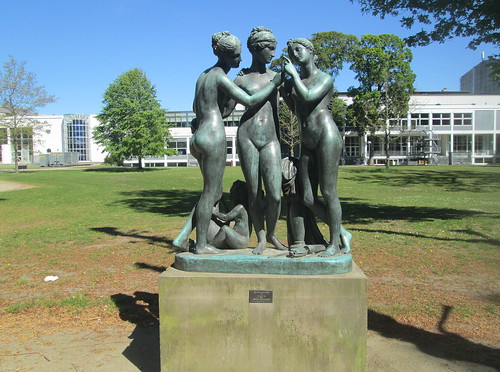
There was also a walkway with statues along its sides. This one is of the Three Graces:-

Sculpture, Aalborg, Denmark

The park is also home to the Singing Trees. Each performer at Aalborg’s Concert Hall is asked to plant a tree alongside which is a device containing a recording of a sample of their music.

Singing Trees, Aalborg, Denmark

Singing Trees, Aalborg, Baltic cruise

Singing Trees, Aalborg, Baltic cruise

Sadly during our visit none the playbacks we tried were working. Here’s a clip from You Tube where they were:-

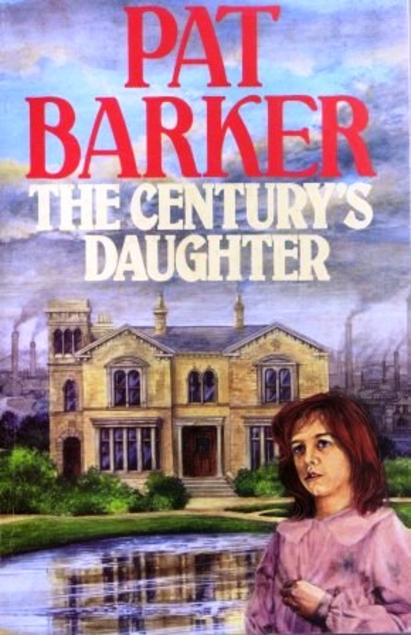
The Century’s Daughter by Pat Barker

Virago, 1986, 286 p. (This novel is also known as Liza’s England.)

The Century's Daughter cover

Stephen is a social worker, troubled by the youths down at what passes for the local centre, and also by his parents who are uncomfortable with (or in his mother’s case unaware of) his homosexuality. He is assigned to Liza Jarrett, an old woman living with a parrott called Nelson (whom she inherited from a pub landlord when the pub closed down) in a terraced house scheduled for demolition but which she is unwilling to give up. Liza was born on the stroke of midnight at 1899’s turn into 1900 and dubbed ‘Daughter of the Century’ by the local newspaper, a clipping of which her father was very proud. This made her one of that generation who lost brothers in one war and sons in the next. The novel is, though, more a tale of female resilience in and around that century’s defining landmarks (which it deals with only tangentially, even if their repercussions impact mightily on Liza’s life.) It intersperses Liza’s memories with Stephen’s experiences in the present as he comes to appreciate her and her determination to make the best of things, to fend for herself, to depend on nobody, and, with its present being the 1980s, illuminates the passing of a sense of community, of worth, “‘that’s where it all went wrong you know. It was all money. You’d’ve thought we had nowt else to offer. But we did. We had a way of life, a way of treating people.’”

There is some ground here to which Barker would return in her Regeneration trilogy (in particular the Great War and its munitions workers known as canaries.) While it tends to the bleak there are some moments of wry humour. At Stephen’s dad’s funeral, “‘It’s like a wedding in there,’ Stephen said. ‘No it isn’t,’ said Christine. Weddings aren’t that cheerful.’”

This was Barker’s third novel and while the characterisation is good her writing had not quite yet attained the maturity it would display later. The story is engaging though and Liza’s life reflects the stoicism of the women of her generation and class not often exhibited in fiction with the novel overall a threnody for a lost solidarity.

Pedant’s corner:- a missing comma before a piece of direct speech (x 2,) wrack and ruin (OK, it’s a legitimate alternative but to me wrack is a seaweed, so, rack and ruin), minaly (mainly,) “from his dying from his dying body” (only one ‘from his dying’ needed.) “Most of the crowd were young” (Most of the crowd was young.)

Streets in Aalborg, Denmark

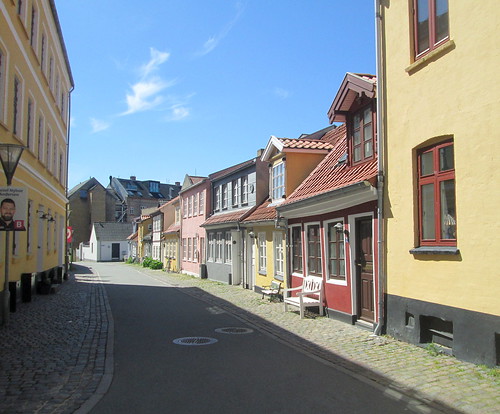
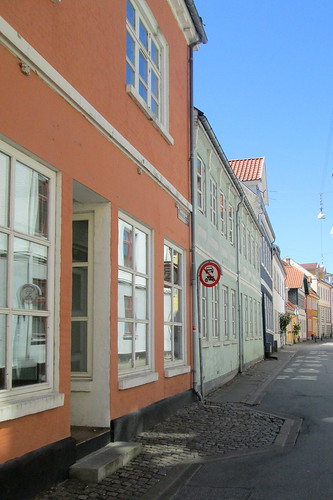
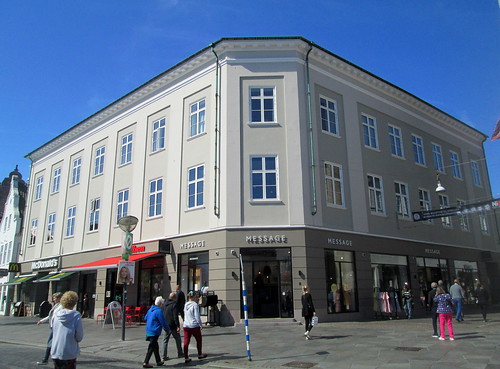
Aalborg (see earlier post) had some nice older buildings in streets quite near the city centre:-

Older Buildings, Aalborg, Denmark

Old Street in Aalborg, Denmark

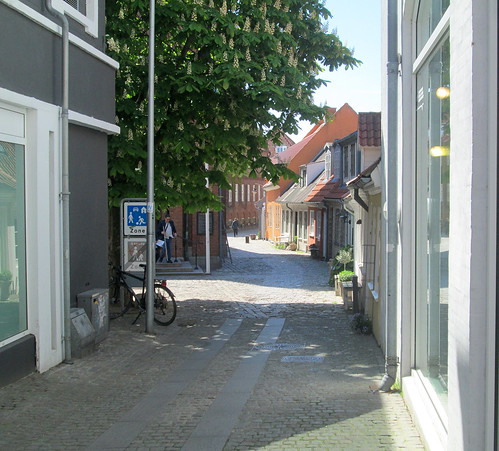
Looking one way, then the other in another old street:-

A Street in Aalborg, Denmark
Street in Aalborg, Denmark

Buildings in Aalborg, Denmark

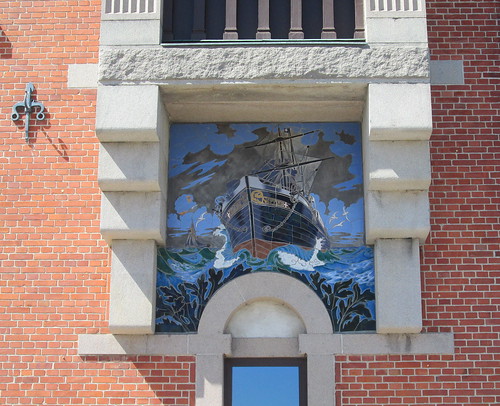
The first building we encountered after crossing the road between the dock and Aalborg‘s centre contained above a window this rather lovely mural of a sailing ship. (I think it was made of tiling):-

Ship Frieze, Aalborg,Denmark

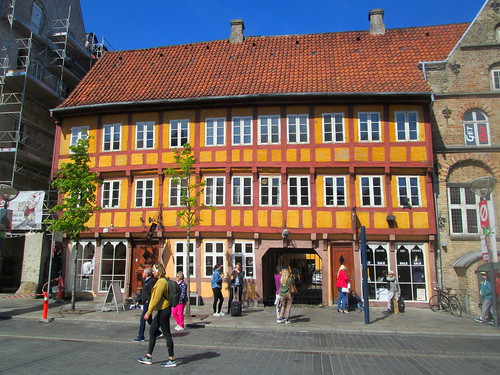
Then there was this almost Tudor style building:-

Aalborg Building, Denmark

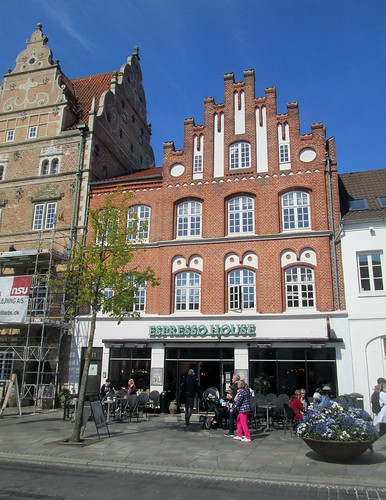
This seemed Dutch in appearance:-

Aalborg Building, Denmark

And this was the closest approach to Art Deco:-

Aalborg Building, Denmark

Another vaguely Tudorish building, off a side street, complete with fountain in front:-

Aalborg Building, Denmark

More Dutch style here:-

Aalborg Building, Denmark

A Barred Spiral Galaxy

Form Astronomy Picture of the Day for 11/6/20, barred spiral galaxy NGC 1300.

Isn’t it lovely?

NGC 1300

Bookshelf Travelling for Insane Times – Translated Fiction

Time for Reader in the Wilderness’s meme again.

These shelves contain my paperbacks of fiction translated from languages other than English. Evidence here of my usual suspects – Bohumil Hrabal, Mario Vargas Llosa, Naguib Mahfouz, Diego Marani, Gabriel García Márquez, Irène Némirovsky, Orhan Pamuk, but nearly all of these have been worth reading. In fact I would say there are no real duds here. The English language books on the lower shelf belong to the good lady and are shelved there because they fit into the space:-

Translated Fiction Bookshelves 1

Several really large hardbacks are too big to sit on the above shelves so have to be kept separately. These are not all translations but there is more Orhan Pamuk, more Naguib Mahfouz, more Irène Némirovsky, and then the English language Salman Rushdie. The John Updike omnibus is the good lady’s:-

Large Books Shelf

Bugs by John Sladek

Macmillan, 1989, 215 p.

Bugs cover

Sladek was one of those writers who contributed to the New Wave of Science Fiction in the 1960s. His SF always had a kind of sideways slant, not as bonkers as R A Lafferty but not conventional in any way.

This novel has a Science-Fictional premise in that it postulates the creation of a thinking robot but is designed more as a satire on the contemporary corporate culture of the 1980s and of USian manners, usages (Tea tier tgo for “To eat here, or to go) and sexual mores. It also rather spectacularly blows out of the water Gene Wolfe’s first rule of writing: ‘never name a character Fred.’

Said Fred is Manfred Jones, an English writer who has come to New York at the behest of his agent only to find that the project he had been lured with does not exist. His wife, Susan, is disgusted by their cockroach infested rooms and soon flies back home. Fred applies for a job as a technical writer at VIMNUT Industries in Minneapolis. He is mistaken for someone else and taken on – as a software engineer – and the misapprehensions go on from there.

He is rescued from a cloud of gnats by a Soviet spy calling herself K K who, of course, “speaks” with v replacing w, omits words like ‘a,’ ‘the’ and the odd ‘it,’ and says ‘darlink’ rather than darling and tries to recruit him. Various organisations offer him money over the phone, he is investigated by the IRS even though his pay-check from VIMNUT, which becomes Cyberk Corporation before he even joins, then later VEXXO, only one of a string of companies in the book constantly being renamed, while Fred’s British accent also leads to him continually being asked, “Why don’t you Brits bugger off out of Ireland.”

The whole is interspersed with background news items – most with ludicrously named reporters such as Aramis Whiteflow and Porthos Floog – on the killer targetting the Little Dorrit Restaurant chain. There is, too, an ongoing set of presidential sanity hearings. (If only, I hear you say.) There are embedded quotes from Bookends era Paul Simon songs and explicit references to Mary Shelley’s Frankenstein, whose fate the robot fears, especially after it is kidnapped and blamed for a death that took place during the incident.

Bugs is entertaining and clever, a perfect light read for lockdown or any other time, but sensitive souls should note there is a character described as a Negro who at one point says to a receptionist, “all you gotta do is put it in your ad: No niggers need apply.”

Pedant’s corner:- Talos’ (Talos’s,) “all he could do was to put down the chair” (all he could do was put down the chair,) caviar (caviar.) “Seeing her though tears” (through tears,)


free hit counter script