Archives » 2020 » June

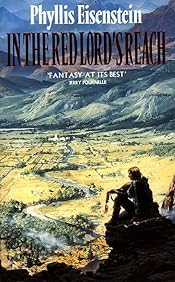
In the Red Lord’s Reach by Phyllis Eisenstein

Grafton, 1993, 286 p.

 In the Red Lord’s Reach  cover

These are the continuing adventures of Alaric the minstrel, hero of Born to Exile, who has the ability to transport himself instantaneously from one place to another, a trait he has to keep secret for fear of being called a witch. In his wanderings he comes to the domain of the Red Lord where he offers his musical services in return for the usual bed and board. Very soon he realises that there is something disturbing at the heart of the Red Lord’s reign. The hold the Lord has over the valley is as a reward for protection against bandits – of whom Alaric has seen no sign – and screams come from the Lord’s tower every night. When Alaric says it is time for him to leave he is taken to the tower where he finds the Lord tortures and eventually kills his victims, a fate now intended for Alaric.

He escapes (of course, how could a self-teleporter not?) and makes his way to the north lands where he falls in with the deer-herding (and riding) nomads who live there. The chief, Simir, himself a fugitive from the Red Lord, takes to him, as does Xavia the daughter of the nomads’ witch, Kata. Kata’s potions and prognostications are a solace for the nomads – she yearly provides them all with the Elixir of Life and imbues the men with the talent to hunt. Here being a witch is not seen as devilry, though Alaric does not accept that for a while. His relationship with Xavia is not taken well by Simir’s sons and leads to a confrontation. The sons are exiled and Alaric finds himself desired as a successor by both Simir and Kata.

The bad winter which follows leaves the nomads with few deer, no prospects for the next year and little option but what all along the reader knew was coming; to try to overthrow the Red Lord.

It’s decently enough written and engaging (not to mention remarkably free of errata) but an attempted rationale for Alaric’s powers as tapping into what seem to be magnetic field lines, described when Kata leads an expedition north to harvest the strange flowers which grow only there at midsummer and provide the ingredients for the Elixir of Life, sits somewhat oddly with the otherwise purely fantastical premise.

Pedant’s corner:- a missing comma before a piece of direct speech. “‘Pilgrim’s bound where?’” (Pilgrims.)

Art Deco Hotel, Tynemouth and Mouth of River Tyne

The Turk’s Head, Tynemouth, has Art Deco styling:-

Art Deco Hotel, Tynemouth

I couldn’t go to Tynemouth and not have a look at the River Tyne’s mouth.

Mouth of River Tyne with North Sea beyond:-

Mouth of River Tyne, Tyne and Wear

Tynemouth War Memorial

Tynemouth, as its name suggests, lies at the mouth of the River Tyne in Tyne and Wear, Northeast England, on the river’s northern bank.

Its War Memorial is situated in a small park-like area between Huntingdon Place and Front Street, Tynemouth’s War memorial has an unusual construction with four curved columns built of granite. The facing column has a downward pointing sword piercing a wreath with, below, the inscription, “To the glory of god and in memory of our fallen 1914 -1918 1939 – 1945.”

Tynemouth War Memorial

West aspect. I assume the upper names are for the Great War and the lower for World War 2:-

War Memorial, Tynemouth, West Aspect

North aspect:-

Tynemouth War Memorial, North Aspect

East aspect:-

East Aspect, Tynemouth War Memorial

Art Deco Semis, Whitley Bay

Brick-built Art Deco semi-detached houses in (I think) Whitley Bay. They were in that area anyway.

Horizontals, verticals, rounded bay windows, flat roof. Pity their eyes have been poked out:-

Art Deco Houses, Northeast England

Whiley Bay Art Deco Houses

Crowdie and Cream by Finlay J MacDonald

Warner Books. First published 1982. In The Finlay J Macdonald Omnibus, 1988, 174 p.

The Finlay J Macdonald Omnibus cover

This is MacDonald’s memoir of growing up in Harris, (which is known as the Isle of Harris even though it’s only the southern half of an island: ditto the Isle of Lewis, the northern half.)

Between the Twentieth Century’s two great wars the south of Harris was being repopulated with the aid of a Government intiative but this was still a harsh time when there were few amenities in the temporary turf-roofed dwellings the families occupied while they built their own stone ones – and not many in those – though the remains of the houses whose occupants had been cleared several generations earlier were a stark reminder of worse. There were no inside toilets – the great outdoors sufficed. Water for drinking and cooking was drawn from a nearby burn. In the times Macdonald is remembering the more convenient Tilly lamp superseded paraffin lighting and its whiter light was a source of regret. Electricity and gas were not even a dream.

The book embeds a history of Harris as the author explains his family’s circumstances and delves into the customs of the islanders while the delights of Toffee Cow (McCowans Highland Toffee, now sadly no more) become one of the author’s pleasures as he grows.

A lot of the narrative describes MacDonald’s schoolroom reminiscences, especially the initial tribulations of being solely a Gaelic speaker till he attended school (whose medium was of course exclusively English -inevitably the tawse features at times) and despite this not being published till the author was in his fifties he still manages to retain (or simulate) a child’s perspective. “Gillespie and I had long since learned to distrust adults when they were trying to sound reasonable.” He also comments on the curious circumstance by which the education all the parents desired for their children would most likely ensure that those children would leave the island in pursuit of the opportunities which that education had brought.

The coming of the Great Depression brings further hardship as the Harris Tweed trade declines. (Its use of human waste to fix the dyes require for colouring the tweed obliging everyone – visitors included – to avail themselves of the pee-pot when nature called is matter-of-factly described.)

There are several moments of humour, the new schoolteacher’s Word Game foundering on the definition of an organ, the kilted Dr MacBeth misunderstanding the question asked of him by a new father – this last had me giggling for about half a minute; not the usual response to reading tales of bygone Scottish life.

Like many a Scottish novel this autobiography is another of those laments for a past time, of the loss of a way of life, a documentation of things past. MacDonald certainly has an eye for it, and a way with words – even if they are in his second language.

Pedant’s corner:- Port Sunlight in Lancashire (it’s in the Wirral peninsula, not traditionally considered Lancashire,) “ ‘grace and favour ” (this opened quote was never closed,) while pages later we had “ away down in the south’ ” (a closing quote mark for an unopened quote,) bye-blow (by-blow,) “having failed to illicit information” (elicit,) another end quote that had not been opened, another opened quote remaining unclosed, “until we were hustled off the bed” (off to bed,) liguistic (linguistic,) “to smoothe them” (smooth them,) “even the Prince of Wales wears it” – the kilt – “whenever he ventures north of the Caledonian Canal” (I don’t think Balmoral – or Braemar – are north of there,) goloshes (my dictionary gives this as an alternative spelling but it was always galoshes in my day.)

Minor Art Deco, Rothbury, Northumberland

Rothbury’s Co-op.

Minor deco, mainly in the stonework round the windows. Pity those windows have had their eyes put put.

Art Deco in Rothbury

Rothbury Art Deco

SF Bookshelf Travelling for Insane Times (ii)

Large SF paperbacks this week for Judith’s meme at Reader in the Wilderness.

I keep these in an old music cupboard I inherited from my great-uncle. I’ve got so many of these they have to be double-parked, so you can’t actually see the first and third shelves shown here when the cupboard is opened. Stacking some on their sides gives me an extra 4 cm of space. Click on the photos to enlarge the pictures.

These include a J G Ballard, Iain M Banks, Chris Beckett, Eric Brown, Ursula Le Guin and Ian McDonald:-

Large Science Fiction Paperbacks (i)

Annoyingly, even these large paperbacks do not all come in one size. The upright ones to the right here are smaller than the previous books. More McDonald, Tim Powers, Kim Stanley Robertson, Adam Roberts, Hannu Rajaniemi, a lesser Robert Silverberg, Kurt Vonnegut:-

Large Science Fiction Paperbacks (ii)

More Ballard, Banks, Beckett and Brown. Lavie Tidhar, Neil Williamson and another step down in size:-
Large Science Fiction Paperbacks (iii)

John Crowley, M John Harrison, Dave Hutchinson, Stanisław Lem:-

Large Science Fiction Paperbacks (iv)

Markinch Ibrox Disaster Memorial

This memorial to the five boys from Markinch who died in the Ibrox Disaster on 2/1/1971 lies directly opposite the entrance to Balbirnie Park.

Markinch Ibrox Disaster Memorial

Interior, Markinch Primary School

I posted about the outside of Markinch Primary School here.

In May 2019 I had occasion to visit the school and got a look at the interior. Imagine my delight to find these Art Deco style doors at the entrance to the school’s Assembly Hall, complete with porthole windows and glass bricks.

Interior Markinch Primary School

I didn’t have my camera. All three of these photos were taken on a mobile phone, so are a bit blurry.

The stairway has Deco flourishes-

Stairway, Markinch Primary Schoo

With a nice curve to the handrail:-

Markinch Primary School Stairway

Something Changed 35: Kiss From a Rose

A bit of “Hey Nonny Nonny” this week. Not from the middle ages but from 1994.

(The oboe is a wee bit reminiscent of Jethro Tull’s Coronach.)

Seal: Kiss From a Rose

free hit counter script