Archives » 2020 » June

Friday on my Mind 191: The Sun Goes Down

A bit of psychedelia today. I previously described The Monkees as an unusual source of psychedelia. I would submit this group is equally unlikely.

Dave Dee, Dozy, Beaky, Mick and Tich: The Sun Goes Down

For comparison purposes here is the A-side from the same single. In this clip the group is obviously miming. Standard practice for the day, though.

Dave Dee, Dozy, Beaky, Mick and Tich: Zabadak

For Interzone 288: Hope Island

 Hope Island cover

My latest book to review for Interzone will be Hope Island by Tim Major.

I read his previous novel Snakeskins earlier this year.

I must admit to being surprised when the book fell on the doormat this morning. The list of possible review books for Iz 288 was only sent out a couple of days ago. I’ll get onto it as soon as possible.

Cloud Cuckoo Land by Naomi Mitchison

The Traveller’s Library, 1928, 348 p.

Cloud Cuckoo Land cover

This contains a dedication which I would have thought to be quite daring for the 1920s, “To my lover.”

The book is set during the Pelopponesian War, starting off on the island of Poieëssa in the Aegean Sea. Here young Alxenor is caught between the wishes of his brother, Euripaides, to support Sparta against the island’s overlord Athens, and those of Chromon, the brother of the girl he likes, Moiro, in favour of the democrats. When the revolt aganist Athens comes, Alxenor is only able to save Moiro with the help of a Spartan, Leon, and find she has made an enemy of Chromon. He and Moiro flee to Athens where he is taken in by Theramenes, a trader, and marries Moiro. He is only able to make money by enlisting as a rower on one of Theramenes’s triremes but it is never enough and he and Moiro live more or less hand-to-mouth, even when they have a son, Timas. Moiro is pregnant again when Alxenor has to make another sailing trip and he advises her to keep the new child if it’s a boy or else expose it (in the Greek way) if it is a girl. It’s a girl and his wishes are followed by the household. Thereafter things between Moiro and Alxenor are broken and he takes care not to make her pregnant again.

On one of Alxenor’s trips he receives news that Sparta’s navy has defeated that of Athens at Aegospotami and the fall of the city becomes a foregone conclusion. Thus it is that Alxenor and his family end up in Sparta at the household of Leon’s cousin where Moiro has an affair with Leon and the inevitable happens. Her loyal slave attempts to get rid of the child but it goes wrong and Moiro dies. Here the Spartans offer to bring up Timas as one of their own. Alxenor is willing at first but another non-Spartan who is undergoing the same training as intended for Timas secretly warns him not to allow it. He and Timas make their escape and head for Poieëssa.

This is another illustration of Mitchison’s clear love for ancient times as in The Corn King and the Spring Queen and Travel Light (and also Blood of the Martyrs.) Her knowledge of the times and customs shines through but I would perhaps have enjoyed this more if I’d had a wider knowledge of the Pelopponesian war than merely that it was a contest between Athens and Sparta.

As a novel, though, this has a peculiar ending in that it doesn’t seem to have a conclusion. It just stops. And I still can’t quite see in what context the title Cloud Cuckoo Land is apposite.

Pedant’s corner:- Theramenes’ (Theramenes’s. All names ending in ‘s’ in this book are treated similarly, though,) shrunk (x 2, shrank,) “he dare not” (past tense, dared not,) “none of the Spartans were back” (none … was back,) slipt (archaic spelling of slipped – or is it Scots?) “two fellow-servants of Isadas’ went” (doesn’t need that apostrophe after Isadas,) “wouldn’t leave go” (wouldn’t let go.) “None of them were …” (None of them was… .) mistress’ (mistress’s,) sunk (sank.) T S Elliot (in a chapter epigraph. T S Eliot.) “‘Aren’t I ever going back’” (Please. ‘Amn’t I ever going back?’)

A Danish Fjord

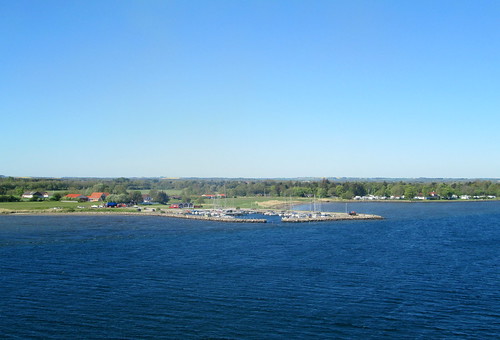
This isn’t the sort of view normally associated with fjords. The word usually conjures up images of steep, almost mountainous sides and a narrow waterway.

Jutland from Limfjord 1

This however is the Limfjord, which cuts Jutland in Denmark in two. And the countryside by its banks is flat. I thought that perhaps in Danish the word fjord just means inlet. (It seems it does, if you type ‘fjord’ on the ‘Danish’ side of this link. In all the other Scandinavian languages ‘fjord’ translates as ‘fjord’.)

Jutland from Limfjord 2

We sailed up the easternmost bit of the Limfjord on our approach to the last stop on the trip, Aalborg, Denmark’s fourth largest city.

Jutland from Limfjord 3

The Fish Can Sing by Halldór Laxness

Harvill Panther, 2001, 252 p, including i p note on pronunciation and ii p map of Iceland. Translated from the Icelandic, Brekkukanstannáll, (Helgafell, Iceland, 1957,) by Magnus Magnusson.

 The Fish Can Sing  cover

There is something almost mythic, or fabular, about the origins of narrator Álfgrímur Hanson, born in the mid-loft of Brekkukot, a dimly lit turf-roofed shack on the outskirts of what would become Reykjavík, and who never saw his mother again, as she was in transit to the US, sponsored by the Mormons or some such. Instead he was brought up by the pair who lived in Brekkukot, whom he called grandfather and grandmother even though they were no relation at all. Grandfather Björn is a lumpfisherman, wedded to the old ways, plying his trade by hand. He never changes the price of his fish; neither when a surplus lowers others’ nor when a shortage makes his catch more valuable. Brekkukot is also a way-station for those with nowhere else to go, packed with adults sleeping in the same cramped space, always available to house those needing a bed. Such is the atmosphere that surrounds him, though, that Álfgrímur does not realise he could be considered poor until almost into adulthood. Not that he ever thought about it, he simply didn’t question Brekkukot’s place in the world.

His grandfather has a firm sense of what is right and proper with his “conviction that the money which people considered theirs by right was unlawfully accumulated, or counterfeit, if it exceeded the average income of a working man; and therefore that all great wealth was inconsistent with common sense.”

In many ways, perhaps due to similarly inclement climates, Icelanders’ attitudes to the world as shown here have something of the Scots sense of endurance about them. Álfgrímur tells us, “I could swear on oath that growing up I never heard the word ‘happiness’ except on the lips of a crazy woman who lodged in the mid-loft with us for a time.” He instances many Icelandic phrases with this kind of sentiment. ‘They have plenty of salt fish,’ = they’re doing all right, ‘Oh, he’s fat enough,’ = he’s well, ‘Oh, you can see it on him’, = he’s unwell, ‘He’s a bit low,’ = he’s more dead than alive, ‘He’s off his food these days,’ = dying of old age, ‘he’s packing his bags now, poor fellow,’ = on his deathbed. When a married couple separated, ‘Yes, there’s something wrong there I believe,’ was said. Or is this stoicism simply due to Álfgrímur’s particular circumstances? “At Brekkukot every word was precious, even the little words.”

The book is set at a time when change is coming to the country yet still before Iceland had gained independence from Denmark. The prickly relationship between the island and its then ruler is alluded to often in unflattering mentions of the Danish king and brought into sharper focus by the sentence, “The only insult that can really rile an Icelander is to be called a Dane.” And Icelanders had apparently always considered what the Pope said about religious faith laughable.

A lot of the novel is taken up with the saga of Garðar Hólm, of Hríngjarabær, close to Berkkukot. He is apparently the only world-renowned Icelander, a singer, known to crowned heads and the Pope. His returns to the island are eagerly awaited, promoted in the newspaper, the Ísafold, but often found to be only rumour or called off at the last minute. Yet he makes unheralded appearances in Reykjavík and the odd visit to Brekkukot. He and Álfgrímur strike up a relationship of sorts, especially after Álfgrímur is employed by Pastor Jóhann as a singer at funerals and learns of the concept of the one pure note. On one occasion he and Álfgrímur even exchange footwear. Yet Álfgrímur notes Garðar Hólm’s rather dressed down appearance. The singer is said to be unmarried (a very minor sub-plot has the daughter of the owner of Gúðmúndsen’s Store – an institution in Reykjavík – hankering after him) but there are also tales of a woman with two children in a hut in Jutland. Garðar Hólm exerts a large influence on Álfgrímur. In one of their conversations, he tells Álfgrímur in relation to wealth that, “The man who is worth anything never gets a jewel,” in another that in encyclopaedias, “murderers, particularly multiple murderers, command much more space than the greatest geniuses and men of intellect.” There are heavy allusions to the possibility that Garðar Hólm’s fame is nothing of the sort and is a sort of trick pulled off by Gúðmúndsen to bolster Icelanders’ thoughts of themselves.

Perhaps it is Álfgrímur’s almost naïve acceptance of things but there is in all this a dislocation almost like that encountered when reading fiction by South American writers. It can’t though be said to be magic realism because the writing is resolutely realistic throughout. There are things undoubtedly lost in translation and others that perhaps only Icelanders could fully understand. But the point of reading translated fiction is to help expand your view of the world. Laxness’s writing fulfils that function very well.

Pedant’s corner:- “the kind of audience he attracted there were” (the kind of audience… was,) “for a long rime now” (a long time, I think,) “‘And for that reason she does not want you not to drown in the Soga Stream’” (omit that second ‘not’,) galoshes (galoshes, x 2,) “a horde of fat men comes running over waving cheque books and hire him” (plus points for ‘comes’ but it then also ought to be ‘hires’.)

Stockholm Archipelago

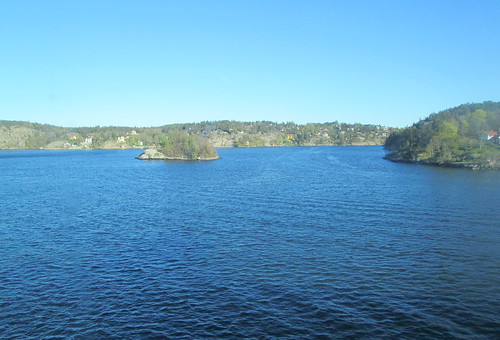
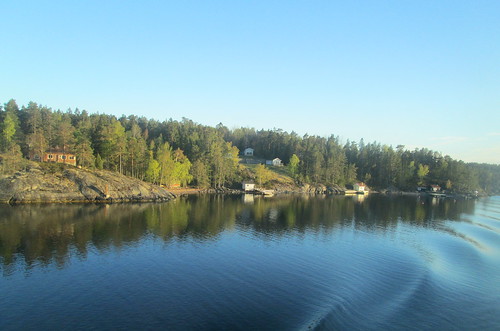
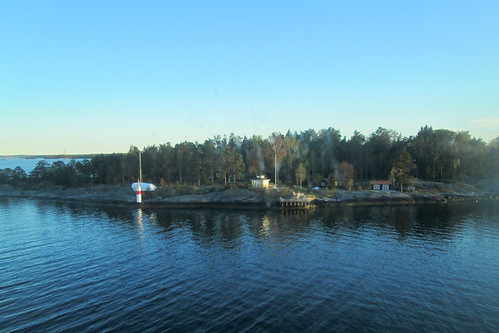
Our approach to Stockholm had been overnight so we hadn’t seen the environs. On the way out in the evening we found it is a beautiful set of islands through which the ship made its way. Back in the day I suppose these must have made Stockholm very easily defensible from the sea.

Stockholm Archipelago 3

Stockholm Archipelago 4

Stockholm Archipelago 1

It must be great to be able to jump into your yacht and take off:-

Stockholm archipelago, Sweden,

Stockholm Archipelago 2

Stockholm Archipelago 5

Stockholm Archipelago 6

Stockholm Archipelago 7

Stockholm Archipelago 14

Stockholm Archipelago 13

Stockholm Archipelago 15

Stockholm Archipelago

Fiction Bookshelf Travelling for Insane Times

This week my contribution to Judith Reader in the Wilderness’s meme is my shelves of recent fiction written in English. They include UK, US, Irish, Canadian, Australian, Nigerian, Malaysian and Egyptian writers and even one part Vietnamese author. Click on the photos to enlarge.

There’s barely a dud here. Notable to me are Philip K Dick’s non-Science Fiction novels (stretching recent there a bit.) Sadly these were not published till after his death.

Also there, though, is Samuel R Delany’s autobiographical book The Motion of Light in Water not to mention some commemorative china and wooden elephants.

English Language Fiction Books

Peter Ackroyd’s The House of Doctor Dee would be there too if the good lady hadn’t swiped it for her 20 Books of Summer reads.

However that would be on the next shelf stacked on its side as it’s one of those large paperbacks. I put those and some hardbacks from below upright to take the photo below. (The James Wellard is also hardly recent.)

English Language Fiction Tall Books

Stockholm Architecture

The coach had dropped us off near Gamla Stan – old Stockholm, well worth a wander round. (In pre-coronavirus days anyway):-

Gamla Stan, old Stockholm

Art Nouveau-ish Building, Gamla Stan, Stockholm:-

Art Nouveau-ish Building, Stockholm

Church and bridge round corner from Gamla Stan:-

church, Stockholm

Traditional architecture:-

Stockholm building

Stockholm, conifers

Gustav II Adolf (Gustavus Adolphus) statue and building opposite Riksdag and Opera House, Stockholm:-

Building and Statue Near Riksdag, Stockholm

More modern Swedish style:-

Modern Building, Stockholm

Storm of Locusts by Rebecca Roanhorse

Hodder, 2019, 317 p.
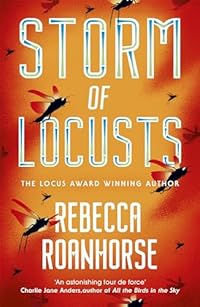
 Storm of Locusts cover

This is the second of Roanhorse’s Sixth World sequence featuring the adventures of Maggie Hoskie, Monsterslayer. I reviewed the first, Trail of Lightning, here. We are again in Navajo country, Dinétah, and straight away Maggie is asked by Hastiin, of the Thirsty Boys, (drought still afflicts the land after the environmental catastrophe known as the Big Water,) to help with something big and bad over near Lake Asááyi. On the way she is introduced to Ben, who is not a young man, but a teenage girl, Hastiin’s niece, whom Hastiin asks Maggie to look after if anything should happen to him, which naturally it soon does. The something big and bad turns out to be a woman with wings who can sing others to submission and is an adherent of the White Locust. Hastiin is killed, Ben blames herself for attracting the winged woman’s attention and tries to kill her in revenge. In the aftermath Maggie has to accept reponsibility for Ben, who we find, like Maggie, has clan powers, in her case to track people. The winged woman – despite her singing abilities – is then forgotten by the narrative.

Rissa and Clive Goodacre of the All-American bar encountered in the previous book come knocking asking for Maggie’s help to rescue their brother Caleb, taken apparently by Maggie’s former ally, Kai, whom she betrayed in the course of defeating then burying her mentor, Neizghání, whose sword of lightning is now in Maggie’s possession. A video of the abduction is in the bar’s archive, and despite not being very revealing does show Kai mouthing, “I love you. Don’t follow,” presumably to Maggie. Though Maggie is insistent she no longer wants to kill anyone and any pursuit means she might have to, follow is of course what she does, accompanied by Ben, Clive, Rissa, and a shapeshifter called Mósí, escaping pursuit by a swarm of locusts which can devour everything in sight and assemble themselves into a human shape.

They find Caleb at Dinétah’s southern entry gate, complete with a set of wings and pinned by stakes to the wall that surrounds Dinétah. (For some reason all the Goodacres have red hair. Odd, it isn’t a dominant gene.) The trail leads out into the Badlands beyond Dinétah. Within hours our adventurers are captured and taken to Knifetown, overseen by a man called Bishop who is a trader of all kinds but especially of breedable women. He deems Maggie and Rissa too dangerous though. They are to be harvested for their organs. Somewhat too easily they talk themselves out of captivity by persuading Bishop’s pilot, Aaron, to help them. This is good for plot reasons as he is the brother of Gideon, the White Locust. Mósí engineers that they stop at an abandoned casino named Twin Arrows, where Maggie becomes reacquainted with Ma’ii (Coyote) whom she had killed in the previous book, “The problem with immortals is that they don’t stay dead,” and engages in a game of chance with the god Nohoilpi. There is a diversion to a place called Wahheap, where Maggie learns from Tó how to control Neizghání’s sword, then on to Amangiri and the final confrontation with the White Locust, who holds a grudge against Dinétah and plans to destroy it.

Maggie is an engaging narrator. Despite all the mayhem, violence and killing, not all that much by way of plot, and the lack of filling in of background detail of this supposed future the book is well written. Roanhorse shows understanding of the human condition and a flair for character depiction. The blending of Navajo myth and beliefs with a Fantasy plot works well as a story but the control over natural phenomena by those with powers is always a stretch for me.

The last chapter is a bit of a tease as it does not relate at all to the main thrust of Storm of Locusts but instead promises more in the Sixth World.

Pedant’s corner:- “When the adrenaline spike that drive them fades” (drives then,) “at apace” (at a pace.) “Something about Rissa seem to repel the light” (seems,) “she slides off mattress” (the mattress,) “there’s no arcing patterns” (there are no arcing patterns,) a closed quotation mark at the end of a paragraph when the next paragraph started off with the same speaker (x 1,) “‘I’ve never drank alcohol before’” (never drunk.) “He shakes he head.” (his head.) “‘How it is my fault?’” (How is it my fault?,) “as we race for the Lupton” (for Lupton,) “like she’s relived” (relieved,) “Caleb’s rushes on” (Caleb rushes on,) a missing comma before a piece of direct speech. “His freezes” (He freezes.) “Feedings us to the sporting dogs.” (Feeding us to,) hanger (hangar, used correctly later,) “what looks to be modified Heckler assault rifles” (what look to be,) the sheathe (the sheath,) “I loved the way it shined” (shone,) “the pressure of fingers on my neck disappear” (disappears.) “His stumbles back” (He stumbles,) “sounds like I great idea” (like a great idea,) “righted the plan” (righted the plane.) “The use it against a god?” (To use it against a god?) Nohoipli (elsewhere always Nohoilpi,) “making them they sparkle like diamonds” (no ‘they’ needed,) “rarer in this world that you think” (than you think,) “rolling through by body” (through my body,) “‘if you haven’t notice’” (noticed.) “The docks creaks and moans” (the dock,) “I sheath the sword” (sheathe,) “There’s a an individual” (no ‘a’.) “Kai shoulders fall slightly” (Kai’s,) an unneeded end quote mark at the end of a normal piece of prose (x1.) “The spill of pebbles under my feet sound like” (the spill …sounds like,) “reaching up hands up” (only one ‘up’ required.) “The impossibly rare smell of sugar and cinnamon waft from the dish” (the … smell … wafts,) “I cry out at my fingers bend and crack” (as my fingers,) “and his eyes – whatever light they had before – snuffs out” (- whatever light they had before snuff out,) Diyin Dine’ e (elsewhere always Dine’ é,) “the handful that are left” (strictly; the handful that is left.) “Stepping out of from behind” (either ‘out of’ or ‘from’, not both,) “from having the relive the horrors” (having to relive,) “her face tight” (his face.) “As in on cue” (As if on cue,) “his breath coming is gasps,” (in gasps,) Dinetah (elsewhere always Dinétah.)

Reelin’ in the Years 174: Burning – RIP Steve Priest

So, farewell then, Steve Priest, bass guitarist with The Sweet.

On one of the band’s Top of the Pops performances Steve managed to outrage my father with his make-up and pouting to the camera. I just thought all of that was an in-joke, a very muted kind of rebellion.

I’ve already featured what I think of as the band’s good hits; the ones that weren’t mere bubblegum fluff.

The Sweet’s B-sides were their attempt to show that they were serious musicians. Some see them as forerunners of and influences on later heavy metal bands. At the time most of my acquiantances thought they were maybe trying a bit too hard.

On this one (the B-side of Hell Raiser) it sounds like they were trying to channel Led Zeppelin, specifically The Immigrant Song.

The Sweet: Burning

Stephen Norman (Steve) Priest, 23/2/1948 – 4/6/2020. So it goes.

free hit counter script