Archives » 2018 » March

Art Deco in Pittenweem?

Pittenweem is a fishing village in the East Neuk of Fife.

It has an annual Art Festival which we usually attend. While there last year I came upon this Art Deco/Moderne building, acting as one of the venues. Whatever it’s certainly 1930s.

Art Deco/Moderne, Pittenweem

Art Deco/Moderne Building, Pittenweem

View from behind. A garage is to the left here:-

Side View, Art Deco/Moderne, Pittenweem

The garage:-

Art Deco Style Garage, Pittenweem

Pittenweem Primary School is not quite Art Deco, being erected in 1912, but has some prefigurative elements:-

Not Quite Art Deco, Pittenweem Primary School

Left-side entrance to Pittenweem Primary School:-

Entrance, Pittenweem Primary School

Path Into the Unknown: The Best of Soviet SF

McGibbon and Kee, 1966, 185 p No translator’s name given.

Path Into the Unknown cover

The first story in this collection, The Conflicta by Ilya Varshavsky is dedicated, To Stanislav Lemm (sic) “in memory of our argument which will never be resolved”. It focuses on a mother distraught at the affection in which her child holds the robot household help, an extremely intelligent machine but not without its own emotions.

A household robot also features in Robbyb again by Ilya Varshavsky. This one becomes increasingly cantankerous as it tries to apply logic to everything.

In Meeting my Brotherc by Vladislav Krapivin a young boy sees himself as the brother of a cosmonaut on a mission from long ago. When the mission returns his wish is fulfilled in a roundabout way. This story is less focused on the SF set-up than Varshavsky’s two, and more on human relationships.

A Day of Wrathd by Sever Ganovsky sees a journalist go seeking a group of artificially produced reasoning creatures called Otarks who may be more intelligent than humans but uncompassionate.

In An Emergency Casee by Arkady and Boris Strugatsky a spaceship returning from Titan to Earth is plagued by an infestation of eight-legged flies.

Arkady Strugatsky’s Wanderers and Travellersf features a scientist investigating a new type of cephalopod who meets a spacefarer who in turn has become the source of radio signals.

The Boyg by G Gor is the tale of an unusual school classmate whose father claims to have found evidence of aliens on Earth in the Jurassic period, one of whom may have survived to the present day.

In The Purple Mummyh by Anatoly Dneprov, said mummy is an artefact convolved (printed) from radio signals emanating from across the universe – its colour a manifestation of the Doppler Effect – and (barring a reversal of internal organs,) an exact replica of the narrator’s wife. This is taken to be proof of the existence of anti-matter worlds.

Reading this was a strange experience. Whether any infelicities are due to the nature of Soviet SF, to the translation(s) or to the times in which the stories were written is difficult to discern. It was interesting though.

Pedant’s corner:- patronymics are throughout spelled with “ich” at the end, the modern style is “ic”. Otherwise; aStanislav Lemm (now more usually written in English as Stanislaw Lem,) bDescartes’ (Descartes’s,) “watching the telly” (felt far too prosaic for the rest of the narration; “watching TV” might have fitted better,) paperbooks (paperbacks is the accepted term.) c”too late for Alexander to change their plans” (yes it was the group’s plans but the construction feels clumsy,) an ice-locked land, devoid of any life” (yet it has a breathable atmosphere? That requires oxygen – which requires …. life. Later we find it has plants – of a sort. But still one of the cosmonauts says ‘if it wasn’t for the sheet of ice there would be life here,’) milleniums (millennia,) one of them refers to himself as an astronaut (he seems to be Russian so would be a cosmonaut.) dTranslated into USian, “there was not a single trail of chimney smoke or a stack of hay” (nor a stack of hay,) sprung (sprang,) sybernetic (now spelled cybernetic,) staunch (stanch,) Nubio (context implies Nubia.) d“the spaceship lost speed and deviated from its course” (??? Not in any kind of orbital mechanics that I know,) unvoluntarily (involuntarily,) one end quote mark was missing. “.. go round sprinkling them with alcohol. Then set fire to them.” (deliberately set a fire? On a spaceship?) f“your onboard wireless” (reads very oddly nowadays; radio is referred to later,) ampule (is this USian for ampoule?) “the less chances there were “ (the fewer chances.) gseomthing (something,) “part were very much in doubt” (part was,) prgramme (programme,) “things that that there weren’t the slightest mention of in our textbooks” (that there wasn’t the slightest mention of,) a missing end quote for a piece of direct speech. “Everyone he had ever known were all here” (everyone was all here,) philosophere (philosopher,) “hydrogen links” (may be a direct translation from the Russian but the term in English is hydrogen bonds,) “a dinosaur which had small front teeth with very stressed grasping functions and no teeth” (small front feet.) Whether I could stomach him or not?” (That isn’t a question so does not require a question mark,) “the diing room” (dining room.) hparallelopiped (parallepiped,) radio-eradiation (seems to be a somewhat clumsy attempt to render into one word the radiation masking caused by a Faraday cage even though eradiation has an opposite sense.)

BSFA Awards Booklet Arrives

The BSFA’s annual booklet containing the nominees for the various awards for 2017 publications arrived on Thursday morning 29th Mar.

BSFA Award Booklet 2017

The deadline for postal votes is (was!) Mon 26th Mar and for electronic submissions Wed 28th Mar. The results will be announced on Saturday 31st Mar.

Not the BSFA’s fault it arrived late. Easter is about as early as it can be this year and there was precious little time between the close of the submission phase for the final nominations and Easter. They’ve done well to get it out at all.

Just as well I’m going to Eastercon this year where I can vote in person.

I’ve got my work cut out to read it all before then though.

My (belated) thoughts on its contents will appear next week.

Reelin’ In the Years 147: Wherewithal

Clifford T Ward was an unusual pop star. Who else would have based a popular song around a Robert Browning poem in Home Thoughts from Abroad? (See here track 7.)

Not only did Ward use the word wherewithal in this song, he made it the title.

And I doubt you’ll find non-pareil in any other song lyric. (Granted, nonchalant is less rare.)

Clifford T Ward: Wherewithal

“A New Era” at Modern Two

We’ve been to the New Era exhibition of Scottish Modern Art 1900-1950 at the Scottish National Gallery of Modern Art (Modern Two.)

It’s not quite as good as the previous exhibition True to Life (for which I see some of the links to the paintings are no longer working) but there is still some good stuff there.

More so in the first two galleries. The pictures became darker both in tone and appearance as the galleries wore on.

Stanley Cursiter’s “The Regatta” is particularly striking with its bold slabs of colour:-

The Regatta

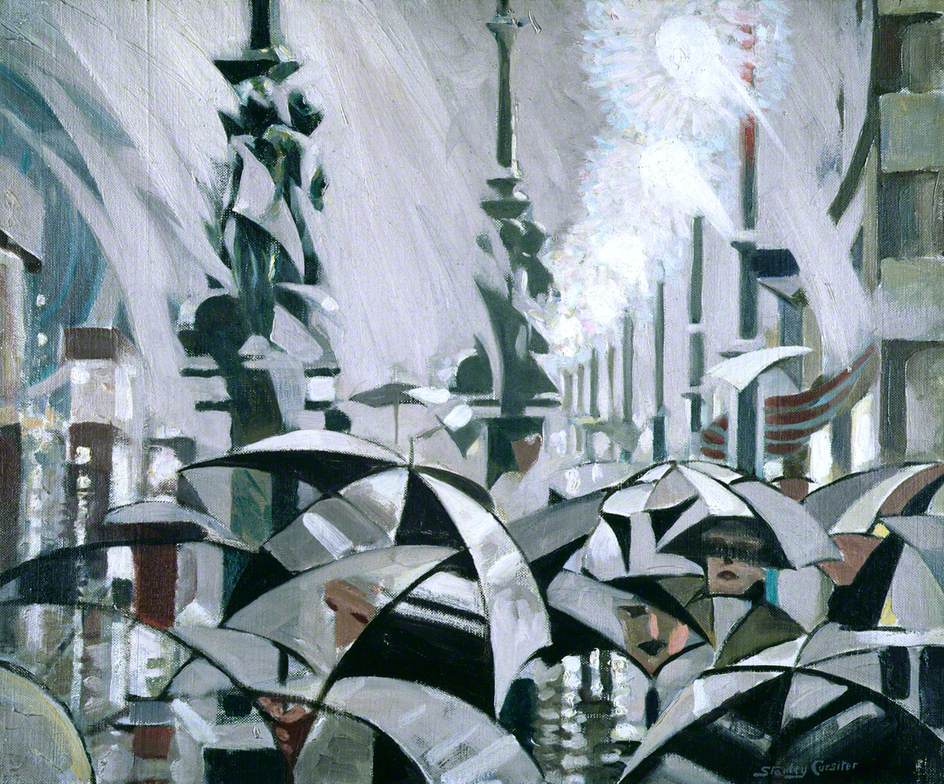
Cursiter’s “Rain on Princes Street”:-


J D Fergusson is more usually reckoned a colourist but though not an official war artist he was allowed to paint Portsmouth Docks during the Great War.

Porstmouth Dockyard

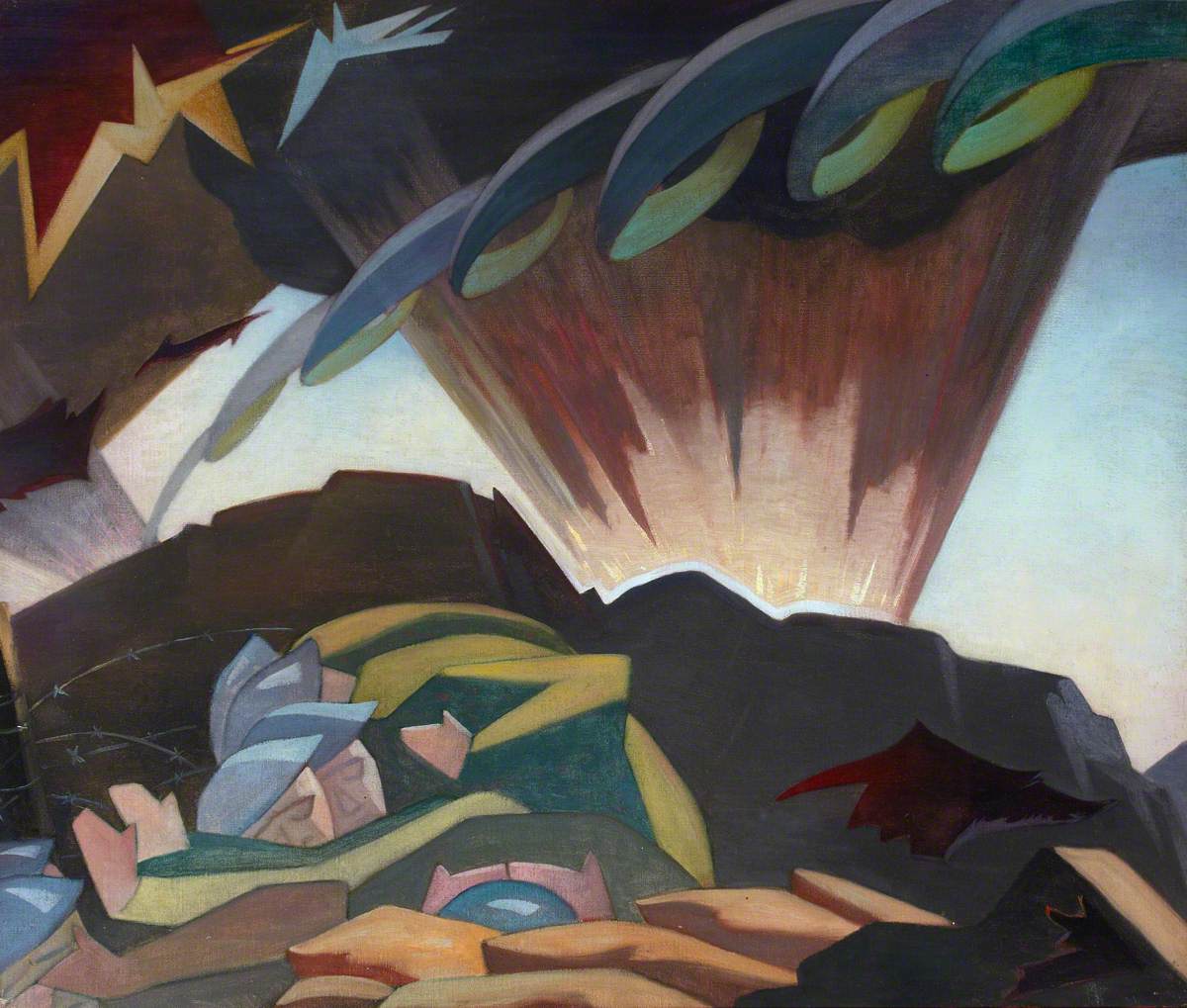
Another evocation of war is in Eric Robertson’s “Shellburst”:-


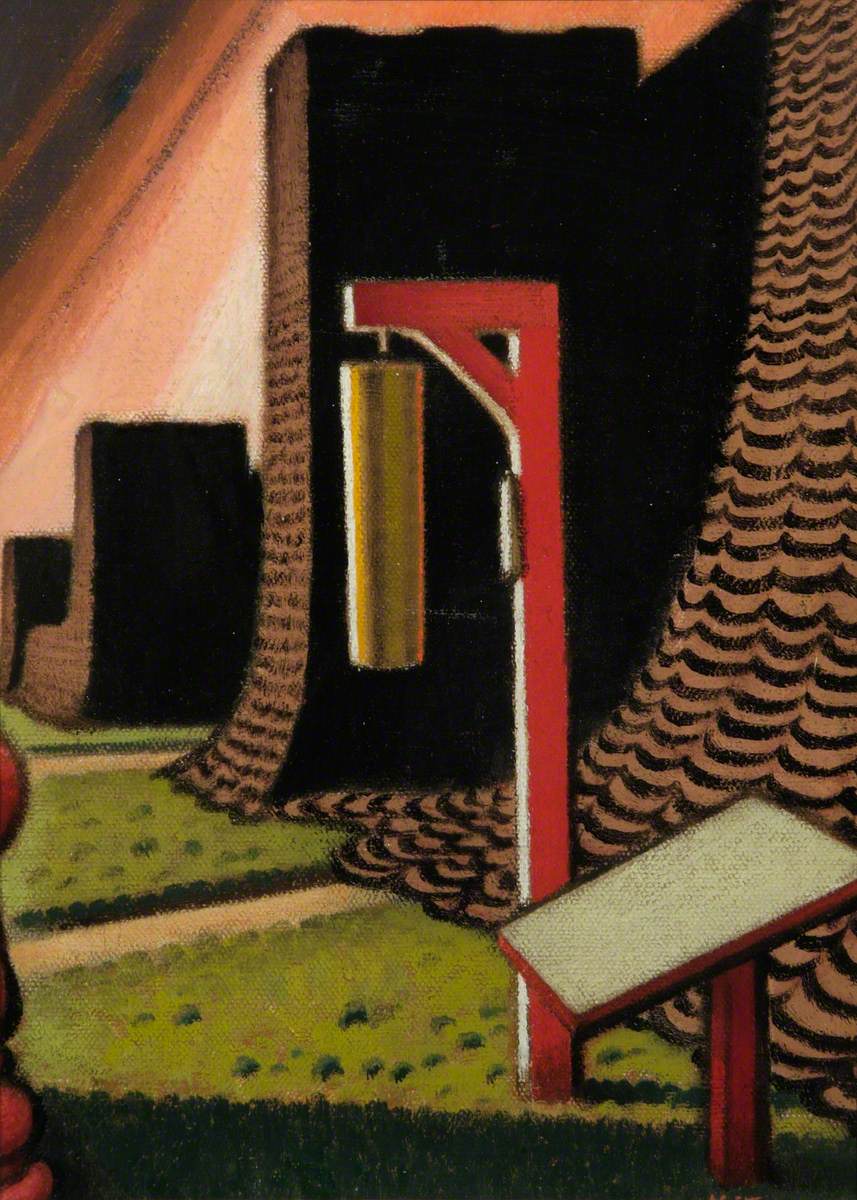
So too does Keith Henderson’s “Camouflage Hangars and Gas Gong”:-

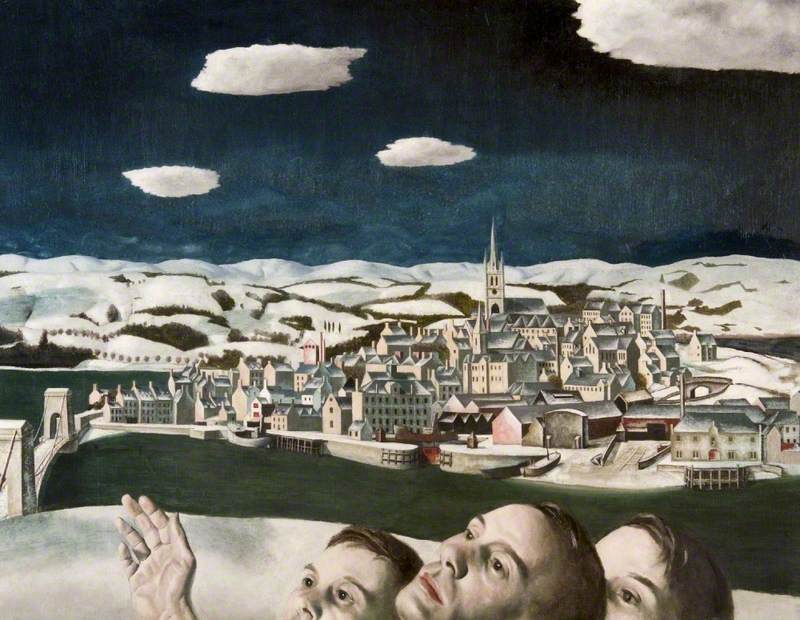
The caption for Edward Baird’s “Unidentified Aircraft over Montrose” is odd as it says the bridge at the lower left has since been replaced by a suspension bridge but the one depicted is clearly exactly of that type:-


William McCance’s “Study for a Colossal Steel Head” is very modernistic:-

Study for a colossal steel head

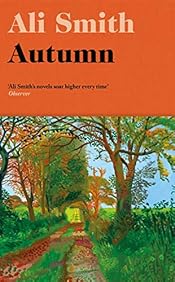
Autumn by Ali Smith

Hamish Hamilton, 2016, 270 p.

Autumn cover

This is a short novel, very short. Nevertheless it has no fewer than five epigrams. That it starts with the sentence, “It was the worst of times, it was the worst of times,” is perhaps a signifier that it aspires to literary memorability. It was written in the aftermath of the 2016 referendum on the EU and reflects (though only in asides) the divisions in the country which that revealed but addresses more fully the latent racism which it brought to the surface. The book has that unjustified right-hand margin that is a feature of Smith’s publications and like Andrew Greig’s When They Lay Bare, which I read immediately prior to this, does not use quotation marks for dialogue, which impairs comprehension not at all.

The narrative is mainly concerned with Elisabeth Demand who as a child formed a friendship with her much older next-door neighbour, Daniel Gluck, but also has an eye for the absurdities of everyday life. Along the way Elisabeth develops an interest in the female Pop Artist Pauline Boty who Elisabeth finds has been all but removed from the histories of British Pop Art because she was a woman.

The novel is good on Elisabeth’s problematic relationship with her mother but appears a little unfocused, indeed rambling at times. It’s all easily taken in and has some amusing moments but like most of Smith’s writing (with the possible exception of How to be Both) it’s all a little flat. I don’t feel the burn.

Pedant’s corner:- “it’s one of those coincidences ……but in real life mean nothing at all” (one of those coincidences … but in real life means nothing at all,) “to taxiderm real children” (is taxiderm a verb? I thought the verb was stuff,) dismissible (dismissable.)

Fortingall and the Fortingall Yew

This is a bridge on the road into Fortingall:-

Bridge at Fortingall

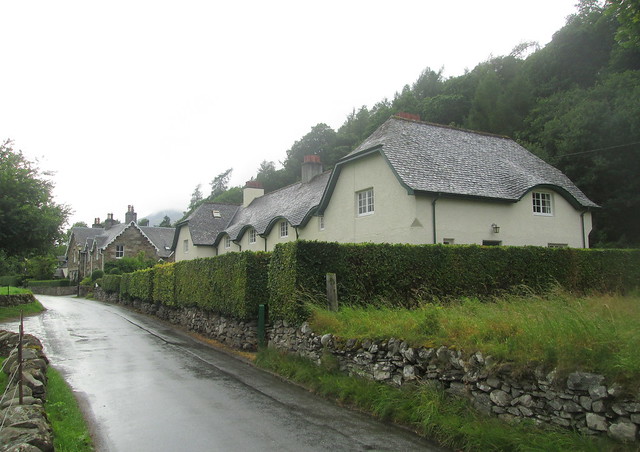
As well as some Arts and Crafts houses –

Fortingall Arts and Crafts

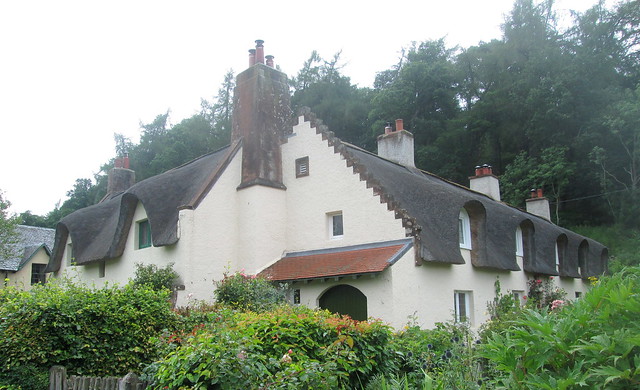
some with thatched roofs

Fortingall Arts and Crafts

– the village has this idiosyncratic building:-

A House in Fortingall

It also has a unique claim to fame. It is home to supposedly the oldest living thing in Europe, the Fortingall Yew, which can be seen to the left of the church in the link at the top of this post and here:-

The Fortingall Yew

The plaque informs us that The Tree Council designated this one of fifty Great British Trees, June 2002:-

Fortingall Yew and Plaque

St Mirren 5-0 Dumbarton

SPFL Tier 2, St Mirren Park*, 27/3/18.

Well. The inevitable happened here.

After Saturday’s exertions and disappointment it was always likely we would be flat for this game.

We could have done without losing five goals though and the result at Caledonian Stadium means we’re more than two wins adrift of eighth and only eight games left.

Wee’re not going to claw that back.

*aka Paisley 2021 Stadium.

Shocked! Shocked!

The Australian PM is reported to be shocked and disappointed about the recent ball tampering by his country’s cricketers.

Has this guy never heard of sledging? As far as I’m aware it’s an Australian invention – or at least its designation is. And it’s essentially a form of cheating.

I can’t help feeling he’s coming over a bit Claude Rains as Captain Louis Renault in Casablanca.

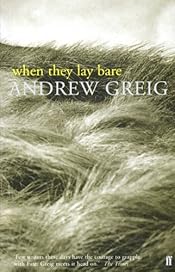
When They Lay Bare by Andrew Greig

faber and faber, 1999, 326 p.

When They Lay Bare cover

So much enduring literature is about love, sex and death. Greig is good on all three, especially love and its tragedies. In When They Lay Bare David Elliott comes to the family home to show off to his father, Simon, his intended. Meanwhile a strange woman has moved into a cottage on the estate. In David’s childhood Simon had had an affair with Jinny Lauder – for whose death he had been tried for murder, and found not proven. The shadow of those events lies over the book, as, since it is set in those same debatable lands Greig would return to in Fair Helen (but here we are in the twentieth century,) does the history of the borders. Border Ballads are frequently quoted and the book’s epigram is an extract from The Twa Corbies. Throughout Greig does not separate off direct speech by quotation marks but this is never a problem to decipher.

The novel has a central conceit wherein the story is foreshadowed by the descriptions of illustrations on a set of eight plates belonging to the woman in the cottage who at first gives her name as Mary Allan but then says she is Jinny’s daughter, Marnie. The eight sections into which the novel is divided are designated as Plate 1, Plate 2 etc – though 4 and 5 are titled Lover’s Plates (Rose and Red respectively.) These descriptions are rendered in italics. The rest of the narration is carried from the viewpoints of David, Marnie, Simon (from whom we learn the details of his doomed affair with Jinny, a grand passion indeed) and his factotum Tat, a voyeur in his youth whose evidence was crucial to the verdict and who leveraged his knowledge into gaining his position on the Elliott estate. Tat’s narration is littered with Scots words and phrases, as is Simon’s but to a much lesser extent.

Marnie is one of those women whom Greig draws so well. She often alludes to Spook, her word for manifestations of sixth sense, a phenomenon not at odds with Borders history (though in that regard the appearance of Jinny to Tat at the novel’s crux was perhaps a step too far.) Important, too, is a precarious bridge over the Liddie Burn, the scene of one of those Border tales from times past.

Marnie is the heart of the book, the driving force of its motor, the hinge around which the other characters revolve – though Jinny’s actions and her motivations for them are almost as influential – but the most Greigian of sentiments is voiced by David, “Sin and sex make us glow like coals in the dark. That’s why we do it. To burn.” One of the reasons we read novels is to experience that burn, if only at second hand.

Pedant’s corner:- Quite why the title is all in lower case on the cover is beyond me. It isn’t on the title page. Otherwise: “the prosecution were” (was,) “only a name and a brief tale remains” (remain; in an extract from a piece about border legends,) usually before a piece of dialogue or unspoken thought there is some sort of punctuation. In one instance it was missing, smoothes (smooths.) “That is the cause of the love he feel for his companions” (feels,) “‘he’d had to have grovelled’” (OK it was in dialogue but, “he’d have to have grovelled”,) imposter (impostor.)

free hit counter script