More from True to Life

At the True to Life, British Realist Painting in the 1920s and 1930s exhibition at Modern Two I noted down striking works by at least 25 artists.

These two paintings by Harold Williamson sum up the 1930s.

Spray:-

Spray by Harold Williamson

Picnic:-
Picnic by Harold Williamson

Other aspects of 1920s/30s life were also covered. This is a portrait of the jazz musician Tom Whiskey (M Julien Zaire) by Glyn Philpot:-

Tom Whiskey by Glyn W Philpot

There was too an example of that quintessential 1930s art form, the railway poster. Fortunino Matania’s “Blackpool”:-

Blackpool by Fortunino Matania

Lancelot Glasson’s The Young Rower 1932, caused raised eyebrows at the time it was first shown – perhaps because it showed a young woman apparently at ease with her body.

On the other hand the distinctly quease inducing (I felt uncomfortable being in the same room as it) Little Sister by Dod Procter seemingly excited very little adverse comment despite depicting a barely pubescent girl.

But how about this: William Oliphant Hutchison’s “Walter Rankin Local Defence Volunteer” which as I recall is permanently on display in room 5 at Modern Two (but don’t quote me on that. Whatever; it surely lies outside the exhibition’s time frame.)

Private Godfrey to a tee:-

Walter Rankin Local Defence Volunteer by William Oliphant Hutchison

True to Life Exhibition at Modern Two, Edinburgh

A couple of weeks age we revisited the True to Life Exhibition at Modern Two, (Scottish National Gallery Of Modern Art,) Edinburgh.

I’ve left this a bit late as the exhibition is only on for a few more days now. Its full title is True to Life, British Realist Painting in the 1920s and 1930s.

I found this to be much more enjoyable than the Beyond Caravaggio exhibition recently finished at the Scottish National Gallery (see also here.)

The first picture in True to Life, though, David Jagger’s “Conscientious Objector”, would not have looked out of place at that Beyond Caravaggio exhibition. It exploits light in much the same way as those did. This is apparently a self-portrait:-

Conscientious Objector by David Jagger

“By the Hills” by Gerald Leslie Brockhurst features on the True to Life Exhibition catalogue cover though for me it’s a bit too sharply delineated. The artist was said to have used lipstick to paint the lips here:-

By the Hills by Gerald Leslie Brockhurst

Another such too sharp picture was Meredith Frampton’s “A Game of Patience”:-

A Game of Patience by Meredith Frampton

As with the David Jagger painting above Edward Baird’s “Dan Cross” also looks as if it could leap off the canvas. I feel as if I know this person:-

Dan Cross by Edward Baird

Keith Henderson’s The Harbour Crowd is another fine example of the capture of light. As I recall this painting was one of the exhibits in the Palace of Arts at the Empire Exhibition, Scotland, 1938. There was a black and white reproduction in the relevant souvenir booklet.

The Harbour Crowd by Keith Henderson

Some of the paintings in “True to Life” stretched the definition of realist somewhat.

Though it does contain figures (including the artist) “The Deluge” by Winifred Knights seemed to me to be at least influenced by Vorticism:-

The Deluge by Winifred Knights

Nora Russell by John Downton captures the impatient aspect of the early adolescent schoolgirl very well. I get the impression she didn’t really want to be painted:-

Nora Russell by John Downton

One Day in the Life of Ivan Denisovich by Alexander Solzhenitsyn 

Gollancz, 1963, 190 p. Translated from the Russian, Один день Ивана Денисовича, (Novy Mir, Moscow, Nov 1962), by Ralph Parker.

I bought this many (many) moons ago but had resisted reading it so far it as I thought the subject matter may have been too depressing. Reading about life in a labour camp is not overly appealing after all. It was still familiar, though. There are many similarities here to Primo Levi’s account, If This Is a Man, of being in Auschwitz.

Despite those reservations I found One Day (as the book’s spine has it) remarkably readable – a testament to the original writing and to the translation. This is also true of Levi’s books.

Ivan Denisovich Shukhov has been imprisoned for ten years in effect for being captured by the Germans. The main aim is to get through each day with as little friction or attention as possible. This particular day starts with Shukhov feeling unwell and thinking of reporting to the sick-bay but the day’s quota of the ill has been filled and he has to return to work.

He is in the 104th squad and, despite the novel being relatively short, the relationships between its members are carefully illustrated. Even (especially?) given his circumstances he still takes pride in doing a job well (today’s is brick laying which can be tricky as the mortar is liable to freeze) – though it helps that if seen to do so they may get extra food – Shukhov is careful to savour, or husband and hide for later, each item of food.

There are petty indignities such as the incessant counting at roll-calls to be endured, the fact that even thoughts aren’t free as they always cycle back to the same things. Each small achievement, that extra item of food, the finding of a piece of metal which might be fashioned into a knife, is a victory, but you must never set your sights beyond what is in front of you.


Pedant’s corner:- “sleepy heads propped again their rifles” (against, surely?) “fivefifty grams” (fifty five? [And grammes if we’re British],) “tommy-funs at the ready” (tommy-guns,) [this next was in a footnote] “a percentage of the plan t amounts to” (of the plan it amounts to,) a missing end quotation mark at the finish of a piece of dialogue.

Local Wildlife

Son of the Rock Acres overlooks what remains of the grounds of the former Balbirnie Estate, indeed it is built on part of it, though half the original estate is now a golf course.

A group of deer lives on and around the estate. Sometimes they even run across the access road.

A deer in a copse nearby. You can just spot its rump if you look carefully:-

A Deer

I managed to get a bit closer. The deer are not easily startled unless someone comes along with a dog:-

Deer's Rump

Deer in Trees

Trees and Deer

Occasionally the modern world intrudes. There is main road to or so hundred yards away but the noise is muted by intervening houses. Not so the helicopters which have been known to land at the hotel to which the big house (Balbirnie) has been converted. Nor the odd gyrocopter/microlight:-

A Gyrocopter/microlight

The True Price of Coal

For some reason we stopped in Loanhead, Midlothian, on our way back from Crichton Castle and Crichton Collegiate Kirk (see earlier posts.)

There we found this memorial “To the memory of those men who died in accidents at Bilston Glen Colliery during its working life and to all others who lost their lives in mining accidents in the community of Loanhead.”

The True Price of Coal

It’s Life, Jim: More Or Less As We Know It

As an SF reader and writer I was of course intrigued by the recent report in Science that a bacterium has been found that uses arsenic instead of phosphorus in its cell mechanisms. As a chemist, though, I was reasonably underwhelmed. While it is true that carbon, hydrogen, nitrogen, oxygen, sulphur and phosphorus are the six elements whose atoms are needed by most living things on Earth – trace quantities of other elements’ atoms are of course necessary for the full range of operation, iron in the haemoglobin of red blood cells for example – it wasn’t beyond the bounds of possibility that a particular organism would be able to substitute atoms of a similar element for one or other of these for certain purposes; especially if that organism lived in an extreme environment. Arsenic for phosphorus is not such a big jump. They are both in the same group of the Periodic Table, one directly above the other, and while arsenic is usually poisonous, cells working in an arsenic rich environment might be thought to be able to develop tolerance. It’s only a step from that to actually utilising the stuff. The reseachers seem to have given the organism concerned little choice in the matter, as the BBC report makes clear.

In all other respects it seems the biology of the bacterium is entirely on a par with the rest of life on Earth, some of which can live in all sorts of weird places.

So not alien, then, despite some of the hype. See Wired.

What would be really interesting would be if someone found a non-carbon based organism.

Don’t hold your breath.

Apart from anything else I don’t know if anyone’s looking – or what to look for if they did.

The Gourlay Girls by Margaret Thomson Davis

B&W, 2000, 237 p.

This is a sequel to Davis’s novel The Clydesiders, though it might as well not have been. The actual plot here does not require it. It could as easily have been anybody’s daughter who fled the house after her grandfather died in front of her when she had frozen at his fit and not fetched his medicine. As it is, Davis more or less uses it as a thread to tie this one to the first book in her trilogy.

Wincey (Winsome) is that much-loved daughter of Virginia and Richard Cartwright, whom everyone sees as close to her grandfather. Wincey knows his darker side though. When he takes that fatal fit she watches immobile as he dies, before fleeing off and taking the first tram she sees. She ends up crying on a street in Springburn where Florence Gourlay befriends her and takes her home – as an orphan otherwise destined for the workhouse. In a sense Wincey strikes lucky. The Gourlays – father Erchie, mother Teresa, eldest sister Charlotte, twins Euphemia and Bridget and Granny, Erchie’s mother, who gets all the best lines – are a friendly loving family and treat Wincey as one of their own.

It is the thirties though, and times are hard with Erchie unemployed. Salvation comes with the family’s sewing activities spearheaded by Charlotte but which, with Wincey’s help and Erchie’s knack for mending machines, is built up over the years into a successful business. Flies in the ointment are employee Malcy making up to Charlotte with an eye to the main chance and Wincey’s total aversion to men. She is cold even to Erchie, who has given her no reason to be. Very occasional chapters deal with the loss Virginia and Richard feel at Wincey’s disappearance, the strains it places on their marriage and their ongoing friendship with Virginia’s first husband James Mathieson, bound as they are by their socialist principles.

All this takes place in the shadow of the 1930s, the growth of Nazism in Germany and the shadow of forthcoming war. One bright spark is the Empire Exhibition of 1938 held in Glasgow’s Bellahouston Park, the mention of which in the book’s blurb enticed me to buy it in the first place. Literally bright; the night time illuminations were famously spectacular. Though Davis has clearly researched it (she may even have attended the event,) the scenes at the Exhibition itself are a little cursory. Then again a lot of the book is. Relationships are sketched out, developments telescoped, the treatment rushed, the information dumping and drawing of background somewhat crude. Sometimes conversations are too obviously designed to provide the reader with explanations. Though probably true to life as it was then the female characters seem much too eager for Wincey to be married off given she’s still in her mid-to-late teens.

Davis has been described as Glasgow’s Catherine Cookson. I’ve not read any Cookson. And I won’t in the future.

Pedant’s corner:- Davis uses the term ‘abusing’ of Wincey’s grandfather’s treatment of her. That’s an anachronistic word for what was more likely known in the 1930s as molesting or interfering with.
Otherwise; “of the abdication King Edward VIII” (abdication of King Edward,) “‘Any digestives,’ Granny asked” (a question mark, not a comma, after ‘digestives’,) “hokey kokey” (hokey cokey,) an end quotation mark in the middle of a piece of direct speech. “‘For years they’ve been these camps’” (there’ve been,) a missing comma before a piece of direct speech. “‘Did she do along with this story’” (go along.) “‘Hiding’ yer heid in the sand’” (Hiding, [or, Hidin’] yer heid.) “‘An aw wis right’” (An ah wis right,) “‘When’s she ever been a blether,” Granny wanted to know’” (a question mark, not a comma, after blether) “along side” (alongside,) “the Atlantic restaurant” (it’s a proper noun, so Atlantic Restaurant,) “‘You really do believe there’s going to a war, then’” (going to be a war.)

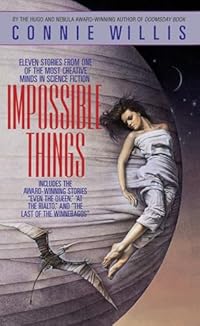
Impossible Things by Connie Willis

This is a book of short stories by the person who has won more Nebula and Hugo Awards than any other writer.

Bantam, 1994, 471 p, plus vi p Introduction by Gardner Dozois Plus vi p of Acknowledgements and lists of contents and illustrations.

The Last of the Winnebagos sees a near future where a mutated parvovirus has killed off all species of dog. Only jackals are left and even those are vanishingly rare. The Humane Society monitors and polices any animal deaths. The roads are dominated by water tankers servicing the city of Phoenix and the like and travelling very fast to blur the speed cameras. Our narrator is a photojournalist who sees a dead jackal on the road while on his way to photograph the last Winnebago, and is drawn into a web of suspicion.

Even the Queen was apparently written in response to complaints that Willis never wrote about women’s issues. (Her view is of course that there ought to be no restrictions on what a writer writes about.) In the story a device called a shunt disseminates a drug called ammenerol which prevents periods. The narrator’s daughter causes a stushie in the family when she announces she wishes to join a group called the Cyclists, who see shunts and ammenerol as instruments of the male patriarchy seeking to deprive women of their natural functions. Nevertheless, the story is played for laughs.

Schwarzschild Radius combines the theory of a star’s gravitational collapse into a black hole with the memories of a Dr Rottschieben who apparently served with Schwarzschild in the Great War. It’s beautifully written and its embedded metaphor ingenious but doesn’t really hold up under retrospective scrutiny.

Ado imagines a future (very litigious, very USian) in which everybody complains about everything and so teaching is made almost impossible. Hamlet consists of only two lines.

Spice Pogrom is Willis’s tribute to Hollywood screwball comedies but also reminded me of one of James White’s Sector General stories. Aliens called Eahrohhs have come to Earth, or, rather, to a space station called Sony which has an idiosyncratic housing policy. One of them, Mr Ohghhifoehnnahigrheeh, has promised to deliver NASA a space program (sic) and narrator Chris’s Nasa employed fiancé has billeted him/it on her and told her to allow it/him whatever it wants. There is plenty of the incidental happenings the screwball comedy enshrines to complicate the story-line. This one turns on whether Mr Ohghhifoehnnahigrheeh actually understands the English words they are all using but the story’s pay-off doesn’t really reward the time investment required by the reader.

Winter’s Tale riffs on the theory that since Shakespeare was low-born he could not have written all those magnificent plays and poems. Told as by Anne Hathaway it plays with that notion (which Willis’s foreword insists is surely incorrect,) and with the possibility that Christopher Marlowe’s murder in a Deptford Inn was faked while also providing a reason for Shakespeare’s famous bequest to Anne.

In Chance a woman has moved back to the town where she attended college (where everything is the same but everything is different) because her husband, who is interested only in career advancement, has a new job there. She starts to see the students as people she knew back in her youth and wonders on the chance happenings that change lives for the better – or worse.

In the Late Cretaceous is a satire on neologisms and academia, with the institution where it’s set also riddled with an over-officious set of traffic wardens, ticketing anything that doesn’t move. The professor of palæontology is a metaphorical dinosaur, still using chalk on blackboard. Willis’s preface to this laments what she calls political correctness, as being inimical, or at least antithetic, to comedy and moans about “every anti- (Choose one: smoking, animal research, logging, abortion, Columbus.)” Well she did include anti-abortionists, so she’s not a complete lost cause.

Time Out centres round a project to produce a “temporal oscillator” with which to manipulate “hodiechrons” (quantum units of time which Willis has presumably named from the Latin for today and the Greek for time.) An anatomy of both the quotidian routines of marriage and parenthood – the domestic detail is thoroughly true to life – the vicissitudes of not well resourced research and nostalgia for youth it suggests a mechanism for the origins of déjà vu. The whole is intricately plotted but leans a bit too heavily on light-heartedness.

Jack returns to the subject of the London Blitz which Willis explored in her short story Fire Watch and novels To Say Nothing of the Dog, Blackout and All Clear. As in those (and The Doomsday Book) it is marred for a British reader by a failure to get details of life and usages in the UK correct. The story concerns a new member of an ARP unit who shows an uncanny knack for detecting bodies buried by rubble. He also disappears sharply to his day job. The narrator develops suspicions.

At the Rialto’s title has a different meaning to Sons of the Rock of my generation compared to those who hail from elsewhere. It was the name of the local cinema. The Rialto here is a hotel in Hollywood hosting (or not) a meeting of quantum physicists. The plot revolves around a series of uncertainties.

Pedant’s corner:- flack (x3, flak,) “the Queen of England” (was of course not crowned as such but as Queen of Great Britain and Northern Ireland – and is of course Queen of many other places besides,) gladiolas (gladioli,) Russian Front (in the Great War it was called the Eastern Front,) LaGrangian points” (Lagrange points,) a missing comma before a piece of direct speech. “‘The seasons’ just started’” (season’s.) “‘Five years and no sex have made desperate’” (have made me desperate’,) “I don’t’” (I don’t,) a missing full stop, “setting her cap for you” (setting her cap at you,) liquor (the British usage is booze, or drink,) a character is said by another to be from Yorkshire but himself says he’s from Newcastle (all British people know Newcastle [either of them] isn’t in Yorkshire,) ME 109s (it’s Me 109s – and the text implies that type of plane was a bomber. It was a fighter,) bannister (banister,) oleo (the word used in the UK for this type of spreadable butter substitute is margarine,) a missing comma before a piece of direct speech, automobile jack (‘car jack’, or just ‘jack’,) row houses (terraced houses,) the Duchess of York (by this time [1941] the said woman was the Queen and was only ever referred to as ‘the Queen’,) a medal is said to have been awarded at a military HQ (investitures are [and were even during the war] held at Royal Palaces,) a recipient’s father is said to have pinned the medal on his son himself (medals are conferred by a member of the Royal family or perhaps, in extreme cases, by a representative such as a Lord Lieutenant,) the Duchess of York kissed the award recipient on both cheeks (absolutely not,) “and said he was the pride of England” (the ‘pride of Britain’ possibly, ‘England’ I very much doubt. The Queen [formerly Duchess of York] was Scottish,) an inland revenue collector (a taxman,) “had gotten married” (had got married,) the award recipient had shot down fifteen German planes so must have been in Fighter Command but is later said to be flying nightly bombing missions over Germany – a Bomber Command task.) “‘meaning’ or possible ‘information’” (or possibly.)

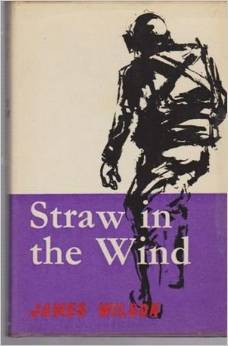
Straw in the Wind by James Wilson

Hutchinson, 1960, 205 p

  Straw in the Wind cover

John Gavin was just too late to be involved in the Great War. He has nevertheless managed to learn to fly and after a period barnstorming in the US takes up a post in South America in a nascent air postal service. This book is very good indeed on the practicalities of early aviation, but especially its drawbacks. The rigours and contingencies of operating such a service in a potentially unstable country are also a major consideration. It is James’s relationships with his employer, the locals, his fellow pilots and their wives, which provide much of the substance here though. The characters, even those met briefly, ring true to life.

There are said to be only seven plots in literature. It would not be too much of a spoiler to say that the one deployed here is, “the getting of wisdom.” There is an element too of the Scottish novel’s penchant to lament time past, the something lost, as Gavin realises that the (not quite) carefree ‘knights of the air’ era is coming to an end. “For me, the biplane was part of the dream. It belonged with the free-roaming life of the barnstormer, and, when it went, that free, vagabond life went with it,” and later, “I had taken part in the end of an era, and in that I felt privileged as a man would feel privileged to have sailed in the last of the windjammers. But there was no going back. The freebooting days were gone for ever.”

There is too a recognition, in the form of a missionary storekeeper named Meikle, that the indigenous peoples will not be well-served by civilisation being brought to them.

Wilson could certainly write. I reviewed his Interrupted Journey here. It is a pity that he only ever published two novels. I would like to have read more.

Pedant’s corner:- Guinivere (Guinevere,) a missing quotation mark at the end of a piece of direct speech (x 2.)

The Siege of Trencher’s Farm by Gordon Williams

Published as Straw Dogs by Bloomsbury Film Classics, 2003, 157 p. One of the 100 best Scottish Books.

I have not seen the film into which this was made and which provides the title for this reprint of the original text of Williams’s novel. The subject matter did not attract me. It still doesn’t. I only read this for completeness, because it’s on that 100 best list.

 Straw Dogs cover

In the run-up to Christmas a snow storm cuts off the village of Dando Manchorum in the English West Country. At a do in the village a young girl, Janice Hedden, goes missing. Search parties are organised. George Magruder, a US citizen, decides to take his English wife Louise and daughter Karen back home to Trencher’s Farm for safety before returning to the search. In the meantime Henry Niles, convicted child molester and murderer, has been thrown out of the van in which he was being transported from a hospital procedure back to the local prison for the criminally disturbed and is wandering the roads. Magruder’s car hits him and the family takes him back to the farmhouse till a doctor can come out to see him. When George finds out who Niles actually is he phones the police but due to the snow drifts they won’t be able to get there for hours.

Several of the locals, especially Tom Hedden, the missing girl’s father, convinced Niles must have abducted her, hear the news Niles is at the farm and they decide to take justice into their own hands. The siege of the title is their attempts to get in and those of George and, less so, Louise, to resist them. The beseigers are partly inspired by the tale of Soldier’s Field when some of their ancestors collectively killed the rapist and murderer of a young local girl but as none would talk weren’t subsequently prosecuted.

Niles himself, portrayed here as a bewildered, inadequate soul and of course totally innocent of abducting or killing Janice Hedden (though not the crimes for which he was incarcerated,) plays an off-stage part for most of the novel, locked in the Magruder’s bathroom before being stuffed into the loft.

The relationship between George and Louise is gone into in some detail but in the end reduces to the kind of sexual politics reflective of the decade in which The Siege of Trencher’s Farm was written (the 1960s.)

There isn’t really much insight into the human condition in these pages. The locals are depicted as very insular (which may be true to life) but the besiegers are more or less unthinking yokels – or else disturbed. I wouldn’t recommend the book to anyone unless they like descriptions of violence. It’s yet another crime book on that 100 best list. Presumably it’s only on there due to its – or the film’s – notoriety. It certainly hasn’t much by way of literary merit.

Pedant’s corner:- “worked as a mechanic as the Compton Wakley garage” (mechanic at the Compton Wakley garage,) hung (several instances; hanged,) Niles’ (Niles’s,) “‘he won’t say nothin’. all right.’ “ (comma after ‘nothin’’ rather than a full stop.)

free hit counter script