Archives » BSFA Awards

BSFA Awards

This year’s BSFA Awards (for works published in 2025) have been announced.

Best novel:- When There Are Wolves Again by E J Swift.

Best shorter fiction (novellas, novelettes):- The Apologists by Tade Thompson.

Best short fiction:- Godzilla as a Young Man Named Mike by E M Faulds.

Best translated fiction:- Liecraft by Anita Moskat, translated by Austin Wagner.

I’d like to add special congratulations to my friend Neil Williamson who, as editor, won in the Best Collection category for Blood in the Bricks.

BSFA Award Nominees 2026

Again I’m late to this.

The BSFA Award winners will be announced at Eastercon on Sunday.

The nominees are:-

Best novel-

The Salt Oracle by Lorraine Wilson

Edge of Oblivion by Kirk Weddell

When There Are Wolves Again by E J Swift

Project Hanuman by Stewart Hotston

A Granite Silence by Nina Allan

Of these I’ve read only Project Hanuman since I reviewed it for ParSec.

There are now two awards for short fiction: best short fiction (short stories) and best shorter fiction (novellas, novelettes etc not novel length) too many nominees to list here, plus best translated short fiction and best fiction for younger readers. There is also a category for best collection.

I have received a link to the BSFA Awards Booklet but haven’t yet got round to looking at it.


BSFA Award

This year’s winners were indeed announced at Eastercon and the full list can be found here.

As far as the adult fiction categories go we have –

Short fiction:

Why Don’t We Just Kill the Kid in the Omelas Hole by Isabelle Kim

Shorter fiction – which somewhat confusingly is for longer fiction than the short fiction category; ie novella and novelette (whatever a novelette is):-

Saturation Point by Adrian Tchaikovsky

Novel:

Three Eight One by Aliya Whiteley

I note there was an award for best translated short work:

Bone by Bone by Mónika Rusvai, translated from Hungarian by Vivien Urban.

I haven’t read any of them.

(I have read the novel withdrawn from consideration, Alien Clay by Adrian Tchaikovsky. My review appeared in ParSec 13 and will do so here in due course.)

BSFA Award Shorlist

I’m late to this this year.

The awards will have been made at Eastercon on Sunday but I haven’t been paying attention.  I also didn’t receive the usual BSFA produced booklet but I think it’s now gone over to electronic only.

The main fiction categories’ nominees were:-

Best Novel

Calypso, Oliver K. Langmead (Titan)

Rabbit in the Moon, Fiona Moore (Epic)

Alien Clay, Adrian Tchaikovsky (Orbit) Removed from the ballot at the request of the author

Three Eight One, Aliya Whiteley (Solaris)

The only one of these I have read is Alien Clay and that has been withdrawn from consideration.

Best Shorter Fiction (for novelettes and novellas)

Navigational Entanglements, Aliette de Bodard (Tordotcom)

What Happened at the Pony Club, Fiona Moore (Fusion Fragment 8/24)

Saturation Point, Adrian Tchaikovsky (Solaris)

Charlie Says, Neil Williamson (Black Shuck)

Best Short Fiction

Why Don’t We Just Kill the Kid in the Omelas Hole, Isabel J. Kim (Clarkesworld 2/24)

The Portmeirion Road, Fiona Moore (Clarkesworld 5/24)

Unquiet on the Eastern Front, Wole Talabi (Subterranean 10/24)

Intrinsic – Extrinsic – Terrific, Aliya Whiteley (The Utopia of Us)

The full list of nominees is here.

BSFA Awards 2024

This Year’s BSFA Awards (for works published in 2023) were announced at this year’s Eastercon in Telford, Levitation 2024.

The usual BSFA booklet containing the nominated works – or extracts from them – wasn’t posted out this year. Instead it was supplied by email as a PDF. I don’t like reading fiction from a screen so I’m afraid I didn’t get round to reading it all.

The fiction winners were:-

Best Novel: The Green Man’s Quarry, Juliet E. McKenna (Wizard Tower)

Best Shorter Fiction (for novelettes and novellas): And Put Away Childish Things, Adrian Tchaikovsky (Rebellion)

Best Short Fiction: How to Raise a Kraken in Your Bathtub, P. Djèlí Clark (Uncanny 1-2/23)

Best Collection (for collections and anthologies): The Best of British Science Fiction 2022, Donna Scott, ed. (Newcon press)

Best Fiction for Young Readers: The Library of Broken Worlds, Alaya Dawn Johnson (Harpercollins)

Congratulations to them.

BSFA Awards Shortlist

The BSFA has published its shortlist for this year’s awards, for work published in 2023.

I see that the number of award categories has increased and there is now a best translated short fiction category.


BSFA Awards Booklet 2022

British Science Fiction Association, 2023, 64 p.

BSFA Awards Booklet 2022

This is the usual annual BSFA booklet containing the nominated art works and the nominated works of short fiction – including those in the younger readers category.

All of the adult fiction nominees’ stories must have been too long to reproduce fully here as we are given only extracts – as was also true for the younger readers category.

Of Charms, Ghosts and Grievances by Aliette de Bodard is a fantasy featuring a dragon kingdom and ghosts. The extract is well written byt such stuff doesn’t really grab me.

Sellers’ Remorse by Rick Danforth is narrated by Sheytl, a door-to-door salesman – for a god.

Luc by Or Luca has a content warning at the beginning. The extract contains Chapter 5 and a part of Chapter 6. Our female protagonist feels that she is surrounded by water – complete with parrotfish. Her psychoanalyst even tells her, “It seems like you’re drowning.” The extract is too short to allow judgement on whether this is an actual physical phenomenon (thus making the story a fantasy) or she is suffering from delusions/hallucinations.

Ogres by Adrian Tchaikovsky seems to be set in a fantasy Dark Ages except the feudal overseers are ogres. What we read here is the story’s set up.

The extract from A Moment of Zugzwang by Neil Williamson is the beginning of a detective tale where protagonist Stina investigating what she thinks is a suspicious death confronts her suspect, Dimitra Klimala, a woman with no publicly available information about her, over a game of chess.

The non-fiction nominees were:-

“Too Dystopian for Whom? A Continental Nigeria Writer’s Perspective” by Oghenechovwe Donald Ekpeki which criticises the Western slant on dystopias, partly by arguing that dystopia is always somewhere in the world; circumscribed lives are common in non-Western societies. (I would add that that is also true of most of them as well.)

“The Critic and the Clue: Tracking Alan Garner’s Treacle Walker by Maureen Kincaid Speller takes issue with early reviews of the book concerned since it requires a deeper analysis.

“Management Lessons from Game of Thrones: Organisation Theory and Strategy in Westeros” by Fiona Moore appears to be an attempt to explain management theory and its applications in the real world by reference to Game of Thrones (seemingly via the TV version rather than George R R Martin’s “Song of Ice and Fire” books.) As such its actual connection to SF and fantasy looks to be peripheral (except in so far as fiction reflects the times in which it is written.)

“Preliminary Observations from an Incomplete History of African SFF” by Wole Talabi and the ASFS does what it says on the tin – complete with graphs.

“Terry Pratchett: A Life with Footnotes” by Rob Wilkins is the author’s account of his time as Terry Pratchett’s PA.

Pedant’s corner:- “‘when she were angry’” (when she was angry,) “to not” (x 3, not to,) “off of” (just ‘off’; no ‘of’,) “look like a twats” (either ‘twats’ or ‘a twat’,) “bowed his hand in respect” (it’s usually heads which people bow in respect.) She lays in her toxic fumes” (She lies in her toxic fumes.) “There’s also the nightmares” (nightmares requires a plural verb form; ‘There are also’.) “She walks over to her bike, still in their usual place” (its usual place, surely?) “Luca’s eyes are stapled to her thighs” (that must be extremely painful,) “outside of” (x 2, just ‘outside’; no ‘of’,) a paragraph break in the middle of a sentence (x 2.) “Luca Looks over” (Luca looks over.) “Let’s say this time is was the apples you couldn’t resist” (it was the apples,) “to go eat apples” (to go to eat,) (to go apologise” (to go to apologise,) “til spring” (till spring,) “so that he an take” (he can take,) Robe’s (Roben’s,) “he’s tried to impose upon you the serious burden of the work” (to impress upon you would be more usual,) “the cavalcade and retinue arrive” (arrives,) another “outside of,” “by similar practices … that has” (practices …. that have,) “too cliché” (too clichéd,) “incred ibility” (incredibility,) “and unpublished typescript” (an unpublished,) epicentre (it wasn’t an earthquake so ‘centre’, or, if you feel the need to emphasise its centrality, hypocentre would be more appropriate.)

BSFA Awards for 2022

The BSFA Awards for 2022 were announced on Saturday at this year’s Eastercon (Conversation) held in Birmingham.

The winners were

Novel:- City of Last Chances by Adrian Tchaikovsky

Short Fiction:- Of Charms, Ghosts and Grievances by Aliette de Bodard

Best Book for Younger Readers:- Unraveller by Frances Hardinge

Non-Fiction:- Terry Pratchett: A Life with Footnotes by Rob Wilkins

I’ll be posting my thoughts on this year’s BSFA AWards Booklet tonight.

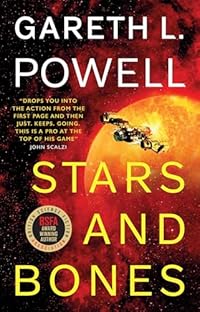
Stars and Bones by Gareth L Powell

Titan Books, 2022, 349 p.

This was one of the nominees for The BSFA Award for Best Novel of 2022. I have not been much enthused by previous works by Powell, so only read this since it was available from my local library. My initial misgivings were reinforced by the first few chapters which were full of information dumping and journalese. However, once the story settled down and stopped jumping between time scales it did get better. A bit.

Many years in the past humanity was on the point of destruction. The nuclear missiles were on their way. Fortuitously at exactly the same time Frank Tucker commenced his experiment and penetrated the substrate surrounding space and time thus allowing wormhole travel. This caused a ripple in the substrate and, Raijin, an angel of the Benevolence, roused itself from its resting place in Jupiter’s atmosphere to save this now clearly worthy species and dispatched the weapons elsewhere. Now humanity inhabits a fleet of arks created by the Benevolence and travels the space ways as the Continuance but is forever forbidden to inhabit a planet again lest it destroy its environment as it had Earth’s. This is of course a deus ex machina, though unusually occurring at the beginning of the tale rather than its end. Life on the arks is what might be called easy. All necessities are provided, flick terminals provide almost instantaneous travel within and between ships via wormholes. There are still some arks which take delight in restrictions on behaviour though. The story is not about everyday existence in the Continuance, however.

Main viewpoint character, Eryn, is part of the Continuance’s Vanguard which scouts the space ahead of the main fleet for “potential threats or opportunities.” (What opportunities? Humans are forbidden from inhabiting a planet.) She pilots a scoutship by interacting with the substrate something not many humans are able to do. She is sent by the Vanguard as part of an expedition to look into what happened to a previous Vanguard sortie to a planet known as Candidate-623 where the crew including Eryn’s sister, Shay, has been lost. The details of what occurred are horrific and Candidate-623 contains a menace not only to Shay’s scoutship but the whole Continuance.

What follows is pretty standard space operatic fare in which the menace – misunderstood but also itself misunderstanding – is confronted, a process which requires the intervention of Raijin. The relationships between humans which Powell shows us are somewhat rudimentary and the feelings he tries to convey are at times described unconvincingly. His interest clearly lies in the pyrotechnics of his story, (close encounters with black holes, the nastiness of the way the menace operates etc.) I can see why at the level of incident people thought this worthy of nomination. Not for me though.

Pedant’s corner:- CO2 (CO2,) Torres’ (several times, Torres’s,) asshole (arsehole, please,) “as their metal structures rusted” (only iron rusts. All metals corrode,) “temperatures far in advance of” (far in excess of,) “the very fabric of space and time were being warped” (the … fabric … was being warped,) liquify (liquefy,) “the prurient activities of the other guests,” (activities can’t be prurient, interest in them can be,) “magnified a fifteen million times” (no need for that ‘a’,) a missing comma before a piece of direct speech, “a studier combat-rated replacement” (a sturdier,) “and roll if between his palms” (and roll it,) volcanism (vulcanism,) “wracking sobs” (racking,) “reached its crescendo” (sigh; reached its climax,) “to fall in love with a someone” (no need for the ‘a’,) dove (dived.)

Recent Arrivals

The Annual BSFA Awards booklet came yesterday.

A couple of days before that The Chinese Time Machine, a collection of short fiction by Ian Watson, had come through the letter box. This is for review in ParSec.

Lots of reading to do then.

free hit counter script