Sterne und Autobahnen
Posted in Writers' Bloc events at 16:48 on 14 August 2013
I’m off to the Writers’ Bloc gig tonight.
Sterne und Autobahnen is at the Spiegeltent, Charlotte Square Edinburgh, starting 9 pm.
Posted in Writers' Bloc events at 16:48 on 14 August 2013
I’m off to the Writers’ Bloc gig tonight.
Sterne und Autobahnen is at the Spiegeltent, Charlotte Square Edinburgh, starting 9 pm.
Posted in Architecture, Art Deco, Empire Exhibition, Scotland, 1938, Glasgow at 12:00 on 13 August 2013
Another black and white postcard of the Empire Exhibition, Scotland, 1938, held in Bellahouston Park, Glasgow. This time, the entrance to the UK Pavilion.
Lovely Deco features; rounded columns with banding at the flagpole supports, vertical dividers, sculptured figures – which, like the lions flanking the steps, were gold painted.

Posted in Eric Brown, War Memorials at 12:00 on 12 August 2013
On Friday we took a trip over to see SF writer Eric Brown and his family in East Lothian.
On the way back we meandered along the coast a bit. I came across a War Memorial on the way into Cockenzie. (I didn’t bother photographing Cockenzie’s most prominent feature, its now disused coal-fired Power Station, whose twin chimneys can easily be seen from across the Forth.)
Cockenzie War Memorial is an elegant simple cross.

It has beautiful surroundings of a large lawn-filled space with flower beds around the memorial itself.

Edited to add: the Scottish War Memorials website gives this as Cockenzie and Port Seton War Memorial.
Posted in Writers' Bloc events at 12:00 on 11 August 2013
Writers’ Bloc’s latest gig is .. a gig! Complete with music.
Unlike most word and music collaborations though, this time the words were written to complement the music rather than the more usual configuration familiar from film and television.
The musicians are John Lemke and Poppy Ackroyd and the event is titled Sterne und Autobahnen.
It takes place on Wednesday (14th Aug) at the Spiegeltent, Charlotte Square, Edinburgh, starting at 9 pm.
Entry is free!
Posted in Irène Némirovsky, Other fiction, Reading Reviewed at 12:00 on 10 August 2013
Translated from the French, Le Vin de Solitude, by Sandra Smith.
Chatto and Windus, 2011, 248 p. First published by Éditions Albin Michel, 1935.
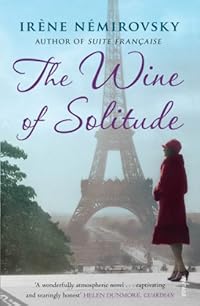
Hélène Karol is the only child of Bella and Boris Karol. Bella feels she has been forced, for financial security, to marry beneath her – she is self-centred and has expensive tastes. Boris is forced to leave his job as he would be tempted to steal to keep her in style. He leaves for, and makes his fortune in, Siberia. While he is there Bella takes a lover, Max Safronov, who considers the child Hélène a nuisance. Boris refuses openly to acknowledge his wife’s infidelities. Némirovsky notes that “a man needs a certain amount of breathable air, a small dose of oxygen and illusion in order to live.”
The novel traces Hélène’s life from early childhood in Kiev, to St Petersburg, then after the Russian Revolution to Finland and finally France. Hélène loves her father but the only person who has any time for her is her governess Madamoiselle Rose, with whose services Bella eventually dispenses, claiming she has set Hélène against her.
The book’s focus is firmly on Hélène and the effects on her of Bella’s indifference. While still a child she reads a book displaying a happy family she thinks is a fantasy and writes in it, “In every family there is nothing but greed, lies and misunderstanding.” The upheavals of the outside world, the Great War, the Revolution, are mostly off-stage – though one of the scenes in Finland has the White Army gradually nearing the village where the Karols are staying. Even when living through interesting times people still have personal concerns. Wars and revolutions are only the backdrop against which their lives are experienced.
Hélène’s hatred of her mother is such that when she grows up and realises a young woman’s attractiveness to men she determines to win Max’s affections to gain a measure of revenge. More subtly Némirovsky has Max’s mother say to him, in respect of Bella, “Women don’t love a man for himself but as a weapon against another woman,” and doesn’t make those Hélène’s words.
Since Némirovsky was herself Ukrainian and emigrated to France it would be too easy to attribute this novel to autobiography. To do so would be to deny the novelist’s art. As a depiction of an emotionally deprived childhood, and its effects, The Wine of Solitude is exemplary. It also stands as a reminder that those effects need not be determinative. We can choose how to behave.
The translation renders the area of Hélène’s childhood as “the” Ukraine. While this was the Soviet designation and may have been the one in use when the book was written in the 1930s I believe the inhabitants of that country prefer just Ukraine. A pedant’s heart will be gladdened by the fact that in the Finnish scenes Smith rendered a question grammatically correctly as, “Whom were they firing at?” though it does appear fussy to modern eyes.
Posted in 1960s, Lyrics, Music, Trips at 12:00 on 9 August 2013
When we were in Cockermouth earlier this year we were in an antique/junk shop where a radio was playing.
I was wandering round looking at items for sale vaguely listening, though the sound was quite muffled. On came the song below. I knew the correct words but for some reason when it came to the, “I’ll be home,” line I heard the next one as, “I’ll be your xylophone, waiting for you.”
It does make a weird kind of sense, though; as most misheard lyrics do.
The Foundations: Build Me Up Buttercup
This is a not very good visual quality live version:-
Posted in Dumbarton FC, Wild Life at 12:00 on 8 August 2013
This spectator on Saturday didn’t think much of the game.
Totally ignoring the play.

PS. I thought you weren’t allowed to invade the pitch….
Posted in Dumbarton FC at 22:33 on 7 August 2013
Before Saturday’s game against Albion Rovers there was a minute’s applause in memory of Hughie Gallacher, Sons legend and our highest ever scorer.


Posted in Reading Reviewed, Science Fiction at 12:00 on 7 August 2013
Gollancz, 2012, 792 p
Warning: the book is a time travel story. It is difficult to discuss without getting ahead of (behind?) yourself. The following may contain spoilers.
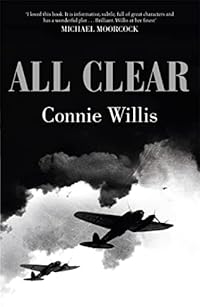
This is the continuation of Blackout. Had I not read All Clear so soon after I would have put it off for a long time which could have been a problem as little concession is made to anyone who by chance hasn’t read the first book of the pair. We plunge into the story with no preamble.
Our historian heroines/hero, time travelling from 2060 Oxford, are still stuck in 1940, either unable to get to their drops or waiting in vain for them to open, and still worrying that they have changed history for the worse and will not be able to get back to their own time before the continuum exacts its revenge. Polly Sebastian in particular is up against a deadline, having been dropped earlier in her own time to later in the war and the “laws of time travel” do not allow her to overlap time frames. All of the historians have in one way or another saved the lives of “contemps” and two of them have prevented fires spreading in St Paul’s Cathedral. One even travels to Bletchley Park where he (literally) bumps into Alan Turing and later becomes a vital part of the effort to convince the Germans the D-Day landings will be in the Pas de Calais rather than Normandy. Meanwhile in 1944 Mary hasn’t been killed by a doodlebug but she has gone on to inspire an RAF pilot to develop the “flipping” technique used to deflect their paths. As Polly, dropped into 1940, she therefore knows she has already affected later history yet is nevertheless the main worrier.
There is more Science Fictional stuff revealed in All Clear than there was in Blackout, which makes the nomination for the 2011 Hugo at least understandable (but not forgiveable;) the working out of the plot is neat enough – though there is at least one loose end – and Willis’s prose is never difficult to read. Aspects of her digression/interruption technique are essential to the plot but she lays it on with a trowel and also uses it in other circumstances – without it the book may have been considerably shorter.
Polly eventually comes to understand the true situation – but it has been a long time coming. It’s also a realisation that had occurred to the reader less than a quarter of the way through Blackout, ie approximately 1000 pages earlier. In addition these Oxford historians do seem to have an alarming lack of knowledge of wider history beyond the “prepping” they have done for their drops. (But then, “What ten year period did you study?” was always a jibe directed at history graduates.)
Given the number of bombs and explosions the characters have to endure, the levels of destruction we are shown, it is a matter of wonder that any of London managed to survive the war. However, Willis’s point that the ambulance drivers, rescue workers, ARP wardens, shopgirls, etc were no less heroic and no less important to winning the war than the fighting forces is well made. One of the reasons for carrying on though (apart from sheer bloody-mindedness, a prime motivator for the British in continuing to oppose Hitler) is what else can you do? The alternative is to despair, to give up, to give in. “Up yours!” is surely a healthier response. And these days there is no such thing as a civilian – we are all targets. Ever since the invention of the aeroplane and the submarine it has no longer been possible to outsource the risk of warfare purely to the armed services. (There are perhaps thousands of examples to argue that it actually never has.)
The most flagrant example in this volume of Willis’s lack of knowledge/research over things British is that she has one of her characters pay for an item in the 1940s using a tuppence (2d) piece. Prior to decimalisation in 1971 (when the face values changed in any case) there was no such coin. The denominations available in the 1940s were ¼d, ½d, 1d, 3d, 6d, 12d (1/-,) 24d (2/-,) or 30d (2/6) and, in extreme cases, 60d (5/-) but never 2d. Neither was two half-crowns (total 5/-) enough to cover two tickets at eight and six (8/6.) I’m also fairly sure that no London shops would have been open on Boxing Day 1940 given that it would have been a bank (and therefore public) holiday in England. Another example of her lack of feel for the minutiae of British life is that she doesn’t seem to appreciate how utterly unlikely it would be for someone of poverty-stricken childhood circumstances ever to make it into the highest echelons of the legal profession (to enter it at all, in fact.)
Posted in Curiosities at 12:00 on 6 August 2013
English is an idiosyncratic language, especially when written down. Think, for instance, of the different ways the letter combination “ough” can be pronounced (eg in cough, enough, through, thorough, bough and brought.)
It is apparently, however, only the 33rd weirdest language in the world, though.
The weirdest, Chalcatongo Mixtec, is spoken by about 6,000 people in Oaxaca, Mexico, but strangely (you might naively think) German, Dutch, Norwegian, Spanish and Mandarin are pretty weird.
One of the weirdnesses of Chalcatongo Mixtec is that it doesn’t do anything at all to signal a question; no inversion of word order, no change in inflection, no pre/suffixing.
The least weird language is Hindi, but surprisingly both Hungarian and Basque, which are generally considered to bear little relation to other languages, are in the bottom ten for weirdness, as is Cantonese.
See the link above for the top and bottom tens and the arguments for the ratings.
