Grounds for Complaint
Posted in Curiosities, Linguistic Annoyances at 12:00 on 22 August 2013
I was in St Andrews last week and spotted this notice in a cafe’s window.

Sit in coffee?
I’d rather not.
Posted in Curiosities, Linguistic Annoyances at 12:00 on 22 August 2013
I was in St Andrews last week and spotted this notice in a cafe’s window.
Sit in coffee?
I’d rather not.
Posted in Reading Reviewed, Scottish Fiction at 12:00 on 21 August 2013
Orion, 2011, 227 p.

This is courtesy of my not-quite-yet-but-might-as-well-be daughter-in-law. She now has a box set of Rankin books and so this one, a 2011 reissue of a 1998 edition of the first Rebus novel from 1987, came our way.
As crime isn’t really my thing I’ve never read any Rankin before – I have encountered the TV adaptations – but I thought it might be interesting to compare this to James Oswald’s Natural Causes.
Knots and Crosses is a strange one and wears the author’s literature background heavily. An incidental character is named Laidlaw in honour of William McIlvanney’s eponymous detective (McIlvanney is a literary star worth following, an antecedent of Tartan Noir,) the words laughter and forgetting at the end of a sentence are repeated immediately as the whole of the next. To be fair the introduction to this edition admits the referencing may be over the top, not to mention the occasional off-nesses of tone (“the manumission of dreams.”)
As the book focuses firmly on getting into various characters’ heads the crimes seem almost incidental, their relationship to John Rebus forced. The climactic scene was also interrupted by an unnecessary info dump to allow an over-egged simile.
It all washes down easily enough though. I got through it in two sittings.
As far as a comparison between Oswald and Rankin is concerned perhaps the main difference is that Oswald knew he was writing in the crime genre. At the time of Knots and Crosses Rankin may have been intent on writing a novel featuring crime.
Posted in Architecture, Art Deco, Cinemas at 12:00 on 20 August 2013
Musselburgh has at least three Art Deco buildings.
This is the David Macbeth Moir pub on Bridge Street, a Wetherspoon’s. (David Macbeth Moir is a historical local worthy.)

The building was formerly the Hayweights cinema. Its detailing and lettering is now after Charles Rennie Mackintosh – Mockintosh, then.

Further up Bridge Street is The Royal Bank of Scotland building. That window covered with wooden board is a bit worrying!

On High Street, almost opposite the War Memorial, can be found Poundland. The High Street was busy – difficult to get a photo without traffic.


More of my Musselburgh photos are on my flickr.
Posted in Altered History, Fantasy, Reading Reviewed at 17:18 on 19 August 2013
Gollancz, 2012, 680 p.

The book starts atmospherically with a prologue scene set around the eruption of the Indonesian volcano of Tambora in 1815, which provided the loudest sound in recorded history – an explosion so great that 1200 miles away it was thought to be artillery and threw so much ash into the atmosphere it resulted in “the Year without a Summer” in 1816. Perhaps the first sign that this is not a straight historical novel is that a party of “The Prince’s Men” is on hand – on an ocean-going steamboat.
The novel proper focuses on Conrad Scalese, a rationalist atheist who writes libretti for a living. His latest work has had a triumphant premier but lightning has struck the theatre where it was performed. The local (Neapolitan) Inquisition interprets this as a sign of God’s anger at the opera’s blasphemy and arrives to take him in for questioning. He is saved by the local police chief who conveys him to a meeting with the King of the Two Sicilies who assesses Conrad’s suitability to write the libretto for an opera which the King desires in order to counter a Black Opera which The Prince’s Men plan to perform in a few months’ time. The Black Opera is the secular equivalent of a black mass. Not only will it cause the eruption of Vesuvius, Stromboli, Ætna and other volcanic regions in between, thus devastating the Two Sicilies, it will summon up Il Principe, the God whom the creator God left in charge of Earth. Other intrusions of the supernatural into the narrative have Conrad’s father appearing as a ghost and people known as the Returned Dead – not zombies but fully functioning humans except for lacking the need to breathe.
The premise – that volcanic eruptions can be triggered by singing – is of course unremittingly silly but must be accepted for purposes of story. Invocation of gods or devils by incantation is time-honoured in fiction so their summoning by singing is not too much further of a stretch (but still too much for me.)
Gentle’s characterisation and plotting are excellent, though. The web of relationships around Conrad and the betrayals inherent in the set-up – the Prince’s Men are even more dangerous than the Cammora of Naples or the società onorata of Sicily – are finely detailed. Gentle’s knowledge of, or research on, opera seems solidly based to a non-buff. The collaborative nature of a first production, not only composer and librettist but also the singers, was well depicted.
As befits an altered history of the nineteenth century, the victor of Austerlitz and Borodino, the Emperor of the North, also makes two passing appearances.
Conrad’s sweet-bitterness towards his former love is pithily expressed, “It’s as easy to fall in love with a rich man as a poor man,” and the perennial complaint, “why a sister and a sweetheart will invariably combine their forces to persecute the relevant male,” is aired.
Despite any negativity above Black Opera is never less than readable; even the supernatural stuff.
Pedants’ complaints:- “Sung” count: 1. Livestock is a singular noun. Plus we had a who’s for whose, lay for lie, a beaus for beaux and one, “I can’t explained.” Despite her Italian setting and liberal use of Italian phrases, Gentle employed librettos and palazzos as plurals rather than the Italian libretti/palazzi. (Both forms are, though, acceptable in English.)
Posted in Bridges at 21:18 on 18 August 2013
No town feels complete unless it has a river.
In Musselburgh the River Esk runs through the town. I spotted three bridges there.
This first one carries the main road over the River Esk. The photo was taken from a point just down a few steps from the War Memorial.

This is a view of the other side of the same bridge. Nice arched spans.

Looking upstream from near the bridge in the above photo you can see a second bridge. This looks to be of older vintage. The near bank had nice planting.

(The third bridge was downstream of these two and very flat and boring, possibly a pedestrian bridge.)
Posted in Dumbarton FC at 20:00 on 17 August 2013
SPFL Tier 2, New Douglas Park, 17/8/13
Oh dear. Looks like business as usual.
I do hope this does not mean the wheels have come off the bus.
We’re only saved from being bottom by virtue of a last minute penalty at Central Park.
34 games to go though.
Posted in War Memorials at 12:00 on 17 August 2013
On our trip back through East Lothian we also stopped in Musselburgh.
Museelburgh’s War Memorial is unusual; being octagonal in shape and in the form of a fountain.

This is the reverse view.

This is the memorial in perspective. On the corner where the road bridge crosses over the River Esk. Intersection of Bridge Street and High Street.

According to the Scottish War memorials website the above is the memorial only to the Second World War dead. The First World War one is difficult to find, it says.
Posted in My Interzone Reviews at 12:00 on 16 August 2013
My latest review for Interzone – now arrived – will be of the above book, a collection of stories of the colonial experience written from the perspective of the colonised.
I have been as yet unable to source from the internet a picture of the cover.
Posted in European Championship, Scotland, World Cup, Writers' Bloc events at 19:50 on 15 August 2013
International Friendly, Wembley Stadium, 14/8/13
I didn’t see this as I was attending Sterne und Autobahnen* last night (see last post but one.)
By all accounts there were signs of promise.
I’d like to think, though, that in a European Championship or World Cup qualifier away from home we would not twice lose a lead. This is Scotland however: it will most certainly happen.
*The Writers’ Bloc gig went well, John Lemke’s and Poppy Ackroyd’s music – thoroughly modern for the most part, not my usual listening – was good and expertly performed, the story to accompany it entertained and was well read. The good lady and I may even have got a taste for tripping to Edinburgh for an evening.
Posted in Eric Brown, Reading Reviewed, Science Fiction at 12:00 on 15 August 2013
Solaris, 2012, 384 p.
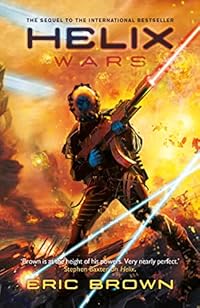
Jeff Ellis is a shuttle pilot who travels between the many worlds of the Helix. On a flight to Phandra his craft is shot down by the Sporelli who are invading from the neighbouring world on the spiral. His life is saved by a Phandran healer, Calla, but they are taken prisoner by the Sporelli. Meanwhile the Mahkan, Kranda, has set out to rescue Ellis from the Sporelli in order to fulfil the debt of honour she incurred when Ellis previously saved her life. She does so but the Sporelli have taken Calla in order to utilise her healing powers on their injured. Thereafter we are involved with the search for Calla as Ellis feels he is now in her debt. Elsewhere, on the Helix world of New Earth, Ellis’s more-or-less estranged wife, Maria, has begun an affair with her boss.
The Helix is one of those familiar SF tropes, a Big Dumb Object. In his first novel set there, Helix, Brown did not explore the structure nor its mechanics to any great degree. That omission is remedied here. The technology of its Builders, which allows its inner exploration, is – as Clarke’s Law has it – indistinguishable from magic, perhaps from the point of view of the story conveniently so. But then if you’ve got a tool kit why not use it? The novel reads like a kind of mashup of the BDO tale and a shoot-em-up.
Brown is incapable of writing a book which does not feature human dilemmas, however. In Helix Wars these seem to sit awkwardly with the more straightforward video game type elements even if the extended interplay between Kranda and Ellis on the morality of the use of force raises the tone.
Brown’s more character driven novels are much more satisfactory. Unless you’re into shoot-em-ups I’d advise you to savour his “Starship” sequence or The Kings of Eternity instead.
Aside:- Helix Wars has a cover which, had Eric not been a mate, would have made me disinclined ever to pick the book up.
