Archives » 2020 » June

Sculpture of Tommy at Seaham, County Durham

Seaham is a town on the North Sea coast in County Durham.

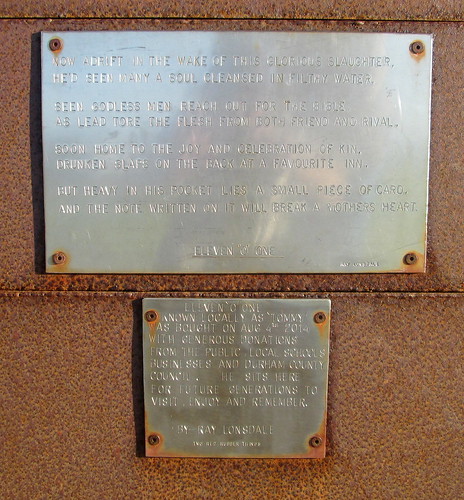
The statue of Tommy is on the seafront in an area known as Terrace Green by Seaham’s War Memorial. It was erected in 2014 to mark the 100th anniversary of the Great War.

Statue of Tommy at Seaham

Detail:-

Detail of Tommy Statue at Seaham, County Durham

Side view:-

Tommy at Seaham, Side View

Reverse:-

Reverse View, Tommy Statue at Seaham

Its sculptor was Roy Lonsdale:-

Sculptor Signature, Tommy Statue, Seaham

Dedication plaques. The sculpture’s proper name is 1101, to reflect the minute of peace at the Armistice which ended the war:-

Inscription, Tommy Statue, Seaham

Other side view:-

Tommy at Seaham, Side View

There are more pictures of Tommy here.

Arthur C. Clarke Award: This Year’s Nominees

The shortlist for the 34th Arthur C. Clarke Award is:

The City in the Middle of the Night by Charlie Jane Anders
The Light Brigade by Kameron Hurley
A Memory Called Empire by Arkady Martine
The Old Drift by Namwali Serpell
Cage of Souls by Adrian Tchaikovsky
The Last Astronaut by David Wellington

I had been looking for the list for a while but not for the first time discovered it had finally been announced via Ian Sales’s blog.

I reveiwed the Charlie Jane Anders book for Interzone 282 and published that review here on 28/5/20.

The Martine and Serpell I had seen good reviews of. The works of Hurley I have read tend to wallow in violence which I find off-putting. I’ve only read Tchaikovsky’s two Children of Time novels. They were OK but no more. Wellington is new to me (and Ian Sales doesn’t think much of his book.)

The Rector and The Doctor’s Family by Mrs Oliphant

Chronicles of Carlingford. Virago, 1993, 196 p, plus xii p Introduction by Penelope Fitzgerald.

 The Rector and The Doctor’s Family  cover

Being two shorter works The Rector, not even novella length, and the more substantial The Doctor’s Family.

In The Rector, the old Rector (profoundly Low Church, “lost in the deepest abysses of Evangelicalism”) has died. Mr Proctor – Fellow of All-Souls Oxford – has come to replace him but finds the practice of ministry very different from the academic life he has left. When his aged mother joins him she divines instantly that at least one of the churchwarden’s two daughters will be “intended” for him. He is terrified and reflects, “But have not women been incomprehensible since ever there was in this world a pen with sufficient command of words to call them so? …. And is it not certain that …. every soul of them is plotting to marry somebody? …. Who could fathom the motives of a woman?” Meanwhile his mother, “watched him as women do often watch men, waiting till the creature should come to itself again and might be spoken to.” That fear, combined with Mr Proctor’s total inability to cope with the needs of a dying parishioner and the demands of sociability lead him to reconsider his position.

The Doctor’s Family.
Dr Edward Rider, not the pre-eminent physician in Carlingford – that would be Dr Marjoribanks – has the medical care of the less well-off of Carlingford society. His only burden is that of his waster of a brother Fred, back from the colonies under a cloud, indolent to a fault and an almost permanent resident in an easy-chair. Two ladies arrive at the door one day and Edward is astonished to find that Fred has a wife, Susan – and three more or less uncontrolled children – come over from Australia with Susan’s sister Nettie, who in turn has just about the means to support them. Nettie is the practical one, arranging lodgings for the ensemble in St Roques’s cottage, and undertaking all the work of the household. Edward becomes enamoured of Nettie, but her sense of duty to her sister’s family is so strong that she will not contemplate leaving them for anything.

It is reasonably clear from Edward’s first encounter with Nettie where all this will be going. There are of course minor complications to the narrative, a potential rival for Nettie’s affections in the person of the permanent curate of St Roques’s church, a tentative leaning towards Miss Marjoribanks while Edward works through his irritation at Nettie’s refusal of his own, but even when Fred dies, drowned in a canal after a night in the pub, Nettie will not abandon her duty. Only the entrance of Richard Chatham, another Australian, (un)distinguished by a luxuriant beard – not common in Carlingford in those days, only Mr Lake has such an affectation and his is very much subdued by comparison – changes the dynamic.

Oliphant’s style is wordy, she was a nineteenth century novelist after all, but her eye for the human heart, for its predicaments, is sure.

Pedant’s corner:- In the Introduction, a missing comma before a quote of direct speech, and one missing at the end of such a quote, Freddie (x 2; the text has Freddy,) “between man and women” (men and women.) Otherwise; “the two Miss Woodhouses” (several times; the two Misses Woodhouse,) “‘It did not use to be’” (used to be,) St Roques’ (St Roques’s.)

Bookshelf Travelling for Insane Times Again

My contribution this week to the meme started by Judith Reader in the Wilderness is the lower portion of that bookcase which contains my collection of recent Scottish fiction.

The upper of these two shelves features Alan Spence, Alan Warner and Louise Welsh – plus to the right William Boyd whom I am never sure whether to count as Scottish or not. At the extreme right are two books on football, Jonathan Wilson’s The Outsider and A Season with Verona by Tim Parks.

On the bottom shelf is my collection of books by Joseph Conrad (the favourite writer of my grandfather, the original Jack Deighton.) These are beautiful Folio Editions, a matching set. To the right of them are various history books plus Periodic Tales and a couple of the good lady’s books.

Books Again

Adrift on the Nile by Naguib Mahfouz

Anchor Books, 1994, 172 p. Translated from the Arabic, Thartharah Fawq al Nīl, by Frances Liardet.

 Adrift on the Nile cover

This novel features a group of friends who regularly meet in the evening on a houseboat on the River Nile to talk about the issues of the day but mainly to smoke kif through a water-pipe.

The viewpoint starts off as that of Anis Zaki, a civil servant with troubles at work and whose wife and daughter died many years previously. Anis’s mind can wander and he has occasional illusions – of the Caliph Harun-al-Rashid, of a whale in the Nile, of conversing with the pharaoh Thutmose III. Sometimes, however, the narrative focus shifts to something more objective.

Others of the company are Ahmad Nasr, notoriously faithful to his wife; Mustafa Rashid, a well-known lawyer; Ali al-Sayid, a famous art critic; Khalid Azzuz, a writer; Ragab al-Qadi, the group’s womaniser in chief. Women are not excluded; Layla Zaydan, a translator, is introduced to new members as “beautiful and cultured” not least in that her golden hair is real, not a wig, while Saniya Kamil turns up whenever her husband has committed an indiscretion. The houseboat is looked after by general factotum Amm Abduh, huge in stature, who mostly keeps himself to himself but when summoned will refresh the water-pipe. As well as making the call-to-prayer at the local mosque he will procure street girls for the members. The group’s female members, despite occasionally spending the night in rooms on the boat, are contrasted to the street girls in that, “‘they are respectable ladies,’” the rationale being, “‘They don’t sell themselves. They give and take, just like men.’”

The text is mostly dialogue, there is not much of a plot here. There is some disquiet one evening when Ragab appears with the teenage Sana al-Rashidi, a student; even more when journalist Samara Barghat arrives, the object of suspicion due to her calling (possibly not unjustified suspicion, revealed when Anis takes the opportunity to rummage in her handbag one evening and filches a notebook which contains a scenario and characters for a play – all based on the houseboat’s habituees.) The only incident occurs on a car journey out of the city, to which Anis had only reluctantly acceded, when, travelling too fast on their return, they hit a pedestrian. But all agree to keep quiet about it.

By showing us a slice of middle-class Egyptian life in the 1960s (when the book was first published in Arabic,) Adrift on the Nile reveals the uneasy connection between Egypt’s past and its then present by subtle indirection.

Pedant’s corner:- Translated into USian (except handbag and purse are used in the British sense.) Anis’ (Anis’s, many instances,) “is a that any description” (no ‘a’,) protozoan (protozoon,) “‘people who will praise you work’” (your work.)

Live It Up 69: When Will You (Make My Telephone Ring)

A very unBritish sounding song this. It’s more like US soul music.

This seems to be a live TV performance with an extra section in the middle that wasn’t on the album version. (Pity about the USian spellings on the subscript lyrics.)

Deacon Blue: When Will You (Make My Telephone Ring)

Cosmic Monster

Part of the Carina Nebula as seen in Astronomy Picture of the Day for 25/5/20.

It looks like something from the cover of a Fantasy novel:-

Part of Carina Nebula

War Memorial, Burnopfield, County Durham

Burnopfield is a village in County Durham, Northeast England. We passed through it on a trip to see Gibside last year and happened on its War Memorial by the side of the road. A granite obelisk, on first sight the memorial seems to be for the Great War only but there are World War 2 names on it:-

War Memorial Burnopfield

Dedications. “In thankful recognition of the men who gave their services and in grateful memory of those who gave their lives in THE GREAT WAR. Greater love hath no man than this that a man lay down his life for his friends. Erected by the people of Burnopfield and District.”:-

Dedications, Burnopfield War Memorial

War Memorial, Burnopfield

Burnopfield War Memorial

Old Hall at Gibside

Gibside is a National Trust property in County Durham.

It’s mostly parkland now but that makes for a good long walk.

There are the derelict remains of an old hall in the grounds though, cordoned off so no access:

Old Hall at Gibside

Whitburn War Memorial

Whitburn is a small village just to the north of Sunderland in Tyne and Wear, England. The War Memorial – for Marsden District – is a granite obelisk.

Whitburn War Memorial

Great War Dedication. The names below – obscured by wreaths – will be for World War 2:-

Whitburn War Memorial Great War Dedication

Memorial from east:-

War Memorial, Whitburn from East

Reverse of Memorial:-

Reverse, Whitburn War Memorial

Marsden District Dedication:-

War Memorial, Whitburn, Marsden District Dedicationn

Memorial from west:-

Whitburn War Memorial From West

free hit counter script