Archives » 2017 » February

Oscar Niemeyer International Cultural Centre, Avilés

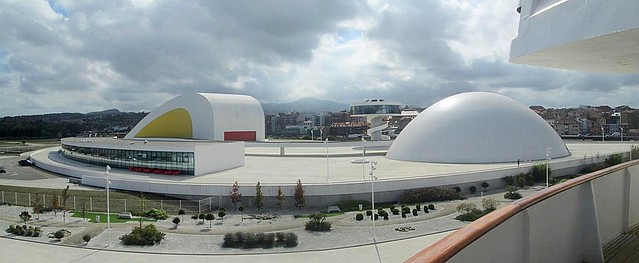
The first thing that strikes you as you look from a ship in dock at Avilés, Asturias, Spain, is the stunning set of Modernist buildings below which collectively make up the Oscar Niemeyer International Cultural Centre or Centro Niemeyer.

Stitch of two photos:-
Oscar Niemeyer International Cultural Centre, Avilés

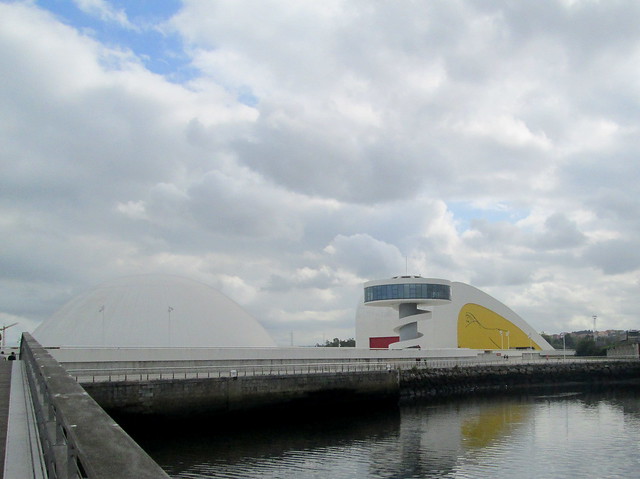
View looking back from the walkway to the town, Reflections in the Ria de Avilés:-

Oscar Niemeyer International Cultural Centre, Avilés

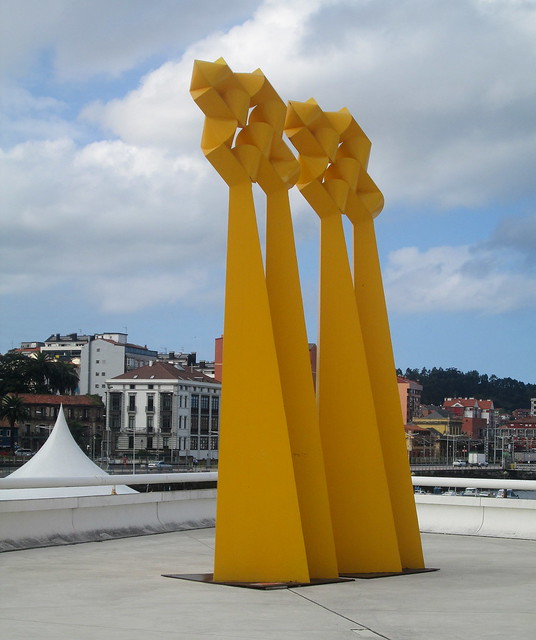
Closer View showing stylised flower sculpture:-
Oscar Niemeyer International Cultural Centre, by Ria de Avilés

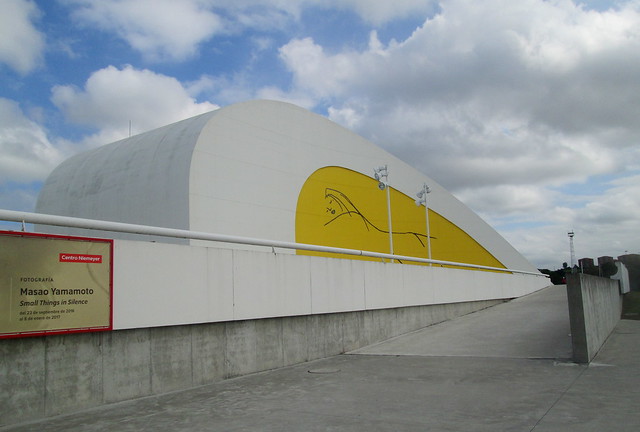
Dome and Auditorium (curved building):-
Detail, Oscar Niemeyer International Cultural Centre, Avilés

Auditorium with “stick” horse:-
Close View, Oscar Niemeyer International Cultural Centre, Avilés

Stairway and vents:-
Stairway and Vents, Oscar Niemeyer International Cultural Centre, Avilés

Tower:-

Tower, Oscar Niemeyer International Cultural Centre, Avilés

Dome, SS Black Watch in background:-

Dome, Oscar Niemeyer International Cultural Centre, Avilés

“Stick” horse detail:-
Horse Detail, Oscar Niemeyer Centre, Avilés

Stylised flowers, Avilés in background:-

Stylised Flowers, Oscar Niemeyer Centre

Dome and Tower:-
Dome and Tower, Oscar Niemeyer Centre

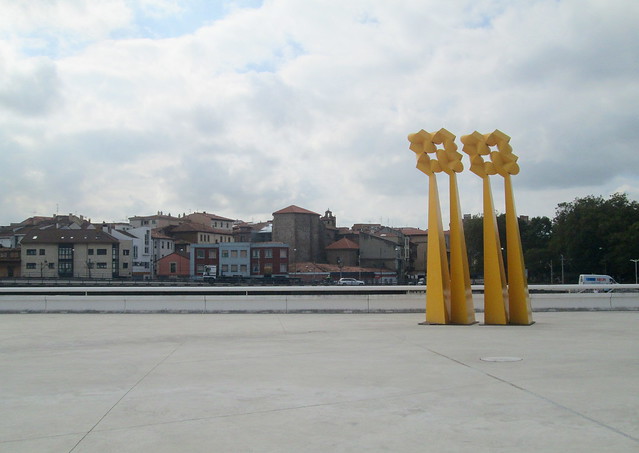
Flowers and Avilés:-

Niemeyer Stylised Flowers

Low rise building. (It’s multi-purpose. It seemed to house the restaurant/café):-

Low Rise Building, Oscar Niemeyer Centre, Avilés

Auditorium reverse angle:-
Curved Building, Oscar Niemeyer Centre, Avilés

Auditorium and tower:-

Curved Building and Tower

Edited to add: Actually on closer inspection that “stick” horse may be a “stick” woman.

Oscar Fail?

I don’t watch the Oscar ceremony. It’s an event which garners publicity way beyond its actual significance or importance for weeks beforehand and I’m not much into films anyway.

Notwithstanding that I couldn’t avoid the aftermath of this year’s do and its wrong envelope saga. Lead item on both the radio and TV news all day.

So the story that was to be the big thing from the Oscars this year didn’t happen: overshadowed by an apparently inexplicable mistake.

My first thought on hearing of what transpired was to wonder if any of this year’s award winners made any anti-Trump comments in their respective acceptance speeches. If they did I haven’t heard a word about them. And naturally it occurred to me that anyone behind the scenes wishing to avoid any discussion that such comments may have caused would have reason to feel very pleased indeed at the actual turn of events.

It may just have been an almighty cock-up (the usual explanation for bizarre occurrences) but if it was a conspiracy to deflect any possible criticism of the recipients and the so-called Academy from T Ronald Dump and his supporters it worked beautifully. I still don’t know the content of any of the winners’ speeches – at least one of which usually makes the news.

If this was a dead cat it was certainly a beezer. Possibly the most dead cat* ever.

Pedant’s corner:- *Yes, I know if a cat is dead, it’s dead and can’t be any more dead. There are no degrees to death after all.

The Panopticon by Jenni Fagan

William Heinemann, 2012, 333 p. One of Scotland’s favourite books.

The Panopticon cover

Narrator Anais Hendricks has spent her life in care; from birth to her age now, fifteen. There was a short period when she had what was in comparison a stable home life when she was adopted by a prostitute. Unfortunately her adoptive mother was killed while Anais was in the room next door. Anais has been in and out of homes fifty-one times and in more trouble at school (which, of course, she barely attends) and with the police than you could count. She has a particular bent for stealing school minibuses then crashing them; and for fire-raising. The book, then, does not promise to be a bundle of laughs and Anais not a likely candidate for salvation. She is bright, though, and reads voraciously, has a keen sense of herself; and of injustice. As a sort of compensation she plays what she calls the birthday game, imagining all sorts of different beginnings for herself, and she dreams of a life in Paris.

We meet her when, under suspicion of having put a policewoman into a coma (of which she vehemently denies her guilt,) she is being transferred to the Panopticon of the title, a building from the centre of which the inmates are under the view of the staff at all times. A clue to her possible mental state is when she sees the stone cat at the entrance – which she dubs Malcolm – move its wings. She also thinks she is the subject of what she calls the Experiment, the project of a mysterious group which may be from another universe or dimension – and for whom the only evidence the reader has is Anais’s words – and she is being tested to destruction in the sense she thinks the Experiment wants her to commit suicide. But, despite the Experiment, she feels that, “I, the young miss Anais, understand wholly that I am just a human being that nobody is interested in.”

She has a keen sense of morality, “I’d lay (sic) down and die for someone I loved; I’d fuck up anyone who abused a kid, or messed with an old person. … I’m honest as fuck and you’ll never understand that. …. I’ve read books you’ll never look at, danced to music you couldnae appreciate, and I’ve more class, guts and soul in my wee finger than you will ever, ever have in your entire, miserable fucking life.” However she cannot reveal this to any of the care workers; not even Angus Everlen, who is the only care worker who has seen any good in her.

Her relationships with fellow inmates, Tash, Isla (a very well-drawn picture of a mother devastated that her HIV positive status has been passed on to her twin children) and Shortie are vividly realised. They become almost a surrogate family but of course cannot look out for each other as much as each of them needs.

Anais’s biological mother may have had psychotic schizophrenia, as may Anais. A man who claims to have witnessed Anais’s birth tells her she is the daughter of an Outcast Queen, who could fly (as Anais imagines she does. But, then, she does take a lot of drugs.)

A rumbling sub-plot concerning Anais’s boyfriend, who it is always apparent has used her (very few of her acquaintances don’t) but is now in prison and owes people a lot of money, comes to a hideous head, triggering Anais’s resolve.

This is a book about the lives of those who are not often represented in fiction – nor ever sympathetically in the normal way of public discourse – and so of course acts a necessary corrective.

It is not an easy read but it is so well written it was easy to read – at least I found it so. The stream of consciousness had a flow to it, logic even, though perhaps it helps to have some knowledge of the culture from which it springs. The splattering of the text with Midlothian demotic and expletives did not offend me (as it might others.) This is the way some people talk, especially those who tend to be discounted by the organs of the state. Anais has a distinct voice – even if you cannot quite be certain what to believe of what she says and it is at times perhaps a little too assured. “I’m a bit unconvinced by reality full stop. It’s fundamentally lacking in something and nobody seems bothered…” “…all the time this infinite universe surrounds us, and everyone pretends it’s not there.” The details of life as an inmate in the care system were convincing enough, though.

The symbol of a Panopticon as a metaphor for teenage existence – especially in the care system – was potentially a good one but at times became a trifle overblown and wasn’t actually entirely justified by the set up shown us in the book.

As a novel I’ll doubtless remember The Panopticon for a long time. I don’t think I’ll ever describe it as a favourite, though.

Pedant’s corner:- Anais refers to The Experiment as plural throughout, also – apart from one “lie” – she uses “lay” for being horizontal and “kosh” for cosh: all of these are direct expressions of Anais though. Otherwise; “he’s always owe them money” (owed,) take the edge of the colours (off, I think,) “‘Vive le révolution’” (Vive la révolution: the speaker is supposed to know her French, she’d get the noun’s gender right,) ditto “vive le” 3 lines later, naïvist (naïvest,) “for something I dinnae do” (didnae.)
The First Steps

Despite the First Amendment to the US Constitution the new President of that country has set in train a course by which freedom of speech in the US might be going to be curtailed.

This is the way a toddler responds to criticism. And neutering the press, is, of course, the way dictators behave.

It’s a classic tactic. Define an enemy against which your supporters can rally. Even when that so-called enemy represents the bedrock of your country’s system of governance – a system which you have sworn to protect.

Add in the fact T Ronald Dump has already gone for Muslims, Mexicans, transgender people, judges and now the press; who will be left to speak up when he comes for you?

To be clear, T Ronald, just because someone disagrees with you doesn’t make them a traitor to their – and your – country. Arguably it makes them more of a patriot than you are.

My country (or my President) right or wrong is a pernicious doctrine.

In fact in a democracy it is the highest duty of a loyal citizen to point out to his or her government when it is doing something wrong.

Falkirk 2-2 Dumbarton

SPFL Tier 2, Falkirk Stadium, 25/2/17.

The referee was Mat Northcroft again.

Despite that – and his usual baffling decisions – it was a decent enough game, even if both teams weren’t quite at it.

Falkirk didn’t really threaten much in the first half. We forced a few corners early on but fell out of it a bit. Their goal may have been a fluke. Their left back was played in and hit it on the volley from where it looped over Alan Martin’s outstretched hand and into the net.

Our equaliser was a peach and came within a minute. Lewis Vaughan picked up the ball and ran at their defence, evading three men before dodging into the box and thumping it across Danny Rogers into the top corner. Honours even at half-time.

Our second ended up a mirror image of our first. Christian Nade chased down a ball in midfield, dispossessed the Falkirk player and played it to Andy Stirling who proceeded to waltz past defenders and then despatch it past Rogers the opposite way to Vaughan. Beautiful stuff.

Unfortunately we couldn’t keep the lead though there was a hint of offside about their equaliser. They did have the ball in the net again but that offside was given and we cleared a shot off the line. They had a looping effort that hit the outside frame of the goal and Daniel Harvie’s header from a corner also hit their bar.

A draw was just about right and a point was more than I expected from the game. It’s awfully tight just above the play-off places though.

The Ragged Man’s Complaint by James Robertson

B&W Publishing, 1993, 158 p.

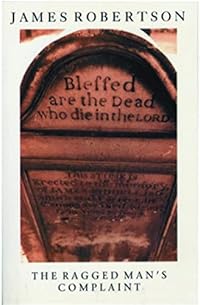
 The Ragged Man’s Complaint cover

This is Robertson’s second collection of short stories, after Close.
Giraffe is told from the viewpoint of a worker in a Safari Park and gives a picture of all the dodgy practices that go on there.
In Plagues a man who works in a bookshop sees frogs everywhere and is worried that’s only the beginning.
Screen Lives displays a woman and a man developing their relationship by acting out lines from the film Notorious.
In The Jonah one of two men hitch-hiking in a backwater reflects on how to turn his life around.
The Claw is the withered appendage of the HIV positive narrator’s grandfather, “caught between hope and history,” in a care home. A monitor of his future.
Squibs contains four vignettes a couple of which approach the style of Iain Crichton Smith’s Munro stories.
Bastards relates an encounter in a pub, where a man mistakes another for “the cunt my wife ran off wi’.”
Facing It is a vignette even shorter than those in Squibs wherein a man sees his innards cascade into the toilet bowl and realises he can no longer ignore his medical problem.
The unarguably apocalyptic The End is Nigh, told in almost biblical cadences, has a Science-Fictional feel as a prophet extends his sermon while wandering the countryside.
There are reflections on writing, relative privilege and Scotland in The Mountain, where for a few months in the winter following his grandfather’s death a man occupies the ancestral croft.
What Love Is examines the distance between married couple Dan and Joan, between men’s lives and women’s. “Dan isn’t frightened of other lives. He imagines them all the time. The only life he is frightened of is his own.”
Portugal 5, Scotland 0 (the comma is Robertson’s – or his publisher’s.) During the game concerned two men in a pub take to discussing Hugh MacDiarmid, poetry and Scotland’s cultural reawakening, turning back only after the game is finished, since the football has begun not to matter so much.
In Tilt Alan’s friend Mike tells him the only question in the world worth asking is, “What’s it about?” (Note the absence of “all”.) Alan’s increasingly shiftless feeling comes to a head one day after an encounter with a recalcitrant pinball machine and Mike’s sister, Mona.
Surprise, Surprise. A man accompanies three girls to a party and while there finds his evening is described in a book he picks from a shelf.
In the absence of the real thing, the Tories having won a General Election again (the book’s publication date suggests the 1992 one) Robert occasionally retreats into The Republic of the Mind. “I just think what a waste of time it is, having to wait to be a normal country, having to waste all this energy identifying ourselves. So I bugger off anyway. To the Scottish Republic of the mind.” On an epiphany he thinks, “You had to come upon it, or it came upon you.” He also realises, “how nobody ever assumed their neighbour was a Tory in a public house in Scotland,” and “We’re a nation of philosophers … at the end of the day. A nation of fucking philosophers.” That expletive is a brilliant piece of emphasis by Robertson. It demonstrates both the glory and the despair of the thought it qualifies.
Someone, perhaps homeless, perhaps not, is Pretending to Sleep. For all the ones who cannot do it for themselves. It is a strange existence. “Funny how in the cells they come to check if you’re not dead. Out here, out in the open, nobody checks” but, “Just by lying there, pretending to sleep, you get under their skin …. deep into them.” It’s a horror story. But not for the pretender.

Pedant’s corner:- staunch (stanch,)

Reelin’ In the Years 130: You’re a Lady, Love is the Sweetest Thing, Roll Away the Stone

I discovered two sad departures this week, both Peters, though one of them actually occurred in January.

Peter Skellern’s affection for the brass band sound made him stand out as a bit old fashioned in the early 1970s.

His biggest hit was You’re a Lady, no 3 in 1972.

Peter Skellern: You’re a Lady

I remembered his revival of Frank Noble’s song Love is the Sweetest Thing as being a bigger hit than in fact it was. It apparently only reached no 60. It has a brilliant lyric, though.

Peter Skellern: Love is the Sweetest Thing

Peter Overend Watts was Mott the Hoople’s bass player and is seen quite prominently in this clip:-

Mott The Hoople: Roll Away The Stone

Peter Skellern: 14/3/1947 – 17/2/2017. So it goes.

Peter Overend Watts: 13/5/1948-22/1/2017. So it goes.

The Colour of Television

“The sky above the port was the colour of television, tuned to a dead channel.”

What do you make of the above sentence?*

Pyrotechnic? Emblematic? Iconic? Redolent of a new sensibility? A clarion call for the new digital age?

Or did it perhaps elicit a bemused, “Eh, what? Come again?”

It is of course the first sentence of William Gibson’s Neuromancer which thrust cyberpunk onto the novel-reading SF public all those years ago now and to which I alluded in my review of Tony Ballantyne’s Dream Paris.

Many saw it as the perfect embodiment of the new style of SF Gibson was promulgating. Yet to me it’s not quite in the league of the wake up calls that “Come on and hear!” or “One, two, three o’clock, four o’clock rock!” were in musical terms. It’s not as pithy for a start. And when you begin to parse it any meaning it might contain slips away.

The sentence has been taken to mean descriptive of an oppressive, lowering sky, deep grey, I assume. (The colour of battleships, painted for action?)

Its first six words are unexceptional. But what, pray, is the colour of television?
I have no difficulty visualising the colour of a (or the) television (which word is still in the back of my mind suffixed by “set”.) Nowadays they’re nearly all black but back when Neuromancer came out in 1984, they could be all sorts, white, blue, pink, yellow. Some even had wood on them; or if it was plasticky, what I used to call pseud wood.

But television, with no defining article, is an abstract noun. Used in this way the word usually means the industry which produces the programmes it displays, not the apparatus they are shown on. And how can an abstract noun have colour? (Another possibility would be the band called Television, also fairly abstract, but that is spelled with a capital T.) It’s not even the apparatus’s screen that could be implied. Nowadays they’re uniformly blackish when the set is switched off; back in the day they were a deep olive green colour. That would be a sky too odd even for Science Fiction – except perhaps off Earth (which this sky wasn’t.)

Then there is that “dead channel”. I don’t suppose the young things these days know what that could possibly look like, when is a channel ever dead now? But then if the channel wasn’t broadcasting (the only possible interpretation of “dead”) the screen wasn’t even a uniform colour. It was spitty and specky, flecked with black and white, displaying what physicists call white noise; not a particular coherent signal as it was designed to do, but any signal – and every signal – picked up in the absence of a modulated transmission. Have you ever seen a flecked, spitty, specky sky? I haven’t. Not then, not now.

That sentence destroyed Neuromancer for me. From that point on I could not trust the author or what he attempted to describe. (I know about unreliable narrators but this was of a different order, it was in the omniscient third person for a start.) I didn’t have quite the same negative response to Gibson’s next novels Count Zero and Mona Lisa Overdrive but still couldn’t really warm to him.

Ballantyne gave us, “The sky was the colour of an unpolished euphonium, tuned to a dead key,” which makes a bit more sense, but only a bit, and he did have the grace to come back to it at the end.

*For myself I think the sky was the colour of an author, straining, unsuccessfully, for effect.

Art Deco in Getxo +

By the riverside on our approach to the Vizcaya Transporter Bridge I spotted this beauty:-

Getxo Art Deco 1

The doorway had some fine detailing:-
Getxo Art Deco 2

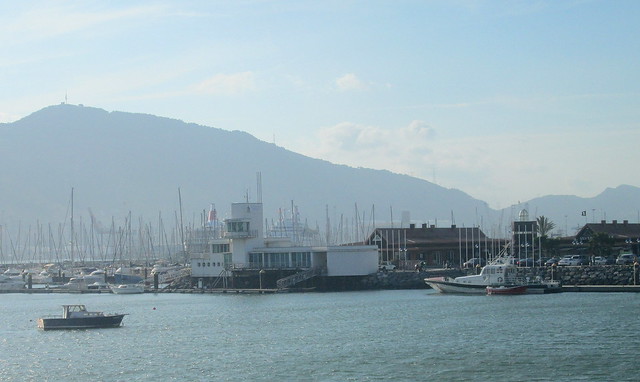
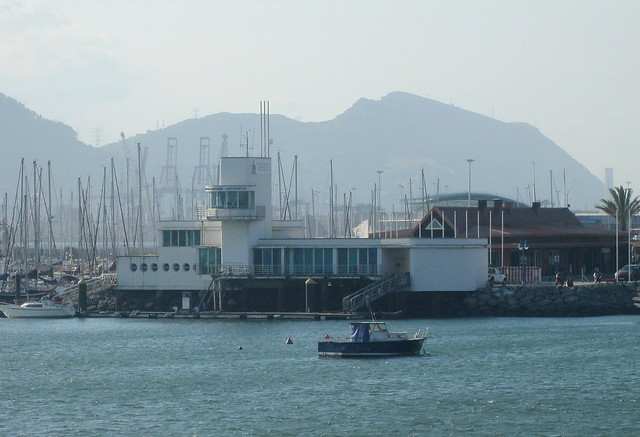
This port/marina building is also in the deco/moderne style. Spot two ships’ funnels behind it:-

Art Deco, Getxo 3

Closer view. It’s like an 1930s airport tower only with porthole windows:-

Art Deco, Getxo 4

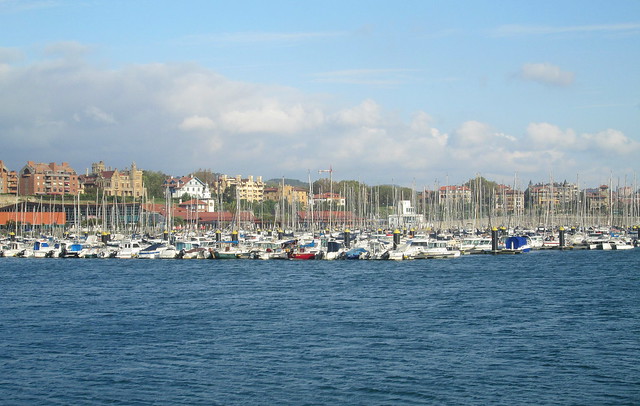
Reverse view looking back to Getxo. Those “English” buildings are prominent to the upper left. The main part of Getxo itself is off to the right:-

Art Deco, Getxo 5

There was another Fred. Olsen line ship docked at the same time as ours, the Boudicca. Both are seen here from the pier approach:-

aGetxo 6 ship

SS Black Watch. The bow has a very angled rake:-

SS Black Watch at Getxo

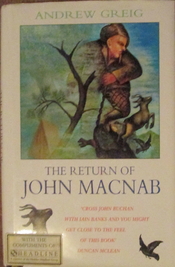
The Return of John Macnab by Andrew Greig

Headline Review, 1996, 285 p.

The Return of John Macnab cover

This, Greig’s second novel, takes as its template John Buchan’s John Macnab which I reviewed here. Once again three men – but this time not “gentlemen” – form an alliance to poach a salmon, a brace of grouse and a stag respectively from three different estates, Mavor, Inchallian and Balmoral, and then deliver the poached items back to the “owners”, as a challenge to “absentee landowners and the Criminal Justice Act” and as a wager to the three estates’ owners; issuing a statement to this effect in the Scotsman newspaper. The “John Macnab” here comprises at first Neil Lindores, Murray Hamilton and Alasdair Sutherland, each with his own special talent useful for the enterprise, but not long after arriving in “a small Highland town” Lindores is sussed out by local journalist Kirsty Fowler who is excited by the project and offers to help them.

Greig’s background in climbing comes to the fore in his description of the scramble needed to get to the pool for the salmon poach and his life as a poet in the sentence, “Seldom had a celebration broken up so fast, as if someone had announced an evening of performance poetry would commence in thirty seconds.”

His descriptions of landscape are loving and there is the odd reflection on the condition of Scotland. On feeling himself squeezed as at the narrow waist of an hour-glass with more past than future as the minutes ran through Neil thinks, “What a depressingly Scottish image. Its negativity was another thing that was true about his country. It went along with tholing, bearing, putting up with, and taking a certain satisfaction in the expected bad news when it came.” Yes indeed. That’s Calvinism for you. Neil does go on, though, to sense “it was a wrong picture. He was groping for another, still true but more affirmative.” At another point, “He hugged Murray. This was a first – they were Scottish, after all.”

The big problem John Macnab faces here is Balmoral. It is late summer and HRH is in residence. Consequently the place is hoaching with Special Services, Army and Police as well as the usual ghillies and gamekeepers. The authorities cannot ignore the possibility that John Macnab is merely a cover for a terrorist attempt on HRH’s life.

The text occasionally refers to Buchan’s novel, as it has to, and even critiques it in mentioning that Buchan’s women are really just chaps – though with (small) breasts. Greig’s intent is somewhat different; and his women are certainly far from chaps. Kirsty is as rounded and complex a character as you could wish (such women are a common factor in Greig’s novels) and is thoroughly involved in the poaching efforts – as are Sutherland’s and Hamilton’s wives and the former’s family – at least in the second one. Sutherland’s wife, though she has had an affair, tells Kirsty she would kill him if he were to do the same. Ellen Stobo, a policewoman attached to the security services but who finds herself coming to an understanding of John Macnab, is also well drawn. To be fair to Buchan he was writing adventure tales for a male audience in a time that was less aware. Greig is by far the better examiner of the human condition though.

The John Macnab template – while driving the events of the plot – at times gets in the way of Greig’s greater facility with personal relationships but in the end his own concerns overwhelm Buchan’s. Still, he nearly overdoes it, veering very close to the tradition of the Scottish sentimental novel (compare Iain Banks’s Espedair Street,) in the final pages. But he is too canny to yield a conventional ending.

That template means that The Return of John Macnab is not quite up there with Greig’s best – all the other novels of his I have read; see “Andrew Greig” in my categories – but for an exploration of human uncertainties, hesitations, lust for life and willingness to take risks, emotional as well as physical, it’s still pretty damn good.

Pedant’s corner:- midgies (midges – which spelling does occur in the book once but otherwise with the extraneous “i”,) swopped (swapped,) “‘but there a problem comes with it’” (but there’s a problem,) autogiro (autogyro,) hoochin’ (usually spelled – and pronounced – hoachin’,) the main work party were loading gear (the party was,) none of the computer systems were down (none was down,) a missing end quote mark.

free hit counter script