Archives » 2024 » September

Friday on my Mind 237: Mas Que Nada. RIP Sérgio Mendes

Sérgio Mendes, who popularised Bossa Nova in the 1960s, has died.

I remember this very familiar tune as getting a lot of airplay at the time but it wasn’t a hit in the UK. (Only Never Gonna Let You Go was, and it only got to no. 45 in 1983.) It is however probably the one for which he will be most remembered.

Sergio Mendes and Brasil ’66: Mas Que Nada


Sérgio Santos Mendes: 11/2/1941 – 5/9/2024. So it goes.

Floating Hotel by Grace Curtis

Hodderscape, 2024, 296 p. £16.99. Reviewed for ParSec 10.

Welcome to the Grand Abeona Hotel, a once (and still) luxury spacefaring hotel, now a little down on its luck but still presenting a sumptuous face to the universe. Curtis tells us it has ‘class.’ Well, maybe, but as described it has – for 2774 – a decidedly (but deliberate) retro aesthetic, a restrained colour palette, an analogue appearance. Internal communication is by printed paper slips sent in sealed tubes through hydraulic glass pipes. It even has an old-style cinema (which hosts The Shit Movie Club.)

Its manager in 2814, Carl, blagged his way onto the hotel forty years earlier by pretending to be a porter/bell boy. Its 2774 manager Nina took him on and he has worked his way up. Absorbing waifs and strays – or inadvertent stay-ons – seems to be the hotel’s only recruitment policy as this is how Daphne – who bears an echo of the second Mrs De Winter in that she was in service to a domineering employer (but was sent back to retrieve a forgotten muff not aware she was on the last shuttle out) – comes on board. A measure of her diffidence is that Daphne speaks in a s-s-stutter. Back in the day the Abeona used to roam the galaxy almost at random but since Nina’s retirement its schedule has become more regular.

Background information and commentary are vouchsafed to us through intermittent ‘dispatches’ from someone known as The Lamplighter. Through these we discover the political system in this corner of the universe is exploitative. Various planets are systematically stripped of their resources, the workers on these worlds exposed to a harsh existence and left with little to themselves at the end. All this is overseen by a seemingly immortal Emperor, the Great Patrician, against whom the Lamplighter rails in his missives, disseminating descriptions of the Empire as decadent, stagnant, over-stretched, propped up by propaganda and the toil of the workers, and – worse – providing salacious intimate details about the Emperor, suggesting his longevity is merely through the creation of a succession of clones whose heads lie pickled on a shelf somewhere in the Imperial Palace. By decree, all thoughts of life forms outside ‘the Pyramid of Consciousness’ (at the top of which are humans and whose supreme pinnacle is of course the Emperor) are “Absurd, Anti-intellectual and Not allowed.”

Is Curtis perhaps being a little unimaginative here? Emperors and Empires have been a bit passé in SF for some considerable while, after all. And yet they do seem to be making something of a comeback (though under other designations) in the world where her book will be read. I also wondered about the economics of such a travelling resort, we are given no information about such mundanities beyond the fact that maintenance is most likely being skimped.

Successive chapters focus on events occurring to individuals on the ship, mostly hotel workers but with the odd passenger/guest added in – with a potted biography provided for every one of them.

Someone is sending poems, specifically sonnets, and Shakespearean ones at that, to various recipients but this strand seems to be a bit of a red herring and soon peters out.

The Shit Movie Club meets once a week and its present offer is an “over-acted, badly written, glitzy, teeth-rotting affair of the highest order” called Friends from Beyond and is of course a violation of the Pyramid of Consciousness. The staff love it.

A minor strand deals with the Problem Solvers’ Conference held on the hotel, whose attendees have been given a message to decode. Linguist Professor Azad and maths whizz Ooly Mall (a mathemagician) are drawn as one of the pairs to try to solve the puzzle. Their findings trouble them.

The main plot revolves around the identity of the Lamplighter. His, or her, dispatches used to be sent from chance locations but now are seemingly on a steady rota. As a result, agents of the Emperor have come to suspect he, or she, travels on the ship. They are ruthless in their investigations.

There is no dazzling new concept here, no innovation – the story is set in a hotel after all, the events could occur in any similar establishment (or cruise ship) – no deep insight into the human condition, but Curtis writes well enough, though her characters can be broadly brushed. It’s not meant to be anything more than entertainment (which that world in which it will be read certainly sorely needs) but in that it succeeds.

The following did not appear in the published review.

Pedant’s corner:- “when he arrived into the lobby” (when he arrived in the lobby.) “‘Aviary law states’” (last time I checked an aviary was for birds. Whatever else it is the Grand Abeona is not a bird. ‘Aviation law’ will not do. ‘Space law’? ‘Interplanetary law’?) “rose to a fresh crescendo” (No, no, no. The crescendo is the rise, not its peak,) “outside of” (just ‘outside,’ no ‘of’,) “the hoi polloi” (I know people misuse the phrase in this way but ‘hoi’ actually means ‘the’ so this reads as ‘the the polloi’.) “‘Who’s language is it?’” (Whose language is it?) “hung a pair of necklaces, either sides of a waxing crescent and waning gibbous, becoming on occasion a whole full moon as they overlapped” (the ‘either’ is odd, ‘moon’ ought to follow gibbous, and the image conjured up actually makes no sense; how can a pair of necklaces resemble both a crescent and a gibbous moon? The geometry is wrong,) Ralf (previously Ralph,) “didn’t ordain to respond” (didn’t deign to respond.) “He was knelt up on the seat” (He was kneeling up on the seat,) “the throw blanket folded neatly on” (just ‘a throw folded neatly on’.) “There were around the half a dozen people still in the running” (There were around half a dozen people…,) “the mesh underside of the catwalk” (not ‘of’, and it ought to simply be ‘the mesh of the catwalk’,) an unindented new paragraph, “a truckload of idiotic aristocrats set to work” (a truckload … sets to work,) “Ephraim relished in the rules” (Ephraim relished the rules,) “bearing down on the Uwade” (bearing down on Uwade,) “his sock draw” (sock drawer,) “same with the trouser draw” (trouser drawer,) “a place to lay low” (to lie low. Annoyingly, ‘lie low’ was used later,) “reached a painful crescendo” (no: ‘reached a painful climax’,) “that clunk-hiss of decompressing air” (it’s not air that escapes when you open a drinks can, it’s CO2,) “vocal chords” (vocal cords,) “the sense he was sat beside her” (sitting, or, seated.)


War Memorial, Chapel-en-le-Frith

Chapel-en-le-Frith is a town in Derbyshire. It lies off the A6 about seven miles north of Buxton. Its War Memorial is a square broad pillar/column with corner abutments and a domed top, by the B 5740 through the town.

From road :-

South Aspect, Chapel-en-le-Frith War Memorial

West aspect. Erected 1919 to record the honoured names of the men from the parish of Chapel-en-le-Frith who served in the Great War.

War Memorial, Chapel-en-le-Frith

A + beside the name denotes the dead. World War 2 names were added later.

Close view, South Aspect War Memorial, Chapel-en-le-Frith

North aspect:-

Chapel en le Frith War Memorial

East aspect:-

East Aspect, Chapel-en-le-Frith War Memorial


Ron Yeats

Former Liverpool and Scotland footballer Ron Yeats has died.

His arrival at the club, along with Ian St John, was credited by the legendary Bill Shankly as being the turning point to propel Liverpool to the top of the English game in the 1960s. Prior to their signings Liverpool had been jogging along as a middling Second Division club. So impressed was Shankly by Yeats that he immediately made him captain. Promotion followed straightaway, then two Championships sandwiched Liverpool’s first ever FA Cup win. Such was his stature that he was nicknamed “The Colossus”.

Given all that it now seems surprising that Yeats was only ever capped by Scotland twice.

Ronald (Ron) Yeats: 15/11/1937 – 6/9/2024. So it goes.

Episodes by Christopher Priest

Gollancz, 2020, 360 p

This is a collection of the late author‘s shorter work culled from throughout his career. Each story is prefaced by a ‘Before’ section saying how it came to be written and an ‘After’ section describing how the writing went and where the story was published. Priest’s writing is always controlled and well executed. In general it tends towards a feeling of unease, as if something is lurking below the surface or what has seemed to be reality morphs into something else but here I was surprised by how much of the contents leaned towards horror.

The Head and the Hand. A man who had become famous through allowing himself to be mutilated is persuaded out of retirement for a final cut.

A Dying Fall relates the thoughts that flash through a man’s mind as he is falling in front of a subway train. They are of travelling on a motorway in Belgium and of the training course in parachute jumping/sky diving he took there.

I, Haruspex is, I assume, in the mould of H P Lovecraft. (Priest’s ‘Before’word says it was solicited by a games company wanting something based on that author’s Cthulhu Mythos but he had no familiarity with that at all – similarly I have not. The company, while paying, never used the story and Priest later found a home for it elsewhere.) Effective in its own way it is told in an old-fashioned language of stilted particularity that, for a first person narration, is curiously distanced (not to mention distancing) and overladen with exclamation marks. After consuming his special meals, narrator James Owsley, descendant of a long line of haruspices, can halt or reverse time for a while. Off the Great Hall of his home, Beckon Abbey, lies a hagioscope over a pit which loathsome things are seeking to escape. In a nearby bog a German bomber plane is held in slow suspension as it crashes after being shot down, even though this is 1936. Someone, not a member of its crew, waves to him from the impending wreck and a voice speaks in his head.

Like the author’s novel The Space Machine, written as an hommage to H G Wells, Palely Loitering, a tale of time travel and thwarted love, bears the influence of Edwardian fiction. Despite including space travel (the McGuffin here – called the Flux Channel – was built to help launch a starship on its way,) the story has a resolutely antique feel to it. Its atmosphere of picnics and bandstands, its social and family dynamics were distinctly retro even in the 1979 in which it was first published. After the starship left, three bridges were built across the Flux Channel. The one leading straight across is the ‘Today’ bridge, two others, built at slight angles to the Channel, lead respectively to ‘Yesterday’ or ‘Tomorrow’. Our narrator as a boy one day leapt off the end of the ‘Tomorrow’ bridge and found himself thirty-four years in the future, where a young woman is pointed out to him by a man who says she is waiting for her sweetheart. The reader can from then fill in the gaps but Priest’s execution of the story is impressive.

An Infinite Summer again bears Edwardian hallmarks – but then part of it is set in 1903 where Thomas Lloyd is on the point of proposing to his intended, Sarah, when he is frozen by a camera-like device wielded by someone from the future. The frozen tableaux which result from these capturings can not be seen by contemporary passers-by but only by the unfrozen and the travellers from the future. The effect on Thomas wears off only in 1935 when he is free to move around again but has to wait more years for Sarah to unfreeze. In 1940 he, and Sarah’s image, are caught in the aftermath of the shooting down of a German bomber. The image of one of the bomber’s German crew held in suspension above a river after being captured by a freezer is unforgettable. I note the similarities here between this incident and the one in I Haruspex.

The Ament* is the tale of a man who was once part of a project to film two children, one male and one female, every week, to document changes during their growth and beyond, but who in his adulthood has dreams of committing murder. But are they dreams? The story is told in two alternating voices, his and a third person viewpoint.

The Invisible Men are those (not all men) who are detailed by their USian masters to spy on a British Prime Minister who feels he has to resign due to a financial scandal. (His statement that, “It’s British tradition for a public figure to resign his position if caught in the wrong,” seems altogether quaint now, 50 years after first publication.) His observations of his surroundings on a clandestine meeting on the Norfolk coast with his USian partner – a co-leader of a UK seemingly on the brink of becoming the 51st State – imbue the tale with a sense of foreboding.

The Stooge is employed by a stage illusionist to fake amazement at his tricks on being ‘randomly’ picked from his audience. The story’s title becomes doubly apposite.

In futouristic.co.uk a man responds to an email offering to sell him a time machine. It doesn’t work. For him.

Shooting an Episode presents the ultimate in reality TV, though it’s more like reality streaming. For its subjects no holds are barred. The trouble comes when our narrator has to go in amongst the participants to clean up their mess.

In The Sorting Out Melvina comes home late one night to find her door lying open having been forced. With increasing fear she moves through all her rooms, wondering if the man she has recently dumped has something to do with it, but a phone call reveals he is an hour away. Yet various of her books have been misplaced, their dust covers placed upside down, their normal, random arrangement systematised. One has been glued to a curtain.

In its ‘After’word Priest describes the gathering of books (which is what most readers do) as a kind of quiet madness. Well, all obsessions are. At least it’s a harmless madness.

*Amentia is the condition of feeble-mindedness or other general mental deficiency.

Pedant’s corner: Méliès’ (Méliès’s – especially since the final ‘s’ of Méliès is unsounded, thus demanding the apostrophe ‘s’ for its possessive,) maws (used for ‘mouth’; a maw is of course a stomach,) interlocuter (interlocutor,) aureole (areola,) Mrs Adams’ (Adams’s,) “more yachts were parked further away” (parked? Can you park a yacht?) “the king” (x 2, the King,) “the sort of problems the bank were concerned with” (the bank was concerned with,) soccer (football.)

Penrith Castle

If you turn left after passing through the War Memorial Arch at the entrance to Penrith’s Castle Park you can stroll up to the ruins of Penrith Castle, in the care of English Heritage. There’s not much more to say about it beyond what is on the information board.

Penrith Castle Information Board

Penrith Castle

Penrith Castle Side View

Remains, Penrith Castle

Penrith Castle Ruins, Town Beyond

Penrith Castle Remains

Penrith Castle Ruins


More Reviews

Hot off the presses and to be read for ParSec, come Birdwatching at the End of the World by G W Dexter – a post-apocalypse novel with a twist – and Darkome by Hannu Rajaniemi, seemingly another post-apocalypse novel this time in a world of multiple pandemics where an implantable mRNA vaccine factory will protect you from new viruses.
The twist in Birdwatching at the End of the World is that the survivors are the pupils of a girls’ school located on an island. The pitch writes itself.

Hannu Rajaniemi I know. He used to be part of the same writers’ group as I was before his day job as a microbiological researcher took him to the USA. His expertise in the field will doubtless lend authenticity to his story. I have reviewed several of his books already; here, here, here, and here.


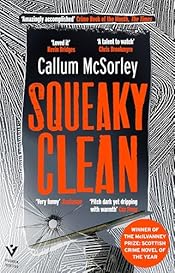
Squeaky Clean by Callum McSorley

Pushkin Vertigo, 2024, 405 p.

Alison McCoist has been all but shunned in Glasgow’s police after she made a mistake in believing the confession of a man called Knightley to the murder of a young pregnant woman. The real culprit remains at large and DI McCoist – who has enough on her plate already what with her name being similar to a well-known former footballer (‘I’ve heard all the jokes already’) and only seeing her twin children under access conditions at weekends – is as a result widely thought to be on the take.

In parental terms Davey Burnet is in the same boat as Alison. His estranged wife Sarah is seeking an order to prevent him seeing his four-year-old daughter Annalee. His job at Sean’s carwash does not pay well and he has problems with booze.

When Paul McGuinn turns up in an expensive car asking for it to be cleaned – of evidence of his extra-marital exploits – Davey and would-be law student Tim do too good a job. McGuinn keeps returning.

Meanwhile DI McCoist is working away in the background trying to redeem her reputation. Her attention is drawn to the carwash by a complaint from a female customer who left her child in the back seat to go shopping while her car was being cleaned and was subjected to abuse and threats by Sean when she came back.

One day Davey mistakes the date of his child access hearing and when reminded of it by his mother panics into taking McGuinn’s car to try to make it on time. He is blocked in on the way, and kidnapped. People out to get McGuinn – a local crime boss into trafficking, prostitution, and with a yen for violence – have made a mistake. As a harmless innocent they let Davey go and burn the car. But Davey’s error has delivered both himself and the carwash business as a whole into McGuinn’s hands. Soon all sorts of clean-up jobs, most of them grisly, fall Davey’s way.

There is a sticker on the front cover saying this won the McIlvanney Prize for Scottish Crime Novel of the Year. I thought it was all right, diverting enough but not especially notable in terms of crime fiction. It did have a strong sprinkling of Glaswegian dialect. For my taste there was too much violence but I suspect crime readers would not be displeased by that.

Oh, and despite the foregrounding of the detective in most of the commentary/reviews of Squeaky Clean I have seen this is actually Davey Burnet’s story not Alison McCoist’s.

Pedant’s corner:- on the back cover “half the Glasgow copshop think DI Alison McCoist is bent” (half the Glasgow copshop thinks ….,) bicky/bickies (biccy/biccies,) gyprock (several times. That building material’s proprietary name is Gyproc,) “next him” (next to him.) “Dannie’s Gibb’s body” (Dannie Gibbs’s,) sprung (sprang,) “dove in” (dived in,) “a twitching bag of ticks” (of tics,) epicentres (centres,) “pouring out a gash on her forehead” (pouring out of a gash,) staunch (stanch.)

Peterhead 1-0 Dumbarton

Scottish Challenge Cup,* Round Three, Balmoor Stadium, 7/9/24.

So our ridiculously bad record in this competition continues. As I recall we have only once played more than two rounds in it in any particular year, and of course that time we made it to the final.

Also this was up in Peterhead and they pretty much had our number over the past few seasons. Plus the team was ….. I believe the phrase is ‘heavily rotated’.

Ah well.

Time to concentrate on the league. (At least until the real cup comes around.)

*SPFL Trust Trophy if you must.

Kirkcaldy (And District)’s Lost Art Deco Heritage. 6. Swimming Pool, Burntisland

Old Burntisland Swimming Pool:-

It was apparently an outdoor Lido style pool:-


The photos are from Love Kirkcaldy!’s facebook page


free hit counter script