Summerland by Hannu Rajaniemi
Posted in Reading Reviewed, Science Fiction at 19:15 on 19 May 2019
Gollancz, 2018, 328 p.
I had scheduled this post to appear when I was away but for some reason only the title appeared. I’ve now binned that one. Here’s the full version.
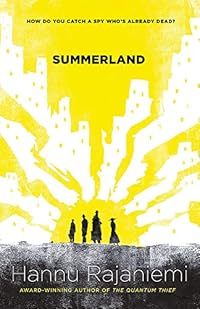
Rajaniemi’s first few novels were fairly dense narratives where not much concession by way of information dumping was made to the reader who in consequence was forced to do a bit of work in following their stories. As an approach this had its merits, as the rich, layered depths revealed themselves slowly and made for a more enriching read. By contrast Summerland has a more common narrative structure with no corresponding demands on the reader beyond suspension of disbelief. Given its timeline it could be classified as an Altered History but the milieu it depicts is really not one for which that description could fully apply being more sui generis.
Sometime towards the turn of the nineteenth and twentieth centuries radio experiments led to contact with the world of the dead. Now a whole system of communications – via ectophone and ectomail – exists between the realms, the Queen rules from what is called Summerland, the Great War was won with the aid of ghastly apparitions like the ectotank, but still a kind of cold war exists between Great Britain and the USSR. Transition between the realms (ie death) is mediated via Tickets which provide a destination for a departed soul. Without a Ticket a dead person is subject to Fading as their soul evaporates away. This will also happen even to those who had a Ticket unless sufficient suffusions of a substance known as vim occur.
The book is set over several months in late 1938 and January 1939. There is no Nazi threat but renegade from the USSR and its own Summerland god engine, Iosef Dzhugashvili, is fomenting trouble in Spain.
Rachel White is an operative of the British security services entrusted with the protection of a Soviet defector. After telling her of the existence of a mole called Peter Bloom, he blows his brains out. Her report of this revelation to her superior is greeted with dismissal, her gender being seen as making her an obvious target for an attempt to foment suspicion and distrust. Bloom, is, however, known to be close to the Prime Minister, Herbert Blanco West (whose mere name is enough to trigger associations in the reader even before we learn of his past as a draper’s apprentice who had dreams of Martian invasions and invisible men.) Similarly Rajaniemi has a bit of fun in slotting in the likes of Guy Burgess, Kim Philby and Anthony Blunt as minor characters in his tale.
The plot then consists of the usual kind of spy story albeit complicated with interferences from the spirit realm whose denizens can take over bodies in the “live” world on a kind of hire basis but also monitor the emotions of the undead, thus making it difficult to lie to them. The tale is however – unusually for a spy story – told from the viewpoint of the spy, Bloom, as well as the would-be spycatcher, Rachel.
The existence in the realm of the dead of shadowy entities called Cullers who will leap on any detected activity in the zone and pounce to ensure its inhabitants will Fade is not made much of in Summerland whose text is mainly Earth-bound and taken up with White’s efforts to prove Bloom is a spy. There is slightly more to Rajaniemi’s story than this but its appeal lies in the idea of a parallel world of the dead and its ability to interact with the ‘real’ world rather than the plot it contains.
Pedant’s corner:- I read an advanced reading copy so many of these may have been changed for final publication. “could really use a person of your calibre” (the British English for this is ‘could really do with’,) “desk a parking lot for memos” (again, ‘parking lot’ is not British English,) “lay low” (lie low,) “none of the security measures were enough” (none … was enough,) “there were a number of small glass vials” (there was a number,) “ we have a bloody mess in our hands” (on our hands,) a missing full stop at a sentence end (x2,) “she lunched with the junior staff with the canteen” (in the canteen,) “more spare time in my hands” (on my hands,) a missing start quotation mark, ”she managed slur the words” (to slur,) “in the in the” (one ‘in the’ too many,) prime minister (x2, Prime Minister,) “reached a crescendo” (a crescendo is a process, not a culmination; ‘reached a climax’, Crookes’ (Crookes’s,) “gift of gab” (gift of the gab,) “‘the benefit of doubt’” (the benefit of the doubt,) “I could use a little flattery’” (I could do with a little flattery,) “‘I just I can’t help you’” (an ‘I’ too many,) “a fearsome, feathered hat” (doesn’t need that comma,) “‘Say, do you see….’” (No English Oxford student would start a question with ‘Say’. ‘I say’, perhaps, but not ‘Say’,) “Peter let go of the drainpipe caught the roof’s edge” (and caught,) “‘you do this it a lot’” (no need for the ‘it’,) “folded his lanky frame into his bench in with great difficulty” (no ‘in’ required,) a missing end quotation mark, “the groans of the old coach” (‘the old couch’ makes more sense,) “times ten” (multiplied by ten,) “‘what are you going ty do next.’” (Is a question so needs a question mark rather than a full stop,) Djugashvili (x3, elsewhere Dzhugashvili,) “Leading up her bar exam” (up to her bar exam,) “‘setting up a meet’” (a meeting,) Symonds’ (Symonds’s,) “rode in their wake of as they pushed their way” (‘in their wake as they pushed’,) dove (dived. Please,) “‘I could, in fact, use some advice’” (I could, in fact, do with some advice,) Rache (elsewhere always Rachel,) “the men’s room” (the gents,) maw (it’s a stomach, not a mouth,) “the car’s hood” (the car’s bonnet,) “on a chair in cell” (in a cell.)
Tags: Hannu Rajaniemi, Science Fiction, Summerland
