Seven Adventures in Time and Space. Paizo, 2011, 255 p.
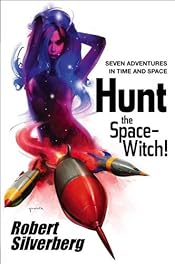 These are reprints of early Silverberg stories from the 1950s which first appeared in Science Fiction Adventures. As the stories’ titles (not to mention the book’s cover illustration) suggest they are firmly in the pulp tradition and bear most of that era’s faults and suppositions. Planet Stories as a publishing venture was set up precisely in order to resurrect them.
This volume has seven of Silverberg’s stories from that time plus an introduction from the author remembering those early days of his as a writer.
Slaves of the Star Giants. Lloyd Harkins wakes up in a future where giant creatures (whose descriptions are a bit like dinosaurs) have taken over Earth and its humans have degenerated into pre-civilisation mode while giant robots plough back and forth. He has been summoned there by someone called the Watcher who primes him to enter a place called the Tunnel City and use to overthrow the aliens. This story is typical of those where humans – especially those of the twentieth century US variety, and, naturally, males – are superior creatures.
Spawn of the Deadly Sea is set on a far future Earth which was conquered by aliens known as Dhuchay’y who flooded the planet and left its human inhabitants to live on floating cities (each of which specialises in one product with which it can trade,) and then disappeared. Dovirr is a youngster in one of these cities, Vythain, who wishes, despite the chances of being killed on sight) to join the crew of Gowyn, the local Thalassarch (one of the human rulers who go around the cities collecting tribute; apparently in return for protection from pirates.) There are also undersea creatures known as Sea-Lords who will eat anything organic thrown into the water. These are descended from humans genetically altered to fight the Dhuchay’y but who were produced too late to make any difference. Dovirr vows to Gowyn to destroy the Dhuchay’y should they ever return.
The whole scenario falls completely to pieces if you give it a moment’s thought – what use would tribute in gold be to a Thalassarch who spends all his time plying the seas? – even while reading it. However, these stories were never designed to be anything but mere entertainment.
The Flame and the Hammer. The decaying Galactic Empire is threatened with revolt. Legend has it that a device known as the Hammer of Aldryne will end the Empire by killing the Emperor. Duyair, son of the High Priest on Aldryne is interrogated by the priesthood when his father is killed by Imperial torturers seeking the Hammer. He has no knowledge of its existence or whereabouts. The rebellion starts with the new High Priest Lugaur Holsp claiming to have the Hammer but he plans to collude with the Emperor to enrich himself. It falls to Duyair to thwart this.
Valley Beyond Time. A selection of humans, several men and two women, plus three aliens, find themselves in a valley from which they seem unable to escape. They have been plucked from their normal lives by a being named the Watcher presumably to see how they react and interact. The usual jealousies and conflicts arise before they begin to test the valley’s boundaries.
In Hunt the Space Witch! Barsac seeks his friend, Zigmunn, who had been left behind on the planet Glaurus when he failed to get back to his spaceship on time. He finds Zigmunn has recently fallen under the sway of the Cult of the Witch and was taken to the planet Azonda. Barsac has to be inducted into the cult, a process involving a kind of conditioning, in order to follow him. Barsac has to overcome the conditioning to succeed.
The Silent Invaders. The people of the planet Darruu are in conflict with Medlin. In surgically enhanced disguise as a human named Harris, Aar Khiilom of Darruu has been sent to Earth to thwart the efforts of Medlin to enlist Earth as an ally. His encounter with Beth Baldwin – who turns out to be a similarly disguised Medlin spy – leads Harris to a reassessment of his loyalties.
Spacerogue. Barr Herndon is the spacerogue of the title. He has sworn revenge on Seigneur Krellig after his family had been killed during a looting raid by some of Krellig’s henchmen. Recruitment into a smuggling operation gives him the chance to achieve this.
These stories have the faults of the time they were written and the outlets to which they were sold. The protagonist is always stronger or more forceful than his opponents, there is an awful lot of casual, unthinking violence, women are generally treated as little more than sex objects, not many are given any kind of agency. The prose is barely workmanlike. They do not bear comparison with the author’s later works. This collection is only for the Silverberg completist.
I also have to say the book’s cover is execrable.
Pedant’s corner:- Harkins’ (several times; Harkins’s,) “unable to get at this throat” (at his throat,) focussed (focused,) “in an old age” (in old age; no need for the ‘an’,) a missing comma before a piece of direct speech, a missing start quote mark at the beginning of another, “‘but there was no organisation on Aldrynel’” (that ‘l’ ought to be an exclamation mark,) “‘the throne of his father distinguished’” (has very odd syntax,) mind-wracking (mind-racking,) “shrugged and shagged a mass as it hung before him” (not shagged I should think; snagged makes more sense,) Vellers’ (x 4, Vellers’s,) (like a faroff musical chord” (a far off musical chord,) vender (vendor,) Glaurus’ (x 2, Glaurus’s,) “as if in each of the masks a witch shined” (shone,) Harris’ (x 3, Harris’s,) “the music reached an ear-splitting crescendo” (sigh; the music crescendoed to an ear-splitting climax,) a missing close-quote mark at the end of a piece of direct speech, “the proteus’ body” (proteus’s,) Morais’ (x 2, Morais’s.) “The Lady Moaris could not have been more than twenty-three or twenty-five” (well, which is it then? If she was twenty-five she was more than twenty-three.)



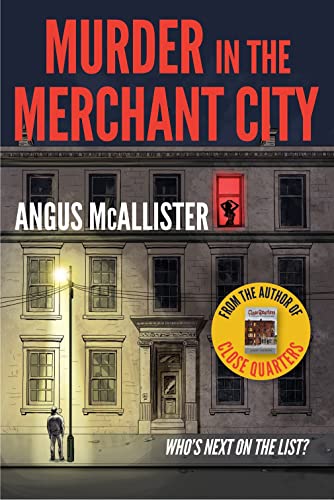 The book’s title perhaps says it all – there are murders, some scenes are set in Glasgow’s Merchant City – but is a trifle misleading. The action centres not on the Merchant City itself but on the so-called Merchant City Health Centre, a massage parlour – and an establishment with all the connotations that description of a business inevitably invokes. This is staffed by women in white coats – at least until they take them off to get down to offering extras. The most important of these to the plot are the beautiful Miranda, with the beaming smile and that way of saying, “How are you?” to her regulars, no nonsense up-front Claudia, the conventionally attractive Candy, the more homely in style Annette, and new girl Justine.




 I’m not quite sure how to categorise this. I’ve seen it described as Alternate/Alternative History (what I prefer to call Altered History) but I can’t see any change in actual history in it. It has no discernible