Archives » 2020 » August

Tolquhon Castle

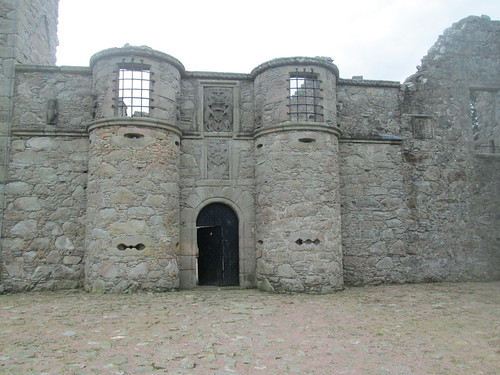
On the way up to Peterhead we also stopped at Tolquhon Castle near Ellon in Aberdeenshire. The access road is quite narrow but still fine. The castle itself is fairly typical but has an impressive entranceway.

Tolquhon Castle, Aberdeenshire

Tolquhon Castle, Aberdeenshire

Tolquhon Castle Entrance

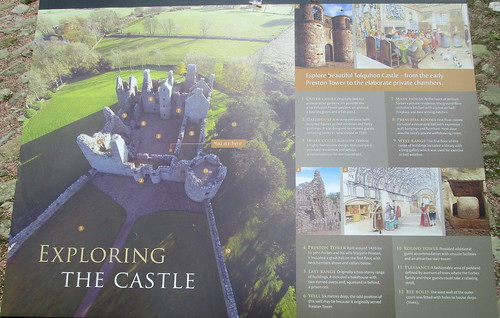
Castle Information Board showing how it looked back in the day:-

Tolquhon Castle Information Board

Castle courtyard:-

Tolquhon Castle Courtyard

Information diagram:-

Tolquhon Castle, Diagram

Entrance from above:-

Tolquhon Castle Entrance from Above

Courtyard from above entrance:-

Tolquhon Castle, Courtyard from above Entrance

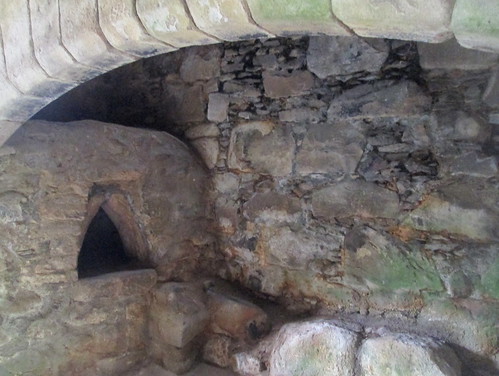
Fireplace:-

Fireplace, Tolquhon Castle

Part of interior (with another fireplace):-

Tolquhon Castle Interior

Window and window seat:-

Tolquhon Castle Window and Window Seat

Courtyard from above looking back towards entrance:-

Tolquhon Castle, Aberdeenshire

Steps up to solar:-

Tolquhon Castle, Aberdeenshire

Agnes Grey by Anne Brontë

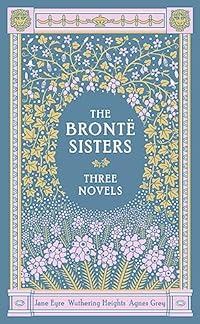
In “The Brontë Sisters: Three Novels,” Barnes and Noble, 2012, 164 p (plus iii p Introduction to the three novels.) Agnes Grey was first published 1847.

 The Brontë Sisters: Three Novels cover

Narrator Agnes Grey is the daughter of a poor-ish clergyman on whose infirmity she decides to find work as a governess to help out her family financially, albeit in a small way. The novel is a more or less straightforward account of her experiences first of all in a family where the children fail to do as they are asked, over-indulged as they are by their parents, a thankless endeavour not soon enough brought to an end, then in another – the Murrays – where she is in charge of two much older daughters, both of whom are headstrong in various degrees. The influence of Brontë’s own life in providing a milieu for her heroine is therefore obvious.

Agnes Grey is God-fearing, thoughtful and mindful of her place in the scheme of things and of her obligations to be compassionate. That others of higher social standing than herself may not be so minded, is something she becomes acutely aware of.

The hypocritical minister, the more truly Christian curate, the calculating mother prepared to sacrifice her daughter’s future happiness to a title, the scheming young girl callously set on snaring a man’s heart while never intending to gratify that desire, all make an appearance here. This fits neatly into the template of the Georgian or Victorian novel. It is all over rather quickly and it is relatively obvious from the moment of the appearance of the curate, Mr Weston, in Agnes Grey’s life where it will end. Everything seemed rather rushed, though, more like sketches for a novel than the complete article.

Pedant’s corner:- In the Introduction; a repeated full stop. Otherwise; no start quote mark when a chapter begins with a piece of dialogue, “it would be with different, feelings” (why the comma?) opportunityl (opportunity,) visiter(s) (several instances, visitor(s),) by-the-bye (previously – on the same page! – by-the-by.) “‘What do your mean, sir?’” (you,) secresy (an old spelling?) “None of the Murrays were disposed to….” (None … was disposed to,) visa versa (nowadays always vice versa,) wofully, woful (now spelled woefully, woeful,) “the congregation were departing” (the congregation was departing,) “not to shabby or mean” (not to appear shabby or mean,) worky-day (now spelled workaday,) “said be” (said he.)

Stoneware, Pitmedden Garden

More photos of Pitmedden Garden.

Gates with steps down to formal garden:-

Gates, Pitmedden

Heart shapes by the gates above:-

Heart Shapes in Stone, Pitmedden

Bottom of steps:-

Below the Gates Pitmedden Garden

Drinking fountain at steps:-

Gates from Formal Garden, Pitmedden

Steps and gates above:-

Gates and Stairs, Pitmedden

Another set of gates. There is a private area beyond:-

Gates, Pitmedden Garden, Second Set

Human sundial:-

Human Sun Dial, Pitmedden

The human acts as the sundial’s gnomon by standing where indicated, according to the month. It obviously matters what the weather is like. I tried it but cast no shadow at all:-

Human Sun Dial Plaque, Pitmedden

SF Bookshelf Travelling for Insane Times (vii)

This meme started with Judith at Reader in the Wilderness but has now been taken up by Katrina at Pining for the West.

Science Fiction Books Again

This shelf is the last containing SF books I have read. These start at Connie Willis and finish with Roger Zelazny – to whom all bar Silverberg and Le Guin bow down – but also incorporating my copies of the old Spectrum SF magazine (I have six copies of issue 2 because I had a story in it – I also had one in issue 3 but only got four copies of that) and 17 issues of Galaxy Magazine. [Edited to add. I forgot my four copies of the Destinies collections are in there too.]

In there is also my John Wyndham collection.

The 20 books following I had read (from Dumbarton Library it must have been) before I bought copies to keep and have housed them separately from my other SF ever since.

Then you’ll note two copies of a book called A Son of the Rock, plus a Zelazny collaboration.

Pitmedden Garden

When I was up north for the Peterhead game in August last year we took the chance to visit Pitmedden Garden as it’s always been somewhere the good lady wanted to see.

In the formal garden there’s some odd topiary:-

Topiary, Pitmedden Formal Garden

A fountain:-

Fountain, Pitmedden Formal Garden

A pond:-

Formal Garden, Pitmedden

Some geometric planting:-

Pitmedden Garden, Ellon, Aberdeenshire

Pitmedden Garden, knot garden, Aberdeenshire

An upper terrace with a semi-circular sculpture at the far end:-

Terrace, Pitmedden

The terrace gives a good view of the formal garden:-

Pitmedden, Formal Garden from Terrace

Formal Garden from Terrace, Pitmedden

The Gone-Away World by Nick Harkaway

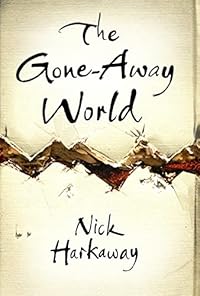
William Heinemann, 2008, 540 p.

 The Gone Away World cover

The Jorgmund Pipe circles the Gone-Away world, protecting its environs from the Stuff which conjures new people and things out of dreams snatched from the minds of survivors of the Go Away War by delivering FOX (inFOrmationally eXtra-saturated matter) into the air surrounding it. It is the aftermath of said War, so-called because of the deployment of Go Away bombs (which do as their name suggests; their targets simply disappear.) Not quite as secret a weapon as its original users thought, though, since retaliation in kind came swiftly, leaving only pockets of normality in its wake and the unforeseen side-effect of strange apparitions/demons/monsters, (delete as to taste) swirling out of the affected areas, manifestations of Stuff.

Nothing hereafter ought to detract from what in the end turned out to be an engaging, emotionally involving read. Harkaway is a talent, as he has shown in subsequent books, but this novel is not without its flaws – even if it does have a daring conceit as its turning point.

We kick off when (despite an anonymous phone call advising its employees not to) the Haulage & Hazmat Emergency Civil Freebooting Company of Exmoor County, of which our narrator is a member, takes up a contract to put out a fire which threatens to destroy both the Pipe and the factory producing FOX. The company’s unwieldy title is an indicator of Harkaway’s approach here, an exuberance of word-play which tends to the wearing – at least until the book settles down. The author is certainly not afraid to call a spade a horticultural implement and otherwise circumlocute all the way around a subject in an attempt to provide levity, or (if you wish to be generous) to avoid cliché or the humdrum. It certainly makes for an impressive word-count. It was Harkaway’s first novel though, so we may forgive a little exuberance. (A little, but not a lot.)

Despite the destruction wrought by the Gone-Away bombs, there are still buses and cars (leaving me to wonder where the petrol for them came from) streetlamps, shops – gentlemen’s outfitters no less – and hierarchies of wealth much like that in the world before the war. Despite all having changed, in the larger settlements of the Pipe’s environment things appear to be much as they were before the War. (A nit-picking complaint, I agree, the author’s invention and creativity have been expended in other areas and it is possible to ask too much of a narrative, but it seemed to me to land on a default which the scenario would have made unlikely and thus undermined it.)

Then there is the book’s structure. By all means begin as near to the end as possible (as a piece of writing advice I read recently had it) but it is perhaps a mistake to presage a set-piece then – for all that it is the novel’s fulcrum – delay its depiction for well more than half the book. From that set-up we jump to our narrator’s back-story and relationship with his lifelong friend, Gonzo Lubitsch, his tutelage by a Zen master known as Wu Shenyang, his dabbling with roughly left-wing politics as a means to accessing girls, his targeting as a subversive and turning into a soldier and counter-insurgent, his encounter with the inventor of the Go-Away bomb, his awareness of the dirtiness of politics and international financial manœuvrings, his experience of the War and of its aftermath in the building of the Jorgmund Pipe. One highlight of this is a description of the difficulties of organising and carrying through a first-date – or making flapjacks – in a war zone; a ‘normal’ war zone at that.

The piece of authorial bravado at the heart of the book – which in its own terms justifies that structural choice – does not quite make up for it. For what happens when we are finally shown the Civil Freebooting Company extinguishing the fire – and incidentally discover along with the characters just how FOX is made – calls into question all that has come before. Not quite as in Kate Atkinson’s A God in Ruins but in a similar vein (yet opposite sense.) It does though highlight the question of what it might mean to be human. That is, of course, fiction’s job.

Pedant’s corner:- a few commas missing before pieces of direct speech, “one less layer” (one fewer,) “to test their metal” (Dearie me! The thing is you test is mettle,) hiccough (there is no derivational evidence for this spelling; hiccup,) “dinted grill” (grille,) appalls (appals,) genii (except in the sense of ‘spirit’ – which here it was not – the English plural of genius is geniuses,) infinitessimal (infinitesimal,) “so now there is now a crowd” (one ‘now’ too many,) “layed out” (laid out,) “beautiful woman are not rare” (women,) rarified (rarefied,) “‘I thought you were a gonner’” (a goner,) “I have kneeled” (knelt,) burglarised (for heaven’s sake! The word is burgled,) squidgey (squidgy,) Archimedes’ (Archimedes’s,) an opened parenthesis which is never closed (unless it was by the parenthesis later on the same page. But it didn’t read like that.)

Britain in the the 15th Century

I’ve just been perusing the blurb on the publisher’s page for a book called Divine Heretic written by one Jaime Lee Moyer.

The blurb starts with the sentence, “Everyone knows the story of Joan of Arc, a peasant girl who put Charles VII on the throne and spearheaded France’s victory over Britain before being burned by the English as a heretic and witch.”

Britain? In the 15th century? That’s some Altered History! The United Kingdom didn’t become so until about 300 years later, 1707 in fact.

I wonder who at Jo Fletcher Books (for it was they) thought Britain had an army in the 1400s – or that back then such a country existed that could have one. Or doesn’t know the difference between Britain and its constituent parts. Or mistakenly thought they might offend some not English inhabitant of the present day UK by saying England (in which case they failed miserably.)

(At least they put the blame for Joan’s burning in the right hands.)

Live It Up 71: Sugar Mice

The second single from the Clutching at Straws album, which overall dealt with the effect, and strains, of continuous touring and presaged the split of Fish from the band.

This one contains one of Steve Rothery’s signature (and excellent) guitar solos.

Marillion: Sugar Mice

Aberdeen, Wallace Statue and Market Cross

Statue of William Wallace in Aberdeen. This stands near Union Terrace Gardens. It is inscribed, “Willam Wallace, Guardian of Scotland” and in addition, I tell you a truth, liberty is the best of all things, my son, never live under any slavish bond, and was paid for with funds left for the purpose by John Steill of 38 Grange Road in Edinburgh, the son of James Steill sometime of Easter Baldowrie in Angus:-

William Wallace Statue, Aberdeen

Aberdeen’s Old Market Cross dates from 1686:-

Old Market Cross, Aberdeen

War Memorial, Aberdeen

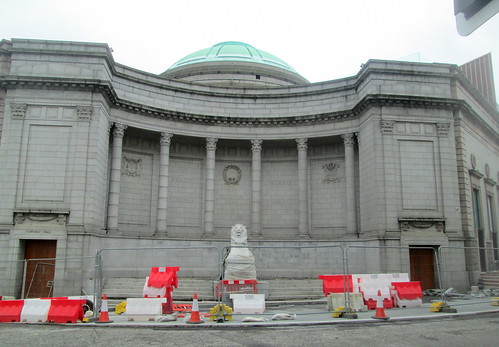
Aberdeen’s main War Memorial is located at the end wall of Aberdeen Art Gallery and Museums. I believe Aberdeen’s Roll of Honour is housed inside the museum.

The Memorial comprises the wall and a stone lion. The wall is inscribed, “MCMXIV – MCMXIX, To Our Glorious Dead, MCMXXXIX – MCMXLV.”

Unfortunately in August last year there were refurbishment works going on.

Wider view. Refurbishment works in evidence:-

War Memorial Aberdeen

Closer view:-

Aberdeen War Memorial

free hit counter script