Archives » 2020 » August

Balmoor Stadium, Peterhead

Balmoor Stadium is the home of Peterhead FC.

I visited it for the first time when Sons played up there in August last year.

From access road:-

Balmoor Stadium, Peterhead From Access Road

The photos below take you on a clockwise circuit of the interior.

East Stand from northwest:-

East Stand, Balmoor Stadium

Main Stand from north-ish:-

Main Stand, Balmoor Stadium

Main Stand from northeast:-

Main Stand, Balmoor Stadium

East Stand:-

East Stand, Balmoor Stadium

North end:-

North End, Balmoor Stadium

East Stand from north:-

East Stand Balmoor Stadium

East Stand from south:-

Balmoor Stadium, East Stand

Main Stand from southeast corner:-

Balmoor Stadium, Main Stand

South end and part of Main Stand:-

Balmoor Stadium, South End and Main Stand

Royal Border Bridge, Berwick (Berwick Rail Bridge)

The Royal Border Bridge, Berwick was built between 1847 and 1852 to carry the railway over the River Tweed.

From north bank:-

Rail Bridge, Berwick. Royal Border Bridge

Southern part:-

Royal Border Bridge, Berwick

From Tweedmouth:-

Rail Bridge, Berwick, From Southeast

Tweedmouth War Memorial

Tweedmouth’s War Memorial stands at the southern end of Berwick Bridge almost in the shadow of the newer Royal Tweed Bridge.

From Berwick Bridge (Royal Tweed Bridge in background):-

Tweedmouth War Memorial

The Memorial’s inscriptions are, “In ever grateful and proud remembrance of the brave men of Tweedmouth who fell in the Great World War 1914-1918 and of the men and women of Tweedmouth who lost their lives in the Second World War. They were a wall unto us both by night and day.” “Erected by the inhabitants of Tweedmouth and other friends.” There is also a dedication to 2nd engineering officer Paul A Henry GM, 8/6/1982, aboard RFA Sir Galahad, at Bluff Cove – Falkland Islands. Below are the dates “1914-1919” and “1939-1945” and “To the memory of the men and women of Tweedmouth who have fallen since 1945.”

War Memorial, Tweedmouth

Memorial from west:-

War Memorial Tweedmouth

Reverse of memorial:-

Tweedmouth War Memorial, Reverse

Behind the Memorial on the wall bordering the River Tweed are some shields installed to remember those whose names were not included on the Memorial itself. From left to right: Civilian Personnnel, Royal Air Force, The youth of today remember the youth of yesterday. This last has the furtehr information, “These shields were requested by the children of the area In Memory of the Fallen.” “We do not forget.” (Royal Tweed Bridge and Berwick Bridge in background.)

Shields by Tweedmouth War Memorial

There are two more shields to the right of Youth of today; Royal Navy and British Army:-

War Memorial Shileds, Tweedmouth.2

Tweedmouth War Memorial and Berwick Bridge from Royal Tweed Bridge:-

Tweedmouth War Memorial and Berwick Bridge

Old Bridge Over the Tweed, Berwick Upon Tweed

I have posted pictures of Berwick’s bridges before, in 2010.

Berwick’s old bridge was built between 1611 and 1624. Previously wooden bridges had spanned the river but were variously destroyed by floods or military action.

From Tweedmouth side:-

Old Berwick Bridge

From newer bridge (to west; stitched photo):-
Berwick Old Bridge

From northwest, on new bridge (stitched photo):-

Old Berwick Bridge

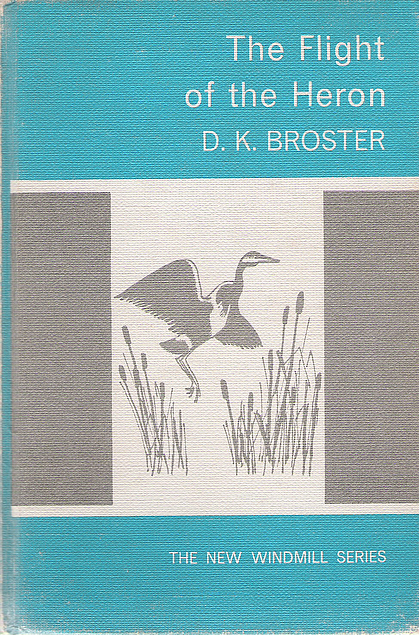
The Flight of the Heron by D K Broster

William Heinemann, 1956, 286 p. First published 1925.

 The Flight of the Heron cover

Broster wasn’t Scottish but the background to her story most certainly is, probably the most worked-over seam in Scottish history, the Jacobite Rebellion of 1745-6, from Scott kicking off the whole historical novel malarkey with Waverley to Diana Gabaldon’s Outlander.

The focus here is very much not on the battles of that rebellion but on the relationship between Jacobite Ewen Cameron (of Ardroy) and a Government Army Officer, the Englishman Captain (later Major) Keith Windham of the Royal Scots.

Just after Bonnie Prince Charlie has landed in Scotland, Windham is captured by Cameron (due to no fault of his own – his horse shying at a heron rising in front of it, which only slightly injures him but breaks the horse’s leg – leaving him all but defenceless.) Windham is surprised to find Cameron not the barbarian of his expectations but a gentleman with fine and chivalrous manners. Having given his parole, Windham is indebted to Cameron for intervening when on a stroll round the Ardroy estate he comes across locals retrieving their arms cache from the thatched roofs of their houses and is thereby thought to be a spy. In the meantime, we find that Cameron’s foster-father – who is a seer – has predicted that Cameron and Windham will meet a total of five times, leaving the reader totting up their encounters. Sure enough the pairs’ paths cross again in Edinburgh after the Battle of Prestonpans when Windham has sallied from the castle in an attempt to capture the Prince – to whom Cameron is now aide-de-camp – who is visiting a house nearby, and once again Windham finds himself indebted to Cameron for allowing him to escape the clutches of Highlander reinforcements.

Windham’s opportunity to repay these favours occurs in the aftermath of Culloden when he arrives just in time to prevent the execution of an almost dying Cameron – wounded and exhausted, barely able to stand – at the hands of a detachment of Government soldiers sweeping the countryside for rebels. Windham’s speiring of Cameron as to the whereabouts of Clan Chief Lochiel then becomes a source of distrust between them before two final meetings in prison resolve their situation.

The book is dedicated to Violet Jacob, whose Flemington – which covers much the same ground as this – and Tales from Angus I read in 2015. Broster is not as good a stylist as Jacob was, though. Indeed, her prose tends to the utilitarian, but she does have an eye for landscape.

It is, however, impossible to read this book nowadays without wondering about its undercurrent, Windham’s several times expressed “strong attraction” for Cameron. His striving to ensure Cameron does not suffer unduly in the Government soldiers’ hands – even to the point of incurring the direct displeasure of the Duke of Cumberland – speaks of something more than mere obligation or friendship. A something that perhaps could not be addressed in so many words on the book’s first printing in 1925.

Pedant’s corner:- the very first word! Prolouge (Prologue,) h (he,) “‘the Elector’s’” (the meaning was ‘of the ‘Elector’ hence, the ‘Elector’’s,) a missing full stop, “a file of soldiers were advancing” (a file … was advancing,) Glangarry (Glengarry, I think,) “more then stupefaction” (more than,) ‘Hangman Hawley (‘Hangman Hawley’,) Mullins’ (Mullins’s,) an unnecessary end quotation mark, “which was, be believed” (which was, he believed,) Babenoch (Badenoch,) “‘for you solicitude’” (your,) “aide-de-camps” (aides-de-camp, as was used elsewhere, except for one “aides-de-camps”) a few missing commas before pieces of direct speech, lous d’or (louis d’or,) will-o-the-wisps (wills-o-the-wisp,) “were else” (where else,) staunch (stanch.)

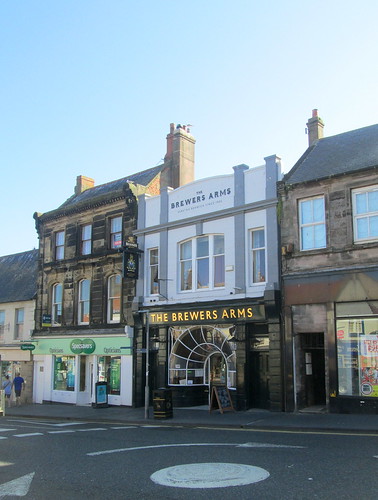
Unusual Shop Window, Berwick

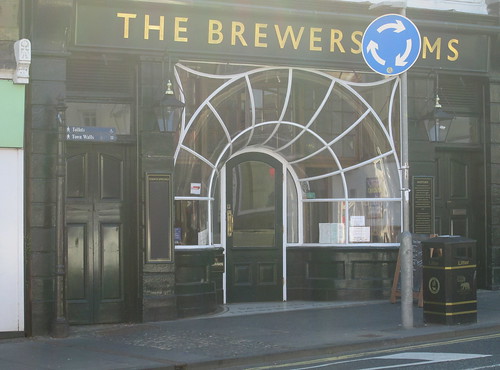
A stunning piece of window glazing on The Brewer’s Arms, Berwick-Upon-Tweed. There’s almost a hint of Deco on the building’s upper portions and roofline.

From south(ish):-

Shop Window Glass, Berwick

From north:-

Window Glass in Berwick Shop

Windows close up:-

Shop Window Glass, Berwick

More Bookshelf Travelling for Insane Times

(Another entry for Judith’s meme at Reader in the Wilderness.)

These are kept on the bottom two shelves of an old display cabinet. Mostly old books with lovely bindings – Bruce Bairnsfather‘s Bullets and Billets is in there – but also some modern Folio Editions of Siegfried Sassoon‘s Memoirs of a Fox-Hunting Man and its sequel plus Crime Stories from the Strand.

Old Books

Dunbar Battlefield

The last major act in Scotland of the Wars of the Three Kingdoms – still known to some as the (English) Civil War – was the Battle of Dunbar in 1650.

We’ve been to Dunbar many times and I had spotted a signpost pointing to the battlefield but at the time had an appointment elsewhere so couldn’t stop.

Last year the good lady and a friend had signed up to FutureLearn history course on the battle, their interest triggered by the discovery at Durham Cathedral of human remains which turned out to be those of Scottish soldiers captured during the battle, and taken to Durham to be kept imprisoned (under atrocious conditions) in the Cathedral, where some died.

So it was that last summer we made a concerted effort to find the battlefield. Yes, there was that signpost but there’s not much in the way of information boards at the battlefield itself or on the road the signpost pointed along. This very recently erected stone was set back from the road and commmemorates those taken prisoner at the Battle of Dunbar, 1650.

Dunbar Prisoners Memorial

However, I am not sure if the two pictures below are of the battlefield or not. (North Sea in background.) After we came home I read up a bit and found the site of the battlefield straddles the main A1 road but does lead down towards the sea.

Dunbar Battlefield

Dunbar Battlefield

Once back at the road from which the signpost points we discovered this memorial. On it is an inscription, “3rd September 1650,” and a quotation from Thomas Carlyle, “Here took place the brunt or essential agony of the Battle of Dunbar.” (In the background is a modern cement works – and a horse):-

Dunbar Battlefield (1650) Marker Stone

Close-up:-
Battle of Dunbar, Carlyle Stone 1

A museum in Dunbar had a display about the battle including a piece of tapestry commemorating the Battles of Dunbar 1650, and Worcester 1651:-

Tapestry Panel, Dunbar Museum

Ancient Evenings by Norman Mailer

Picador, 1984, 715 p.

 Ancient Evenings cover

The main preoccupations of the novel as a form throughout the years have been with love, sex and death. This is not a love story and, since it revolves around reincarnation, that pretty much takes care of death. (Not entirely, there is a long description of the Battle of Kadesh, which isn’t exactly mortality free, and to be reborn one has to die, but these are all-but incidental.)

That leaves only sex, la petite mort. And boy, does it leave sex. You name it, it appears in these pages.

Not that there is much intimation of that to start with. We begin with someone – we quickly learn this person is named Menenhetet Two – waking up in the Great Pyramid of Khufu, assuming himself to be dead, and making his way up into the light. (Ancient Egyptians of course had an afterlife.) This is the first of seven Books in the novel, The Book of One Man Dead. The others are The Book of the Gods, The Book of the Child, The Book of the Charioteer, The Book of the Queens, The Book of the Pharaoh and The Book of Secrets, in all of which the chapters are preceded by that section’s descriptive Egyptian hieroglyph.

The first two are fairly turgid, the second, The Book of the Gods, being an account of Egyptian mythology but which doesn’t seem to serve much of a purpose beyond illustrating their Gods’ convolutions. It is only in the third section that we begin to have some appearance of story. Here Menenhetet Two, as a seven year-old boy, accompanies his parents (mother Hathfertiti and father Nef-khep-aukhem, who in Egyptian tradition are half-siblings,) and his great-grandfather Menenhetet One, to a celebration known as the Night of the Pig (an unclean animal of course,) in the presence of Pharaoh Ptah-nem-hotep, also known as Ramses the Ninth, in the royal city of Memphi. The later chapters play out the ramifications of this evening and Menenhetet One’s reminiscences of his four lives so far, but are mostly set during the life and times of the Great Pharaoh Ramses the Second, (Usermare Setpenere,) whom Menenhetet One served in various contexts – as charioteer, then General, then governor of the little queens in the House of the Secluded (the Pharoah’s harem,) then guard to Ramses’s Queen, Nefertiri, and later to the Pharaoh’s third Queen, the Hittite princess Rama-Nefru, but also, in Menenhetet One’s second life, as High Priest – during his long reign.

Egyptians, due to the influence of the Nile, are privy to other people’s thoughts and Menenhetet Two experiences all of this – and knowledge of his mother’s desire to actually have sex with Ptah-nem-hotep (eventually fulfilled) – mostly by pretending to be asleep. So it is that Menenhetet Two learns his great-grandfather and his mother have been long-time lovers and his real father is Ptah-nem-hotep, conceived by Hathfertiti through devious means.

Mailer makes a fair enough attempt to mimic ancient Egyptian speech patterns and phraseology but in the main the novel is overwritten, which renders it hard going to start with. The details of Menenhetet One’s first life though do manage to conjure some interest but there are still significant longueurs within most of his reminiscences.

My overall memory of this book, however, is likely to be of the quite ridiculous amount of sex it contains.

Pedant’s corner:- On the backcover “Nefititi” (In text it’s always Nefertiri.) Otherwise; lay (lie,) Isis’ (Isis’s,) Osiris’ (Osiris’s,) Horus’ (Horus’s.) “The air alt red” (altered.) “My means might be one-seventh of what once it had been” (of what once they had been.) “Ahead were nothing but mountains covered with trees” (Ahead was nothing but…,) paniers (panniers,) “the first of our advantages were the bows” (the first … was the bows,) staunch (x 2, stanch.)

Something Changed 37: Losing My Religion

There’s something about this I just like. Perhaps it’s the mandolin. Or maybe the lyric. Or that it actually ends.

Whatever, it’s a great pop song.

REM: Losing My Religion

free hit counter script