Archives » Alastair Reynolds

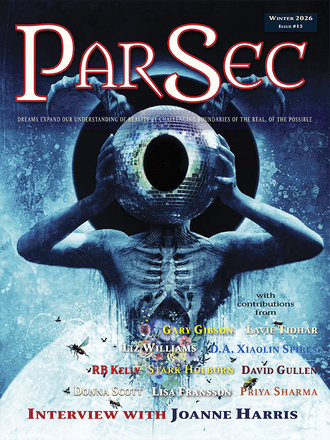
ParSec 15 Update

ParSec 15 is indeed live and I now have my copy.

I found it does contain my reviews of City of All Seasons by Oliver K Langmead and Aliya Whiteley along with The History of the World by Simon Morden but not that of Project Hanuman by Stewart Hotston.

I have four other reviews there though:-

The Measurement Problem by David Whitmarsh,

Halcyon Years by Alastair Reynolds,

Exiles by Mason Coile,

plus Solstice by Ruth Aylett and Greg Michaelson.

Halcyon Years

Another book to review for ParSec.

This time it’s the latest by Alastair Reynolds, titled Halcyon Years.

Judging by the front cover blurb it’s a Space Opera.

Why not? Reynolds is rather good at them.


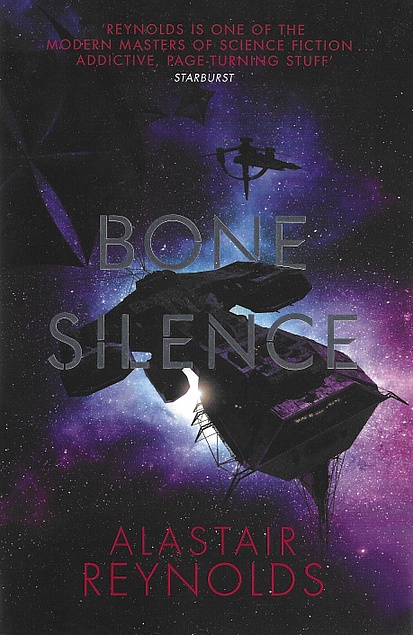
Bone Silence by Alastair Reynolds  

Gollancz, 2020, 605 p.

This exploration of a far future Solar System travel through which is powered by solar sails with auxiliary rocket powered launches for shorter journeys continues the adventures of the Ness sisters, Adrana and Fura, after the events of Revenger and Shadow Captain. The readjustment of the economies of the Congregation following the sisters’ agglomeration of a cache of quoins – which resulted in their values changing – is in full swing but they are in flight from a squadron representing the banks and commerce, led by one Incer Stallis. In search of a bone skull (skulls are a kind of mystical communication device only accessible by adepts) to replace Revenger’s defunct one, they take over another ship, the Merry Mare and split the two crews.

Adrana’s promise to an alien, the Clacker, Tazaknakak, to take him to the spindly habitat known as Trevenza Reach gives her an objective. Meanwhile Fura’s ongoing succumbing to the glowy threatens to completely debilitate her while crew member Strambli has been taken over by ghostie stuff.

Adrana’s suspicions about Lagganvor – whom they picked up in Shadow Captain – multiply while her curiosity about the Congregation’s history (the so-called Occupations which have been recurring at increasing intervals and in whose thirteenth instance they all live) grows.

The scenario’s resemblance to (post)Napoleonic era naval encounters adds a swashbuckling feel to proceedings as does some of the terminology. In a sense this is old boy’s adventure stuff with SF trappings – except of course the adventurers are women.

Fura realises quoins are drawn to the Old Sun, and it is revealed they are really little machines, (or vast machines yet mostly hidden,) healing angels designed to descend into the ailing fires of the Old Sun and make it youthful again. Each is a sort of engine in its own right, “‘not quite existing in the same plane of space and time as we do’” robbed from their true purpose, manipulated by aliens who needed humans to retrieve them from baubles.

In a somewhat hurried coda (in terms of what has gone before) they find the source of the recurring Occupations, an artefact called the Whaleship. A reference to Moby Dick?

While I found this conclusion a touch unsatisfactory the ride Reynolds takes us on in this trilogy is an attractive one. The Ness sisters are good company.

Pedant’s corner:-  “into the open top of the one of the central tanks” (into the open top of one of the central tanks,) “the epicentre of the console” (the centre of the console,) maw (many times. A maw is a stomach; not a mouth,) “being stirred around in bucket of cement” (in a bucket of,) Werrenwell (elsewhere always Werranwell,) “can’t fix in jiffy” (in a jiffy,) “presented with lavishly-wrapped gift” (with a lavishly-wrapped gift,) sprung (many times; sprang,) “‘a number of enter[rising successes to his success’” (clumsy double use of success,) “positioning it within cradle at the focal point” (within the cradle,) fit (fitted,) “had called in to the warn her” (had called in to warn her,) an extraneous opening quote mark within a piece of dialogue, “the intervals between volleys was much reduced” (the intervals … were much reduced,) “at that great long tableaux” (tableaux is plural: tableau,) “faded but not entire disreputable café” (but not entirely disreputable,) “back out from under overhang” (under the overhang.) “‘Why not eh.’” (is a question so ‘Why not, eh?’,) “Stallis’ face” (Stallis’s,) “urging them to not to delay” (urging them not to delay,) “even if none of the sizes were an  ideal fit” (even if none of the sizes was an ideal fit,) “as yet the wounds were little too raw” (were a little too raw.)

Shadow Captain by Alastair Reynolds

Gollancz, 2019, 430 p.

The previous novel in this sequence, Revenger, was narrated by Arafura Ness. In this one, by contrast it is her sister, Ardana, whose viewpoint we are privy to.

Like in Revenger, the scenario – even down to modes of speech – is reminiscent of old-time pirate stories and the adventures have a swashbuckling feel, though the characters are blessed with (some) higher-tech.

They inhabit a human society arranged in the Congregation, an array of worlds centred round the now fading Old Sun. All of human activity is carried out within a volume only eighteen light minutes across. Fairly recently an enigmatic race of aliens known as Crawlies has entered into The Congregation whose past history has consisted of a series of so-called Occupations in which what Ardana calls monkey civilisations – of which her own is only the latest – have risen only to fall again. These efflorescences take place on a fairly regular basis, a fact which Ardana feels is significant and may be due to an object orbiting the Old Sun at a considerable distance beyond The Congregation’s limits. That, though, is for a later book.

Travel between the many scattered usually relatively small worlds is by spaceships powered by solar sails, with rocket powered launches used for shorter distances (approaches to habitats and so on.) This slow mode of travel is of course a direct analogue of sailing ships of the past.

Due to having to eat lightvine to survive, Fura is a victim of a disease known as the glowy. In the last book she rescued Ardana from the clutches of the notorious pirate Bosa Sennen, who was killed and her ship taken over. Bosa’s malign influence on Ardana in trying to mould her into a possible successor still lies within her and comes out in times of stress. The sisters are now in charge of that ship, Nightjammer, which they call Revenger. Their companions are Surt, Prozor, Strambli, Tindouf (who speaks like an old sea dog,) and a diminished AI called Paladin.

Their first objective here is to stock up on fuel for their launch to which end they have to venture down into the habitat where Bosa stored it. Inside they follow a corridor traversed every thirty-eight or so minutes by a tight-fitting sphere, rolling over everything in its path like something out of Indiana Jones, not to mention a group of zombie-like twinkle-heads from which they have to flee with only a couple of fuel tanks.

However, on the Revenger’s scope Surt has noticed a sail flash, possibly from a shadowing ship. Being on Bosa’s ship whose death being unknown  means they will likely be taken for her and subject to possible arrest.

In the captain’s cabin an object called the Glass Armillary (though it’s more like an orrery) displays the Congregation as a series of spheres arranged in processionals – rings around the Old Sun.

When Strambli is injured while the sails are being adjusted to disguise Revenger’s appearance, there are three possible habitats to find medical help. Metherick needs too much fuel, the inhabitants of Kathromil hate Bosa, which leaves Wheel Strizzardy. Fura secretly has another reason to land there as she hopes to find a man called Lagganvor, one of Bosa’s former crewmates who managed to escape her clutches.

Wheel Strizzardy, a gloomy, misbegotten place somehow or other suffering from sodden conditions, turns out to have fallen under the control of Mister Far-Gone Glimmery, a victim of the glowy more advanced than Fura. Glimmery’s physician, Dr Eddralder, administers a palliative when he suffers an attack, but to protect against poisoning Eddralder also has to give the drug to his daughter Merrix beforehand.

An incident involving the death of a Crawly allows them to leverage an escape along with Eddralder, Merrix and Lagganvor, whose knowledge of Bosa’s habits enables them to locate the world known as The Miser where she kept her hoard of quoins the Congregation’s mysterious currency. What happens there means they have to get themselves well away from the Congregation presumably to seek out Ardana’s object circling well away from the Old Sun. But Ardana knows Lagganvor and Dr Eddralder have secrets of their own.

While Shadow Captain has plenty of incident – and intrigue – it wasn’t as engaging as Revenger. This may be the curse of middle parts of trilogies. The scenario is no longer new, the resolution delayed. It is executed well though, the main characters are sufficiently complex to remain interesting. The third instalment, Bone Silence, (bones are a fantastical type of instantaneous communication device involving twinkles) is on my tbr pile.

Pedant’s corner:- maw (x 2, it’s not a mouth,) “none of the others were directing,) (none of the others was directing,) “like a gristly pendulum” (grisly? Though gristly also works,) “like a carrion” (like carrion,) “‘we’d unwise to’” (we’d be unwise,) “none of us were immune” (none of us was immune.) “‘At least day or so’” (At least a day or so,) “to be reliable judge” (to be a reliable judge,) “off of” (just ‘off’, no ‘of’,) “feeling that that,” (only one ‘that’ needed,) sunk (sank,) “a Bone Merchants” (Bone Merchant’s.) “One was small black pouch” (was a small black pouch,) “it was handsome piece” (was a handsome piece,) “though I had strived” (had striven.) “‘Is it a falsehood, I trust?’” (It is a falsehood, I trust?) skeptical (sceptical,) “was a like a coffin” (no need for that first ‘a’,) an extraneous end quotation mark, sprung (sprang,) “‘may spare us a save us two or three days’” (either ‘may spare us a two or three days’ or ‘may save us two or three days’.) “‘Yours is still be finalised’” (still to be finalised,) “on such a doubtful grounds” (either ‘on such doubtful grounds’ or ‘on such a doubtful ground’,) “that might have once have adorned” (has one ‘have’ too many,) from whence (just ‘whence’,  the ‘from’ is superfluous,) diaphanous (diaphanous.) “Lagganvor’s answered me” (Lagganvor answered me.)

Permafrost by Alastair Reynolds

Tor.com, 2019, 172 p.

Reynolds can be relied upon to give us good, solid well-written SF. This is a departure from his usual galaxy-spanning Space Opera epics though; a tale of environmental catastrophe and time travel.

Permafrost is the name of the time travel project, whose base is located in Kogalym in the far north of Russia. In 2080, after an event known as the Scouring has removed nearly all life on Earth starting with insects and radiating outwards from there, Valentina Lidova, an 80 year-old woman is recruited into the project seemingly because she is the daughter of mathematician Luba Lidova who worked on the mathematics of paradoxes. It is explained to Valentina that time has a block structure, more like a crystal lattice than a river, circuit diagram or tree. But the lattice isn’t static. It can adjust itself or be adjusted.

The project is regulated by four AIs named The Brothers, each after one of those in the Karamazov novel. The time travel mechanism involves twinned electrons called Luba pairs one of which is sent back into the brain of an experimental subject in the past.

The choice of Valentina as the first chrononaut (though Reynolds eschews this term) surprises the rest of the trainees as she joined the most recently. She is sent into the mind of Tatiana Dinova, a woman undergoing brain scans in 2028.

Complications ensue when Valentina discovers Tatiana is able to communicate with her and when others of the trainees sent to an earlier time begin to interact with her. It seems that even further in the future than 2080 efforts are being made to disrupt their mission and their controllers have become desperate and taken risks.

The story then settles down into what are in essence two chases, one in 2028 to secure the caching of a sample of seeds for use in 2080 and one in 2080 to obviate interference from the further future.

This is excellent, well-constructed SF.

Pedant’s corner:- “There were flaws in it imperfections,  impurities and stress points.” (There were flaws in it; imperfections,) “the thunderclap arriving after a lighting flash” (lightning flash,) focussing (focusing.) “Cho had even showed me” (shown me.)

Elysium Fire by Alastair Reynolds

Gollancz, 2018, 410 p.

The Glitter Band is an extensive collection of space habitats in orbit around the ochre and mustard clouded world of Yellowstone, forming a ring girdling the planet. It is an extensive democracy; votes being carried out in real time across the system due to a set of implants in people’s brains invented by Sandra Voi. The integrity of the system and its laws is watched over by a police force known as Panoply, administered by agents called Prefects. Their instrument of control is a device called a whiphound; semi-autonomous, sinuating AI creatures. This is the second of Reynolds’s novels featuring Prefect Tom Dreyfus, the first of which I reviewed here.

The immediate threat to public order here is a disease which Panoply has named wildfire, where people’s brains suddenly melt for no apparent reason. The occurrence of these deaths is on an exponential trajectory and there is no noticeable link connecting the victims. A secondary concern is the tendency of some of the habitats to seek independence from the rest of the Glitter Band. In this regard the activities of rabble-rousing populist Devon Garlin, making speeches contending that Panoply is a malign force, overbearing but at the same time unable to protect its citizens, who should therefore free themselves from its shackles.

Another strand features the adolescent brothers Julius and Caleb, being trained by Marlon and Aliya Voi to shape quickmatter and carry on the family tradition of safeguarding the Glitter Band’s democracy by subtly manipulating its data flows in undetectable ways. This is not a clear-cut process. The boys have recurring dreams of a massacre and their relationship to Marlon and Aliya is not as straightforward as they think.

In his investigations Dreyfus interrogates the beta-levels of wildfire’s victims. These are computer-held simulations of dead people’s brains, containing their memories. A strange white tree-like structure whose image appears in some of the victims’ backgrounds, along with the help of a shadowy character named Aurora who is able to communicate directly with Dreyfus but whose bargain with him Panoply would regard as treason leads him to a place named Elysium Heights, where the novel’s connections begin to untangle.

Aurora and her antagonist the Clockmaker both featured in that earlier novel, The Prefect, but the latter makes no appearance in this novel. Clearly there is more Reynolds intends to explore in his scenario.

Plenty of plot, then and also plenty of incident. Reynolds spins his yarn with facility. There’s certainly less well written and plotted Science Fiction knocking about.

Pedant’s corner:- The copy I read was an ARC (proof) so some of these may have been corrected before publication; “but even the tiniest of worlds might lay temporary claim to a ring system, if a moon or asteroid fell into their gravity well” (its gravity well,) epicentre (centre.) “‘In time you be privy’” (you may be privy.) “‘There doctor isn’t here’” (Their doctor.) “‘I I’ve had a lot of practice’” (has a superfluous ‘I’ at the start,) “laying over” (this really ought to be ‘lying over’,) “a note of insubordinance” (insubordination,) focussed (focused,) a missing comma before a piece of direct speech (x 2,) candelabra (used as singular; that’s a candelabrum.) “‘He doubt he was even aware’” (We doubt he was..,) Fuxin- Nymburk (elsewhere Fuxin-Nymburk,) a paragraph break in the middle of a sentence (x 2,) “‘the scale necessary to affect change’” (to effect change.) “He felt as if was being made to” (as if he was being made to.) “It was a like taking” (omit the ‘a’,) rabble-rowsing (rabble-rousing,) “None of the elevators were operational” (none …. was operational,) “‘tell them the specialists’” (omit ‘them’.) “Doctor Stasov emerged sooner after” (soon after,) “but now he decided to keep it to himself, at least for now” (has one ‘now’ too many,) unmistakeable (unmistakable.) “Malkmus twisted around to speak of them” (to speak to them,) “to offer more than a token effect” (token effort makes more sense,) “walking to a halt” (coming to a halt, surely?) “‘Only a few days I was beaten up’” (a few days ago I was,) a missing opening quotation mark. “The overgrowth had had only managed to push its tendrils” (only one ‘had’ needed,) “seemed to take this as challenge” (as a challenge,) “its arms dangling at its side” (sides.) “‘If one of us decided to withdrew’” (either ‘If one of us withdrew’ or ‘If one of us decided to withdraw’,) “each brother was using every means at their disposal” (at his disposal.) “‘It’s may be time’” (either ‘It’s maybe time’ or ‘It may be time’,) “had long ago learned recognise and trust” (learned to recognise.) “‘I told you she was in good hands, didn’t?’” (didn’t I?) “on at a time” (one at a time,) staunch (stanch,) “as he took into the bloody tableau” (as he took in,) “allowing to Lethe to rotate” (allowing Lethe to rotate,) sprung (sprang,) “‘whether you want to admit or not’” (to admit it or not.) “But a single shudder of ran through Marlon” (shudder of ??? Grief is the most plausible word missing,) “off-hand facility with quickmatter than any wealthy son might have had” (that any wealthy son) “who isn’t afraid the embrace the truth” (to embrace,) “almost as if were reaching into” (almost as if he were,) “as if were” (as if we were.)

Terminal World by Alastair Reynolds

Gollancz, 2010, 491 p.

Spearpoint is a tiered city whose tip reaches beyond the atmosphere. Post-human angels (though they call themselves human and the other inhabitants pre-human) occupy the Celestial Levels and ride thermals with their wings. These are where the most advanced technology still works. Angels are feared, even hated, by those in the levels below. Down the tiers – through Neon Heights, Steamtown and Horsetown – the transition between different zones is debilitating or worse (requiring anti-zonal drugs to ameliorate the symptoms) and technology becomes progressively unusable. From time to time the zone boundaries quiver or shift due to disturbances in The Mire, aka the Eye of God, the chaotic origin point for the zones. A religious text called the Testament seems to allude to this.

The viewpoint character is Quillon, a former angel altered so as to be able to survive in the lower levels as a kind of spy, but whose wing buds keep growing and must periodically be surgically removed by his friend Fray. Quillon habitually wears tinted glasses to avoid his eyes betraying his angel nature, but has long since abandoned any allegiance to his origins when he found he was being used. The action kicks off when the body of a fallen angel is delivered to him in the mortuary where he works as a pathologist. Just as he is about to cut into it the body speaks to warn him. The angels know where he is and are coming for him. With the help of a man called Fray and his courier Meroka, who hates angels, he embarks on a journey away from Spearpoint. On that trip a sudden catastrophic shift in the zone boundaries affects most of the lower levels of Spearpoint.

Quillon and Meroka have to hide from a caravan of scavenger-rapists called Skullboys (whose clothing and symbology seems to be inspired by heavy metal) but notice a cage containing a mother and her child. Also inhabiting the plain below Spearpoint are metal and flesh creatures named carnivorgs, whose feeding habits are particularly noisome. (The clue is in the name, carnivore organisms, but their gruesome preference is for drilling into and eating brains – often leaving a victim alive but severely incapacitated.)

Later Quillon and Meroka are able to free the mother, Kalis, and child, Nimcha, but both bear the distinctive mark of a tectomancer. Kalis’s is fake to try to protect her child from the widespread fear of tectomancers, held responsible for zonal shifts, a minor one of which had given them Quillon and Meroka the opportunity to free them. Nimcha claims to have caused the shift. Her mother believes Nimcha can close the Eye and Nimcha says, “‘The tower wants me to make it better.’” So it seems they must go back.

This is prevented by them being taken up by the Swarm, a sort of flying circus (in the Richthofen sense) of dirigibles presided over by a man called Ricasso. He has had a project to use captured carnivorgs to produce an anti-zonal drug much more effective than the current one. He is learned and in his conversations with Quillon says, “The Testament tells us that we were once allowed through the gates of paradise.” Beyond the gates lay numberless gardens, each with its own sun and moon. Spearpoint may be a ladder to the stars.

Internal politics within the Swarm and an attempted coup delay things for a while but eventually they embark for Spearpoint with a cargo of the drug, taking a shortcut through a region called the Bane forever known as an area from which no-one returned but now, since the huge zonal shift, likely to be passable. While traversing it they pass over a series of downed aircraft of decreasing technological complexity and a truncated tower which appears to be an exact counterpart of Spearpoint, but obviously defunct before running the gauntlet of Skullboy military positions below the intact tower.

The characters refer to the planet as Earth but there are internal indications (the air is thinning, the forests dying, the planet getting colder, and there are three extinct volcanoes in almost a straight line plus another enormous natural mountain) that it is in fact Mars, backed up by one of the Mad Machines at Spearpoint’s centre mentioning Earth as a separate place.

While it is a powerful plot motor the zone shift is a neat idea which allow Reynolds to write SF without having to think up future technologies.

This is a complex yet highly readable piece of SF with all of the betrayal, loyalty, treachery and power plays that you might expect from its quasi-military/political elements but Reynolds does not neglect character. Meroka is a mouthy delight, Quillon troubled but decent at heart, Ricasso a refreshing input of philosophising. However, Kalis and Nimcha are never any more than plot enablers. It is all very enjoyable stuff though.

Pedant’s corner:- “He scratched a finger under his right eye” (he has a finger under his right eye?) sprung (sprang,) wintery (wintry, which was used later,) amoebas (fine in English but amoebae, or, even better, amœbæ, is more classical,) “the other lying on their side” (‘its side’,) “he was taken not back to the others” (odd syntax. What’s wrong with ‘he was not taken back to the others’?) crenulations (crenellations, I assume,) close-minded (closed-minded?) “from some of other captains” (some of the other captains,) “where the blade had missed it mark” (its mark,) “none of the other skeleton staffers were in any way annoyed by it” (none of the other …was … annoyed,) hiccough (hiccup; hiccough is a misattribution.) “‘He hopes do,’” (‘He hopes so’,) “that was now hoving into clear view” (hove is past tense, ‘that was now heaving into clear view’.) “The best that Curtana could hope for were a few lucky strikes” (the best is singular, hence, ‘was a few lucky strikes’,) “none of the machine guns were operable” (none was operable.) “There were a handful of enclaves” (There was a handful,) staunched (stanched.)

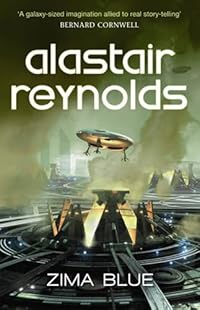
Zima Blue by Alastair Reynolds

Gollancz, 2009, 503 p, including 3 p Introduction by Paul McAuley.

This is a collection of Reynolds’s short(ish) stories from the early part of his writing career. They vary in length from short story to novella.

The Real Story is a beautifully well-thought out and executed tale of an investigation by journalist Carrie Clay into the whereabouts many decades later of the first man to land on Mars. His was a solo project which almost went catastrophically wrong and caused him profound psychological problems. There is a great set piece where the pair of them base jump from Mars’s premier city into that deep scar across the Martian surface, Valles Marineris.

Beyond the Aquila Rift is set in a universe where barely understood technology left behind by aliens allows interstellar travel. Sometimes, though, there are routing errors. Our narrator ends up beyond the local bubble in the Milky Way, beyond the Aquila Rift.

In the framing device of Enola the remnants of humanity live out their lives terrified of the alien enolas reining down destruction from the skies. The middle section of the story, the meat in the sandwich, contains the recollections of the last of the enolas, AI weapons of mass destruction but capable of reasoning with one another.

The world of Signal to Noise is one where correlators can “cold-call” similar machines in other realities, resonate with and lock on to them to allow information transfer. In the wider world implanted nervelinks can connect one body to the sensory inputs of another, sedated, body, giving control over it. In his world, Mike’s wife dies in an accident. His friend, Joe Liversedge, works in the correlation unit – where they were about to try nervelinking between worlds – and gives him the opportunity to interact with his estranged wife’s counterpart in a newly correlated other world. But the signal fades with time.

Cardiff Afterlife is set in the same milieu as Signal to Noise a few years later. Joe Liversedge doesn’t like the use the governments (and the parallel universes’ governments) are making of the correlation capability and sets out to do something about it.

The far future of Hideaway is one in which humans have long left Earth and its location has long been forgotten. The remnants of the Cohort, on a ship called the Starthroat, are in a decades long flight from a species known as the Huskers. When a Husker fleet is also detected in front of them the crew is forced to head for a likely planetary system to hide out. Unfortunately the star and the system’s biggest planet have unusual activity in them. The details of this involve some speculative physics. The story is told in five parts. For some reason in my proof copy parts 3-5 were in italics while 1 and 2 had been in a normal typeface.

In Minla’s Flowers, Merlin, a survivor from the previous story, is thrown out of the Waynet, an ancient interstellar transport system. He is forced to seek aid on a planet of a nearby sun, whose inhabitants’ technology is at the biplane/airship stage. He discovers the Waynet will intersect with the system’s sun in about seventy years. He drops them hints about physics so that they will be able to develop the means to leave for another world, coming out from ‘frostwatch’ cold sleep every fourteen years or so to see how things are going. The story has an embedded reference to Margaret Thatcher’s “no such thing” comment about society.

Merlin’s Gun is a third story featuring Merlin. Here Sora survives an otherwise devastating Husker attack only for her familiar to shut her down in frostwatch for three thousand years – relativistic time-scales are one of Reynolds’s characteristics – waking her up only when a likely rescue ship enters the system where she is hidden. Merlin takes her on his quest to find the ‘gun’ which will allow the Huskers (whose true nature is revealed here) to be defeated. Reynolds’s knowledge of the SF genre is exemplified when he calls the gun ‘a weapon too dreadful to use’.

In Angels of Ashes aliens called the Kiwidinok, whose perception of quantum reality differs from that of humans, came to Earth and revealed to a “lucky” volunteer, Ivan, the remnants of a nearby neutron star whose formation ‘miraculously’ spared Earth the radiation devastation. The Kiwidinok suddenly left again. Ivan became the inadvertent Founder of a new religion but he is now on his deathbed and wishes his truth to be known.

Spirey and the Queen is another story set during an age-old interstellar war, where Von Neumann machines nicknamed wasps have evolved into consciousness but its main thrust is concerned with protagonist Spirey – from a branch of humanity which is entirely female – and her endeavours to survive while on a mission to kill a traitor and her discoveries about the reasons for the war continuing.

Understanding Space and Time is for some strange reason printed in italics. Its subtitle, Mars ain’t the kind of place to raise your kids…, is a tip of the hat to the holographed Piano Man who appears in the story, complete with Bösendorfer grand. He appears to John Renfrew, the last survivor of humanity, in a habitat on Mars. Renfrew has little to do but converse with the holograph and use the few books available to try to understand space and time. With the later help of Aliens called the Kind who resurrect him from mummified death centuries after he suffers an accident on the Martina surface he spends his days, years and centuries, unlocking the layers of reality.

Digital to Analogue is, in effect, about an ear-worm which is akin to a virus, propagating via the sampling of a music track, and may be a new life-form.

Everlasting explores a ramification of the many worlds theory. Moira drives hurriedly through the snow to Ian’s house as he had talked on the phone about not killing himself. There he expounds his notion that in every dangerous branching of the worlds there will always be one where there is an unlikely survival and that he is therefore effectively immortal. Then he produces a revolver with one round in it. The twist in this tale is not hard to foresee but is arguably inevitable in any case.

Zima Blue is a story about memory and belonging, the tale of a universe-renowned artist called Zima, body adapted to endure the most extreme environments – interstellar vacuum, the pressures of gas giants etc – famous for the increasing vastness of his works (to the scale of moons,) and the particular blue colour he always employs. He gives his final interview to the Carrie Clay of The Real Story earlier in this book and produces his final, very much scaled down, artwork.

Pedant’s corner:- In the Introduction; “That’s doesn’t mean” (That doesn’t,) “that begin in a different times and places” (in different times,) “none of the stories … are” (none … is.) Otherwise; “none of my expectations were actually contradicted” (none … was,) epicentre (centre,) overlaying (overlying,) “the atmospheric gases became steadily more fluidic” (gases are already fluids; they flow. I think Reynolds meant ‘steadily more like liquid’,) “to condense the air into its fluid state” (ditto; liquid state,) “glimpsed_moving”, “added_some”. “Slammed_Tyrant”. “The_closer”, (I have no idea what those underslashes are for, and another appeared in a later story) “‘with the things I’ve showed you’” (shown,) “letters in Lecyth us A marched in stentorian ranks across the high vertical face” (how ranks of alphabetical symbols can be loud is something of a puzzle.) “The music reached its crescendo now.” (No. The crescendo is the rise, not its climax,) “where gouged by” (were gouged by,) “had opened a rosewood box and showed them to him” (shown,) “like kneeling orisons” (I didn’t know invocations/acts of supplication to a deity could kneel,) “I understood the math” (Oh, please. It’s ‘the maths’,) “‘as it conveniences us’” (no need for the ‘it’,) one story’s afterword has no indents at a new paragraph. “The moment reached a kond of crecscendo” (No. It reached a kind of climax,) smidgeon (smidgin, or, smidgen, but in any case, the word has no ‘o’ in its spelling,) “for old time’s sake” (times’,) “finding that the scene was established in Newcastle made up for the wrench” (‘the scene that was established’ makes sense of this,) a new paragraph that is not indented, “than any prescience on my behalf” (on my part,) Sacks’ (Sacks’s.)
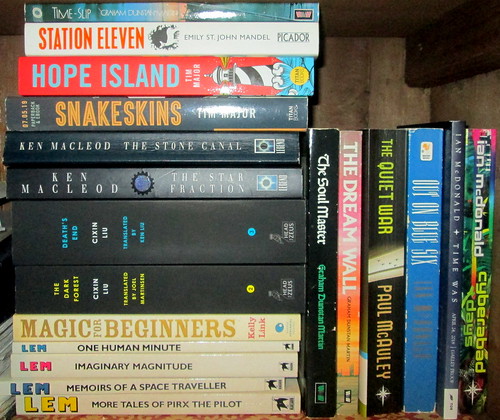
SF Bookshelf Travelling for Insane Times (iv)

The remainder of my larger SF paperbacks. These are on the lower shelves of the old music cupboard. Looking at these photos two of the books seem to have wriggled away from alphabetical order. (I’ve fixed that now.)

Stanisław Lem, Ken Macleod, Cixin Liu, Graham Dunstan Martin, Ian McDonald:-

Large Paperback Science Fiction

China Miéville, a Tim Powers, Christopher Priest:-

SF Large Paperback Books

Alastair Reynolds, Robert Silverberg, Norman Spinrad:-

Science Fiction Large Paperbacks

Lavie Tidhar, Kurt Vonnegut, Gene Wolfe, Ian Watson, Roger Zelazny, (well half of one is):-

SF Books, Large Paperbacks

SF Bookshelf Travelling for Insane Times (ii)

Large SF paperbacks this week for Judith’s meme at Reader in the Wilderness.

I keep these in an old music cupboard I inherited from my great-uncle. I’ve got so many of these they have to be double-parked, so you can’t actually see the first and third shelves shown here when the cupboard is opened. Stacking some on their sides gives me an extra 4 cm of space. Click on the photos to enlarge the pictures.

These include a J G Ballard, Iain M Banks, Chris Beckett, Eric Brown, Ursula Le Guin and Ian McDonald:-

Large Science Fiction Paperbacks (i)

Annoyingly, even these large paperbacks do not all come in one size. The upright ones to the right here are smaller than the previous books. More McDonald, Tim Powers, Kim Stanley Robertson, Adam Roberts, Hannu Rajaniemi, a lesser Robert Silverberg, Kurt Vonnegut:-

Large Science Fiction Paperbacks (ii)

More Ballard, Banks, Beckett and Brown. Lavie Tidhar, Neil Williamson and another step down in size:-
Large Science Fiction Paperbacks (iii)

John Crowley, M John Harrison, Dave Hutchinson, Stanisław Lem:-

Large Science Fiction Paperbacks (iv)

free hit counter script