Archives » 2020 » April

Warnemünde, Germany

Third stop on our Baltic cruise last year was Warnemünde, North Germany. It lies at the mouth of the River Warnow and is effectively the port for Rostock, of which it is administratively part.

We could have taken trips to Rostock – or Berlin – but decided not to. The Berlin one involved a long bus trip would only have allowed a few hours in the city and Rostock wasn’t particularly attractive.

From the dockside on the River Warnow you have to cross an inlet to get to the main part of Warnemünde. Looking north:-

Warnemünde, Inlet of River Warnow from Bridge

Looking south:-

Warnemünde, Looking South on Inlet of River Warnow

Warnemünde is a nice wee place with quite a lot of modern architecture but in the town centre mostly older type buildings:-

Warnemunde street, Germany

Building, Warnemünde

One of its tourist attractions is this lighthouse, which is not beside the sea:-

Lighthouse, Warnemünde

I also spotted this windmill up a side street:-

Windmill, Warnemünde

Passing On by Penelope Lively

Penguin, 1990, 214 p.

 Passing On cover

Helen and Edward Glover have into middle age lived with their overbearing mother Dorothy (from whose clutches their younger sister Louise had long since escaped by marriage) in a crumbling pile called Greystones which has an accompanying area of land known as the Britches. The novel starts at Dorothy’s funeral with Helen reflecting, “Eternal life is an appalling idea, especially in mother’s case,” and thereafter traces the lives of Helen and Edward in the following weeks. Helen has a part-time job at the local library, Edward teaches at a nearby girls’ school but it is their inner lives which foreground the book.

In its initial stages the novel is deceptively light in tone, like a cross between The Shell Seekers and The New Moon with the Old, but as it progresses it develops an accumulation of detail which underpins its seriousness.

The terms of Dorothy’s will come as a shock. She has left Greystones to Louise’s teenage son Phil, now in that rebellious stage, adorned by a black crest of hair streaked with green, but with Helen and Edward having the right to live in the house until death. Only the Britches has been left to the Glovers. This is in one sense suitable as Edward has always felt more at home with nature than people (“the natural world thinks nothing and neither laughs nor cries,”) awkward at dealing with the world, and Helen is increasingly brought into the company of solicitor Giles Carnaby through dealing with the probate. She finds herself falling for him. She still sometimes sees her mother in the house and hears Dorothy’s voice in her head commenting on her foolishness. Dorothy’s classification of girls had been, “Pretty was best, clever was worst.” Her disparagement of any friend – especially male – Helen might bring home made sure she stopped doing so. While clearing out a cupboard Helen finds that Dorothy many years ago, by accident or design (but the narrative leaves little room for doubt which,) prevented an attachment developing by not passing over a letter Helen had received from Peter Datchett. Running in and out of the narrative is local builder Ron Paget, whose yard neighbours Greystones, and who is always out for the main chance and has perennially had his eyes on the Britches as ripe for development.

The interactions of the characters can verge on the seemingly mundane, Helen’s almost adolescent infatuation, her does-he doesn’t-he should-I-contact-him thoughts, Giles’s slipperiness, the hints at and revelation of Edward’s true nature, Louise’s battles with Phil, his blossoming at Greystones when he comes to get away from mum for a bit, Ron Paget’s persistent unsubtle attempts to wheedle the Britches out from under the Glovers, but the picture they build becomes more and more compelling.

I would say this does not quite achieve the heights of excellence which the same author’s Moon Tiger did but is another demonstration that quiet lives lived (more or less) quietly still have their dramas and deserve recording.

Pedant’s corner:- frequently commas were missing before pieces of direct speech, Windowlene (for the glass cleaner. It’s spelled ‘Windolene’,) a mack (this abbreviation for mackintosh is usually spelled mac,) “from whence” (whence means ‘from where’ so ‘from whence’ would mean ‘from from where’. I know the two words appear as such consecutively in the text of a hymn but that doesn’t make it correct.)

Verdant Works, Dundee

The Verdant Works Dundee is a museum of the city’s heritage of jute production, housed in a former jute mill. It’s somewhere we had meant to visit for a while but when we’re in Dundee we’re usually busy doing something else or going on somewhere else. The cruise ship docking there gave us the opportunity to pop in for a look.

The guide was a former jute worker who operated all the machinery for us. The noise of each one was very loud. Considering that the machines are only third-size it made you realise what a cacophony the real environment with twenty or more carding, rolling, spinning etc machines on the go must have been. Many people went deaf.

Jute bales:-

Jute Bales, Verdant Works, Dundee

Interior from upper floor:-

Interior, Verdant Works, Dundee

Verdant Works ceiling:-

Verdant Works, Dundee, Ceiling

Upper floor and ceiling. The wood is lovely:-

Ceiling, Verdant Works, Dundee

Beam engine which used to power the machines:-

Beam Engine, Verdant Works, Dundee

Photo in the Verdant Works of the Art Deco Taybank Jute Works, Dundee, Spinning Department, opened 1949. I have photographed this building myself in 2009.

Taybank Jute Works, Dundee

Tay Bridge and V&A Dundee

The first stop on the cruise we took last year was … Dundee! It’s only about twenty-five miles or so away from Son of the Rock Acres but it cost £200 less, each, for us to board at Newcastle rather than embark a day later at Dundee. No brainer.

The ship’s docking point in Scotland’s fourth city did give me a view of the Tay Bridge I hadn’t had before, though.

Tay Bridge

To the extreme right of the above photo is the new V&A Dundee, better seen in the photo below with RSS Discovery and Discovery Point beyond V&A:-

Tay Bridge and V&A Building

Wandering round the city centre I came across these stone penguins having a wee daunder:-

Model Penguins, Dundee City Centre

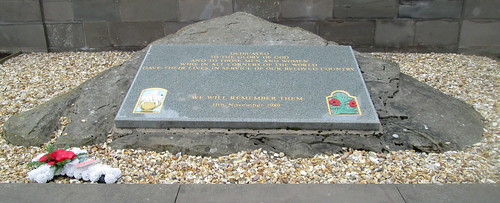
Nearby was this plaque commemorating the 70th anniversary of the end of the Great War. “Dedicated to the glory of god and to those men and women who in all corners of the world gave their lives in service of our beloved country. We Will Remember Them, 11th November 1989.”

Anniversary War Memorial, Dundee City Centre

War Graves, Muckhart

Muckhart is a collective term for two small villages in Clackmannanshire, Yetts o’ Muckhart and Pool of Muckhart. Both of these are near to Cowden Garden but unlike the garden are on the main A 91 road.

I found these graves in Muckhart Parish Church graveyard in Pool of Muckhart, which has a lovely situation below the Ochil Hills.

Serjeant W Cairns, Royal Engineers, 30/11/1918. War Grave Muckhart

Lieutenant J D Cairns, B Sc, CA, 54th L A A Regt, R A, (Argyll and Sutherland Highlanders) Territorial Army,18/3/1946, aged 42:-

War Grave, Muckhart

I suppose these may have been father and son.

One of the other gravestones contained dedications to two brothers, Gunner James Petrie, Royal Field Artillery, died of wounds, 5/4/1918, aged 26.
Private David Petrie, Black Watch, killed in action, July 2nd, aged 20.

War Inscriptions, Muckhart Grave

Not Friday on my Mind 60: From Home

From home is where we’re all doing things at the moment. It brought this to mind.

(Not that the song has anything to do with coronavirus. Keep safe everyone.)

It was the B-side of Wild Thing, at least in the UK.

There’s that earthy very Troggy quality to this and listening to it again it presages both punk and Adam and the Aunts.

There’s a video clip here of the group performing it live in 1967.

The Troggs: From Home

Star War Memorial

Star, or Star of Markinch, is a village in Fife, lying between Markinch and Kennoway, and a few miles from Son of the Rock Acres.

Its War Memorial is a plaque on the wall of the Primary School.

Star War Memorial

Surrounded by Celtic knot work the inscription is “1914” (as a monogram) “Pro Patria” plus a monogrammed “1918” then, “To the glory of god and in memory of the men of Star who fell in the Great War, followed by their names and, “They overcame and they loved not their lives unto the death.

War Memorial, Star

Cowden Garden Again

Last April we visited Cowden Garden again. (There’s not much chance of another visit in the immediate future.) he garden had come on a bit in its development.

It takes a lot of work to achieve it but there’s something very relaxing about the way a Japanese garden looks:-

Lake and bridge:-

Lake and Bridges, Cowden Garden

Zen garden, raked in the Japanese style:-

Japanese Garden, Cowden, Scotland

Zen Garden, Cowden Garden

Ornamental stone:-

Ornamental Stone, Cowden Garden

Lake and pagoda:-

Lake and Pagoda, Cowden Garden

Bridge over lake:-

Bridge over Lake, Cowden Garden

Path and bridge over lake:-

Path and Bridge over Lake, Cowden Garden

Tree, lake and bridges:-

Tree, Lake and Bridges, Cowden Garden

Small bridge and Zen garden:-

Zen Garden, Cowden Garden

Closer view:-
Small Bridge and Zen Garden, Cowden Garden

Lunch was soup with bread and a coffee.

Cup, Cowden Garden café:-

Cup, Cowden Garden Cafe

Kennoway War Memorial

Kennoway is a village in Fife, a few miles east of Markinch.

Its war memorial is a Celtic Cross above a tapering granite plinth:-

Kennoway War Memorial

Great War Dedication; in the stone wreath above the plinth, “1914 – 1918” then “Kennoway,” “Erected in loving memory of the men of this parish who gave their lives fighting for their couhtry’s honour.” Names for the Great War:-

Great War Dedication, Kennoway War Memorial

Other Wars Dedication; World War 2, “1939 -1945,” Malaya, Korean War, Falklands:-

Other Wars Dedication, Kennoway War Memorial

Reverse; “Other conflicts, Afghanistan, Stephen Walker”:-

Kennoway War Memorial, Afghanistan

The Back Burn, Balbirnie (i)

The Back Burn runs through the Balbirnie Estate on its way from the East Lomond round Markinch and on to the River Leven near Methilhill. It’s good for walks – even when you’re not cooped up by a lockdown.

After wandering under the A 92 and through a wooded glen it runs past the eighteenth hole of the golf course built over half of the estate:-

Balbirnie burn

Then down a cobbled slope:-

Burn

Under a bridge:-

Back Burn

On:-

Burn

And on:-

Back Burn

Back Burn

Before swinging under another bridge to make a turn under Stob Cross Road across to the railway line and down the east of Markinch:-

Back Burn

One of the things you might not expect to see in Fife but is present in the estate is a Giant Redwood tree:-

giant redwood tree

There’s a wildlife pond between the boarded path and the redwood as seen from near the burn:-

A Giant Redwood in Fife

Balbirnie Estate has a lot of rhododendron plants. They’re just about on the point of coming into flower this year. This was from 2019:-

Rhododendron, Balbirnie, Fife

free hit counter script