Archives » 2020 » April

2020 Hugo Awards Shortlists

The shortlists for this year’s Hugo Awards have been announced. Amazingly I have actually read some of these (the ones in bold the one also in italics as an extract only, in the BSFA Awards 2019 booklet) – partly due to Interzone, but also becasue I read Ted Chiang’s collection Exhalation towards the end of last year.

Since the Worldcon (at which these awards are presented) which was to take place in New Zealand has been cancelled for attendees I assume the ceremony will now have to be virtual, as will the con itself.

The nominations are:-

Best Novel

The City in the Middle of the Night, by Charlie Jane Anders (Tor; Titan)
Gideon the Ninth, by Tamsyn Muir (Tor.com Publishing)
The Light Brigade, by Kameron Hurley (Saga; Angry Robot UK)
A Memory Called Empire, by Arkady Martine (Tor; Tor UK)
Middlegame, by Seanan McGuire (Tor.com Publishing)
The Ten Thousand Doors of January, by Alix E. Harrow (Redhook; Orbit UK)

Best Novella

“Anxiety Is the Dizziness of Freedom”, by Ted Chiang (Exhalation (Borzoi/Alfred A. Knopf; Picador))
The Deep, by Rivers Solomon, with Daveed Diggs, William Hutson & Jonathan Snipes (Saga Press/Gallery)
The Haunting of Tram Car 015, by P. Djèlí Clark (Tor.com Publishing)
In an Absent Dream, by Seanan McGuire (Tor.com Publishing)
This Is How You Lose the Time War, by Amal El-Mohtar and Max Gladstone (Saga Press; Jo Fletcher Books)
To Be Taught, If Fortunate, by Becky Chambers (Harper Voyager; Hodder & Stoughton)

Best Novelette

“The Archronology of Love”, by Caroline M. Yoachim (Lightspeed, April 2019)
“Away With the Wolves”, by Sarah Gailey (Uncanny Magazine: Disabled People Destroy Fantasy Special Issue, September/October 2019)
“The Blur in the Corner of Your Eye”, by Sarah Pinsker (Uncanny Magazine, July-August 2019)
Emergency Skin, by N.K. Jemisin (Forward Collection (Amazon))
“For He Can Creep”, by Siobhan Carroll (Tor.com, 10 July 2019)
“Omphalos”, by Ted Chiang (Exhalation (Borzoi/Alfred A. Knopf; Picador))

Best Short Story

“And Now His Lordship Is Laughing”, by Shiv Ramdas (Strange Horizons, 9 September 2019)
“As the Last I May Know”, by S.L. Huang (Tor.com, 23 October 2019)
“Blood Is Another Word for Hunger”, by Rivers Solomon (Tor.com, 24 July 2019)
“A Catalog of Storms”, by Fran Wilde (Uncanny Magazine, January/February 2019)
“Do Not Look Back, My Lion”, by Alix E. Harrow (Beneath Ceaseless Skies, January 2019)
“Ten Excerpts from an Annotated Bibliography on the Cannibal Women of Ratnabar Island”, by Nibedita Sen (Nightmare Magazine, May 2019)

Best Series

The Expanse, by James S. A. Corey (Orbit US; Orbit UK)
InCryptid, by Seanan McGuire (DAW)
Luna, by Ian McDonald (Tor; Gollancz)
Planetfall series, by Emma Newman (Ace; Gollancz)
Winternight Trilogy, by Katherine Arden (Del Rey; Del Rey UK)
The Wormwood Trilogy, by Tade Thompson (Orbit US; Orbit UK)

Reelin’ in the Years 171: Ain’t No Sunshine. RIP Bill Withers

Another 1970s songwriter gone.

Writing a love song, or at least a good love song, is a difficult trick to pull off. That Bill Withers managed to tread the line between enuine feeling and mawkish sentimentality on the right side speaks of his talent.

He had very few hits but the songs for which he’ll be remembered in the UK, Lean on Me, Just the Two of Us, Lovely Day and Ain’t No Sunshine, do just that. Lovely Day is one of the few examples of a feel-good song that is pitch perfect.

The last of those four seems more appropriate to mark his passing though.

Bill Withers: Ain’t No Sunshine

William Harrison (Bill) Withers: July 4/7/1938 – March 30/3/2020. So it goes.

Celestial Jewel

From Astronomy Picture of the Day for 6/4/20.

Barred spiral galaxy NGC 1672.

NGC 1672

Art Deco in Warnemünde

There was quite a lot of Deco style (certainly Moderne style) in Warnemünde. Most of it is of relatively recent construction though.

This was directly across the River Warnow from the ship’s berth. Loads of horizontals and verticals, then there are those semi-circular projections at the entrance:-

Art Deco in Warnemünde

From beach. Wellenrausch Restaurant and Cafe. Kurhaus. Paulo Scutaro Ristorante. Hellas Greichische Gastlichnet. Rule of three in windows, canopies, rounded ends.

Warnemünde, Modern Art Deco

This also fronted (backed?) onto the beach:-

deco , Warnemunde, Germany

Seebad, Eines der schönsten erholungsgeblete der Ostsee, (one of the most beautiful relaxation spots on the Baltic Sea.) Sweeping curves, plus horizontals and rule of three in windows:-

Seebar, Art Deco Style in Warnemünde

On the walk back to town there was this shop. Meermode (Sea Fashion):-

Warnemünde, Art Deco Style

Art Deco Style, Warnemünde

The Beach, Warnemünde

Warnemünde has the broadest beaches on Germany’s Baltic coast as evidenced by this photo from the Wikipedia page linked to above:-

View of Warnemünde
By A.Savin (Wikimedia Commons · WikiPhotoSpace) – Own work, FAL, Link

On that you can see also how long the beach is and the large number of deck chairs – each of which has a set of screens (against wind?) This was my photo from further along of the beach and the headland beyond:-

Warnemunde beach , Germany

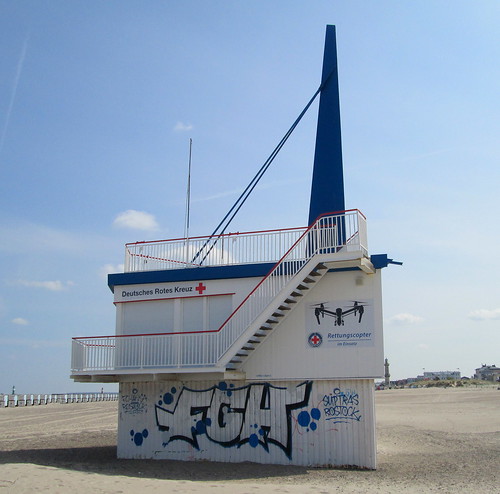
The beach has a Red Cross Station (Deutsches Rotes Kreuz,) closed at the time we were there – too early in the season, the beach was more or less empty of people:-

Warnemünde beach, Red Cross Station

You’ll note Revoltes Rostock, Devil’s Fish and Hansa Rostock Ultras graffiti.

There was more graffiti round the side. FC Hansa Rostock and Supras Rostock:-

Red Cross Building, Warnemünde Beach

We walked along the beach for some distance but didn’t quite brave the Baltic waters. Between the beach and a small road, along which I saw at least one bus pass, there was a lovely woodland walk which we took back to the town:-

woodland walk, Warnemunde, Germany

Cutting It Short by Bohumil Hrabal

In The Little Town Where Time Stood Still, Abacus, 2011, 134 p. Translated from the Czech, Postřižiny (Cutting,) by James Naughton.

 The Little Town Where Time Stood Still cover

From the sixty-metre chimney of the limited-liability municipal brewery it is obvious that the small town where this short novel is set is situated on an island in the Elbe. The story is narrated by Anna Czilágová, (born Kalovice, in Moravia.) Her husband, Francin, manages the brewery and loves order and regularity. They are somewhat ill-matched as Anna loves chance and the unexpected. Francin constantly complains that the ways she does things are not suitable for a decent woman. Only when she is sick can he feel that she needs him as much as he needs her. He owns an Orion motor-bike, which very rarely survives an outing without breaking down and which he sequentially invites every man in the town to help him service (which takes hours) so that they avoid his eye thereafter.

Uncle Pepin, actually Francin’s cousin, descends on the couple one day to stay for a week or so but never leaves. In his spare time he frequents only drinking establishments which have ladies’ service. He is a hit with the ladies, or likes to think he is. Nostalgic for the old Empire, Pepin’s recurring phrase is, “a soldier of Austria can never be defeated.”

Anna’s golden hair (which is always lifted out of the way by the local shopkeepers as she mounts her bicycle to keep it from tangling in the wheels,) which she had to avoid treading on on the way up, flies out like a beacon in the wind, where she sits having scaled the brewery chimney with Uncle Pepin, watching the fire brigade called out to rescue them from their perch, as those below thought they were engaged in a suicide attempt. This is only one of the scenes which have a magical realist feel, but there is also a layering of everyday detail, as when Anna helps the local butcher to make sausages, or she consumes cream horns (in an unsuitable unlady-like manner, of course.)

The new fashion comes to the town with the advent of wireless, soldiers bringing in the apparatus, allowing everyone in turn access to an earpiece with the sound, but thinner, stretched out, of a brass band playing Kolíne, Kolíne all the way from Prague. In the build-up to the book’s final significant event various things get cut short, the brewery chairman’s horse’s mane and tail, Anna’s skirt, her dog’s tail.

A curiosity is that the story is partly translated into Scots. At first, because the words appeared in Pepin’s speech, I wondered if this was an attempt to represent a regional Czech accent but then Scots words (doucely, spale, wame) cropped up in the main text. (The translator was brought up in Edinburgh.)

Pedant’s corner:- “the dynamo pumping the …… where the light bulbs shine, the dynamo starts to” (dynamo was probably repeated in the original Czech but its repeat is superfluous,) maw (it’s a stomach, not a mouth.) “‘Direktion!’” (why use the German spelling?) pelargonias (pelargoniums. If, in any case, the word had a Greek plural it would be pelargonia,) Jesus’ (Jesus’s,) “hundred of barrels” (‘hundreds’.)

More Modern Warnemünde

Rooftop garden:-

Rooftop Garden, Warnemünde

Close-up on rooftop plants:-

Warnemünde, Close-up on Rooftop Garden

Deco-ish style house. It’s mainly the rounded bay window, here:-

Decoish House, Warnemünde

Civic planting:-

planting in Warnemunde, Germany

Planting, Warnemünde

Warnemünde, Planting

planting in Warnemunde, Germany

Just at the ship’s de-embarkation point there was an exhibition of sand sculptures, Sand Welt (Sand World):-

Sand Welt (Sand World) Sculpture, Warnemünde

By Susanne Ruseler, The Netherlands:-

Warnemünde, Sand Sculpture

By Andrius Petkus, Lithuania:-

Sand Sculpture, Warnemünde

Detail:-

Detail, Sand Sculpture, Warnemünde

S S Magellan at Warnemünde. Ferry across River Warnow in foreground:-

Magellan at Warnemünde

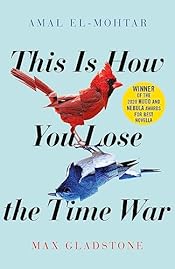
This is How You Lose the Time War by Amal El-Mohtar and Max Gladstone

Jo Fletcher Books, 2019, 203 p. Published in Interzone 283, Sep-Oct 2019.

 This is How You Lose the Time War cover

On behalf of the Agency, Red travels upthread into the past and downthread to the future to effect changes in the different Strands of the worlds, (“so many Atlantises,”) waging an eternal time war against Garden, tweaking conditions here, ensuring individuals thrive there, so that they may be in a position to affect history in the Agency’s favour.

At the end of one such mission Red finds a letter which should not be there and on which is inscribed the instruction, “burn before reading.” Despite knowing that it is a trap designed perhaps to kill her, to convert her to the other side, or to compromise her with her own, she decides to comply with the instruction and reads the message. It is from her adversary, Blue; an acknowledgement of her part in making Blue raise her own game, an expression of admiration, a declaration of inevitable victory. Red responds with a letter of her own.

So begins a long correspondence achieved through an increasingly bizarre series of dead drops in which the two agents’ regard for one another deepens and grows into something else.

The book’s narrative is carried via sequences describing Red’s and Blue’s endeavours to change different strands’ histories, each followed by the contents of a letter written to one by the other. Only in one instance is this strict authorial practice not followed and that is where Blue’s letter is encoded in six seeds but Red only swallows three of them and so only gets part of the whole message. (This makes sense in the context of the novel.) Their letters are studded with recommendations, allusions and digressions and embellished by postscripts, PPS’s and even at times PPPS’s.

In all but the first (and the three ante-penultimate) non-epistolary sections the reader is vouchsafed a line or two at the end wherein a seeker manages to reconstitute the letter we are about to read for ourselves. Red becomes aware of this pursuer and is continually looking over her shoulder to see if she can catch her shadower and therefore also wary of contact with her Commandant in case she is suspected of treason. So too, Blue with Garden.
The deployment of various Science Fiction tropes is essential to the novel’s overall effect but to begin with they are merely there, as a kind of exotic background; none of the strands or missions is explored in any detail, there is no mechanism ascribed to the ability to travel in time, Red and Blue are just able to do it. Up to its denouement the plot could have been akin, say, to the jockeyings of John le Carré’s Smiley and Karla but its resolution and the identity of the mysterious seeker are thoroughly dependent on the story’s premise.

All this is laced with the occasional piece of sly humour – a group of participants at the assassination of Julius Caesar (or, rather, a Julius Caesar) seems to consist entirely of agents known to Red – and allusions such as “hoarse Trojans” and “across half a dozen strands, of mice, of men, plans, canals, Panama.” Add in references to Ozymandias, Mrs Leavitt’s Guide to Etiquette and Correspondence, Bess of Hardwick and an exhortation by Blue to Red for her to read Naomi Mitchison’s Travel Light (of which we are later given a short critique) and the reading experience becomes a rich one. The letters are a particular delight. Necessarily so, for they are the narrative’s focus, the means by which we come to understand and appreciate the relationship between Red and Blue, and their mutual goals.

This is a book which eschews the flash, bang, wallop of much of the modern SF genre, containing SF of an enquiring and knowing kind, yet playful with it. Discursive, though relatively short, it is still economic, packing a lot into its 199 pages. It deserves a wide audience.

The following did not appear in the published review.

Pedant’s corner:-“knew one other” (one another,) “fleeing with child” (with a child,) centimeters (centimetres,) “it amuses Blue to no end” (that would mean ‘without purpose’; ‘it amuses Blue no end’ is the phrase required.) “Adaption is the price of victory” (Adaptation is the..,) “colour” but “humor” (does one of the authors use USian spellings while the other doesn’t?) maw (it’s a stomach, not a mouth,) proboscides (it is the Greek plural of proboscis – the ‘English’ plural is proboscises – but I’ve only ever seen probosces before. Apparently that has a specialised use in biology.)

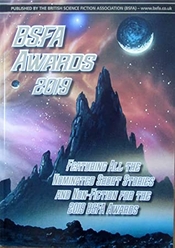
BSFA Awards Booklet 2019

British Science Fiction Association, 2020, 72 p.

 BSFA Awards 2019 cover

Four of the six “stories” in the short fiction category are extracts from longer works.
The first To Be Taught, If Fortunate by Becky Chambers1 is couched in the form of a report from one of the first human expeditions to an exoplanet back to an Earth fourteen light-years distant. There are some aspects of Chambers’s writing which have improved since I read her first novel but still in evidence here was that impulse to dump unnecessary information. For example, why give us an account of the (Earthly) life cycle of a metamorphic insect? By all means mention it; but to expound on the detail? Similarly authors ought to avoid formulations like, “If enzyme patches are still used medically, you know this already,” providing the example of an insulin patch for diabetics. On reading this I had the thought that Chambers is either still writing amateur fiction or else writing Science Fiction for people who don’t read Science Fiction.
Jolene by Fiona Moore2 I read in Interzone 283.
Ragged Alice by Gareth L Powell3 is again an extract. Set on the west coast of Wales we are following the investigation of female detective Holly Craig who has the ability to see people’s inner light, or darkness. This deals with information dumping much more subtly and more naturally than did Becky Chambers.
The Survival of Molly Southborne by Tade Thompson (an extract again) is one of those “many lives” narratives which have become common. Here drops from Molly Southborne’s blood can generate genetically identical duplicates of her. These usually turn on her and try to kill her. The story is narrated by the last one, whom Molly has trained to survive her own death in a fire.
For Your Own Good by Ian Whates4 is about a man who has spent his life working towards AI rights waking up in different virtual realities. The moment when his car’s AI adds a vocative, “Dave,” to its sentence when first addressing him is chillingly reminiscent of 2001: A Space Odyssey. It also acts as a foreshadowing emphasised by its later phrase, “‘It’s for your own good, Dave.’”
I read This is How You Lose the Time War by Amal El-Mohtar and Max Gladstone5 for review in Interzone 283 (see link above.) I don’t usually post those reviews here till a year has gone by but will make an exception in this case in my next post. Suffice to say I thought it was excellent.

As to the non-fiction:-
In Chapter 6 of “The Pleasant Profession of Robert A Heinlein” by Farah Mendlesohn (reprinted here) the author argues that Heinlein’s support of the US Constitution’s Second Amendment’s ‘right to bear arms’ is, as evidenced by his fiction, more nuanced than people usually allow, as such carrying is shown as being almost useless.
The introduction to “Sideways in time: Critical Essays on Alternate History” by Glyn Morgan and C Palmer-Patela featured here says the form is not merely a sub-genre of SF, illustrates its long history distinguishes between the counterfactual (academically accepted,) and fiction and outlines three different kinds of altered history stories, the nexus, the true altered history and the parallel worlds story.
The extract from “About Writing” by Gareth L Powell boils down to ‘just do it’.
H G Wells: A Literary Life by Adam Roberts looks in detail at Wells’s A Modern Utopia.
Away Day: Star Trek and the Utopia of Merit by Jo Lindsay-Waltonb discusses the role of work in Star Trek’s post-scarcity utopia.

I won’t get round to the two novels I’ve not yet read and I’m not too enthused about any of the art works nominated this year.

Pedant’s corner:- 1“The closest access I had to nature were the hydroponic planters” (closest access … was the …,) “soft-ware … neighbour-hood” (why the hyphens?) “How can anyone be expected to care about the questions of worlds above when the questions of the world you’re stuck on those most vital criteria of home and heath and safety – remain unanswered?” (needs a comma after ‘stuck on’.) “It didn’t matter where you from” (where you were from.) 2This has the sort of underlining used in manuscripts to denote when a word is to appear in italics in the final version, “to lay over top of it” (over the top of it,) it’s set in Britain and narrated by a Brit so why the use of ‘pickup’ for a truck and ‘veterinarian’ for a vet? 3whiskey (it was a single malt, so, whisky. The second time ‘whiskey’ appeared may have been referring to Jack Daniel’s, so I’ll let it off,) “he tended to avoid the alcoholic binges which tended to follow team matches” (one ‘tended’ too many inside the space of eight words,) the text also mentions “a recently laid-off teacher” (such a teacher would have to have done something major to have been dismissed, lay-offs are highly unusual.) 4Ballearics (Balearics,) sprung (sprang.) “‘Humankind will be made aware of how far beyond them we are,’” (how far beyond it we are.) “‘Humanity must believe they can continue to trust us,’” (believe it can continue to trust us.) 5“knew one other” (knew one another,) “fleeing with child” (with a child,) centimeters (centimetres.)
aascendency (ascendancy.) b“That is is” (only one ‘is’ required,) “making a Data a slave” (making Data a slave,) Keynes’ (x7, Keynes’s,) Roberts’ (Roberts’s – used later,) “becomes freighted cognitive and emotional significance” (is missing a ‘with’ before cognitive.)

Warnemünde Again

In Warnemünde town centre is a sculpture of a man and two women in a boat. It is the Pilot’s Monument for Stephan Jantzen, sailor, harbour pilot and life saver.

Sculpture, Warnemünde Town Centre

A nearby plaque bears information about the sculptor, Reinhard Dietrich Lotsenehrung. It also says, “1976 Beton, Eigentum Hansestadt Rostock.” (1976 concrete, Property of the Hanseatic City of Rostock.)

Sculpture plaque, Warnemünde

In another side street there was this unusual fountain:-

Fountain Warnemünde

Which bore this plaque:-

Plaque, Fountain, Warnemünde

The small park had a pillar containing books acting as a library:-

Book Pillar In a Park, Warnemünde

The children’s play area had this delightful ride a (working) digger:-

Play Digger in a Park, Warnemünde

free hit counter script