Archives » 2019 » September

Dumfries Art Deco (v) Carers Centre, a Garage and Two houses

More Art Deco from our visit to Dumfries in May 2018

This is on Whitesands, over the road from the river Nith. Now a Carers Centre. Surprisingly the windows haven’t been too mucked about with:-

Art Deco Building, Dumfries

A former garage, again on Whitesands, close to the River Nith. Now multiple shops:-

Art Deco Garage, Dumfries

This Deco house on has had its eyes poked out:-

Art Deco House, Dumfries

It lies on New Abbey Road, just at its junction with Pleasance Avenue.

Dumfries, Art Deco House

Gable end:-

Gable End, Art Deco House, Dumfries

Its gate posts:-

Gate Posts, Art Deco House, Dumfries

This neighbouring Art Deco house, almost a mirror image of the previous, is in Pleasance Avenue:-

Neighbouring Art Deco House, Dumfries

Frontage:-

Frontage, Neighbouring Art Deco House, Dumfries

Gable end:-
Gable End, Neighbouring Art Deco House, Dumfries

A List. (Well; Part of a List)

This list – supposedly of the 100 best books of the 21st century (so far) – was published in The Guardian Review on Saturday 21/9/19. (Some of them are non-fiction which I’m extremely unlikely to read.)

I’ve split it in two for purposes of concision in a post.

The usual annotations apply. Those in bold I have read, an asterisk denotes intention to read.

100 I Feel Bad About My Neck by Nora Ephron (2006)
99 Broken Glass by Alain Mabanckou (2005), translated by Helen Stevenson (2009)
98 The Girl With the Dragon Tattoo by Stieg Larsson (2005), translated by Steven T Murray (2008)
97 Harry Potter and the Goblet of Fire by JK Rowling (2000)
96 A Little Life by Hanya Yanagihara (2015)
95 Chronicles: Volume One by Bob Dylan (2004)
94 The Tipping Point by Malcolm Gladwell (2000)
93 Darkmans by Nicola Barker (2007)
92 The Siege by Helen Dunmore (2001)
91 Light by M John Harrison (2002)
90 Visitation by Jenny Erpenbeck (2008), translated by Susan Bernofsky (2010)
89 Bad Blood by Lorna Sage (2000)
88 Noughts & Crosses by Malorie Blackman (2001)
87 Priestdaddy by Patricia Lockwood (2017)
86 Adults in the Room by Yanis Varoufakis (2017)
85 The God Delusion by Richard Dawkins (2006)
84 The Cost of Living by Deborah Levy (2018)
83 Tell Me How It Ends by Valeria Luiselli (2016), translated by Luiselli with Lizzie Davis (2017)
82 Coraline by Neil Gaiman (2002)
81 Harvest by Jim Crace (2013)
80 Stories of Your Life and Others by Ted Chiang (2002)
79 The Spirit Level by Richard Wilkinson and Kate Pickett (2009)
78 The Fifth Season by NK Jemisin (2015)
77 Signs Preceding the End of the World by Yuri Herrera (2009), translated by Lisa Dillman (2015)
76 Thinking, Fast and Slow by Daniel Kahneman (2011)
75 Drive Your Plow Over the Bones of the Dead by Olga Tokarczuk (2009), translated by Antonia Lloyd-Jones (2018)
74 Days Without End by Sebastian Barry (2016)
73 Nothing to Envy by Barbara Demick (2009)
72 The Age of Surveillance Capitalism by Shoshana Zuboff (2019)
71 Jimmy Corrigan: The Smartest Kid on Earth by Chris Ware (2000)
70 Notes on a Scandal by Zoë Heller (2003)
69 The Infatuations by Javier Marías (2011), translated by Margaret Jull Costa (2013)
68 The Constant Gardener by John le Carré (2001)
67 The Silence of the Girls by Pat Barker (2018)*
66 Seven Brief Lessons on Physics by Carlo Rovelli (2014)
65 Gone Girl by Gillian Flynn (2012)
64 On Writing by Stephen King (2000)
63 The Immortal Life of Henrietta Lacks by Rebecca Skloot (2010)
62 Mother’s Milk by Edward St Aubyn (2006)
61 This House of Grief by Helen Garner (2014)
60 Dart by Alice Oswald (2002)
59 The Beauty of the Husband by Anne Carson (2002)
58 Postwar by Tony Judt (2005)
57 The Amazing Adventures of Kavalier and Clay by Michael Chabon (2000)
56 Underland by Robert Macfarlane (2019)
55 The Omnivore’s Dilemma by Michael Pollan (2006)
54 Women & Power by Mary Beard (2017)
53 True History of the Kelly Gang by Peter Carey (2000)
52 Small Island by Andrea Levy (2004)
51 Brooklyn by Colm Tóibín (2009)

As you can see I’ve only read four of this selection – all of them broadly under the SF or fantasy umbrella.

Dumfries Art Deco (iv) Dumfries Academy

In May last year we passed through Dumfries in a different direction from before and I spotted that Dumfries Academy building is Art Deco.

From left:-
Dumfries Academy Building

It reminds me a bit of the old school building in Moffat, but that’s smaller.

Gable end:-
Gable End Dumfries Academy Building

Frontage. Stitch of two photos:-

Dumfries Academy Frontage

Centre portion:-

Centre Portion, Dumfries Academy

Detail. note roofline and clock face:-

Detail, Dumfries Academy

Pluto’s True Colours

From Astronomy Picture of the Day, 10/9/19.

Pluto, how it would appear to human eyes. Mostly brown, apparently.

Pluto in true colour

East Fife 2-2 Dumbarton

SPFL Tier 3, New Bayview, 21/9/19.

I’d have taken a draw before the game but having been 2-0 up (albeit against the run of most of the play) it definitely feels like two points dropped and an opportunity missed.

Then again we haven’t exactly been defensively sound at any point this season (the game at Annan apart) so I’m not at all surprised we couldn’t hold out.

After a brief flurry from Sons at the start East Fife had most of the play in the first half and had several efforts come close. Then in one of our occasional forays up front we got a corner on the right. Joe McKee’s delivery was well met by Morgyn Neill but the keeper made a smart stop down to his left. He had no chance with the header resulting from the subsequent corner, Ryan McGeever powering his header (almost identically flighted by McKee) into the top corner.

They had what looked from our end a stonewall penalty appeal but the ref booked the forward (who didn’t complain) for a dive.

Three minutes into the second half Ruaridh Langan took the ball for a walk in their area and was fouled. Isaac Layne stepped up and despatched the pen. It was too long a time left for any Sons fan to feel comfortable though and East Fife began to throw the kitchen sink at us.

Sure enough they got a man over after a free kick and though Conor Brennan got both hands on the ball somehow it slithered over the line.

East Fife now had their tails up and came at us even more strongly but were leaving gaps at the back as a result.

Still they it was who scored next after McGeever’s clumsy challenge in the box. Again Brennan got both hands to it but it squirmed under him. I merely note that another keeper might have saved both these efforts.

There were several more scares and also a few opportunities for us to score before the end (notably when Matthew Shiels was through one-on-one but he telegraphed his finish which was in any case too weak.) When it came the final whistle was something of a relief.

East Fife looked a good side, spreading it about well, looking like they knew what they were doing and well worth their position at the top of the table so this was a good point in that regard.

We looked good in patches but gave the ball away too often and frequently failed to get a pass away quickly enough and far too often resorting to a punt up to Layne.

Two home games coming up to finish the first quarter. We’ll see where we are by then.

The Violent Century by Lavie Tidhar

Hodder, 2014, 347 p.
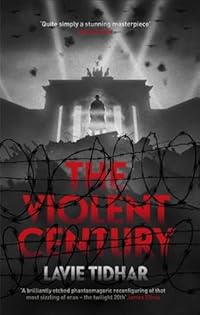
 The Violent Century cover

This is at once an unusual but also common tale, innovative in style but not so much in plot. (Then again, there are only supposed to be seven of those.) The narrative is conducted in large part via short, verbless sentences, sometimes only one or two words long, at times almost reading like a description of a film playing out before the reader’s eyes, telling us what we would be seeing on the screen. Now and then an authorial voice slides in, adopting the first person plural, as if the reader is a cinema audience relating the story to itself. The narrative jumps backwards and forwards in time from 1926 to the present day, allowing Tidhar’s characters to be active at various points in the unfolding of the violent mid- to late twentieth century, even the early twenty-first. Scene changes are akin to cinematic dissolves, though each is “captioned” with its time and place in its chapter heading. Throughout, direct speech is not set within quotation marks – which does lead to the occasional phrase requiring a reread.

The plot begins (and periodically unwinds) like an echo of le Carré’s Tinker, Tailor, Soldier, Spy, Henry Fogg called in by his old oppo, Oblivion, to meet the Old Man, boss at his former employer, The Bureau for Superannuated Affairs, to be questioned about his past evasions.

The background is that sometime in 1932 Dr Joachim Vomacht pushed the button on his machine and unleashed a quantum wave. As a Dr Turing (Alan, we assume) tells the British altered, recruited to a training area in Devon, “To observe an event is to change it. On the quantum level. When Vomacht pressed the button, everything changed. The Vomacht wave was a probability wave. The wave made genetic changes at a subatomic level… For most the change was undetectable ….. But perhaps a few hundred became … you.” The changed, dubbed Übermenschen, have superpowers and are named appropriately. Fogg conjures fog out of the air or any smoke available, Oblivion destroys things, Spit conjures up and projects bullets from her mouth, Mr Blur … blurs, Tank is built like one, Mrs Tinkle can make time retrace itself. Corresponding Übermenschen exist in other countries. The US has Tigerman, the Green Gunman and Whirlwind; the Soviets, the Red Sickle and Rusalka; Germany, Schneesturm and Der Wolfsmann.

The crux of the plot is Sommertag, Vomacht’s daughter Klara, who can pass through doors into a perfect summer’s day, an attribute Fogg finds irresistible despite her being an enemy citizen when they meet. His defence is that, “‘It,’” (the Vomacht wave,) “‘fused into her somehow. It kept her pure.’”

Tidhar appears to have gone to great lengths to make sure that history in this story is unchanged from what the reader knows happened – apart from the appearance of rocket men on the Russian Front (unless this is a WW2 manifestation of which I had not previously heard, a singular unlikelihood) and the Potsdam Conference being held one year later than it was, still with Churchill attending rather than Attlee as it would have been in 1946 (and as it was for the latter part in 1945) – the rise of the Nazis, World War 2, the Cold War, Vietnam, September 11th all take place here as they did in our time. It is as if the comic books were true and those superheroes were present to take part in events but without affecting anything substantial, participants but not decisive.

One scene in Afghanistan involves Sheik Osama bin Mohammed bin Awad bin Laden calling the changed ‘abominations’ while the Americans (who regard him as, “The rich spoiled son of a rich and powerful family…. Playing soldiers in the desert,”) are trying to use him against the Soviets – and thereby sow the seeds for the Twin Towers whirlwind. Of that 11th September our (plural) narrator tells us, “That day we look up to the sky and see the death of heroes.”

A Russian says, “We should have learned from your history. The British. Three wars and you lost every one. You can’t win a war here. You couldn’t, we can’t, and whoever comes after us is going to lose too. This land hates invaders,” and warns, “This bin Laden. This Saudi. Kill him now. Kill him when you have the chance, or he will turn on you.” Easy to say in a book published over ten years after an event but many did give out warnings at the time.

The Violent Century is admirably plotted and well paced, with an atmosphere of menace throughout, I’m puzzled as to why this wasn’t on any award shortlist for its year.

Pedant’s corner:- Antennas (antennae.) “Facing the bar counter are a row of barstools.” (Facing the bar counter is a row of barstools,) barkeep (not a British usage. We say ‘barman’ or maybe ‘landlord’,) “air separating into nitrogen and hydrogen” (that’s a neat trick, there’s very little hydrogen in air, only what is the relatively low proportion of air comprised of water vapour.) “None of us choose what we become” (None of us chooses,) King George IV (George VI, as he was correctly designated later,) “the moans reach a crescendo” (a climax perhaps; a crescendo is a build-up, not a culmination,) eldrich (eldritch,.) “None of them have been properly introduced yet” (None of them has been properly introduced.) “None of them are.” (None of them is,) Roberts’ (Roberts’s,) “none come” (none comes,) “do this hundreds of time” (of times.) “Millions more watched the ceremony around the world in a special broadcast by the BBC.” (Millions around the world watched the Coronation ? In 1953? Before communication satellites? I don’t think so.) “The only thing in motion are his eyes” (‘thing’ is singular so cannot have a plural verb form; ‘the only things in motion are his eyes,) Johnny Rivers’ (Rivers’s,) a missing question mark after “What do I know”, another question mark ought to replace a comma later on, “we’re not in the army here, Bob, Bob says, Yeah, yeah,” (a full stop instead of a comma after the first ‘Bob’) “Incoming!” (British troops do not shout this. They yell, ‘Take cover!) “Goddamned” (nor do British folk say this.)

Live It Up 59: Drive

I saw from The Guardian that Ric Ocasek, song-writer for the US band The Cars, has died.

The group’s highest UK chart placing was at no. 3 with My Best Friend’s Girl in 1978, a song which was of a piece with those punkish times.

The much less abrasive Drive reached no. 5 in 1984 but its use the next year in the Live Aid concert of 1985 to background scenes of the famine the concert was designed to help alleviate led to a reissue where it climbed to no. 4. Since then it’s been almost impossible to hear the song without those images coming to mind.

This, though, is the official video from the original release.

The Cars: Drive

Richard Theodore Otcasek (Ric Ocasek): 23/3/1944 – 15/9/2019. So it goes.

Dalbeattie War Memorial

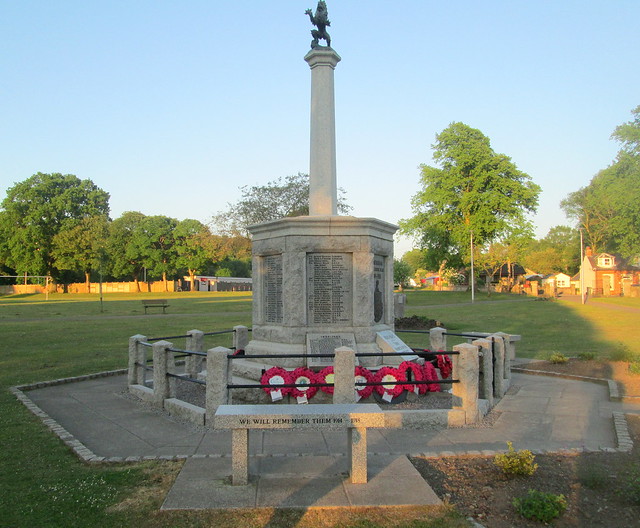
This lovely example of a War Memorial is in Colliston Park, Dalbeattie. A column with lion finial surmounting a hexagonal base, made out of local granite.

Dalbeattie War Memorial

The bench in front is inscribed, “We will remember them 1914-1918.”

War Memorial Bench, Dalbeattie

Inscription, “In Memoriam, our glorious dead, 1914-1918,” and “1939-1945, their names liveth forever.”

Inscription, Dalbeattie War Memorial

Names. Great War above, WW2 below.

Names, Dalbeattie War Memorial

Great War Names:-

Dalbeattie War Memorial, Great War Names

More Great War Names, Dalbeattie War Memorial

More Great War Names. Note St. Nurse Jessie J Paterson TFNS:-

War Memorial, Dalbeattie, More Great War Names

Names for both wars:-

Nmaes for Both Wars, Dalbeattie War Memorial 7

Interzone 283 Has Arrived

Interzone 283 cover

Interzone 283 has landed on my doormat.

The issue contains, among the usual fare, two reviews of mine:-

The novel This is How You Lose the Time War, a collaboration written by Amal El-Mohtar and Max Gladstone.

Palestine +100 edited by Basma Ghalayini, the first ever collection of SF from Palestine.

Time flies….

I’ll need to be getting on with reading the books for review in issue 284.

Islecroft Stadium, Dalbeattie

Home of Dalbeattie Star F C, who currently ply their trade in the Scottish Lowland League.

The stadium lies to the side of Colliston Park, Dalbeattie.

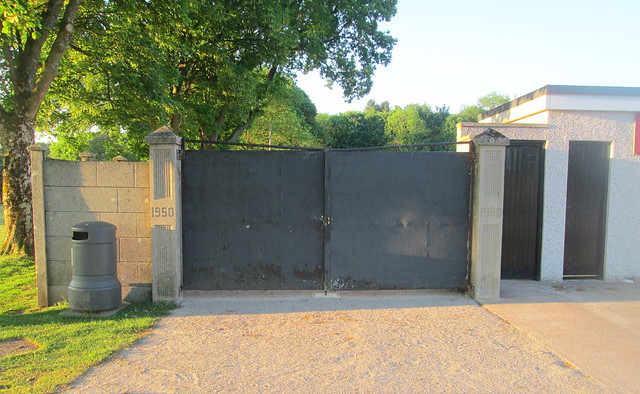
Exit gates:-
Entrance/Exit Gates, Islecroft Stadium, Dalbeattie

Turnstiles:-

Islecroft Stadium

Stand:-

Stand, Islecroft Stadium, Dalbeattie

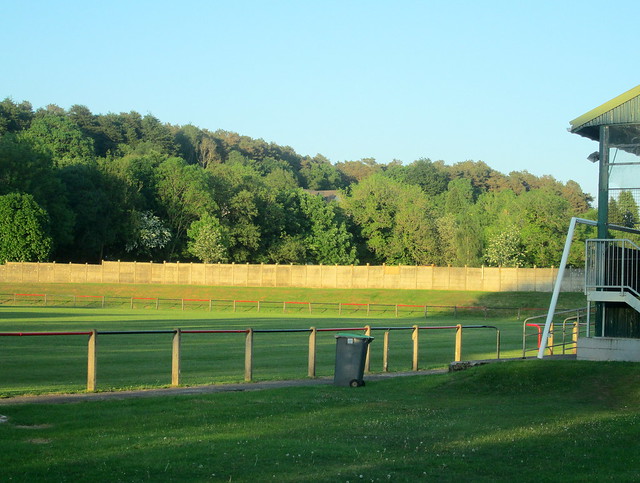
The stadium was closed when I visited Dalbeattie so these views of the pitch are somewhat restricted being taken through or over the fence:-

View of Pitch, Islecroft Stadium, Dalbeattie

Pitch and Dugouts, Islecroft Stadium, Dalbeattie

Part of Pitch, Islecroft Stadium, Dalbeattie

free hit counter script