Archives » 2019 » May

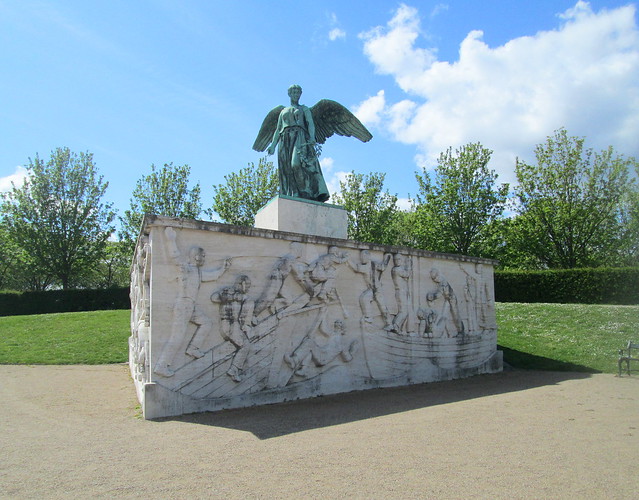
Maritime Monument, Copenhagen

This impressive monument greets you as soon as you leave Langelinie Pier in Copenhagen, Denmark, the second* stop on our recent Baltic cruise.

Monument to Mariners, Copenhagen

The winged female figure of Remembrance (modelled on Nike of Samothrace) is dedicated to those Danish merchant mariners who lost their lives in the First World War.

Maritime Monument, Copenhagenn

*(Our first stop was actually in Dundee. For some reason the trip cost £200 less – each – from Newcastle even though the ship was doing exactly the same journey.)

Shoreline of Infinity 11½: Edinburgh International Science Festival 2018

Shoreline of Infinity 11½ cover

In “Pull up a Log” editor Noel Chidwick puts the case for SF as a way to fulfil the question, “Can Science Fiction save us?” posed as the title of the spoken word Event Horizon the magazine was invited by the International Science Festival to put on in connection with the festival.

Some of the contents have appeared in previous issues. Charlie: A Projecting Prestidigitator by Megan Neumann and the poem The Morlock’s Arms by Ken McLeod appeared in Shoreline of Infinity (SoI) 2, We Have Magnetic Trees by Iain Maloney, Pigeon by Guy Stewart and the poem South by Marge Simon in SoI 3, Goodnight New York, New York by Victoria Zevlin and the poem Starscape by J S Watts in SoI 6, Message in a Bottle by Davyne DeSye in SoI 7, the poem Spring Offensive by Colin McGuire in SoI 8, while The Sky is Alive by Michael F Russell, The Last Days of the Lotus Eaters by Leigh Harlen and the poem the evening after by Peter Roberts in SoI 9.

We start with the poem Can Sci-Fi Save Us? by Jane Yolen and then the fiction kicks off with A Cure for Homesickness by Anne Charnock in which a contract employee ponders whether to extend her time.
Winter in the Vivarium1 by Tim Major is set in a future ice age. Ice statues suddenly start to appear outside the Vivarium for the rich and privileged whose upkeep is seen to by viewpoint character, the much less privileged Byron.
Charlie’s Ant2 by Adrian Tchaikovsky is about the dispute between Central Control and the ants of Charlie field over how maintain a farm’s production of grain. (Unbeknownst to both, the human society they were set up to service has broken down.)
In Candlemaker Row3 by Jane Alexander an unspecified disaster has hit Edinburgh. Our narrator is a woman who once lived there, now employed to verify its digital reconstruction – especially its aromas.
The titular Mémé of Juliana Rew’s story is one of the few survivors of her age group left after a flu epidemic wiped out older people. She becomes venerated and an influencer.
Monoliths4 by Paul McAuley looks to have been inspired by 2001: A Space Odyssey and the phenomenon of crop circles. Set in the author’s Quiet War universe three conspirators contrive to build a monolith on the far side of the Moon. When touched it will activate a radio signal beamed at the galaxy’s centre. Thirty-six years later more such unattributed monoliths begin to spring up all over the Solar System.
In A Distant Honk by Holly Schofield, a research biologist is tracking the behaviour and habitat of the wild clown population, which is dying out.
The Day it all Ended5 by Charlie Jane Anders shows a worker for a producer of useless but made highly desirable items deciding to tell his boss where to stuff it all only to find that was what the company had been waiting for to put into effect its real plan.
The narrator of Last of the Guerilla Gardeners6 by David L Clements is exactly that. Big agribusiness corporations have taken over seed distribution with only a dedicated few guerrilla gardeners left to scatter wild seed about. And there has been a crackdown on them. This story does for plants what Number Ten Q Street did for food.
This is followed by the poem: Now a Ragged Breeze by Jane Yolen.
Then in “Working the High Steel”7 by Jennifer R Povey, Malisse is a female Mohawk used to being told to get back to the reservation. But she is a construction worker, on a kind of space elevator. The finished project is being tested when one of the transit pods hits a problem. She goes out to try to fix it. After all, “‘Mohawks don’t fall.’”
The Rest is Speculation8 by Eric Brown is set over two million years in the future when representatives of all the sentient species which have populated Earth are brought to witness the planet’s last moments. The story nods to James Blish’s Surface Tension.

Pedant’s corner:- 1“Bryan dropped down from gantry” (from the gantry,) “the ha-ha that obstructed views of the town” (obscured is more usual,) jerry-rig (jury-rig.) 2Despite the author being British we have fit as a past tense (fitted,) “sufficient to even take the ants aback” (since this was about the ants’ attitudes this should be ‘sufficient to take even the ants aback,’) “I have had to considerable increase” (considerably.) 3“the skin team are working on it” (strictly ‘the skin team is working on it’,) “the Nor” Loch” (x2, Nor’ requires only an inverted comma, not an end quotation mark.) “Architects drawings” (strictly, Architects’.) “His team have been running behind” (his team has been.) 4 “ratio of 1:4:9, the square of the first three integers” (the squares of the first three.) 5ne280ws (???) CO2 (CO2, x 3,) a missing comma before a piece of direct speech. 6lept (leapt,) unlisenced (unlicenced,) gardner (gardener.) 7two odd line breaks on page 147, “a 140-pound woman could not hold a 230- pound man” (either both, or neither, should have a space after the 140 or 230,) “ I don’t really see she could have stayed on when the passenger pod after it started moving’” (no ‘when’ required,) “‘when the pod is stationery’” (stationary.) 8“this lacunae in our memories” (lacunae is plural. Either ‘these lacunae’ or, ‘this lacuna’. The first would make more sense,) eyes-stalks (eye-stalks – unless the stocks had more than one eye each,) “‘And they?’ I Kamis asked?” (The ‘I’ is redundant.) “Time interval later” count; 2.

Friday on my Mind 179: Move Over Darling – RIP Doris Day

While I was away Doris Day died. Her heyday was in the 1940s and 50s – the latter mostly as a film star – but her recording career spilled over into the 1960s and included this belter, part-written by her son, 1960s record producer Terry Melcher.

The song has a peculiarity in that of the fourteen times the title’s words are sung during it, only two of these are uttered by Day herself.

This is an unusual stereo version.

Doris Day: Move Over Darling

Doris Mary Ann Kappelhoff (Doris Day:) 3/4/1922 – 13/5/2019. So it goes.

McDiarmid Park, Perth

McDiarmid Park is the home of St Johnstone FC, and was the scene of the Challenge Cup* Final, 24/3/18.

My posts on the final are here, here and here.

Ormond Stand from access road:-

Ormond Stand, McDiarmid Park, Perth

Ormond and Main Stands:-

Ormond and Main Stands, McDiarmid Park

Main Stand (stitch of two photos):-

Main Stand, McDiarmid Park, Perth

View of North Stand:-

View of North Stand, McDiarmid Park, Perth

North Stand from Main Stand:-

North Stand from Main Stand, McDiarmid Park, Perth

East Stand:-
East Stand, McDiarmid Park, Perth

Ormond Stand from Main Stand:-

Ormond Stand from Main Stand, McDiarmid Park, Perth

*Irn Bru Cup

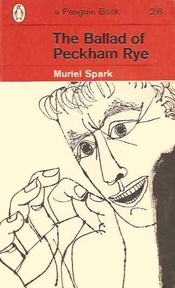
The Ballad of Peckham Rye by Muriel Spark

Penguin, 1960, 141 p.

 The Ballad of Peckham Rye cover

Dougal Douglas has been hired by Meadows, Meade & Grindley, manufacturers of nylon textiles, because “the time has come to take on an Arts man.” The novel relates the effect this appointment has on some of the workforce and also on the inhabitants of Miss Frierne’s lodging house where he holds a tenancy. One of these effects is that Humphrey Place jilted his intended, Dixie Morse, at the altar, an incident referred to in the book’s first lines but not fully described till later.

I confess I find myself totally underwhelmed by Spark’s writing. There is something about it which is just too detached. I never feel I get close to understanding why her characters behave the way they do, what motivates them; Humphrey’s jilting of Dixie being a case in point. Spark is held in high regard though, so maybe it’s my expectations of fiction that are at fault.

That this was published in another time – nearly sixty years ago now – is evidenced by the casual use of the phrase “nigger minstrels”.

I have two more Sparks on my to be read shelves so I will be coming back to her – but perhaps not in the immediate future.

Pedant’s corner:- a missing end quotation mark after a piece of direct speech (x 2,) “ the brussels” (Brussels,) Hooch (it’s heeooch, or heeugh.) “‘You did, a matter of fact’” (the phrase is ‘as a matter of fact’ but this was in dialogue,) ditto “‘What you know about kids?’” (What do you know?)

Same Planet?

Not for the first time Ruth Davidson has come to my attention. I have previously noted her resemblance to Benito Mussolini.

It struck me a while ago that she is largely responsible for the present mess that the UK Parliament has got itself into over Brexit. At the last general election – one in which the UK’s future relationship with the EU was the most important issue facing the country – her campaign consisted solely of insisting that the Scottish electorate reject any more unneccesary elections in the form of a second Scottish independence referendum. (The irony that that general election was itself totally unnecessary in that Theresa May had a perfectly workable majority and no need to bother the electorate seems to have been lost on Ms Davidson.)

The upshot, however, was that the number of Scottish Conservative MPs increased from its previous derisory level to 13. Given that Mrs May managed to lose Tory MPs in the rest of the UK this was something of a triumph for Ms Davidson. However its consequence was that rather than Theresa May losing power those 13 Tory MPs gave her an outside shot at a Parliamentary majority, with DUP help.

The outcome we all know. The Westminster Parliament has been unable to come to any agreement on what the future relations between the UK and the EU ought to be and all is chaos. Without those 13 Scottish Tory MPs there may well have been a different Government – under a different Prime Minister – and an orderly withdrawal from the EU might have been cobbled together. British politics would not then be in its present parlous state. And we have what is arguably another “unnecessary” election.

Yet, what lay in my post on my arrival back from holiday? (A holiday I might add in which my visits to Denmark, Germany, Estonia, Finland and Sweden showed a degree of civic engagement with the elections to the European Parliament sadly not in evidence in the UK in previous years to this – and given the lack of posters on lampposts round my area in this year too. A coincidental mayoral election in Rostock might have added to the interest there, though.)

Well there was a Scottish Tory European election leaflet barely mentioning Europe (if at all) but pleading for votes so as to forestall a further Scottish independence referendum. Ms Davidson it seems has only one tune. Her cupboard is bare. If it weren’t for the prospect of another independence referendum what on Earth would she campaign on? She has nothing to say on any other subject.

Since she has seemingly learned nothing and has forgotten nothing perhaps Ms Davidson is a Bourbon rather than a Mussolini.

Niki Lauda

One of motor racing’s greats, Niki Lauda, has died.

Though he only won the F1 World Championship three times, his talent was acknowleged as being of the highest quality.

His courage in coming back from a horrific accident in which he almost died at the 1976 German Grand Prix at the Nürburgring to race again only 40 days later was incredible. Arguably though, his withdrawal from the final Grand Prix that year in Japan, where the weather conditions were appalling, took even more courage as that year’s World Championship was on the line. As a result his great friend and rival James Hunt won the Championship – by one point. Lauda’s team, Ferrari, was not best pleased.

It marks Lauda’s resolve that he made that decision and still came back to win the World Championship the next year – and again seven years later.

Andreas Nikolaus (Niki) Lauda: 22/2/1949 – 20/5/2019. So it goes.

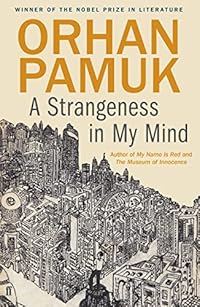
A Strangeness in my Mind by Orhan Pamuk

faber and faber, 2015, 613 p including v p Contents, ii p Aktaş and Karataş family tree, v p Index of characters and vii p Chronology. Translated from the Turkish Kafamda bir tuhaflik by Ekin Orlap.

 A Strangeness in my Mind cover

This is the story of Mevlut Karataş who wanders the streets of Istanbul at night selling boza – a kind of fermented drink concocted so as Turks could believe they were not actually drinking alcohol even though they were – from the panniers hung from the pole across his shoulders. While the narrative is mainly carried by a third person account of Mevlut’s life and thoughts, the viewpoints of many of the individuals connected to Mevlut are interpolated into the text. All of these are written in the first person and introduced by that narrator’s name. Though all the details of Mevlut’s life from his arrival in Istanbul to help his father on his boza rounds, through his prolonged and ultimately unfruitful sojourn at the Atatürk Secondary School for Boys, his years conscripted in the army, the attempts to sell yoghurt, ice cream and cooked rice, the other ventures into employment, cashier in a café, car park guard, electricity inspector – residents of Istanbul seem to have been very creative in the ways they could steal electricity from the supply company – it is his love life which provides the book’s main thrust.

The first chapter depicts the defining incident in Mevlut’s life, and it is as magic realist as you could wish – only not magical at all. For three years Mevlut had been writing letters to Rayiha, a girl whose eyes he had stared into at the wedding of his cousin Korkut. Korkut’s brother Süleyman agrees to help Mevlut elope with Rayiha and arranges the deed. When Mevlut glimpses the girl in the back of Süleyman’s van that night he is bewildered to discover she is not the one he thought he had been writing to. Nevertheless, he marries her, comes to love her and have two daughters with her. Süleyman’s deception, of course, (he had designs on the girl with the eyes, Rayiha’s sister, Sadiha, himself,) has ramifications throughout the book.

Many observations about love are made within the text. Hadji Hamit Vural avows, “‘if you’re going to love a girl as deeply as your brother here … you’ve got to make sure to start loving her after you’re married …… but if you fall in love before that .. and you sit down to discuss the bride price with the girl’s father, then those cunning, crafty fathers will ask you for the moon … Most couples would not fall in love if they got to know each other even just a little bit before getting married …. There is also the kind that happens when two people get married and fall in love after that … and that can only happen when you marry someone you don’t know.’” Süleyman’s later lover Melahat (a stage performer under the name Mahinur Mehrem) lets us know that, “‘I could write a book about all the men I’ve known, and then I would also end up on trial for insulting Turkishness.’”

The changing face of the city into whose nooks and crannies Mevlut wanders plying his wares and the evolution of Turkish life become major themes, with the political ups and downs a background never fully occupying Mevlut’s mind; but a sense of the role played by emphasising the nation is never far away, “in this night, pure and everlasting, like an old fairy tale, being Turkish felt infinitely better than being poor.”

The more you read Pamuk the more it becomes clear that his real subject, his true love, is Istanbul; though Turkishness in the wider sense is also important and affairs of the heart never far away. Here Mevlut’s friend Ferhat tells us that, “What makes city life so meaningful is the things we hide.” Pamuk’s œuvre has probed into those hidden places – more so in A Strangeness in my Mind as his previous books have tended to concentrate more on middle class Istanbul, whereas here our hero (as Pamuk refers to Mevlut several times, this is a knowing type of narration) is one of those for whom getting on in the world has always been difficult, he does not know enough of the right people, never accumulates sufficient capital to become affluent.

Again in a Pamuk novel set in modern times there is an acute consciousness of football, but here no hint of anyone called Orhan Pamuk. If Istanbul itself were not enough, allusions to a journalist character from The Black Book would tie this novel in with previous works.

Through all his modern novels – and arguably in those set in historical times – Pamuk has been picking away at the threads of Turkish life, the tensions between religion and the secular sphere, the restrictions set on the people by political, societal and religious dictats. It is almost possible having read enough Pamuk to feel you know something about Turkey, and especially about Istanbul. This may be a delusion but it’s closer to the truth than those without that experience can ever have.

Pedant’s corner:- no start quotation mark when a chapter begins with a piece of dialogue, shopwindows (shop windows. Is it one word in Turkish?) “enormous billboards that look up one whole side of a six- or seven story [sic] building” (took up makes more sense,) “thirty two liras” (isn’t the plural of lira just ‘lira’? Many instances of liras,) “he would open at random to a page” (‘he would open a page at random’ sounds a more natural construction,) the text refers to Argentina and England being at war, and to ‘English’ ships (that of course should be Britain and British respectively,) occasional omitted commas before and after direct speech, “provide the overhead” (in British English it’s ‘overheads’,) “the lay of all the neighbourhoods” (the lie.)

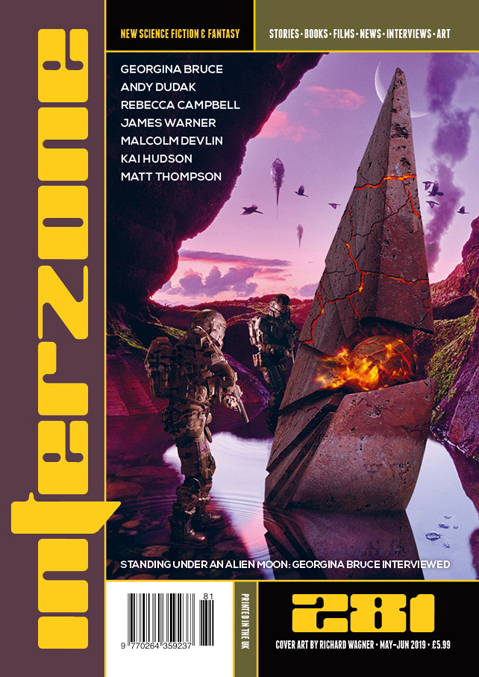
Interzone 281

 Beneath the World, A Sea cover
Interzone 281 cover

Lying on my doormat – among a whole load of other stuff – after I got back from holiday was the latest issue of Interzone, 281 by number.

I had thought that my review of The City in the Middle of the Night by Charlie Jane Anders was due in this one but it’s not there. I assume it will now appear in issue 282.

Also on my doormat (delivered via TTA Press) was Chris Beckett’s latest novel Beneath the World, A Sea. I suppose my review of that one will also appear in issue 282.

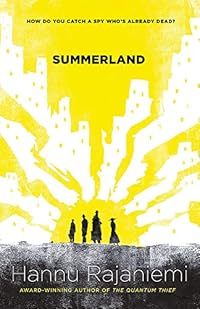
Summerland by Hannu Rajaniemi

Gollancz, 2018, 328 p.

I had scheduled this post to appear when I was away but for some reason only the title appeared. I’ve now binned that one. Here’s the full version.

 Summerland cover

Rajaniemi’s first few novels were fairly dense narratives where not much concession by way of information dumping was made to the reader who in consequence was forced to do a bit of work in following their stories. As an approach this had its merits, as the rich, layered depths revealed themselves slowly and made for a more enriching read. By contrast Summerland has a more common narrative structure with no corresponding demands on the reader beyond suspension of disbelief. Given its timeline it could be classified as an Altered History but the milieu it depicts is really not one for which that description could fully apply being more sui generis.

Sometime towards the turn of the nineteenth and twentieth centuries radio experiments led to contact with the world of the dead. Now a whole system of communications – via ectophone and ectomail – exists between the realms, the Queen rules from what is called Summerland, the Great War was won with the aid of ghastly apparitions like the ectotank, but still a kind of cold war exists between Great Britain and the USSR. Transition between the realms (ie death) is mediated via Tickets which provide a destination for a departed soul. Without a Ticket a dead person is subject to Fading as their soul evaporates away. This will also happen even to those who had a Ticket unless sufficient suffusions of a substance known as vim occur.

The book is set over several months in late 1938 and January 1939. There is no Nazi threat but renegade from the USSR and its own Summerland god engine, Iosef Dzhugashvili, is fomenting trouble in Spain.

Rachel White is an operative of the British security services entrusted with the protection of a Soviet defector. After telling her of the existence of a mole called Peter Bloom, he blows his brains out. Her report of this revelation to her superior is greeted with dismissal, her gender being seen as making her an obvious target for an attempt to foment suspicion and distrust. Bloom, is, however, known to be close to the Prime Minister, Herbert Blanco West (whose mere name is enough to trigger associations in the reader even before we learn of his past as a draper’s apprentice who had dreams of Martian invasions and invisible men.) Similarly Rajaniemi has a bit of fun in slotting in the likes of Guy Burgess, Kim Philby and Anthony Blunt as minor characters in his tale.

The plot then consists of the usual kind of spy story albeit complicated with interferences from the spirit realm whose denizens can take over bodies in the “live” world on a kind of hire basis but also monitor the emotions of the undead, thus making it difficult to lie to them. The tale is however – unusually for a spy story – told from the viewpoint of the spy, Bloom, as well as the would-be spycatcher, Rachel.

The existence in the realm of the dead of shadowy entities called Cullers who will leap on any detected activity in the zone and pounce to ensure its inhabitants will Fade is not made much of in Summerland whose text is mainly Earth-bound and taken up with White’s efforts to prove Bloom is a spy. There is slightly more to Rajaniemi’s story than this but its appeal lies in the idea of a parallel world of the dead and its ability to interact with the ‘real’ world rather than the plot it contains.

Pedant’s corner:- I read an advanced reading copy so many of these may have been changed for final publication. “could really use a person of your calibre” (the British English for this is ‘could really do with’,) “desk a parking lot for memos” (again, ‘parking lot’ is not British English,) “lay low” (lie low,) “none of the security measures were enough” (none … was enough,) “there were a number of small glass vials” (there was a number,) “ we have a bloody mess in our hands” (on our hands,) a missing full stop at a sentence end (x2,) “she lunched with the junior staff with the canteen” (in the canteen,) “more spare time in my hands” (on my hands,) a missing start quotation mark, ”she managed slur the words” (to slur,) “in the in the” (one ‘in the’ too many,) prime minister (x2, Prime Minister,) “reached a crescendo” (a crescendo is a process, not a culmination; ‘reached a climax’, Crookes’ (Crookes’s,) “gift of gab” (gift of the gab,) “‘the benefit of doubt’” (the benefit of the doubt,) “I could use a little flattery’” (I could do with a little flattery,) “‘I just I can’t help you’” (an ‘I’ too many,) “a fearsome, feathered hat” (doesn’t need that comma,) “‘Say, do you see….’” (No English Oxford student would start a question with ‘Say’. ‘I say’, perhaps, but not ‘Say’,) “Peter let go of the drainpipe caught the roof’s edge” (and caught,) “‘you do this it a lot’” (no need for the ‘it’,) “folded his lanky frame into his bench in with great difficulty” (no ‘in’ required,) a missing end quotation mark, “the groans of the old coach” (‘the old couch’ makes more sense,) “times ten” (multiplied by ten,) “‘what are you going ty do next.’” (Is a question so needs a question mark rather than a full stop,) Djugashvili (x3, elsewhere Dzhugashvili,) “Leading up her bar exam” (up to her bar exam,) “‘setting up a meet’” (a meeting,) Symonds’ (Symonds’s,) “rode in their wake of as they pushed their way” (‘in their wake as they pushed’,) dove (dived. Please,) “‘I could, in fact, use some advice’” (I could, in fact, do with some advice,) Rache (elsewhere always Rachel,) “the men’s room” (the gents,) maw (it’s a stomach, not a mouth,) “the car’s hood” (the car’s bonnet,) “on a chair in cell” (in a cell.)
free hit counter script