Super Nova and the rogue satellite by Angus MacVicar
Posted in Reading Reviewed, Science Fiction, Scottish Fiction at 12:00 on 19 March 2024
Knight Books, 1969, 151 p, plus 8 p Diagrams and Technical Data.
 Super Nova is the name of a(n as yet unused in an emergency) rescue ship based on the Moon.
The scene is set on the Moon base, a relatively large establishment with some married couples and a few children among the otherwise unattached. Not quite in that last category (but also not far from it) are Nurse Janie O’Donnel and Assistant Signaller Steve Murray who are attracted to each other but not as yet actually an (as we would say now) item. Gender roles are pretty much what were recognised as such in the late 1960s. Most of the women are either married and stay at home or have nurturing roles. One of the more unusual characters is Norman the News – whose nickname is perhaps an indicator of the author’s Scottish background – a reporter for Earth based newspapers.
The crisis which leads to Super Nova’s launch comes when a supply ship, the Archimedes, is stopped in space near to the incoming Satellite 907 – which has, incidentally, somehow or other managed to make the round trip to Pluto and back in a matter of days – along with a failure of communications. O’Donnel was originally scheduled to be on the Super Nova but Murray volunteers since the usual signaller is incapacitated but mainly to be near O’Donnel.
There is a large amount of information dumping (the story was intended for young adults though.) More noticeably these days the societal assumptions of its time or, rather, of MacVicar’s time, he was born in 1908 after all, are littered through it.
It turns out that in its pass round Pluto Satellite 907 has been taken over by that (minor) planet’s native intelligences, intrinsically hateful. They had in the past boosted Pluto from orbit round Neptune, a manœuvre which also forced Triton into its retrograde motion round its parent.
Close encounters with Satellite 907 lead to the Super Nova’s crew beginning to develop feelings of antipathy towards each other, leading on to much worse emotions. This is of course the influence of the Plutonians. Relief from these comes when Pluto’s spin takes the relevant transmitter round its edge. (Did they not, I wondered, have a relay system to ensure continuity? Never mind, it’s for YA; let’s carry on.)
The main action involves Murray having to approach the satellite during the transmission lull to deactivate its self-destruct device. For this he needs the relevant tools and Janie offers to take them to him. There is an uncomfortable scene where after he loses consciousness and Janie performs the actual deed she later tells him (in order to protect his self-esteem) that he did it.
One of the characters ruminates that, as a historical phenomenon, “Nobody seemed to like the Jews” then that “this was partly their own fault for being so inward looking, so close and clannish, so rigid in their beliefs.” Victim blaming or what.
But all on Earth is apparently now in harmony, technical and social benefits bind everyone in fairness to contribute in work and example. The Plutonians are somehow managing to undermine these feelings of togetherness and instilling fear and distrust – even hate.
The orbital dynamics of all of the ‘stopped in space’ gubbins are of course nonsense but without them there wouldn’t be a story.
The quaintness of this vision of the future is underlined by one of the characters using a “pocket space-range calculator” (looking like a cross between a set-square and a spirit level!) which was his own invention.
It is unusual to find in a work of SF, let alone a juvenile, as these stories were called back then, references to Goethe and James Hogg.
Similarly, I doubt any other piece of SF has ever employed the Scots word ‘douce’. Kudos to Scotsman MacVicar for that.
Diagrams of Satellite 907, the Archimedes class of ship, Pluto’s escape from orbit round Neptune, the Super Nova, a Moon Bus (with a crane attachment!) a laser-armed scout ship and a lunar vacuum suit appear as an appendix.
Sensitivity note: as well as the reference to Jews above, there is a mention of a Negro mayor, and the phrase “the nigger in the spatial woodpile.”
Pedant’s corner:- collander (colander,) “[responsible] for discovering minerals, oils and other products” (oils? On the Moon?) “dog’s-bodies” (nowadays – and perhaps even in 1969 – dogsbodies,) similies (similes,) span (spun,) “on the base of pure logic” (on the basis of pure logic,) “came to a stop in her orbit” (spaceships are not cars; they cannot just stop, they keep going until something changes their direction. This, as a plot point, ought to have been elaborated on,) 9o7 (907,) I noted the abbreviation ‘mike’ (which is now often rendered as ‘mic’,) the burst of flame from an atomic explosion “would become a towering mushroom cloud” (not in space it wouldn’t. The ‘cloud’ would be approximately spherical in shape,) “a spot of rust having formed” (on a screw fixing on a spaceship. In space the chemical conditions for rusting are not present. [To be charitable I suppose the rusting could have occurred during manufacture on Earth.] But also only iron can form rust [other metals corrode, but the result is not rust] but if they are to be launched from Earth, iron is too dense a material to make spaceships from.)
 This one was published twenty years after Welsh’s first novel
 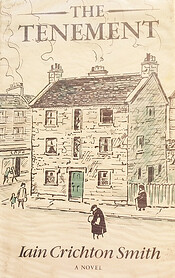 As its title betokens this novel is about the lives of the inhabitants of a tenement which is old, built of grey granite in a town on the east coast of Scotland, and is personified in the first chapter as being somewhat intolerant of young people, preferring its inhabitants to have lived a little. As we start there are no children living in the building.
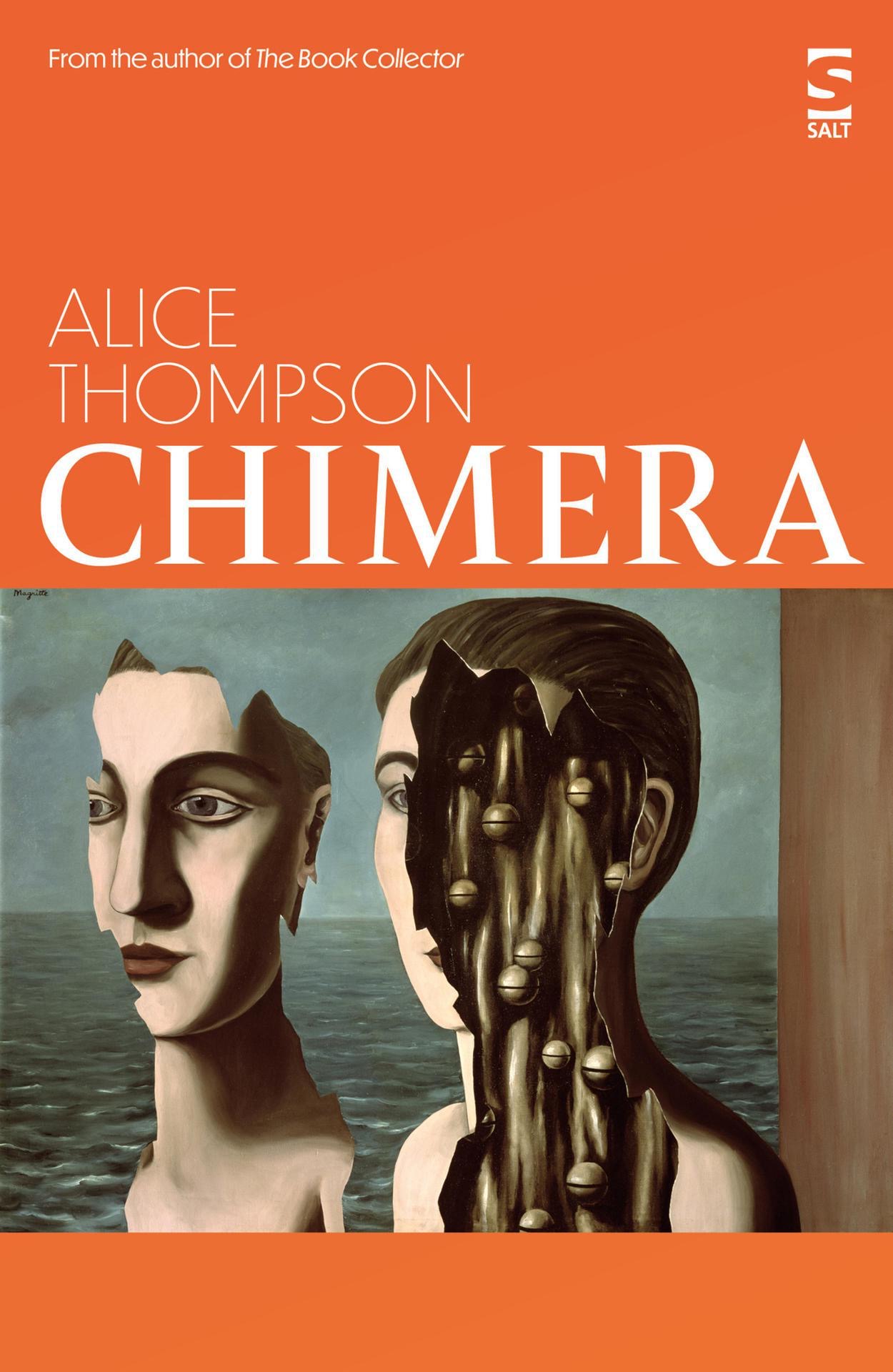 Alice Thompson is a veteran of seven previous novels but as far as I’m aware none of them has been Science Fiction. Concerning as it does a voyage to another planet (or, strictly, to its moon) this book could hardly be described as anything else. Yet it is not a typical exemplar of modern SF. Unlike the brashness of the average space exploration story its tonal qualities are more reminiscent of Stanisław Lem’s Solaris or David Lindsay’s A Voyage to Arcturus. Its epigraph, perhaps the most famous quotation from The Tempest, suggests the trajectory that will follow.
 Crumey’s work has never been marketed as Science Fiction but has many intersections with the genre; not least his exploration of parallel worlds and alternative histories. This is by far, at 509 pages, the most lengthy of his novels yet published. It features some of those earlier preoccupations – music, concepts from Physics, the reliability of memory – yet cannot be said to be truly like any of its predecessors. It is multi-layered, multi-voiced, in parts reading more like a biography of Beethoven than a novel, but never less than readable.
 This is part of a departure for Kennedy. Her earlier books were short story collections and novels intended for adults. However in 2017 she started producing a series of children’s stories about featuring
 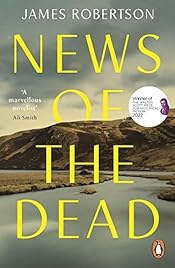 The book is set in a remote(ish) Highland glen, Glen Conach, named for the (unofficial) Saint who first converted the locals to Christianity, in three different time periods.
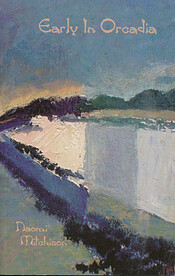 This is Mitchison’s imagination of what life in pre-historical Orkney might have been like for its human inhabitants. It is not much differet from her tales of the times when Vikings were the dominant force in the islands.
 The book is an exploration of the last days of Klaus Mann, son of Thomas Mann. Klaus’s life was always lived somewhat in the shadow of his father, who is often referred to here as The Magician.