The Bachelors by Muriel Spark
Posted in Other fiction, Reading Reviewed at 12:00 on 19 December 2023
Polygon, 2018, 238 p, plus iv p Foreword and vi p Introduction by James Campbell. First published in 1960.
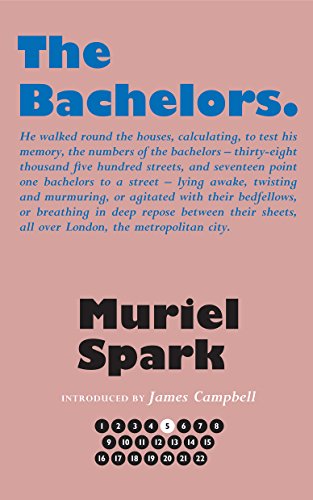 The book starts in a low key, bouncing between the lives of various bachelors living in London and their equally varied reasons for not being or getting married. A note of jeopardy is soon introduced with a séance in which Patrick Seton – a supposedly accomplished spiritualist – performs his shtick for the group known as The Wider Infinity.
It turns out that Seton is facing prosecution for fraudulent conversion, in that group member Freda Flower gave him £2000 to invest in stocks and bonds and he misused it. Handwriting expert Ronald Bridges, who is an epileptic, has been asked by the police to examine a letter said to have been written by Freda to Seton allowing him to use the money for spiritual purposes.
Seton meanwhile has a pregnant girlfriend, Alice Dawes, a diabetic who believes he will marry her when his imminent divorce comes through. Her friend Elsie Forrest is of a different opinion and doesn’t believe he is married at all.
The Wider Infinity has a sub-group known as the Interior Spiral whose members conspire to affect Seton’s trial by colluding on their stories. Things are further complicated when Elsie gets to know Bridges has the letter and steals it from his home.
(Question: why would the police have released it to him? It is suggested in the book that the theft might invalidate Bridges’s subsequent testimony but surely it wouldn’t have happened at all? In any case the letter is returned to Bridges just before the trial.)
Seton is shown to be a thoroughly bad lot when he asks his doctor about the likely effects of relative under- and overdoses of insulin for Alice, whom he plans to take on holiday to an isolated chalet in Austria should he be found not guilty. The trial itself is described much as you might expect.
There is something about Sparks’s writing that just does not sit well with me. It has moments of insight and the occasional piece of sharp observation but here the story has too many characters and the text is laden down by an excess of dialogue and characters’ registers being virtually indistinguishable from each other.
Sensitivity note: One character refers to “Pimps and tarts and Jews.”
Pedant’s corner:- “could come to nought in the end” (come to naught,) “nineteen tirty-two” (nineteen thirty-two. I don’t think Spark was trying to indicate Irish origin,)
Tags: Literary Fiction, Muriel Spark, Scottish Fiction, The Bachelors
