Archives » Scottish Fiction

Best of 2023

These are in order of reading; 18 in total, 9 by women, 10 by men, 8 by Scots (italicised,) 4 translations, 1 SF/Fantasy. The links are to the reviews on here:-

Paradise Reclaimed by Halldór Laxness 

The Women of Troy by Pat Barker 

For the Good Times by David Keenan

The Infinities by John Banville

Wild Geese by Nan Shepherd  

Paper Cup by Karen Campbell

A Would-Be Saint by Robin Jenkins 

Master of the Crossroads by Madison Smartt Bell 

Beethoven’s Assassins by Andrew Crumey  (my review was published in ParSec 8 and will appear here in due course.)     

The Marriage Portrait by Maggie O’Farrell 

The Liar’s Dictionary by Eley Williams

Fishnet by Kirstin Innes 

The Gaze by Elif Shafak

Dancing Lessons for the Advanced in Age by Bohumil Hrabal

Utopia Avenue by David Mitchell 

O Caledonia by Elspeth Barker 

Cybele, with Bluebonnets by Charles L Harness

Of Love and Other Demons by Gabriel García Márquez

My present read (Luka and the Fire of Life by Salman Rushdie) may be an addition to this list (but then again it may not.)

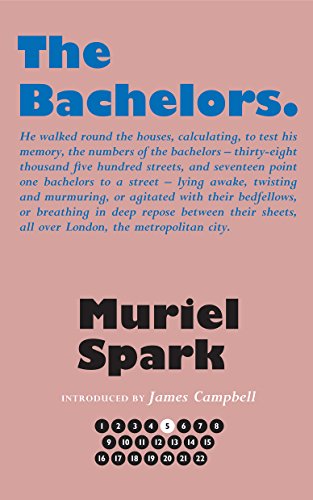
The Bachelors by Muriel Spark

Polygon, 2018, 238 p, plus iv p Foreword and vi p Introduction by James Campbell. First published in 1960.

The book starts in a low key, bouncing between the lives of various bachelors living in London and their equally varied reasons for not being or getting married. A note of jeopardy is soon introduced with a séance in which Patrick Seton – a supposedly accomplished spiritualist – performs his shtick for the group known as The Wider Infinity.

It turns out that Seton is facing prosecution for fraudulent conversion, in that group member Freda Flower gave him £2000 to invest in stocks and bonds and he misused it. Handwriting expert Ronald Bridges, who is an epileptic, has been asked by the police to examine a letter said to have been written by Freda to Seton allowing him to use the money for spiritual purposes.

Seton meanwhile has a pregnant girlfriend, Alice Dawes, a diabetic who believes he will marry her when his imminent divorce comes through. Her friend Elsie Forrest is of a different opinion and doesn’t believe he is married at all.

The Wider Infinity has a sub-group known as the Interior Spiral whose members conspire to affect Seton’s trial by colluding on their stories. Things are further complicated when Elsie gets to know Bridges has the letter and steals it from his home.

(Question: why would the police have released it to him? It is suggested in the book that the theft might invalidate Bridges’s subsequent testimony but surely it wouldn’t have happened at all? In any case the letter is returned to Bridges just before the trial.)

Seton is shown to be a thoroughly bad lot when he asks his doctor about the likely effects of relative under- and overdoses of insulin for Alice, whom he plans to take on holiday to an isolated chalet in Austria should he be found not guilty. The trial itself is described much as you might expect.

There is something about Sparks’s writing that just does not sit well with me. It has moments of insight and the occasional piece of sharp observation but here the story has too many characters and the text is laden down by an excess of dialogue and characters’ registers being virtually indistinguishable from each other.

Sensitivity note: One character refers to “Pimps and tarts and Jews.”

Pedant’s corner:- “could come to nought in the end” (come to naught,)  “nineteen tirty-two” (nineteen thirty-two. I don’t think Spark was trying to indicate Irish origin,)


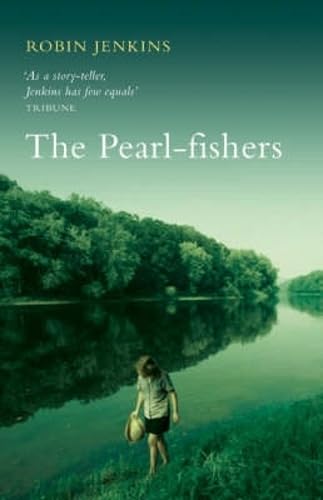
The Pearl-fishers by Robin Jenkins

Polygon, 2007, 181 p, plus vii p Introduction by Rosemary Goring.

The manuscript (actually several iterations of it) of The Pearl-fishers, with its initial title The Tinker Girl, was discovered in Jenkins’s papers after his death, with no indication he had intended for it to be published. Three other versions are stored in the National Library of Scotland, an early handwritten draft with many amendments, and two typescripts, one of which is identical with this published one.

It begins with a group of forestry workers on a break noticing two dilapidated carts drawn by equally decrepit horses as they approach. The carts carry a grey-haired woman, an old man, two children and a striking young woman. The collective thoughts of the workers are that such beauty is wasted on they call tinkers. All the workers that is, except Gavin Hamilton, the same Gavin Hamilton it would seem as appeared in Jenkins’s earlier novel A Would-be Saint, who has a natural disposition towards kindness.

The “tinkers” (Jenkins utilises the word’s negative connotations superbly to point out the prejudice inherent in the locals’ attitudes and suspicions) are travellers, yes, but make their living searching out pearls from fresh water oysters. The group has made the two hundred-mile journey from Sutherland so that the dying old man, the three young travellers’ grandfather, can be buried by the Great Stone where members of his family were interred when he was four.

All they ask of the locals is a field to pitch their tent, and Gavin grants their request. However, he always intended to invite them into his house instead. The young woman is Effie Williamson, the older woman is her mother, the children her brother Eddie and sister Morag.

The children turn out to be far from the feral wild things of the foresters’ imagination. Polite and well-mannered, they take to Gavin, as he does to them. Effie’s feelings are more complex. Her pride makes her want not to take advantage of Gavin’s generosity of spirit but her natural grace wrongfoots the locals – especially the Minister’s sister (also daughter of a minister and niece of a Moderator,) whom it is thought locally has her eyes on Gavin and would make him a good wife, though any relationship between them would doubtless lack passion.

The burgeoning attraction between Gavin and Effie does perhaps progress rather too quickly (the book is only 181 pages long) but it is destined never to exceed the bounds of propriety, despite any opportunities living in the same house presents. Any impediment to its advancement is provided only by Effie’s feelings of reluctance and restraint and Gavin’s deferment to them.

The backgrounds of both Gavin and the “tinkers” are well developed as are the dynamics of the small town setting but there is a rather rushed feeling to the book most likely as a consequence of it being unfinished (or I should say unpolished.) Had Jenkins had more time these could have been remedied. The Pearl-fishers is a worthy addition to his œvre, though.

Pedant’s corner:- In the introduction; Jenkins’ (several times, Jenkins’s,) miniscule (minuscule.)  Otherwise; “The next room they same upon” (came upon.) “She said by the window, waiting for him to come home.” (She sat by the window.) “That young ploughmen” (ploughman.)


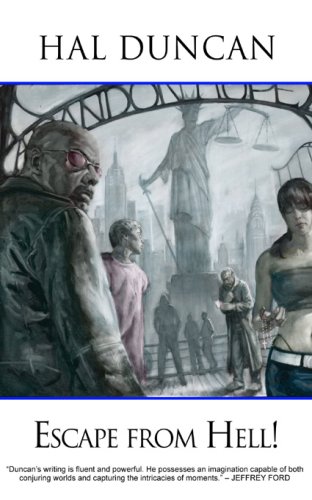
Escape From Hell! by Hal Duncan

Monkey Brain Books, 2008, 147 p.

In the Prologue we are treated to the more (or less) graphic deaths of our four agonists, Seven, Belle, Eli, Matthew. As they must, given the book’s title, all four arrive in Hell which, as depicted here, seems like a version of a modern US inner city complete with its own low-lifes, its own cops (corrupt, obviously,) its own TV station with its star Trent Knightly – reporter for the allusively named Vox News.

Immersed in various nightmare scenarios particular to each, in their own ways they attempt to escape and eventually come together. There are tales of a way out: but this is Hell, maybe these are only rumours. In Hell of course the only way out is down. At its centre they come upon Lucifer, trapped there for four thousand years, and discover the real power behind this infernal place, the one who consigned them all there in the first place. (Traditional religious believers will not look kindly on this revelation.)

Duncan’s story is related in a necessarily urgent present tense and the text contains copious amounts of swearing. Plus one instance of the n-word. With scenes not for the squeamish. It is set in Hell after all.

Pedant’s corner:- 250 mils (the plural of the abbreviation ‘ml’ is ‘ml’,) “there’s no buttons, no switches” (there are no buttons, no switches,) “wet canvass” (canvas,) discernable (discernible.) “Belle whisper a response he misses” (Bell whispers a response,) “a dark maw of a doorway” (a maw is a stomach, not an entrance,) later “a dark maw at its base” (ditto,) “Matthew and Eli skidding round a corner, Belle and Eli close behind” (one of those Elis should be a Seven.) “There’s no tears in Belle’s eyes” (There are no tears.)

King Hereafter by Dorothy Dunnett

Michael Joseph, 1982, 725 p, plus ii p frontispiece showing the lineage of Kings of Scotland (Alba) and Northumbria, ii p backispiece (I apologise for the coinage) of rulers of Orkney, Norway, Normandy and England, iii p maps of mid Europe in the 11th century, Alba (Scotland) and Northern England in AD 1050, and of the Orkney islands and Caithness of AD 1050, and ii p lineage of Danish and Norwegian rulers.
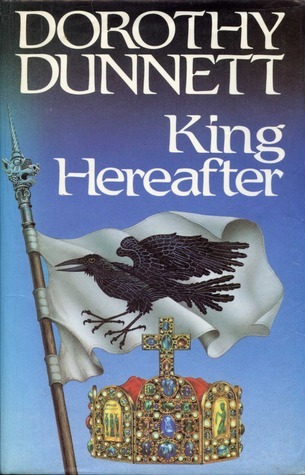
The sparseness of the historical record for Scotland in the Dark Ages leaves something of a blank canvas for the novelist to exploit. In Dunnett’s account of the life of Macbeth MacFinlay (whom Shakespeare portrayed as a villain) she has chosen to fill that canvas by conflating him with a certain Earl Thorfinn of Orkney. (See here.)

In Dunnett’s version, Thorfinn (in the book he is rarely referred to by his Christian baptismal name of Macbeth,) although the grandson of King Malcolm II is more proud of his Orcadian heritage than his Scottish one and keener for that to be passed on to his own sons, to whom he gives Norse names.

He is not the only character to have more than one name. His wife was born in Norway as Ingibjorg Arnason, has the baptismal name Margaret but is known to him as Groa (and in Gaelic as Gruoch.) Aged fourteen she was forced into marriage to a middle-aged Mormaer of Moray, Gillacomghain, who had killed Finnlaech, our hero Thorfinn’s stepfather. When Thorfinn in his turn killed Gillacomghain to regain his lands of Moray he married the widow.

Such was life for high-born women in the Dark Ages; destined only to cement alliances and to breed. (Spoiler alert [Really? Are the outlines of the story not well-known?]: she was to suffer a similar fate when Thorfinn is killed by the man who became Malcolm III who also made her his wife.)

This was the time when the Norse kingdoms had only recently become (at least nominally) Christian and a fair bit of the narrative deals with the merits of the Celtic as opposed to the Roman Church in particular as Thorfinn is trying to unify the Kingdom of Alba’s only loosely held regions of Fife, Angus, Buchan, Caithness etc. Though Thorfin has some sway in Galloway (and Cumbria plus alliances with Ireland) the Lothians were territory disputed with Northumbria. England’s regions (Mercia, Wessex, East Anglia) likewise owed allegiance to one king but their rulers had ambitions of their own.

The novel’s main attention, though, is given to Thorfinn’s Scottish lands and those in Orkney but ranges widely over the Northern Europe of the time and has mentions of King Stephen of Hungary. Thorfinn even makes a pilgrimage to Rome to seek the Pope’s imprimatur. In his youth he had spent some time in the English court of King Canute whose wife Emma (another who had been taken as a wife by her first’s successor,) after her second husband’s death still has her matrilineal fingers spread across England and Normandy.

At times, then, the book reads more like a historical account than a novel. Shifting alliances and manoeuvrings make up most of the intrigue with the interests of the Godwinsson family and William the Bastard of Normandy (which would eventually collide at the Battle of Hastings) begin to loom large towards the book’s end.

King Hereafter can be seen as one of many attempts to rescue the historical Macbeth from the obloquy to which Shakespeare consigned him.

His periglour Sulien here says to him, “‘Men will look back and see a king who strove to build for his people. …. The name each man leaves is a small thing compared with the mark he puts on the world.’”

The book is long, with fairly small print, and paints Thorfinn and Groa’s relationship sympathetically and humanly but also serves as a primer on late 11th century history.

Pedant’s corner:- dwarved (dwarfed,) manoeuvering (manoeuvring,) unfocussed (unfocused,) aureoles (areolas- or areolae,) chorussed (chorused?) pleat (it was hair, so ‘plait’,) basalm (balsam,)
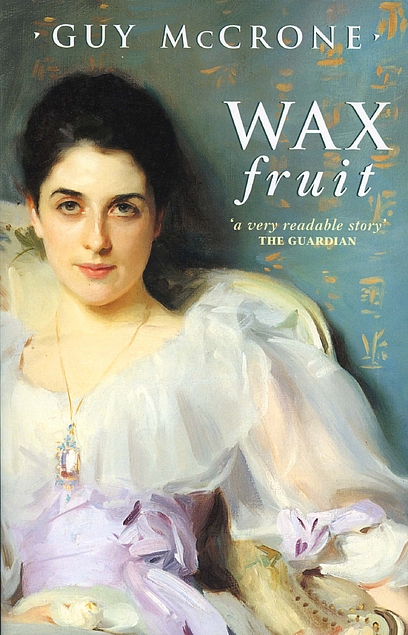
The Puritans by Guy McCrone

Black & White, 221 p. In Wax Fruit, 1993. First published in 1947.

This is the continuing chronicle of the Moorhouse family (from Antimacassar City and The Philistines) who have risen from a farmhouse in Ayrshire to prosperity in Victorian Glasgow, though much of the tale in this one is set in Vienna. The focus is on the relationship between Phœbe, the youngest Moorhouse, and Henry Hayburn who had become engaged towards the end of The Philistines even though he and his family had lost their money in the crash of the City Bank of Glasgow.

Suitable work for Henry being scarce he takes the opportunity presented by Maximilian Hirsch to oversee the setting up of a factory in Vienna to produce new agricultural machinery. First he travels there alone and lodges with the Klem family in a less salubrious part of the city but comes back to marry Phœbe and take her there. They take to the life in Vienna so much that they can laugh at their lack of guilt at availing themselves of the pleasure-grounds in the Prater in Vienna on a Sunday. Henry has few outlets beyond his work but Phœbe makes friends with Hirsch’s maiden aunts.

However, Aunt Bel back in Glasgow is displeased when Phœbe decides she will have the baby she is now expecting in Vienna and intrigues to have her come to Glasgow for the birth – with tragic consequences.

The writing in these tales never rises above the workmanlike. Too much is told not shown. Before Henry ever reaches Vienna the introduction to the narrative of Sepi Klem only ever portends one outcome. She performs much the same function in complicating our main characters’ lives as Lucy Rennie did in The Philistines. I note that – again like Lucy – she is a singer (though in Sepi’s case an aspiring one to begin with) a potential career of which her parents disapprove, wishing her to marry safe bank clerk Willi Pommer. Her flightiness is highlighted by her leaving home without explanation not long after Phœbe arrives in Vienna.

Her return months later allows McCrone to further contrast life in Austria and Scotland by expressing Herny’s internal discomfort of the Klem family’s display of emotion in his origins; coming “from an island where the show of feeling is counted as weakness.”

The Wax Fruit trilogy is not great literature by any means but it is quick and easy to read.

Pedant’s corner:- “doing it’s best” (its best,) “slid them over over the stanchions of the pier” (has one ‘over’ too many,) “whether Sir Charles was pleased or sorry about his, Henry could not discover” (about this,) hoofs (in my youth the plural of hoof was always hooves,) “He took of his hat” (off,) Island (this was not a proper noun; ‘island’,) “for her seriously to flaunt Bel” (to flout Bel,) “the Hirschs’ landau” (the Hirsches’ landau,) bouganvilia (bougainvillea.) “‘But what’s wrong?’ She asked.” (But what’s wrong?’ she asked.”)

O Caledonia by Elspeth Barker

Weidenfeld & Nicolson Essentials, 2021, 212p, plus vi p Introduction by Maggie O’Farrell. First published 1991.

From the outset we know where this tale of growing up as a misfit is going; Barker shows us in her prelude, titled Janet. This is not foreshadowing as such – it goes beyond prolepsis even – but it does set up an intriguing question. Why will what Barker tells us happened, happen? Why was Janet’s misadventure so easily glossed over? What was it about her that made her dismissable? But this is arguably fairer on the reader than Kate Atkinson’s revelation in A God in Ruins which turned upside down what we thought we had learned in all its pages up to that point.
Some reviewers have observed similarities to Dodie Smith’s I Capture the Castle (written much earlier than O Caledonia) but the characters of Cassandra Mortain and Janet are very different and Barker is a much subtler writer but I did wonder while I was reading O Caledonia if Kate Atkinson was familiar with Barker’s novel. I found the weird incidents of Janet’s childhood oddly similar to the manifold earlier days of Ursula Todd in Life After Life; there were perhaps even greater similarities to Atkinson’s first novel Behind the Scenes at the Museum (from 1995.) Still, it allows Barker the acid observation “The subject was closed in favour of the living, who offer continuous material for persecution.”

Janet is a child in wartime living in the manse inhabited by her grandfather and subject to many an admonitory sermon. Scotland’s religious heritage, though never pushed, is an intermittent drum beat through the book as in, “At this time there were many Polish officers in the village. The Marine hotel had been requisitioned for them. They were popular with the lonely girls and the more flighty wives, so that after the war some stayed on and married, while others left behind girls who were even lonelier now, alone with tiny children in the unrelenting chill of a Calvinist world.” (This sort of memory of Polish soldiers was familiar to me from the tales told by an acquaintance who had lived in Kelso during the Second World War.) Barker also has Janet remark, “There seemed no place for gallantry and romance among Calvinists,” and, in a particularly self-flagellating moment “the nature of Caledonia was a pitiless nature and her own was no better.” That it had unintended effects is illlustrated by a passage wherein nannies asked children if they had done what they should today (ie moved their bowels) and unwittingly unleashed dissembling – “a horde of artful dodgers on the world.”

It is when the family inherits Auchnashaugh, a crumbling pile in the Highlands, that Janet’s alienation blossoms. She resents her younger siblings, fails to comprehend adult concerns or live up to their expectations and when older, retreats into books, having an appetite for things beyond her age, Latin and Greek tags and the like. Her experience is summed up by Proust’s phrase ‘l’étouffoir familial’ the family suffocation chamber. Of how many sensitive souls has that been true.

She similarly fails to fit in at St Uncumba’s, the boarding school she is sent to far south in England where her distaste for, and inability at, games and liking for literature are mocked. Until she learns to dissemble.

The signal feature of her otherness is her adoption of a not yet fledged jackdaw whom she names Claws and who is her constant companion at Auchnashaugh.

O Caledonia is far too little known for a book so accomplished. How it did not get onto the list of 100 best Scottish books is beyond me. Perhaps its reissue far too late (2021) could explain it.

Pedant’s corner:- The young Janet sees the beam of a lighthouse sweep her bedroom (but this was in wartime; the lighthouses were switched off as part of the blackout precautions,) “she sucked a vengeful Pandrop” (a pan drop,) “the baby prone within” (the baby supine is more likely,) “golden rod” (goldenrod,) “je men fous” (je m’en fous,) “Miss Wales’ grizzled hair” (Wales’s,) “the gaping maw of the furnace” (stomachs do not gape,) standing in a great Victorian cemetery in Glasgow for her grandfather’s funeral (at that time in Scotland women did not go to interments, still less children,) clipe (usually spelled clype,) “Sir Patrick Spens’ lords (Spens’s,) Sawney Bean is said to have carried out his cannibalistic activities on the Aberdeenshire coast (most accounts put this legendary tale in Ayrshire,) “True Thomas’ faery queen” (Thomas’s,) “Euripides’ Medea” (Euripides’s,) “Barr’s Iron Brew” (the proprietary name is Irn Bru,) “came Francis’ voice” (Francis’s,) “the war memorial” (War Memorial – used later,) “‘a wee Doc and Doris afore ye gang awa’!’” (usually spelled Deoch-an-Doris,) Kiichen (a manuscript misreading of Küchen?) “Watt and Grants” (Watt and Grant’s,) swop (swap,) “Francis’ voice” (Francis’s,) “she was couched out there” (crouched makes more sense,) “Propertius’ poem” (Propertius’s,) “Tiresias’ description” (Tiresias’s) “Claws’ residence” (Claws’s,) “jeune jille” (jeune fille,) “passage from the Georgies” (the Georgics that would be,) “Orpheus’ final loss” (Orpheus’s.)

Fishnet by Kirstin Innes

Black & White, 2018, 345 p.

I read and reviewed Innes’s second novel Scabby Queen two years ago. Fishnet was her first novel and her expertise as a writer is evident from the start.

Six years after her sister, Rona, had disappeared, Fiona Leonard learns that Rona had been making her living as a prostitute. This sends Fiona anew into a search for Rona, trying to track her down, to contact people from Rona’s past, a search complicated by having daughter Bethan to worry about, and an office job as a filing clerk to maintain. In the end her search becomes a quest into the sex industry, what leads people to that line of work, how they feel about it.

The text is interspersed with extracts from prostitutes’ blogs, their online adverts and a few client’s comments on rating sites. Most (though not all) of the clients only want what these adverts call the “girlfriend experience” – vanilla sex, a kiss and a cuddle, a sympathetic ear.

A few passages towards the start and end of the book give us some of Rona’s experiences in her own words.

It is all extremely well written with rounded characters – nobody here is a stereotype, all impress as living, breathing humans.

As Fiona delves deeper into the culture of the sex industry the book almost by default makes the case for better understanding of the nature of such work, that attitudes to prostitution, the perception of it as something to be deplored and whose workers need rescuing from it, comes from a deep-rooted (and no doubt patriarchal) sense that women don’t – indeed can’t – like sex, that those who sell it have no choice in the matter and are necessarily being exploited. A prostitute calling herself Sonja tells Fiona, “‘What people call “the sex industry” is not always, not completely, a bad thing. That just because a person sells their sexual skills, it does not mean that their life is – bam! – forever ruined.’” (Sonja is herself engaged to a man who knows what her line of work is and is not much troubled by it, and later they get married.)

However, the women Fiona meets and talks to are by and large not “street girls” nor those who have been trafficked for the purpose. Instead, they work for themselves, from home (incalls) or occasionally in clients’ hotel rooms (outcalls,) in what might be called the more salubrious end of the sex industry. They also tend to look out for each other. I idly wondered if all sex work became more like this, as well as not being criminalised nor kept under the carpet, would there even be an insalubrious aspect of it?

Innes’s extensive research is nevertheless worn lightly, the knowledge she imparts about the sex industry is unfolded organically, never gratuitously. The story within Fishnet is compelling and its telling assured.

Pedant’s corner:- “In a dumpster” (this is not a Scottish – nor British – usage,) “shrunk away” (shrank away,) a missing quote mark at the start of a piece of dialogue, “fresh air kniving my skin” (knifing my skin,) “I take fulsome, competent notes” (the context was not one of unnecessary, over the top, praise, or oleaginous [which is what fulsome means,] but of excessive attention to detail,) “pyjamed limbs” (pyjama’d limbs,) shrunk (shrank.)


Antimacassar City by Guy McCrone

Black &White, 1993, 208 p. In Wax Fruit. First published 1947.

Wax Fruit is a trilogy of novels set in the Glasgow of the late nineteenth century. Antimacassar City is the first in the sequence.

We are dealing with the saga of the Moorhouse family, originating from an Ayrshire farm in the mid-1800s, though the setting is mainly Glasgow in the 1870s. The youngest Moorhouse, Phœbe, is the result of her father’s second marriage, to a Highland woman, and the book’s first scene describes the night she was orphaned by an accident. Phœbe is portrayed as a restrained, self-possessed girl and, later, young woman. Her older (half)-brother Mungo is the only one of the family left at the farm, the others have moved to Glasgow and are going up in the world. Her brother Arthur’s wife Bel determines to take her in, even though she is expecting their first child.

Phœbe takes a sisterly interest in the child, Arthur, when he is born. A few years later a maid, taking a shortcut home from a visit to his grandmother, loses him in a slum area when distracted by her sister’s presence there. On her own initiative and though still a child Phoebe sets out to find him, braving the shocking – and frightening – conditions of the overcrowded slums, and earns Bel’s everlasting gratitude for his rescue. McCrone’s attitude to the slum dwellers, couched through the middle-class values of the upwardly mobile Moorhouses, is disparaging and dismissive. They are depicted as depraved and dissolute; there is, it seems, nothing to redeem them.

The rest of the book deals mainly with Bel’s attempts to persuade her husband to move out of the city centre to the more salubrious West End and Mungo’s surprising attractiveness to Miss Ruanthorpe of Duntrafford, the local Big House in Ayrshire.

Henry Hayburn, tongue-tied except when enthusing about steam engines and engineering and a friend of another of Phœbe’s brothers, develops on sight a yearning for her. She is less enthusiastic but his family’s exposure to ruin in the collapse of the City Bank of Glasgow brings out her protective side.

The prose here is efficient but fails to spark. Elements of this are a bit like the works of Margaret Thompson Davis (though of course McCrone was published much earlier) but Davis’s attitude to the poor was more empathetic. But she was portraying the honourable poor.

As a cursory representation of Glasgow (a certain echelon of Glasgow) in the mid-Victorian age this is a good enough primer. Literature, though, it is not.

I still have two instalments to go. Maybe it will improve.

Pedant’s corner:- “Gilmour Hill”, “Kelvin Bridge” (1870s designations? now Gilmourhill and Kelvinbridge,) “‘you’ll can move out to the West’” (‘you’ll move out to the West’ or ‘you can move out to the West’,) missing commas before pieces of direct speech. “‘What way, can she not stay at the farm?’” (no need for that comma, it’s not two phrases,) “begging at he door” (at the door.) “Had she been unhappy here she was?” (where she was.) “Sophia as only too prompt” (was only too prompt,) missing quote marks around one piece of speech, “she turned way” (turned away,) “a coil of barbed wire lying rusty and hidden” (Barbed wire was only invented in 1873. There would hardly have been time for it to have been used on an Ayrshire estate and left to rust.)


The Oath Takers by Naomi Mitchison

Balnain Books, 1991, 174 p. With illustrations by Barbara Robertson.

Almost the last novel Mitchison wrote, this is set in the Frankish Empire a few years after the death of Charlemagne. Narrator Drogo is the son of a Lord who owes his fealty to the new King Louis but he is not close to his father. His true influences are his confessors at the local Abbey, where he has learned the noble speech, Latin. His is a world dominated by Christian belief, of God’s Empire, Holy Roman, under an anointed King. A world where oaths are not merely a solemn undertaking, but sacred.

So it is that his father is troubled when he is called to take the oath, not to the King himself but, in his name, to the Count of Paris. Yet the words will be personal. Wriggling on the hooks of conscience will be required if, as the Count seems to presage, he begins to act against the King.

Other important characters in Drogo’s young life are his half-brother Haimo (got on the wrong side of the blanket) and Wolfin, a Saxon hostage whom they meet in Paris. Their first taste of battle comes when Vikings make a raid up the River Seine – a diversion which at least puts off the dread day of oath-taking. Drogo acquits himself well but Wolfin is killed.

In the aftermath Drogo becomes part of a band of swords for hire – all but brigands -stravaiging about the lands of what is now southern France, the agitation of his soul mounting, while waiting for the chance to deliver a letter from his Abbot to one in the monastery of Gellone. While there Dhuoda, the local Lady, asks to see him. She has a task; for him to deliver a letter to her childhood friend, now in Cordoba, in the Saracen lands,  a thought which almost appals Drogo. Yet his confusion at the acceptance he finds there will add to his experiences as he grows into knowing who he is.

In this slim volume, a minor work by any standard, Mitchison has delved into the mediæval Christian mindset, as dogmatic as any, and still shone a light on the deep roots of some of today’s antagonisms.

Pedant’s corner:- waggon (wagon,) Charles’ (Charles’s,) Gomez’ (Gomez’s.)

free hit counter script