A Gift From Nessus by William McIlvanney
Posted in Reading Reviewed, Scottish Fiction, Scottish Literature at 12:00 on 14 August 2023
Mainstream Publishing, 1992, 221 p. First published 1968.
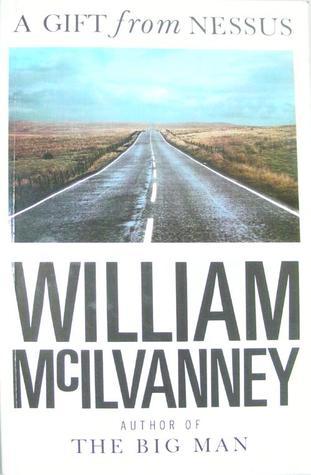 McIlvanney’s writing is held in high regard and now fond memory. This is a book I bought years ago (vaguely wondering if I had already read it) but have only got round to now. (I hadn’t.) It was his second novel, written and published quite a few years before Docherty, the book which would cement his reputation, though, with Laidlaw and The Papers of Tony Veitch he would subsequently be credited as being the “onlie begetter” of the slew of Scottish crime fiction now known as tartan noir.
Eddie Cameron is a sales rep frustrated by his job and life in general. His marriage to Allison has settled into a kind of indifference leavened only by the presence of two young daughters, Alice and Helen, his car is a liability, his interactions with colleagues perfunctory. Compounding his dissatisfaction is the lingering guilt he feels over his affair with schoolteacher Margaret Sutton. The novel is an examination of his swithering over in which direction he should steer his life. Leave his job and go back to working in a bookshop? Quit his marriage and set up with Margaret? Or let things remain as they are. Eddie does not want to cause pain to anyone but things have, of course, gone too far for that. Whatever decision he makes will inevitably grieve someone. The strings of his life begin unravelling when he is accosted one day by Margaret’s brother telling him to stay away from her. Later it turns out his boss, Jim Morton, has also been told of the affair.
While most of the book is focused on Eddie and his thoughts, some scenes are seen from other’s viewpoints, Jim Morton, Margaret, Allison. That chapter on Allison though comes very late in the book; too late really. Her motivations and their intended effect on Eddie ought to have been established earlier.
The characters are all well drawn, recognisably people but McIlvanney’s writing here is consciously literary, his intention in that regard overtly signalled by the classical allusion in the book’s title. However, the prose is at times overwritten, strives too much for weightiness.
There are some lighter moments, though. At one point Eddie reflects on that Scottish institution, the Burns Supper, where, lubricated of course by alcohol, “Men who never contemplated poetry from one year to the next listened to reciters as if they were so many burning bushes. The image of Burns, Scotland’s Jack of all men, would recede further and further until it vanished altogether.”
Pedant’s corner:- “in hawk to” (x 2, in hock,) miniscule (minuscule,) mantlepiece (mantelpiece – this spelling appears later.) “‘I’ll give it to you square, ’Morton was saying’” (has its end quotation mark misplaced.) “‘Everyone of those damned items is justified’” (Every one of those,) “rarified atmosphere” (rarefied,) “brought him to a crescendo” (the crescendo is the bringing, not its end,) “the callous developed by long contact” (callus.) “This was the first word he had heard her speak” (yet, eight lines later is revealed a previous exchange, ‘Excuse me. Is anyone sitting here?’ ‘No. Not at all.’) unsubstantial (insubstantial,) haranging (haranguing,) “vocal chords” (cords,) staunched (x 3, stanched,) focussed (focused.) Could’nt (Couldn’t.)
Tags: A Gift From Nessus, Literary Fiction, Tartan Noir, William McIlvanney

Reading Scotland 2023 – A Son of the Rock -- Jack Deighton
31 December 2023 at 12:02
[…] A Gift From Nessus by William McIlvanney […]