No Dominion by Louise Welsh
Posted in Reading Reviewed, Scottish Fiction at 22:10 on 22 January 2023
John Murray, 2017, 380 p, including ii p Afterword.
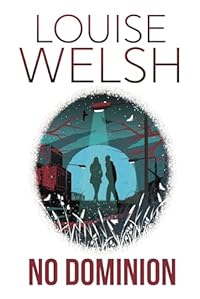
This is the last in Welsh’s Plague Times trilogy in which a pandemic known as “the sweats” has ravaged society. Stevie Flint from A Lovely Way to Burn and Magnus McFall from Death is a Welcome Guest have now been on Orkney for seven years. Apart from the cathedral, still used for significant occasions, Kirkwall has been abandoned and burnt to minimise disease risk. The centre of what authority exists lies in Stromness and is run on democratic lines. Stevie is President of the Orkney islands and has no sexual partner. Neither has Magnus but he acts as father to Shug, a boy now an adolescent and one of the seven children on Orkney who survived the sweats and have been fostered out.
We start at an Easter gathering in Stromness in a former hotel, with the odd musical turn and the adults drinking. It has become obvious that Shug is attracted to Willow, another fostered child also reaching adulthood. Her foster father Bjarne is not keen on the idea of the pair having a relationship and when they leave together gets into an argument with Magnus.
The gathering is interrupted, though, by the arrival of a boat in the harbour containing three people, one of whom, Belle, Magnus had met on his way up to Orkney. The newcomers agree to quarantine on Wyre, one of the smaller islands.
Things come to a head and Magnus finds Shug beaten up. Going to confront Bjarne he discovers him and his wife Candice shot dead in their home. The same night several children go missing, Shug, Willow, other girls called Sky and Moon, a boy, Aril, and a two year-old, little Evie. The three strangers are gone too. Stevie and Magnus delegate themselves to follow them into mainland Scotland to retrieve the children.
From there it is the usual post-apocalyptic scenario, meetings with every-person-for-themselves types, religious nutters, travels through various quasi-feudal fiefdoms, Do-Not-Enter-On-Pain-Of-Death signs, all-but-forced labour in the big city, and, for Stevie, the threat of rape from men who don’t know her.
Welsh has shown she can write. Her first novel, The Cutting Room, was an unusual take on the crime genre and her second book, the novella Tamburlaine Must Die, was simply superb, but it’s a pity she has more recently tipped over into thriller territory. She does illustrate, though, that carrying on earlier notions of morality in post-disaster times has its problematic edges. In her Afterword she says that her vision of the world is that most people are fundamentally good. But books with only good people in them are likely to be boring. No Dominion isn’t boring but it doesn’t really add much to post-disaster literature.
Pedant’s corner:- “Magnus had drank more than he was used to” (had drunk,) snuck (x 2, sneaked,) “Magnus sunk to his haunches” (sank,) “lifted the valence” (the valance,) “3AMP fuses” (3 Amp fuses,) “Burnham Wood” (it was in dialogue but it still should be spelled ‘Birnam Wood’,) wheescht (usually spelled ‘wheesht’,) “the oldest of the pair” (older of the pair.) “The City Chambers were nearby” (in Glasgow the City Chambers is usually spoken of in the singular; was nearby,) “sunk to his haunches” (again! sank,) “the Orkneys” (this was Stevie speaking. Traditionally Orcadians would refer to ‘Orkney’ or ‘the Orkney Islands’. But she wasn’t Orcadian,) “The City Chambers’ marble floors” (if singular then ‘City Chambers’s’.) “Three candelabras” (candelabra is already plural,) a missing end quote mark on a piece of dialogue, “better shape that the provost” (than the Provost,) “‘Let’s hope none of the bastards’ aim improves’” (of the bastards’ aims improves.)
Tags: A Lovely Way to Burn, Death is a Welcome Guest, Louise Welsh, No Dominion

Reading Scotland 2023 – A Son of the Rock -- Jack Deighton
31 December 2023 at 12:00
[…] No Dominion by Louise Welsh […]