Archives » Lewis Grassic Gibbon

Sunset Song

Hurricane Films, Iris Productions, SellOutPictures. Directed by Terence Davies.

We don’t go to the cinema much, life and children got in the way not to mention Kirkcaldy’s dedicated cinema closing down years ago now so we had only what passes for the local “Art House” Cinema to rely on unless we wanted a trek to Dunfermline.

However we couldn’t miss seeing the film of Lewis Grassic Gibbon’s classic book Sunset Song. So it was off to the Adam Smith Theatre again. (But that’s also a longer trip since our house move.)

It is difficult for a film to capture the essence of Gibbon’s masterpiece. I suppose this one made a valiant effort but I have huge reservations. The human story of Chris Guthrie’s life was well enough done but though references to it were made via voice-over (and in the odd bit of dialogue) and there were cutaways to sumptuous views of the countryside the importance of the land to the novel (and Gibbon’s intentions for it) did not come across with anything like enough force.

I noticed that the church used – at least for the exterior shots – was actually the one in Arbuthnott (the village with which Gibbon is most associated) where his memorial is situated. I can’t vouch for the interior as I’ve never been inside. I did feel that the soundtrack choir singing All in the April Evening in the lead-up to the church scene was ill-judged; too lush by far. We also had the minister wearing a surplice; not at all likely in a Presbyterian Kirk. And that pulpit looked disturbingly modern.

Peter Mullan as Chris’s father gave his usual Peter Mullan hardman performance and Agyness Dein’s acting as Chris was fine but really her accent was all over the place. At one point I thought she’d said, “they were burning the winds,” when it was whins. (The h in “wh” words is aspirated in Scots and Scottish English; the sound is more like hwins.) She also pronounced the g in “rang” and for her to be unable to say “loch” properly verges on the criminal for someone playing a Scotswoman. None of the accents struck me as being particularly of the Mearns though.

I also felt the prominence given to Chris’s husband Ewan’s fate towards the end of the film made it seem more of a lament for the fallen of the Great War in general rather than the more particular loss about which Gibbon was writing, for which Ewan stood as a metaphor.

Watch the film by all means – it says a lot about the harsh times and attitudes of the Scotland of a century ago – but for the full Gibbon experience the book is certainly to be preferred.

The Herald’s 100 Best Scottish Fiction Books.

The Herald – formerly The Glasgow Herald – is, along with Edinburgh’s The Scotsman, one of the two Scottish newspapers of note. (Aberdeen’s Press and Journal and Dundee’s Courier could never compare; not least in circulation terms.)

I found the following list of The Herald’s 100 Best Scottish Fiction recommendations just under a year ago at a now defunct webpage http://www.heraldscotland.com/books-and-poetry/your-100-best-scottish-novels where only thirty works were actually given; with a solicitation to readers for further suggestions. Perhaps the page has been removed. It provides some fuel for future reading, though.

Of the 30, I have read 19 (asterisked below – where I also include from the Herald’s webpage the comments which accompanied the nominations, complete with any typographical and other errors.) Where applicable I have also linked to my review on this blog of that particular novel. Those in bold also appear on the list of 100 best Scottish Books.

1 The Death of Men, Allan Massie, 2004*
Anne Marie Fox says: Compelling as suspense and profound as a philosophical exploration of political ideologies and terrorism, ‘post-Christian’ consumer society and family.
2 The White Bird Passes, Jessie Kesson, 1958*
Alistair Campbell, Elgin, concludes: Writing of the highest quality, pared to poetic essence. The unforgettable tale of Janie’s childhood in crowded backstreets richly peopled by characters who live on the margins.
3 The Well at the World’s End, Neil Gunn, 1951*
Janet Feenstra recommends Gunn’s most personal novel: The metaphor of light reflects Gunn’s quest for personal enlightenment. Its optimism has relevance for Scotland now more than ever.
4 The Bridge, Iain Banks, 1986*
Allen Henderson, on Facebook, says: I’m a big Banks fan and for me, The Bridge just pips the Wasp Factory.
5 Cold in the Earth, Aline Templeton, 2005
Julia MacDonald, on Facebook, says: a novel with a clear description of Scottish towns and folk.
6 Fergus Lamont, Robin Jenkins, 1979
Ian Wishart, Edinburgh made this choice.
7 The Antiquary , Sir Walter Scott, 1816
Bryson McNail, Glasgow, writes of the second Scott entry to our list: It has some of the finest descriptive writing ever – the scenes and vistas open before you. It also has a great story line.
8 Joseph Knight, James Robertson, 2004*
Megan Mackie says: It is both a great story and a powerful history lesson rolled into one…a narrative of family relationships, betrayal and social justice told within the context of Scotland’s involvement in the slave trade.
9 Body Politic, Paul Johnston, 1999
Elaine Wishart, Edinburgh, concludes: As well as a great crime novel it paints a very very believable picture of Edinburgh as a city run for tourists – brilliant satire and cracking characters. I read it in one sitting.
10 A Disaffection, James Kelman, 1989*
Mark Barbieri says: Any one of Kelman’s novels could make the top 100 but the story of frustrated school teacher Patrick Doyle is his finest. Sad, honest, funny, vital, incomparable and simply brilliant..
11 The Holy City, Meg Henderson, 1997
Diane Jardine, Glasgow, says: Captured my home town with unnerving accuracy and helped me appreciate its psychology and community just a little bit more.
12 Young Art and Old Hector, Neil M. Gunn, 1942
Myra Davidson, Livingston, concludes: Wonderful depiction of childhood and old age. A Glasgow child, I was evacuated to a croft on Arran and I am still grateful for the introduction to a way of life I would not otherwise have had.
13 Whisky Galore, Compton Mackenzie, 1947
Elizabeth Marshall says: A lovely book that deserves to be included.
14 The House with the Green Shutters, George Douglas Brown, 1901*
Joan Brennan: This has to be among the very top of the finest 100 Scottish novels
15 Consider the Lilies, Iain Crichton Smith, 1968*
Derek McMenamin nominates the writer’s best known novel, about the Highland clearances.
16 Gillespie, J. MacDougall Hay, 1914*
Alan Mackie, Kinghorn says: An epic tale. And just as dark, if not darker than Crime and Punishment as an insight into what it means to be human. Not the happiest book but in terms of style and sheer enjoyment it is right up there with the best for me.
17 The Private Memoirs and Confessions of a Justified Sinner, James Hogg, 1824*
Kenneth Wright justifies his choice: Theology might not sound like a promising subject for fiction, but Hogg’s critique of the hardshell Calvinism that was Scotland’s religious orthodoxy c.1700 is compellingly expressed as ghost story, psychological thriller, earthy kailyaird comedy and drama of personal morality.
18 One Fine Day in the Middle of the Night, Christopher Brookmyre, 1999*
Vicky Gallagher says: I really enjoyed Christopher Brookmyre’s books, especially this one and A Tale Etched In Blood And Hard Pencil – very funny – very Glaswegian!
19 The Heart of Midlothian, Sir Walter Scott, 1818
Robert Miller is convinced it’s a forgotten masterpiece: This book has a real Scottish heroine and is very accurately based in a interesting time in Scottish history.
20 Greenvoe, George Mackay Brown, 1972*
Siobheann Saville says: Tragic, funny, poetic, descriptive – a book that has it all. Some of the passages read like poetry and have to be re-read several times. The wit and setting of ‘Local Hero’ and the family sagas of ‘Stars look down’ – a personal favourite I can read many times and still be surprised.
21 Sunset Song, Lewis Grassic Gibbon, 1932*
The first – and best – part of the Scots Quair trilogy explores several key issues, such as Scottish identity and land use, war, and the human condition. All bound up in an accessible, moving human tale. An evergreen classic.
22 The Prime of Miss Jean Brodie, Muriel Spark, 1961*
First published in the New Yorker magazine, the novel’s heroine was memorably brought to life by Maggie Smith, complete with the girls who comprised her “crème de la crème”. It’s a bitingly funny examination of love, relationships, and power.
23 Trainspotting, Irvine Welsh, 1993
The graphic portrayal of a group of junkies made a huge impact, helped by Danny Boyle’s film. Welsh added a sequel, Porno, and a prequel, Skagboys, is due out in 2012.
24 Kidnapped, Robert Louis Stevenson, 1886*
It may have been written as a “boys’ novel”, but the book’s basis in historical reality and its ability to reflect different political viewpoints elevates it to a far higher place, drawing praise from such figures as Henry James and Seamus Heaney.
25 The Thirty-Nine Steps, John Buchan, 1915*
The first of five novels to feature Richard Hannay initially appeared in serialised form in Blackwood’s Magazine. A rollicking good read ¬- if rendered slightly outdated by its kanguage and attitudes – it inspired British soldiers fighting in the WWI trenches, and the various film versions cemented its place in the literary canon.
26 Lanark, Alasdair Gray, 1981*
Gray’s first novel but also his crowning glory: a marvellous mixture of storytelling, illustration, and textual subversion which set the tone for his future work. The author cited Kafka as a major influence, but just about any interpretation of his words is possible…and that’s the fun.
27 Black and Blue, Ian Rankin, 1997
Not everyone will agree with this choice, but Rankin is the acknowledged king of Tartan Noir, and the eighth Inspector Rebus book won him the Crime Writers’ Association’s Macallan Gold Dagger.
28 The Princess and the Goblin, George MacDonald, 1872
This son of Aberdeenshire’s fantasy is regarded as having had a seminal influence on children’s literature, with such luminaries as Mark Twain and GK Chesterton paying homage. Film versions of the book have not been huge successes, but it appears in the 100 Classic Book Collection compiled for the Nintendo DS.
29 Clara, Janice Galloway, 2002
Galloway first came to prominence with The Trick is to Keep Breathing, but Clara, based on the life of the composer’s wife Clara Schumann and which won her the Saltire Book Award, is seen as her finest achievement.
30 The Expedition of Humphry Clinker, Tobias Smollett, 1771*
Born in Renton, West Dunbartonshire, Smollett trained as a surgeon at Glasgow University, but moved to London to find fame as a dramatist. A visit back to Scotland inspired his final novel, a hilarious satire on life and manners of the time. His fiction is thought to have influenced Dickens.

An Appreciation of Sunset Song

In Wednesday’s Guardian G2 there appeared a piece written by James Naughtie on Lewis Grassic Gibbon’s Sunset Song.

This was I assume occasioned by the imminent release of a film of the book directed by Terence Davies (which I hope does it justice. On that score the outlook is good as, by what I’ve read, Davies seems very struck by it.)

Naughtie was brought up in the Aberdeen hinterland – not quite in the Mearns as was Gibbon – and says many of the terms used and scenes observed in the book are familiar from his youth.

Naughtie sums it all up very well.

My thoughts on Sunset Song are here.

Lewis Grassic Gibbon Centre

The Lewis Grassic Gibbon Centre, dedicated to the memory and dissemination of the works of J Leslie Mitchell – better known as Lewis Grassic Gibbon – lies in the Mearns village of Arbuthnott.

Lewis Grassic Gibbon Centre

We took the good lady’s blog friend Peggy there when she was over from the States. It contains items from Gibbon’s life and memorabilia of the times he lived in.

I picked up several informative brochures, including one with pictures of the covers of the first editions of his books. The one for Stained Radiance might have caused some raised eyebrows when it was published in 1930.

We had a delightful lunch in the café at the front of the Centre before heading off to the churchyard where there is a memorial to Gibbon beside one to members of his family.

Lewis Grassic Gibbon's Memorial, Arbuthnott

War Memorial, Arbuthnott

Arbuthnott is a village in the Mearns, the area south of Aberdeen and north of Montrose.

It is most famous for being the home of writer J Leslie Mitchell (Lewis Grassic Gibbon.) Its War Memorial is on a wall of the local hall.

War Memorial Arbuthnott

In Arbuthnott graveyard there is a memorial to Lt Col Hew Blair Imrie who was killed in Normandy 1944. His name does not appear on the main memorial though.

War Grave, Arbuthnott Churchyard

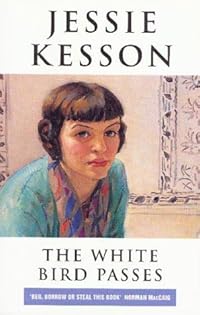
The White Bird Passes by Jessie Kesson

One of the 100 best Scottish Books. Also in the Herald’s “100” best Scottish Fiction Books list and one of Scotland’s favourite books.

B & W, 2009, 153 p. First published in 1958.

 The White Bird Passes cover

Janie MacVean lives with her mother Liza in a tenement in “the Lane,” a thoroughfare in an unnamed Scottish town just after the Great War. Watched over by Poll Pyke, Battleaxe and the Duchess, the Lane is a friendly enough place with folks more or less looking out for each other. Despite their poverty stricken circumstances, Janie loves her mother and the Lane. The occasional (finance dependent) trip to see her grandmother, who lives in a much more salubrious house in the country, only serves to highlight Janie’s contentment with her lot. It is on the one such trip in the narrative that darkness intrudes into the book. Janie’s grandmother is friendly enough but her grandfather disapproves. For in the Lane, Janie has no father – and Liza no husband – to protect her.

Through a series of vignettes the details of Janie’s life are slowly revealed, perennial nits being only one of her burdens. Her attachment to it, her ease with it, are both manifest, the web of her relationships beautifully rendered. But things come to a head when the “Cruelty Man” intervenes and Janie is removed from the Lane as being a neglected child. Between Chapters Eight and Nine eight years have passed and we then see Janie, by now adapted to life in the Aberdeenshire orphanage in the shadow of the Cairngorms to which she has been sent, getting ready for adult life.

In an echo of a phrase in Lewis Grassic Gibbon’s Sunset Song we are told, “Everybody believed in God on Sundays, then laid Him carefully away with their best clothes for the rest of the week.”

The White Bird Passes gives more of an indication into the realities of life in poor areas of Scotland than did the recently read The Guinea Stamp.

Pedant’s corner:- remarkably – even if it is such a short book – I found only a single typo; the lights lit up she street (the.)

2014 in Books Read

The ones that stick in my mind most – for whatever reason – are:-

Signs of Life by M John Harrison
Mr Mee by Andrew Crumey
Be My Enemy by Ian McDonald
The Deadman’s Pedal by Alan Warner
A Scots Quair by Lewis Grassic Gibbon – but in especial Sunset Song
The Moon King by Neil Williamson
The Dogs and the Wolves by Irène Némirovsky
The Last of the Vostyachs by Diego Marani
HHhH by Laurent Binet
That Summer by Andrew Greig
Roadside Picnic by Arkady and Boris Strugatsky
My Name is Red by Orhan Pamuk
Way to Go by Alan Spence

Four SF/Fantasy novels, six Scottish ones (eight if the trilogy is separated) and no less than five translated works.

Grey Granite by Lewis Grassic Gibbon

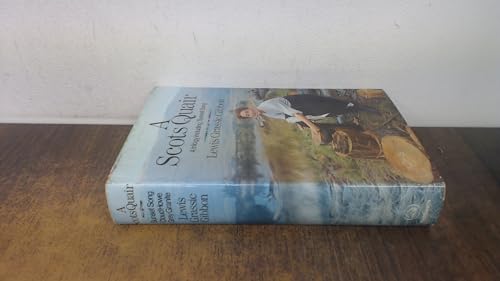
In “A Scots Quair,” Hutchinson, 1966, 156 p. First published 1934.

A Scots Quair cover

After the form of Sunset Song and Cloud Howe, the previous books in Gibbon’s A Scots Quair trio, the text of Grey Granite is divided into four sections, here named after semi-precious stones, Epidote, Sphene, Apatite and Zircon, though unlike its predecessors there is no prelude, proem nor epilude in Grey Granite.

Following the death of her second husband Robert Colquohoun – whose last action to shock his ex-parishioners was to have himself cremated – Chris Guthrie has used what money remains to her to move from Segget and take a half share in a boarding house in the city of Duncairn. [An authorial note at the start informs us this name is amended from the author’s first choice Dundon, since early reviewers in English journals were mistaken in thinking it represents Dundee, nor yet (though it has a Cowgate, a Canongate and a Royal Mile) is it Edinburgh as an American newspaper had it, nor even – notwithstanding its granite buildings – is it Aberdeen (two Scottish sheets) but the city which the inhabitants of the Mearns have hitherto failed to build.]

It is perhaps this setting that makes Grey Granite seem less grounded than the previous two novels in A Scots Quair. While Gibbon’s descriptions of the industrial cityscape are fine they do not have the lyricism of his evocation of rural landscapes. Indeed it is notable that when the story breaks the bounds of the city the writing lifts. But in his defence here Gibbon certainly cannot do without Duncairn. It is absolutely necessary in a novel sequence about modern Scotland (as he was essaying) to encompass the industrial habitat in which most Scots live. And this is only a criticism in the context of Sunset Song and Cloud Howe. Taken on its own Grey Granite would stand as a fine mid-twentieth century Scots novel.

Another factor contributing to Grey Granite’s relative lack of force is the focus moving from Chris to her son Ewan. He is drawn into socialism after taking a job in a metal works which later gains an arms contract. He organises a subsequent strike and is arrested and beaten up by the police. It seems that police accounts of incidents diverging somewhat from what actually happened are never new. In addition, Ake Ogilvie, who had also come from Segget to work in Duncairn, opines, “there was as much graft in the average Scots toun as in any damn place across the Atlantic.”

Once again there is the shifting of narrative viewpoint familiar from Sunset Song and Cloud Howe, by which the Rev MacShilluck for example is well drawn; in a few devastating paragraphs scattered through the book. The text is of its time in some of its references: “psychoanalyst Jewboy chaps” reads shockingly today.

Her business partner, Ma Cleghorn, tells Chris there’s nothing worse than “some old runkle of a woman body living on with no man to tend and no bairns.” As to men, “(they) never live at all. They’re just a squeeze and a cuddle we need to keep our lives going. They’re nothing themselves.” Ewan himself thinks, “A hell of a thing to be History! …. LIVING HISTORY ONESELF.” His treatment of Ellen Johns, a teacher who lodges in the boarding house and helped Ewan along the socialist path is in the end less than gallant. Chris had warned her, though, as we were forewarned in Cloud Howe.

Chris certainly does not have her troubles to seek. Ma Cleghorn dies, Chris contracts a misguided and doomed marriage with Ake Ogilvie, who is instrumental in effecting Ewan’s release from prison. She muses that, “SHE HAD NOTHING AT ALL, she had never had anything, nothing in the world she’d believed in but change… Nothing endured,” and, “We’re all on leading strings out of the past.” She tells Ewan, “The world’s sought faith for thousands of years and found only death or unease in them.” He replies, “It’s the old fight that maybe will never have a finish…. The fight in the end between FREEDOM and GOD.”

On reflection, and after rereading passages, my initial feeling that Grey Granite was not quite at the level of Sunset Song and Cloud Howe may be a touch harsh. It’s a fitting enough conclusion. As Chris comes full circle, “She’d open her eyes and see only the land, enduring, encompassing.”

Spot the Spelling Mistake

I took the photo below well before our trip to The Netherlands. It’s of a poster advertising a production of Sunset Song at the Adam Smith Theatre, Kirkcaldy.

Spot the spelling mistake.

I notice the “schools £9 age 12+” concession rate. I hope that in future exams none of the scholars attribute the book incorrectly.

Cloud Howe by Lewis Grassic Gibbon

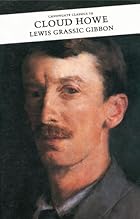
In “A Scots Quair,” Hutchinson, 1966, 156 p. First published 1933. The cover shown is of a Canongate edition.

Cloud Howe cover

Cloud Howe takes up the story of Chris Guthrie from Sunset Song at the point where her new husband, Minister Robert Colquohoun (strange spelling that, Colquhoun is more usual,) is about to try for the vacant post in the parish of Segget, still in the Mearns and not far away from the Kinraddie of the earlier book. Segget is a divided community, not to mention class ridden and status conscious, with the folks in the old part of town despising the spinners who work in the jute mills. Robert’s self-imposed mission there is to improve Segget. On their first walk in Segget Robert, gassed in the Great War, is horrified by Segget’s War Memorial, an angel set on a block of stone, “like a constipated calf.”

The story unfolds over the 1920s, covering almost incidentally the growth of socialism – and its first betrayal – the (lack of) industrial relations, the grinding poverty, the insensitivity of the rich. The narrative voice is not straightforward, shifting, but not obtrusively, back and forth from a tight focus on Chris – or on occasion someone else – to an unnamed kirkgoer of a conservative bent (small and large C.) Gibbon captures the smugness of that holier than thou voice perfectly, “The English aye needed the Scots at their head, right holy and smart at the same time,” is one of the milder observations. Also well captured is its hypocrisy, “You’d seen it all in the People’s Journal, what the coarse tinks did in Russia with women – man they fair had a time with the women, would you say ‘twould be easy to get a job there?”

Segget is replete with characters and nicknames. Ag Moultrie, prone to outbursts of weeping is known as the Roarer and Greeter, the mayor’s resemblance to a monkey has him dubbed Hairy Hogg. Old Leslie at the Smiddy is prone to reminisce, “I mind when I was a loon in Garvock.”

If Kinraddie thrived on gossip then Segget gloats in it. The morning after the Segget Show a farmer and his wife are delighted to come upon two couples “in such a like way” in their barn. “They’d be able to tell the story about them all the years they lived on Earth; and make it a titbit in Hell forbye.” It doesn’t take long after the Colquohouns’ arrival for tales detrimental to Chris to start to circulate – even before Robert attempts to change Segget for the better. Chris is damned either way. If she speaks in Scots she is common, if in English she is putting on airs.

Cloud Howe also begins to focus on Chris’s son Ewan, who is four times referred to in the text as grey granite. Ewan sees nothing wrong with either nakedness or sex and doesn’t take nonsense from anyone. When confronted by Ag Moultrie with a piece of gossip about himself he replies, “I’m sorry I don’t know what you’ve heard, Miss Moultrie, but no doubt Segget soon will. Good Morning.”

It struck me that when a farmer’s wife says she’s heard of Chris from her son, “he lived in London and wrote horrible books,” might be Gibbon referring to himself. I remember reading somewhere that Chris is intended as a metaphor for Scotland. Gibbon foregrounds this twice; once when the local toff, Mowatt, meets Chris and, “was to say later he felt he was stared at by Scotland herself,” and secondly when Robert refers to her as Chris Caledonia. I’m not quite sure whether the narrative is enough to sustain the metaphor.

As in Sunset Song Gibbon once again asserts that the Scots have never really BELIEVED in God. All that is real is the land. “Only the sky and the seasons endured, slow in their change.” The author’s eye and ear for rural and village life is acute. I have no doubt that this is how it was in the Mearns a hundred years ago.

One curio. The phrase, “leave me to twitter,” reads a little differently nowadays from the way Gibbon intended.

free hit counter script