Archives » Lewis Grassic Gibbon

Glitter of Mica by Jessie Kesson

Paul Harris, 1982, 159 p, including 6 p Introduction by William Donaldson. First published 1963.

Glitter of Mica cover

Glitter of Mica is another tale of life in rural Scotland, in the parish of Caldwell, somewhere north and east of Aberdeen. This short novel is similar in some respects to Lewis Grassic Gibbon’s Sunset Song in that the shadow of change hangs over the town and it begins with a recitation of the area’s history. The pre-Second World War past of protagonist Hugh Riddel is gone into as the son of an itinerant fee’d farm hand who could never settle and was never retained until he came to Darklands and cemented his place as a Dairyman. The main thrust of the book is, though, set in the post war period.

The narrative structure is not linear, Kesson adopts a variety of viewpoints to tell her tale delineating life and attitudes in Caldwell through the eyes of Hugh, his wife Isa, his daughter Helen, Sue Tatt (the local woman of easy virtue) and the upstart Charlie Anson. Moreover in its first few pages the book’s defining moment is referred to as being in the very recent past with most of the narrative then circling round and leading up to that point.

The sense of social hierarchy being breached is never far away, the awareness that an increase in equality had come with the war but was still thought unseemly highlighted by the reactions to Hugh’s recent “Address to the Ladies” at a Burns Supper. Yet class differences still prevail. ‘If you’re poor you’re plain mad. If you’re rich they’ve got an easier name for you. A Nervous Breakdown.’

As an exemplar of a certain kind of Scottish fiction this would be hard to beat. It is worth reading for itself though.

Pedant’s corner:- In the Introduction; Endinbro’ (Edinbro’.) “None of the characters are complex people.” (None is a complex person.) Otherwise; God Knows’ (God Knows’s,) “a sun ranging from half a crown to ten shillings” (a sum,) Robbie Burns’ (Burns’s,) a missing end quote mark, Darklands’ (Darklands’s,) calender (calendar,) “before if shocked” (it.) “He had even less illusions” (fewer,) sime wind (some wind,) “loathe to let them go” (loath, or loth.)

The Thirteenth Disciple by J Leslie Mitchell (Lewis Grassic Gibbon)

Black and White, 1995, 262 p, plus ix p Introduction by Jack Webster.

 The Thirteenth Disciple cover

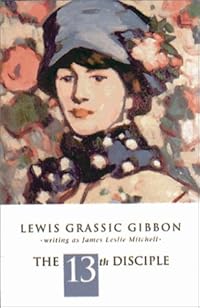
Malcom Maudslay (yes that is the spelling of Malcom used) is a child of that north-east of Scotland which Mitchell/Gibbon wrote about so well, distilling the experiences he gained while growing up there. In this novel the life of a young child in rural Scotland in the early part of the twentieth century is evoked admirably. Like J Leslie Mitchell was himself, Malcom is of a scholastic bent, encouraged to stay on at school by both the local minister and the dominie at Leekan, whose half-French neice, Domina Riddoch, is something of a free spirit, apt to scandalise the neighbourhood with her relaxed attitude to clothing in hot weather.

Malcom more or less self-educates by reading voraciously, though his father would have been keener to see him fee’d at a neighbouring farm. Through the minister he develops an interest in archaeology (which has significance much later) but Malcom soon outgrows his teachers and secures a job in journalism in Glasgow where he meets his first lover, Rita Johnson, and takes up with socialists. He progresses quickly at the newspaper but Rita’s accidental death (there is a hint that it may not actually have been an accident) and a misuse of the paper’s funds mean he has to leave Glasgow. Not quite his usual self, he joins the Army and endures the brutal rigours of training, but his relationship with the greatest influence on his life, Sergeant Major John Metaxa, a man as educated as himself, is in itself an education. A subsequent spell in the trenches in the Great War is described in harrowing terms. There is an occasional narrative conceit whereby we are given quotes from a journal of reflections Malcom supposedly kept in adulthood.

While The Thirteenth Disciple does not reach the heights of Sunset Song (but not even its two sequels quite did that) it signals the direction in which Mitchell/Gibbon would travel and in one delicious passage the Leekan village gossip is described as passing on from Leekan “and its scandalous days and nights – no doubt to that particular hell where all folk live discreetly and unscandalously, where no juicy stories ever circulate, where all girls marry their lovers before they bed with them.” Later, in his role as editor of Malcom’s journals, our narrator tells us, “To us of the early twentieth century the detailed sex-act is still impossible in all literature but the pseudo-scientific. We are, all of us, still, too young and nasty-minded.” It has been said that Andrew Greig was Scotland’s first post-Calvinist writer. On this evidence Gibbon has a good claim to that title.

Pedant’s corner:- In the Introduction; “the age if” (of.) Otherwise; some now obsolete spellings such as Gomorrahn (Gomorran,) tabu (taboo,) juldi (jildi,) Knut Hammsen (Hamsen,) unescapable (inescapable,) Cainozoic (Cenozoic,) Thibet (Tibet,) bye-election (by-election,) unauthentic (inauthentic.) Also there were; Scottish Quarternary (Quaternary,) Jock Edwards’ (Edwards’s,) Kark Liebknecht (Karl,) Epsoms salts (Epsom’s salts,) archeology/archeologist (archaeology/archaeologist; annoyingly the spelling varies from place to place in the book,) “he could fell her breast-nipples against his chest” (breast-nipples? Is there any other kind of nipple on a human?) “Morituiri te salutant!” (Morituri,) a missing end quote mark, “whiskey advertisements” (whisky surely?) a missing start quote mark at the beginning of a quoted paragraph, “Pio Perez’ grammar” (Perez’s,) an extraneous single quote mark, pifistac (???)

Scotland’s Favourite Book Update

You may have noticed from my sidebar I am currently reading Val McDermid’s The Wire in the Blood.

This is my latest from the list of Scotland’s Favourite Books I posted about here.

Of the thirty books shown there that will be 27 I will have read, the only exceptions being:
An Oidhche Mus Do Sheol Sinn (The Night Before We Sailed) by Angus Peter Campbell which being written in Gaelic I could not attempt except in translation,
Harry Potter & the Philosopher’s Stone by J.K. Rowling, which simply does not appeal to me, and
Trainspotting by Irvine Welsh.

That last is, along with Lewis Grassic Gibbon’s Sunset Song, one of only two books to appear on all four lists of Scottish books I have slowly been working my way through.
(The other lists are:- the 100 best Scottish Books; the Herald’s “100” best Scottish Fiction Books; the Scotsman’s 20 Scottish Books Everyone Should Read.)

I have long doubted that Trainspotting could be as good as Sunset Song and have so far resisted its charms. One day I suppose I’ll bite that bullet but for now The Wire in the Blood is the last from this particular list.

The Weatherhouse by Nan Shepherd

Canongate, 2017, 211 p, including 3 p Glossary: plus ii p Dramatis Personae and vi p Introduction. First published 1930.

 The Weatherhouse cover

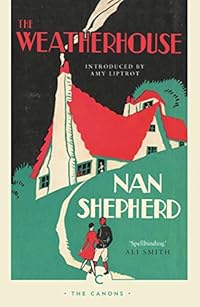
I don’t normally pick up a book according to its cover but I did in this case. It helped that the novel was by Nan Shepherd whose The Quarry Wood I enjoyed a year or so ago. Yet I was also attracted by the illustration which is almost in the style of a 1930s railway poster – a very Art Deco form – even down to the lettering. The house shown is actually wrong though; in two ways. It is much more of an English type of building rather than Scottish and it bears no relation at all to the hexagonal construction described in the text. Pretty, just the same.

That titular Weatherhouse is the home in Fetter-Rothnie of the Craigmyle family, which consists of matriarch Lang Leeb plus her daughters Annie, Theresa and the widowed Ellen. The story though, is more to do with how Garry Forbes, the intended of Lindsay Lorimer, in turn the daughter of Andrew, Lang Leeb’s cousin, came to become a proverb in Fetter-Rothnie.

The former Minister’s daughter, Louie Morgan, claimed after Forbes’s friend David Grey had died in the Great War that she and Grey had been secretly betrothed and carries Grey’s mother’s ring about her neck as proof. Forbes, home from the war as a convalescent, is convinced that can not be the case. He attempts, first to bring the falseness of Louie’s claim to the attention of the Kirk Session (which upsets Lindsay) and then to prevent his knowledge of Louie’s theft of the ring becoming more widely apprehended.

Despite what appears to be a focus on small matters The Weatherhouse nevertheless has a wider resonance, and has some humorous observations. The incidental mention of the man who, because of his brother, waited twenty years to wed his fiancée (who nevertheless brought him children “as a wedding gift”) shows life in those times was not entirely as straight-laced as might perhaps be thought.

Human dilemmas and emotions occur in all places and at all times. Shepherd shows us the humanity of her characters, in all their complexity. This is a fine companion piece to The Quarry Wood. Both these novels bear some similarities to Lewis Grassic Gibbon’s Sunset Song and Cloud Howe but don’t quite have the sweep of the first of those.

Pedant’s corner:- Amy Liptrot’s introduction says Shepherd’s writing is very localised to the foothills of the Grampian mountains and quotes two of the words she uses, stravaigin and collieshangie as being specific to that area. Stravaigin certainly has no such specificity.
In the glossary: keeing (keeking,) snored (smored.) Otherwise: “you’re as light ’s a feather” (light’s,) knit (knitted,) chose (choose,) “a moment before made up on her sister on the road” (before she made up,) a missing comma before a start quote mark.

The Scotsman’s 20 Scottish Books Everyone Should Read

This is a list which was published in 2005.

Again those in bold I have read. 11 out of the 20. Most of the rest are on my “to be read” list for this year.

Driftnet by Lin Anderson
Sunset Song by Lewis Grassic Gibbon
The Prime of Miss Jean Brodie by Muriel Spark*
Knots and Crosses by Ian Rankin*
Buddha Da by Anne Donovan*
Whisky Galore by Compton Mackenzie*

44 Scotland Street by Alexander McCall Smith
Boswell’s Edinburgh Journals
Trainspotting by Irvine Welsh
Selected Poems of Carol Ann Duffy
Greenvoe by George Mackay Brown*
Kidnapped by Robert Louis Stevenson
Lanark by Alasdair Gray*

The Missing by Andrew O’Hagan
New Selected Poems by Edwin Morgan
The Wasp Factory by Iain Banks*
Young Adam by Alexander Trocchi*

Waverley by Sir Walter Scott
The Cone-Gatherers by Robin Jenkins*
Divided City by Theresa Breslin

Again we find Sunset Song and Trainspotting; the two constants in such lists.

Progress in Scottish Reading

A suitable post for St Andrew’s Day.

You may have noticed on my sidebar that I am reading Neil M Gunn’s Young Art and Old Hector.

This is one of The Herald’s “100” best Scottish Fiction Books.

Of the thirty books that were actually listed on that now defunct web page this means I will now have read twenty-nine (having made that my Scottish reading project for the year.)

The only one from that Herald list I have so far missed is Trainspotting by Irvine Welsh, which has appeared on all four lists I’ve been working from* – a distinction it shares only with the otherwise incomparable Sunset Song by Lewis Grassic Gibbon.

For some reason I have a reluctance to tackle Welsh’s book. I have seen the film that was made from it and wasn’t overly enthused. I’ll get round to it sometime.

*Those four lists:-
100 best Scottish Books;
The Herald’s “100” best Scottish Fiction Books;
Scotland’s favourite books;
and The Scotsman’s 20 Scottish Books Everyone Should Read (from 2005.)
This last is the one I shall be working from next year. I’ll post the list in the new year.

Scotland’s Favourite Book

In a programme on BBC 1 Scotland last night the results of a poll to discover Scotland’s favourite book were announced.

These were apparently voted on from a long list of thirty books.

As usual the titles marked in bold I have read; italics are on my tbr pile.The ones marked by a strike-through I may get round to sometime.

An Oidhche Mus Do Sheol Sinn (The Night Before We Sailed) by Angus Peter Campbell
Garnethill by Denise Mina
Harry Potter & The Philosopher’s Stone by J.K. Rowling
How Late It Was, How Late by James Kelman
Imagined Corners by Willa Muir
Knots & Crosses by Ian Rankin
Laidlaw by William McIlvanney
Lanark by Alasdair Gray
Life After Life by Kate Atkinson
Morvern Callar by Alan Warner
Rob Roy by Sir Walter Scott
So I Am Glad by A.L. Kennedy
Sunset Song by Lewis Grassic Gibbon

The Adventures of Sherlock Holmes by Arthur Conan Doyle
The Cone Gatherers by Robin Jenkins
The Cutting Room by Louise Welsh
The Panopticon by Jenni Fagan
The Prime of Miss Jean Brodie by Muriel Spark
The Private Memoirs and Confessions of a Justified Sinner by James Hogg
The Strange Case of Dr Jekyll and Mr Hyde by Robert Louis Stevenson
The Testament of Gideon Mack by James Robertson
The Thirty-Nine Steps by John Buchan
The Trick is to Keep Breathing by Janice Galloway

The Vanishing Act of Esme Lennox by Maggie O’Farrell
The Wasp Factory by Iain Banks
The White Bird Passes by Jessie Kesson

The Wire in the Blood by Val McDermid
Trainspotting by Irvine Welsh
Trumpet by Jackie Kay
Under the Skin by Michel Faber

Thanks to my working through of the 100 best Scottish Books and the Herald’s “100” best Scottish Fiction Books I have read nineteen of these, with two on the tbr and others maybe to consider.

I suspect that in the fullness of time some of the more modern of them will fall away from public affection.

My strike rate for the final top ten was 7/10. The list (in descending order) was:-

10. The Private Memoirs and Confessions of a Justified Sinner by James Hogg
9. The Adventures of Sherlock Holmes by Sir Arthur Conan Doyle
8. Knots & Crosses by Ian Rankin
7. Trainspotting by Irvine Welsh
6. Harry Potter & The Philosopher’s Stone by J K Rowling
5. The Prime of Miss Jean Brodie by Muriel Spark
4. The Thirty-Nine Steps by John Buchan
3. Lanark by Alasdair Gray
2. The Wasp Factory by Iain Banks
1. Sunset Song by Lewis Grassic Gibbon

I am particularly pleased that James Hogg’s The Private Memoirs and Confessions of a Justified Sinner made it here and the strong showing of Alasdair Gray was also welcome. Personally I don’t think The Wasp Factory is Iain Banks’s best book but only one from each author was on the long list.

Gibbon’s Sunset Song was the one I predicted to the good lady would come first. Since its publication it has been an enduring favourite with Scottish readers.

I’m on the Map!

Literally.

Despite me not having a piece of fiction published for a few years – and only ever one novel – I’ve been included on this map of British SF and Fantasy writers. (If you click on the map it will lead you to its creator’s website, where copies can be purchased):-

Science Fiction and Fantasy Literary Map

I’m humbled by this. Imagine me being on the same map as Alasdair Gray, Iain (M) Banks, Ken MacLeod, Ian McDonald, Eric Brown, Arthur C Clarke, J G Ballard, George Orwell et al. Not to mention J Leslie Mitchell (Lewis Grassic Gibbon.)

The Scottish Tradition in Literature by Kurt Wittig

The Mercat Press, 1978, 304 p, including ii p preface, ii p contents. A facsimile of the 1958 edition.

The Scottish Tradition in Literature cover

On the surface it seems a little odd that a book on Scottish literature should be written by a German but Wittig’s second sentence begins, “Scottish literature is part of our European heritage.” He goes on to say he does not wish to erect an invisible barrier that would isolate it from “the larger world to which it inseparably belongs,” but nevertheless, “We must do the literature we are studying the honour of recognising that it has both ‘a local habitation and a name.’” He notes, “Deep down in the heart and mind of many Scotsmen there is a kind of schism arising out of the clash of his conflicting loyalties,” but stresses that “someone from outside can distinguish between the typical and the specific.”

Wittig’s starting point for the Scottish tradition is John Barbour’s epic poem The Bruce, which is, he says, without parallel in the Middle Ages, finding its neglect by scholars (of whatever stamp) truly astonishing. The Bruce predates Chaucer’s great poems and its theme that knightly virtues are of no account unless supported by the ideals of “fredome” and “richt” – ‘A! Fredome is a noble thing!’ – sets it apart from its contemporaries. Barbour is the “first of a long series of Scottish writers who seem not only to be on terms of an informal intimacy with God (or the Devil), but even to be disposed, on occasion, to argue with him. No wonder that the Scottish people were later to find the spirit of the Reformation so congenial.”

Since it manifests itself in pre-Reformation works (of which – William Dunbar’s “Lament ‘Quhen he was sek’” (aka “Lament of the Makars”) with its Timor mortis conturbat me refrain apart – to my shame I was mostly unaware) it would seem therefore that the gloomy prognostications and demeanour of Scots (“the mistrust even of happiness”) are not so much derived from Calvinism but are much more deep-rooted, part of the character induced by harsh, dark winters and the sair fecht of scratching a living from the land. It’s almost as if Scots were marking time till a belief system to embody their experience came along; and thereupon embraced it with masochistic fervour.

Barbour also employs what Wittig identifies as a typical Scottish trait; understatement, particularly in regard to the emotions, and he possessed a keen enjoyment of sense impressions. In Robert Henryson he notes, “genuine emotions of the soul are rather suggested than expressed, but the airs men give themselves are heightened to grotesquerie.” Such sense impressions, personification, or animism – visualisation – is another thread that Wittig discerns in the Scottish tradition. Others include alliteration, an intense economy of expression. He notes that much Scottish poetry is interlinked with music, using traditional metres, often very complicated, internal rhymes, frequent refrain on a thematic word.

After Gavin Douglas – the last of the Makars – and David Lyndsay this spring tide, as Wittig puts it, of the tradition begins to ebb and Scots as a language began to diminish in importance and scope. While the Union of the Crowns meant the old cultural ties with France were cut, more significantly the printing presses were in London and, perhaps crucially, the Bible, and therefore the word of God – in Church and elsewhere – was in English and so English came to be associated with serious, dignified subjects. As a result “‘guid hamelie Scots’ seemed unfit for higher and more intellectual purposes.” In the meantime the Scottish Ballads – “A Treasure-trove” – helped to keep the language alive.

A resurgence came in the eighteenth century with once again as in the Makars an expansion of the language and its uses. This reached a “High Water Mark” with Robert Burns and Walter Scott before tailing off again. In the twentieth century “Another Spring” had its highlights in Hugh McDiarmid, Lewis Grassic Gibbon and Wittig’s prime exemplar Neil M Gunn.

Wittig emphasises the cross fertilisation of Scots with Gaelic. The two languages existed side by side for centuries, even at court. Many Scots sentence constructions have their roots in Gaelic which, according to Alexander MacDonald, is supreme over all other languages, “strong, fluent, copious, resonant, and so forth” but in the main “it is the one language in which, since the Tower of Babel, bard or satirist can scold best. Modern Scottish speech, too, is often said to be unsurpassed for deflating an opponent.” It is especially apparent in poetry, “The chief respects in which Scots differs from English poetry are that it shows a stronger feeling for colour (and for other sense impressions); imagery is sharper and more detailed, it is capable of greater metrical complexity, is apter to personify inanimate objects, takes a keener interest in nature, is full of the spirit of clannishness, and makes a speciality of flyting and extravaganza,” all features, Wittig says, even more strikingly characteristic of Scottish Gaelic poetry.

Wittig states that, “Perhaps no other European literature is so dramatic” yet contrasts that with the lack of Scottish drama, a delicate, developing flower at the time he was writing. Nevertheless quoting James Bridie (Dr O H Mavor) “we cannot perceive the Universe except as a pattern of reciprocating opposites.”

The Scot displays “sometimes an aggressive spirit of independence or egalitarianism,” and is adept at the art of flyting, a contest consisting of the exchange of insults, often conducted in verse, between two parties. Then again the mediaeval Scots proverb has it that, “nippin and scartin’s Scots fowk’s wooin.” “The Scots as a nation are passionately addicted to argument.” “The Scots argue not to find a compromise but in order to disagree, to make their point, to assert their rugged independence and individuality. It is an innate tendency to challenge blind acceptance.” Disputatious for the sake of it, “the fervid Scottish delight in arguing – with themselves if no other opponent is available – ” is prevalent in the works of Scott, the first Scottish writer who endowed landscape with a life of its own to the extent of making it one of the protagonists in his novels. (Wittig’s italics.) Landscape in Scott is much more than mere background, it is a formative influence.

James Thomson the younger wrestled with sin and guilt, and repeatedly saw himself as two separate personalities: “I was twain,/Two selves distinct that cannot join again;/One stood apart and knew but could not stir” typical of the emotional and intellectual dualism of Scots – the “Caledonian Antisyzygy” – which may have arisen due to coming to use one language to express thought, another to express feeling.

In the context of why a Scots tale seems to need a sharply portrayed character to tell it Wittig quotes Robert Louis Stevenson as saying, “the English speak with less interest and conviction, while the Scot puts his whole personality into it” and asks, “Is there any such thing as an absolute detached prose in Scots? Is it indeed, possible?”

Wittig occasionally casts aspersions. He calls William McGonagall the “shabbiest of public-house rhymesters” and says that here it is “not rock-bottom that we touch…. that would suggest something solid; with him, poetry is irretrievably sunk in mire,” while John Buchan’s English verse “reads like exercises in a foreign language.”

He notes how many Scots poets do not mention the sea at all. Neither do most writers of prose. (This may well, though, be related to the lack of fishing till well on in the eighteenth century.)

Drink is “a gateway to a new kind of world that provides distortion, new perspectives, and surprising insights.” Wittig says, “I do not know of any other country in which is found a similar attitude to drink: but when Magnus Merriman speaks of this violent Scotland with its hard drinking as a country worth living in and refashioning it reminds me at once of several Scottish acquaintances, poets and others.”

J Leslie Mitchell (Lewis Grassic Gibbon) produces the effect of a “reality that is both subjective and communal. This is the culmination of the inherently dramatic character of Scots, for all the time somebody is imagined to be speaking – or letting his thinking become audible – though his identity may not be specified.” A person can view himself as “you.”

This is a magnificent book. Wittig’s knowledge of his subject appears encyclopaedic, his insights are sharp, his advocacy of the existence of such a thing as a Scottish tradition in literature and his demonstration of its importance and enduring relevance a stirring redress to those who would claim otherwise.

Pedant’s corner:- Reflexion (reflection,) connexion (connection,) medieval, irreverance (irreverence, which appears four lines later!) simplyc alled (simply called,) for convenience’ sake (convenience’s sake,) sublter (subtler,) Blaweary (Blawearie.)
The Lament: A Scottish Tradition

I mentioned recently in my review of Christopher Rush’s A Twelvemonth and a Day that it fell into that long list of laments with which the Scottish novel is liberally bestowed – going back at least as far as the poem on the state of the nation written on King Alexander III’s death after falling from a cliff in Fife in 1286, but which may well be an oral tradition older still.

This sense of things lost seems to be an itch which Scottish letters is unable not to scratch.

Many of the books on the 100 best Scottish Books list fall into this tradition; of the ones I have read not only the Rush but also Iain Crichton Smith’s Consider the Lilies, Archie Hind’s The Dear Green Place, William McIlvanney’s Docherty, George Mackay Brown’s Greenvoe, Neil M Gunn’s The Silver Darlings, Lewis Grassic Gibbon’s Sunset Song certainly qualify. Arguably Jessie Kesson’s The White Bird Passes also fits the bill; its title certainly does.

Whether this dwelling on things gone by is due to a sense of lost nationhood or not is a matter for debate but the itch is played out not just in Scottish literature, the lament is a major strand in bagpiping and has a long history in song (eg The Flowers o’ the Forest.) The Proclaimers’ Letter From America – “Bathgate no more” etc – is merely a modern take on the form.

Another important strand in the Scottish novel is that of the döppelganger/the supernatural. Here James Hogg’s Private Memoirs and Confessions of a Justified Sinner, which can certainly be seen as a reflection on the duality of the Scots psyche after the Treaty of Union as well as an illustration of Scottish literature’s fascination with the Devil, is the prototypical – and arguably the finest – example though Robert Louis Stevenson’s Strange Case of Dr Jekyll and Mr Hyde is perhaps better known furth of Scotland.

On thinking about all this I realised that, despite being Science Fiction, my own novel A Son of the Rock was also such a lament (though it eschews any truck with the supernatural.) The book was certainly conceived in part as an allegory of the decline of shipbuilding on the Clyde which had occurred in my early lifetime but I had not consciously been aware of any wider resonances while I was writing it. I did though somewhat impertinently consider it as a “condition of Scotland” novel.

Perhaps Scotland’s condition has always been in decline, its writers always noticing what has been, is being, lost. I note here that Andrew Grieg’s Fair Helen is a retrospective lament for the loss of “wit and laughter, music and dance and kindliness” in the Reformation.

free hit counter script