European Union Accession Commemoration Stone, Dyce
Posted in Curiosities at 18:00 on 20 July 2025
Posted in Trips, War Memorials at 12:00 on 19 July 2025
Great War Memorial, St Machar’s Cathedral:-
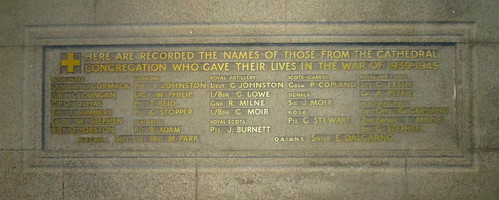
Second World War Memorial:-
Boys’ Brigade Memorial:-
Memorial to John Eugene Crombie, Gordon Highlanders, 23/4/1917, died of wounds:-
Memorial to mediaeval poet John Barbour, the father of Scottish literature with his epic poem The Brus, which predates Chaucer. Barbour was an archdeacon in St Machar’s and is buried in the kirk:-
Unfortunately I must have moved the camera when I pressd the shutter here:-
Effigy of Bishop Lintoun:-
Posted in Other fiction, Reading Reviewed at 19:00 on 17 July 2025
Penguin, 2004, 237 p.

One day Glyn Peters finds in his papers an envelope with his dead wife Kath’s handwriting on it, reading, “Don’t Open. Destroy.”
But who can follow such an instruction? Not Glyn. Fatefully he opens it. And there is the photograph. Of five people, two with their backs to the camera. Kath and a man, holding hands out of view of the other three. And the man is Kath’s brother-in-law Nick. There is also a note saying, “I can’t resist sending you this. Negative destroyed, I’m told. Blessings my love,” in what Glyn assumes is Nick’s hand
Glyn is immediately sent into a tail-spin, examining his past life for clues about his marriage, and into a quest for the truth about the affair, and who knew about it.
He starts with Kath’s sister, Elaine, a (very) successful garden designer, who already has beefs with the rather shiftless Nick, whom she throws out. Their daughter Polly, who had adored Kath, finds that something of an over-reaction, especially since Nick dumps himself on her and makes little effort to find a place of his own, despite her increasingly urgent promptings.
The story is told via several points of view, Glyn, Elaine, Nick, Polly, Nick’s erstwhile business partner Oliver, from whom we learn that “being a woman enabled her” (Kath) “to sail through life, setting her own course, following mood and fancy. Because she was a startlingly attractive woman.” She had once been asked what it was like to be pretty but she laughed it off. But she had also asked Oliver if he was happy.
Clues begin to build that the characters’ knowledge of Kath needs revising; memories of her close relationship with Polly, the fact that she got on well with children generally. “She has become some mythical figure, trawled up at will to fit other people’s narratives. Everyone has their way with her, everyone decides what she was, how things were.”
The marriage with Glyn wasn’t close, both spent time on their own business, Glyn with his landscape expeditions, Kath on various projects of her own.
It’s not until Glyn meets with Kath’s friend Mary Packard, perhaps the only one who really knew her for who she was, that the full tragic picture becomes clearer, but this is withheld from us till late in the book. But, of course, this is when Glyn speaks with her properly for the first time.
At the end Oliver thinks about how something always set Kath apart. “Behind and beyond her looks, her manner, there had been some dark malaise. But nobody ever saw it back then. …. All you saw was her face.”
The different characters’ narratives – some rendered as one half of a dialogue – are all distinctive and compelling, revealing of their flaws and misapprehensions.
The Photograph is a demonstration of how difficult it is to truly know someone, even someone close to us, how impossible it is to detect their inner struggles, especially if we do not recognise the clues.
Pedant’s corner:- “squares and triangles and rectangles and oblongs” (A square is a special case of a rectangle so that’s fine; but an oblong is any non-square rectangle, so is not different from a rectangle that isn’t a square,) “Glyn Peters’ appointment” (Peters’s,) “regale lilies” (usually written as ‘regal lilies’, though the botanical name is lilium regale.) “‘Didn’t Kath use to go to…’” (Didn’t Kath used to go to…,)
Posted in Aberdeen, Architecture at 12:00 on 16 July 2025
Interior of the church.
Centre aisle:-
Ceiling:-
Altar and stained glass window:-
Side aisle:-
Organ:-
Centre aisle and stained glass window:-
Posted in Poetry, Scottish Literature at 12:00 on 15 July 2025
Poems in Scots. Picador, 2024, 124 p, including 4 p Afterword

In her afterword, Jamie, a former Scottish Makar, says these 43 poems are her effort at a literary, lyrical Scots. The poems are mostly quite short (none strays over more than three, sparsely covered, pages) but pack a punch. Each is provided with a translation into English on the lower part of the even numbered pages opposite them. Those English versions tend to seem insipid when set beside the more vigorous originals. Jamie thinks that has something to do with the vowel sounds. For myself I think Scots, as a language – which it still is, however neglected since its heyday as one of the great languages of mediæval Europe – tends to be more earthy, rooted as it was in the land. Also, its consonants are more to the fore.
Four of the works here are Scots versions of poems by others, two by Friedrich Hölderlin (tailored from the English translations of Michael Hamburger) and two by Uyghur writer Chemengül Awut (now sadly disappeared into a re-education camp) translated into English by Munawwar Abdulla. Jamie has adapted Hölderlin poems before.
Jamie had initially envisaged this publication as a pamphlet but her editor at Picador saw no reason why a major London publishing house shouldn’t publish a whole book of poems in Scots, so she “scrievit some mair.”
I’m glad she did. They’re worth reading.
Pedant’s corner:- No entries
Posted in Aberdeen, Architecture, History at 12:00 on 14 July 2025
St Machar’s Cathedral in Aberdeen has not had a bishop since 1690, so it is now technically a high kirk. It is used as a parish church by the Church of Scotland.
Spires:-
From entrance gate:-
From sides:-
Rear of kirk:-
Posted in Other fiction, Reading Reviewed at 12:00 on 13 July 2025
Gollancz, 1963, 190 p. Translated from the Russian, Один день Ивана Денисовича, (Novy Mir, Moscow, Nov 1962), by Ralph Parker.
I bought this many (many) moons ago but had resisted reading it so far it as I thought the subject matter may have been too depressing. Reading about life in a labour camp is not overly appealing after all. It was still familiar, though. There are many similarities here to Primo Levi’s account, If This Is a Man, of being in Auschwitz.
Despite those reservations I found One Day (as the book’s spine has it) remarkably readable – a testament to the original writing and to the translation. This is also true of Levi’s books.
Ivan Denisovich Shukhov has been imprisoned for ten years in effect for being captured by the Germans. The main aim is to get through each day with as little friction or attention as possible. This particular day starts with Shukhov feeling unwell and thinking of reporting to the sick-bay but the day’s quota of the ill has been filled and he has to return to work.
He is in the 104th squad and, despite the novel being relatively short, the relationships between its members are carefully illustrated. Even (especially?) given his circumstances he still takes pride in doing a job well (today’s is brick laying which can be tricky as the mortar is liable to freeze) – though it helps that if seen to do so they may get extra food – Shukhov is careful to savour, or husband and hide for later, each item of food.
There are petty indignities such as the incessant counting at roll-calls to be endured, the fact that even thoughts aren’t free as they always cycle back to the same things. Each small achievement, that extra item of food, the finding of a piece of metal which might be fashioned into a knife, is a victory, but you must never set your sights beyond what is in front of you.
Pedant’s corner:- “sleepy heads propped again their rifles” (against, surely?) “fivefifty grams” (fifty five? [And grammes if we’re British],) “tommy-funs at the ready” (tommy-guns,) [this next was in a footnote] “a percentage of the plan t amounts to” (of the plan it amounts to,) a missing end quotation mark at the finish of a piece of dialogue.
Posted in Trips at 14:00 on 12 July 2025
Posted in 1960s, Friday On My Mind, Music at 16:00 on 11 July 2025
Since Brian Wilson’s death the good lady and I have been listening to the Beach Boys a lot. While doing so it struck me that even without God Only Knows, Good Vibrations and Heroes and Villains they would still be remembered – even revered – for songs like I Get Around, Wouldn’t It Be Nice, Help Me Rhonda, California Girls, Do It Again, Break Away and the arrangement on Sloop John B. And too, the slower, more thoughtful tracks like In My Room, Don’t Worry Baby and The Warmth of the Sun.
I discount here the early surfing inspired tracks Surfin’ Safari, Surfin’ USA and Surfer Girl. (Very few people now remember Jan and Dean, after all.) The ‘hot rod’ songs, Little Deuce Coupe and Fun, Fun, Fun might just creep in however.
I always had a liking for this one though, the B-side of Sloop John B.
The Beach Boys: You’re So Good To Me
Posted in Trips at 19:00 on 10 July 2025
It wasn’t just William the Lion’s grave I photographed at Arbroath Abbey.
Model of the Abbey in its heyday (in visitor centre):-
Other view:-
Information board:-
Ruins from visitor centre:-
Looking back to visitor centre:-
Part of Abbey:-