Posted in Fife, War Memorials at 20:30 on 20 August 2020
Strathmiglo’s War Memorial is in the churchyard and takes the form of a wooden cross. Unusually, the names of the dead are inscribed on copper strips attached to the cross. There are also three VC symbols attached.

The plaque below the cross is inscribed, “Nihil melius patria quam pro mori” (there is nothing better to die for rather then the country) and, “In honoured memory of fallen heroes.”

In the graveyard I also found two war dedications.
David John Campbell Ireland, 2nd Battalion, Argyll & Sutherland Highlanders. Killed in action on the Somme in France, 31/10/1916, aged 36 years:-

William Syme, Royal Scots, who died of wounds in France, 10/4/1917, aged 20 years:-

No Comments »
Posted in Fife at 12:00 on 20 August 2020
Strathmiglo is a village in Fife, in which comedian Ronnie Corbett once had a home. We pass it on a regular basis. The road on which we do that, though, bypasses the main street but the way we come in passes a road named Cash Fues as the land there once belonged to the ancestors of country singer Johnny Cash.
One day last year we took the time to stop for a look round the village itself.
This is the tolbooth, built in 1734:-

View towards East Lomond – the second highest hill in Fife. (The highest is the West Lomond.)

There is a wonderful monkey puzzle tree (araucaria) just off the main street – with the kirk beyond:-

By the entrance to the kirk is a Pictish stone:-
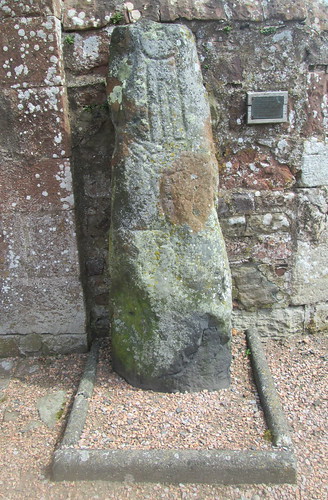
A plaque on the wall beside it has a description:-

No Comments »
Posted in Science Fiction at 20:30 on 19 August 2020
I’m a bit late with this. They were awarded on the 1st of this month.
Best Novel: A Memory Called Empire by Arkady Martine
Best Novella: This Is How You Lose the Time War by Amal El-Mohtar and Max Gladstone
Best Novelette: Emergency Skin by N.K. Jemisin
Best Short Story: “As the Last I May Know” by S.L. Huang
Best Series: The Expanse by James S. A. Corey
I’ve only read the second of these. It was very good.
No Comments »
Posted in Architecture, History at 12:00 on 19 August 2020
Methven is a village directly west of Perth, Perth and Kinross. It was the site of a small battle during the Scottish Wars of Independence but the exact location is uncertain, though there is a signpost on the main road pointing in its direction.
Methven Kirk and Graveyard:-

Lynedoch Mausoleum is a small building in the kirkyard:-

Methven Castle is a seventeenth century house to the east of the village and is privately owned but can be seen from the road:-

Methven Castle in its landscape:-


No Comments »
Posted in Trips at 20:30 on 18 August 2020
There are two graveyards in Moffat, one on the northern outskirts, the other in the village itself.
There notable graves in the second of these.
John Loudon McAdam, inventor of the macademisation method of road building.

Postmaster James McGeorge, guard of the Dumfries and Edinburgh Royal Mail. He and John Goodfellow died about five miles north of Moffat in February 1831 in a ferocious snow storm while trying to get the mail to Edinburgh after abandoning their coach and horses and trying to continue on foot with the seven stone mail bags. A memorial, the ‘Postie Stone,’ lies beside the A 701 near the spot.

Also in the cemetery is the remains of one wall of the Old Kirk:-

No Comments »
Posted in Trips, War Memorials at 12:00 on 18 August 2020
I thought I had featured this War Memorial a long time ago – I photographed it in 2011 – but it seems I haven’t – maybe because that photograph is not the best. The War Memorial is situated in such a position it’s difficult to get a closer in shot without the risk of being run down.

Last year we stopped in the village and I noticed, close by the Memorial itself, a new War Memorial bench round a tree, probably for the Great War 100th anniversary:-


Not only that but there was a War Memorial bin too!


I notice to the left here is a ‘normal’ War Memorial bench. (Or is it two?) I didn’t take a photo of those because I thought I might have done so already. Again it seems I haven’t.
Next time we’re there I’ll need to remember to get better photos of the Memorial itself; and of the bench.
No Comments »
Posted in Architecture, War Memorials at 20:30 on 17 August 2020
This chapel was built by Prisoners of War at Hallmuir near Lockerbie in Dumfries and Galloway.
These prisoners had been in the Wehrmacht units recruited from locals after the Germans invaded Ukraine (perhaps thinking that Ukraine would be better treated by the Nazis than the Soviets) and who subsequently surrendered to the Western Allies in 1945 in Austria.
Like the Italian Chapel on Orkney the interior is sumptuous – see Undiscovered Scotland’s website page on the chapel here.
The Ukrainian Chapel didn’t seem to be open when we dropped in on our way back home from Annan but it was worth seeing.


Near it there is a memorial cross. The stone to the bottom has, “Precious memories of a dearly loved husband always in my heart,” inscribed on it:-

Beside it there is a dedication stone, inscribed, “This cross is dedicated to those who gave their lives for freedom,” then some Cyrillic script, “Поляглим За україну,” which means, “Fallen for Ukraine,” then 27th May 1947-2007.”

For some odd reason, in the same grounds as the chapel there is a relic of Halcrow Greyhound Stadium:-

No Comments »
Posted in Reading Reviewed, Science Fiction at 12:00 on 17 August 2020
The second novel in “Walk to the End of the World and Motherlines,” The Women’s Press, 1989, 219 p.
In Walk to the End of the World fem Alldera finally escaped from the Holdfast, the brutal male dominated enclave which had been set up after the Collapse. Pregnant and starving, she makes her way across the desert into the grasslands where she is rescued by a Mare, one of a society of women who ride horses and patrol the desert to ensure no men from the Holdfast ever learn of their existence and also prevent free-fems, escapees from the Holdfast, from attempting to return to overthrow the men there.
It is these Mares who embody the Motherlines of the title, their ancestors having been made able to bear clones of themselves by scientists before things went awry, resulting in different breeds of descendants who look alike within each type. (The mechanics of the trigger for this reproduction strain credulity a little but also provide a source of derision towards them from the free-fems.)
The Mares’ decision to keep Alldera’s cub (as children are called here) and raise her as a Mare runs against previous practice whereby all such children of the Holdfast were entrusted to the free-fems. Alldera’s allegiances swing between Mares and free-fems (with whom she spends some time) as the narrative progresses. But, despite tensions within each of them, it is her affinity with both groups that brings them closer together among rumours of the Holdfast descending into conflict over diminishing amounts of food.
Motherlines narration does not embody the disjointed structure of Walk to the End of the World but the pastoral/nomadic lifestyles of the Mares and free-fems again resemble those in other books I have read recently, Bluesong and In the Red Lord’s Reach. Charnas is more concerned with the position of women, however, and the societies they might produce if left to themselves. As such Motherlines is in the fine SF tradition of “What if?”
Pedant’s corner:- “she though wretchedly” (thought,) rarified (rarefied,) ws (was,) “the Mare’s visit” (Mares’.)
No Comments »
Posted in Architecture, Art Deco at 20:30 on 16 August 2020
This photo appeared in yesterday’s Guardian as part of their Fantasy House Hunt feature.
It’s a wonderful Art Deco block of flats, white rendering, horizontals, verticals, balconies with rounded corners, flat roof, rule of three in entrance column. All its windows have been ruined though.
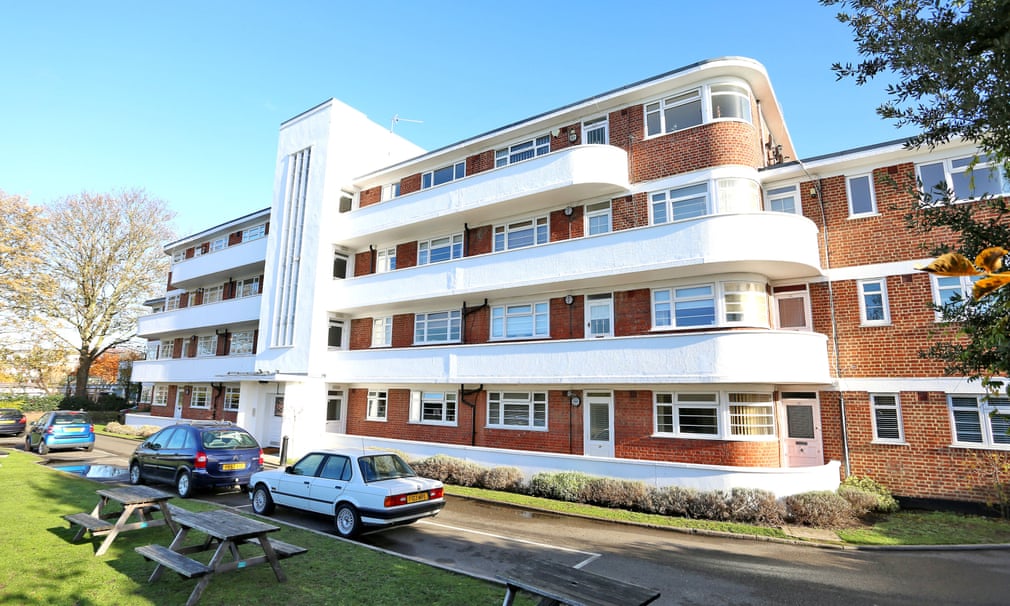
A one-bedroom flat inside it will set you back a cool £495,000.
No Comments »
Posted in Harry Turtledove, Ian McDonald, Memes, Robert Silverberg, Science Fiction at 12:00 on 16 August 2020
(This week’s entry for Judith’s meme at Reader in the Wilderness.)
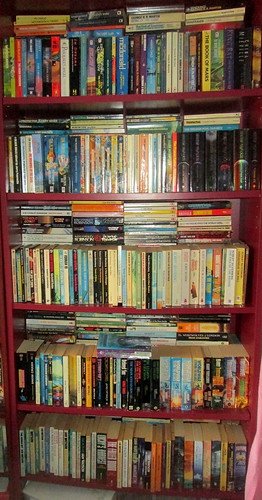
Again these are small-size (original size) SF paperbacks. Again they are housed in the garage and again are double-parked.
It was difficult to get back far enough to fit these all into the photo.
They start at Stanisław Lem and finish at Connie Willis. There’s a whole shelf of Robert Silverberg in here. Other notables: George R R Martin, Ian McDonald, Larry Niven, Christopher Priest, Tim Powers, Kim Stanley Robinson, Bob Shaw, Cordwainer Smith, James Tiptree Jr (aka Alice Sheldon,) Harry Turtledove and Ian Watson.
1 Comment »

