Archives » 2013 » August

Cowdenbeath 3-2 Dumbarton

SPFL Tier 2, Central Park, 31/8/13.

Three points lost.

I didn’t see it coming at half time but we had this game won and were cruising midway through the second. Then it all fell apart.

The first half was formless, not helped by a blustery wind which got worse as the game went on.

Despite not threatening at all Cowdenbeath won two corners in the first quarter. In the conditions our passing game cried out for the shout, “Too much football, Dumbarton!” It’s obviously the way Ian Murray wants us to play though.

Their goal came after Andy Graham was pushed for pace as he chased a forward out right, failing to prevent the pass to the wing. When the ball came in a Cowden player was in space for the shot.

We eventually won three corners right at the end of the half but took no advantage.

Our two goals were belters, fine strikes from Chris Turner, one with each foot. The first the keeper seemed to have covered but it went through his hands. The second was even better; hit the net like a rocket.

Then came the fall. Last man Aaron Barry tried to be too clever and was robbed of the ball. The attacker was straight in on Jamie Ewings who had no chance with the shot.

We began to push for the win then and alarming gaps appeared at the back. This wasn’t helped by the substitution of Scott Agnew by Brian Prunty denuding the midfield.

I thought we’d dodged that bullet when Jamie Ewings saved a penalty late on but the lesson wasn’t learned, we were equally open in the next Cowden attack when they got the winner.

Three points lost but we hadn’t been creative enough. Apart from an early Scott Agnew free kick, which may have been creeping past, their keeper really only had the two goals to (fail to) save. And those were from long range strikes.

Had we actually won this we’d have been equal second on points.

As it is we’re only three points off bottom.

The game at Alloa on Sep 13th now becomes a mustn’t lose.

Edited to add: This was my first look at both Colin Nish and Hugh Murray. The fact they’re not mentioned in the above post might tell you something.

Syria and Parliament

It seems that an outbreak of sanity has occurred in the UK Parliament with its vote against military action in Syria.

Now, chemical weapons are horrible things (even if you are just as dead being killed by high explosive or shell fragments or blast or a bullet; it is difficult to see a moral difference) but I fail to see how attacking Syrian government forces can make life better for the average Syrian even if responsibilty for the use of such weapons were to be established beyond doubt.

Not to mention the wider implications. Pour oil on to a fire, why don’t you? Bombing yet another mainly Muslim country will only encourage those Muslims who have a grievance against the UK already.

[And don’t forget there are many reasons for that grievance. I noted only yesterday that British forces were involved in killing locals in Iraq in the 1920s. This followed the Balfour Declaration of 1917 which laid the path for the eventual Jewish takeover of most of Palestine. Then there was the overthrow of Mossadeq in the early 1950s. The collusion with Israel over Suez in 1956, the Suez invasion itself. The illegal invasion, on totally spurious pretexts, of Iraq in 2003. This is just those instances of UK intervention which impact on the Middle East. (A term which is itself anglocentric.)]

Quite how adding in another external faction to what is a civil war in Syria would help in resolving the situation there is also beyond me.

Just because people say something must be one doesn’t mean you can do anything you like.

Mr Irresponsible (aka David Cameron) has once more shown himself up to be a blustering bully. I suspect his enthusiasm for miltary intervention in Syria is that he believes sending in the armed forces helped both Margaret Thatcher and Tony Blair to be re-elected. (A belief in which he is probably mistaken.) What he hasn’t learned is that the Iraq invasion – or, more accurately, its aftermath – poisoned the opinion of most British people against the assertions of Government spokespeople and Prime Ministers over the reasons for using troops and weaponry.

Military action against Syria could be like stirring up a hornet’s nest with a stick. There is no telling what the consequences would be.

A better response to use of chemical weapons, or any atrocity, would be to make sure that anyone responsible for what are considered war crimes is held to account by the international community. This would mean instant arrest should they stray outside whatever jurisdiction is keeping them safe from it and then arraignment before an international court. This stricture ought of course to apply to anyone, from whatever country, not just those our politicians say they don’t like.

And as to the effects of chemical weapons it might be best to deluge Syria with kits containing antidotes to the chemicals likely to be used – which would render their deployment pointless.

It wouldn’t stop the killing though.

I’m afraid this has been a somewhat unfocused rant. I can’t see a quick way out of the present Syrian imbroglio, the two sides seem too far apart for that.

Civil wars tend to be intractable. Intervention in them needs to have a purpose beyond, “Something must be done.” I didn’t think any of our politicians – least of all Mr Irresponsible – had enough wisdom to see beyond such simplicities. Parliament has at least resolved not to do more harm.

For the moment anyway.

Friday On My Mind 86: The Flashing Blade

I’m changing the arbitrary rules on this category again with this one.

The Flashing Blade was a French TV serial (Le Chevalier Tempête) set in the 1630s during the War of the Mantuan Succession which the BBC broadcast in children’s slots in the late 60s, repeating it several times ending in the 70s.

It was dubbed into English – somewhat atrociously, which added to its charm.

The thing is, though, it was curiously watchable and benefited from a catchy theme tune which had driving guitars and drums similar to Joe Meek productions of the early 60s.

I can’t remember much more about it but this website claims the final episode was never dubbed into English.

According to Wikipedia the theme song was called Fight and was released as a single by “The Musketeers” in 1969.

Pity the You Tube uploader (The Ceefax Twin) put his – or her – logo over a few frames here.

The Flashing Blade theme tune

Gordon War Memorial

Gordon is in the part of the Borders region that was once called Berwickshire.

The memorial is unmissable as you come through the village from north to south.

It’s in the form of a Scottish wayside cross with Celtic ornamentation, and has apparently been moved from its original position in the public park to the crossroads at the centre of town.

It appears to bear only First World War names.* According to the Scottish War Memorials website there are Second World War dead for Gordon but the poster doesn’t say where they can be found.

War Memorial, Gordon, Borders

*One of the names is for a soldier who ws killed in action in 1920. George Stuart Henderson had an unusually high number of decorations; VC, DSO and Bar, MC, and Mentioned in Despatches no less than 5 times. He died in the Arab revolt in what was then called Mesopotamia, now Iraq. Some things never seem to change.

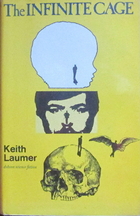
The Infinite Cage by Keith Laumer

Dobson, 1976, 221 p.

The Infinite Cage cover

Well this one took me back.

If it wasn’t yellow jacketed Gollancz hardbacks on the SF shelves at Dumbarton Library in my youth it was Dobson Science Fiction ones. Well, this has a yellow cover but it’s a Dobson. It’s also a former library book. I recently picked it up in a local charity shop.

A naked man wakes up in a police cell with no memories. He escapes more or less by accident and by turns falls into the orbit of Louella, a medium who quickly spots his ability to read minds and conceives of him as a route to riche. For convenience she names him Adam.

He has an ability to tune into voices but his knowledge of society and how to interact with others is limited. This gives Laumer the opportunity to engage in satire on late 60s early 70s US life. (The novel was first published in 1972.)

To make seed money Adam takes a job as an accountant using the experience of one of his voices. He quickly reveals the proprietor was being conned by suppliers and staff.

Through his voices he realises the level of need in the world and resolves to make money so that he can alleviate people’s worries.

This gives Laumer the opportunity to illustrate the difficulties of giving money away – or rather, having your motives for doing so misunderstood or impugned.

Various other adventures befall Adam including tangling with the darker side of the betting industry.

In this context I would note the utter immorality involved in a hospital precipitately discharging a very ill patient on its authorities’ belatedly discovering he has no money for the treatment.

The book is entertaining enough in a slightly old–fashioned way but falls in to metaphysics towards the end. It’s not without merit though, even if the characterisation is sometimes rudimentary.

Largo War Memorial

Largo War Memorial

The memorial is set by the A915 on the road from Leven up the Fife coast to Crail (or across Fife to St Andrews) just out of Lower Largo before the road turns up to Upper Largo. The memorial obelisk is inscribed with the words, “To the Glorious Memory of the Men of Largo Parish who fell in the Great War,” and also bears the names of the First World War dead. The plaques on the wall behind give the names for the Second World War.

Below is a wider view showing more of the wall, which bears the dates 1939 and 1945, one at each end.

Largo War Memorial

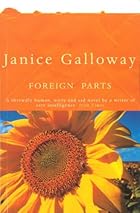
Foreign Parts by Janice Galloway

Vintage, 1995, 262 p.

Foreign Parts cover

The thing that struck me most about this book was its typography. Passages a paragraph long – sometimes smaller, rarely longer, though the paragraphs obviously vary in size – are separated by a double line break. The names of the two main characters

Rona and Cassie
Cassie and Rona

are frequently represented as above in succeeding lines between two double line breaks before the sentence continues. The main narrative, which has paragraph indentation, follows them on a trip through Northern France, has no markers for speech beyond context or an embedded said and can be interrupted by sections blocked off in a rectangle containing extracts from guidebooks to the local areas.

This is supplemented by sections (each with a uniform margin the size of the paragraph indentation above) describing the contents of photographs of Cassie’s life up to this point.

Nothing much happens in the story as the relationship between Cassie and Rona does not evolve significantly over the novel’s span. The main incidents of Cassie’s life were at the times represented by the photographs so we get, em, snapshots of her previous life. There is a passage about how men are more or less uniformly useless – apart from being able to provide sex – which Rona says she doesn’t miss anyway. Do we not take this as read? In any case not enough is made of this notion to allow us to ascribe the book’s title to being descriptive of the male even if Cassie says, “Heterosexuality is a complete farce…… Because what men really are in love with is men.”

Certain details niggled. Cassie and Rona visit a War Cemetery to find and photograph the name of Rona’s grandfather on a wall and much note is made of the crosses. While it is true that French and US War Cemeteries contain crosses (or stars of David, and I vaguely remember crescents on some French Army graves) British and Commonwealth war grave markers are rectangular slabs with rounded tops. There are some crosses at Thiepval, where the names of the otherwise unmarked dead of the Battle of the Somme are inscribed on a huge memorial, but those are the resting places of French soldiers. The cemetery in the book is unnamed.

Pedants’ accounting:- There was a “shrunk” count of 1 and several misspellings. At one point we had sandle but sandal appeared subsequently several times plus a “meritricious” in one of the guide book sections and a “colandar.”

Dumbarton 3-1 Morton

SPFL Tier 2, The Rock, 25/8/13

Well.

We don’t normally do league wins in August.

Having said that, it was only two seasons ago we humped East Fife 6-0 at their place on the 27th (making up for the reverse score the year before.)

But this’ll do nicely.

The two new signings last week, Colin Nish and Hugh Murray, ought to add experience and know-how.

So far the only teams we’ve dropped points against are first and second!

Let’s keep it up at Cowdenbeath and Alloa now, two potentially tricky away games.

Fife’s Art Deco Heritage 10 (ii): Leven Again

When I pass through Leven I usually don’t go via the town itself but use the A915 which only goes through the upper part. Last time though I went via the A955 and consequently viewed not only the War Memorial but also two Art Deco style buildings.

The larger of these is in Durie Street, just off the town centre, and once housed a Co-operative store, built in 1937.

Former Co-operative Building, Leven, Fife from East

The stepping on the roofline, the “brows,” the windows, the horizontals and verticals, and the slight protrusion of the vertical windows flanking the centre ones are all deco features.

This is the upper frontage:-
Former Co-operative Building, Leven, Fife

And here’s a close-up on the frieze above the central windows:-

Detail on Former Co-op Building, Leven, Fife

The trianguloid protrusions flanking the centre portion look like this:-

Window Detail, Former Co-operative Building, Leven

Further out from the town centre on Scoonie road is the Agenda pub.
Agenda, Leven

This one shows the deco detailing:-
Art Deco Detailing on Agenda

Leven (Scoonie Parish) War Memorial

The Fife town of Leven lies in Scoonie Parish. It is the dead of Scoonie Parish which the memorial commemorates.

The main memorial is an obelisk set in well kept surroundings and carries names of WW1 dead. The wall behind commemorates WW2.

Leven (Scoonie Parish) War Memorial 1

Leven (Scoonie Parish) War Memorial 2

Leven (Scoonie Parish) Memorial Wall

free hit counter script