Archives » Andrew Greig

When They Lay Bare by Andrew Greig

faber and faber, 1999, 326 p.

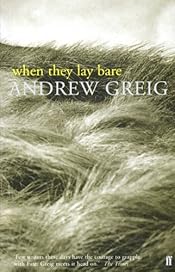
When They Lay Bare cover

So much enduring literature is about love, sex and death. Greig is good on all three, especially love and its tragedies. In When They Lay Bare David Elliott comes to the family home to show off to his father, Simon, his intended. Meanwhile a strange woman has moved into a cottage on the estate. In David’s childhood Simon had had an affair with Jinny Lauder – for whose death he had been tried for murder, and found not proven. The shadow of those events lies over the book, as, since it is set in those same debatable lands Greig would return to in Fair Helen (but here we are in the twentieth century,) does the history of the borders. Border Ballads are frequently quoted and the book’s epigram is an extract from The Twa Corbies. Throughout Greig does not separate off direct speech by quotation marks but this is never a problem to decipher.

The novel has a central conceit wherein the story is foreshadowed by the descriptions of illustrations on a set of eight plates belonging to the woman in the cottage who at first gives her name as Mary Allan but then says she is Jinny’s daughter, Marnie. The eight sections into which the novel is divided are designated as Plate 1, Plate 2 etc – though 4 and 5 are titled Lover’s Plates (Rose and Red respectively.) These descriptions are rendered in italics. The rest of the narration is carried from the viewpoints of David, Marnie, Simon (from whom we learn the details of his doomed affair with Jinny, a grand passion indeed) and his factotum Tat, a voyeur in his youth whose evidence was crucial to the verdict and who leveraged his knowledge into gaining his position on the Elliott estate. Tat’s narration is littered with Scots words and phrases, as is Simon’s but to a much lesser extent.

Marnie is one of those women whom Greig draws so well. She often alludes to Spook, her word for manifestations of sixth sense, a phenomenon not at odds with Borders history (though in that regard the appearance of Jinny to Tat at the novel’s crux was perhaps a step too far.) Important, too, is a precarious bridge over the Liddie Burn, the scene of one of those Border tales from times past.

Marnie is the heart of the book, the driving force of its motor, the hinge around which the other characters revolve – though Jinny’s actions and her motivations for them are almost as influential – but the most Greigian of sentiments is voiced by David, “Sin and sex make us glow like coals in the dark. That’s why we do it. To burn.” One of the reasons we read novels is to experience that burn, if only at second hand.

Pedant’s corner:- Quite why the title is all in lower case on the cover is beyond me. It isn’t on the title page. Otherwise: “the prosecution were” (was,) “only a name and a brief tale remains” (remain; in an extract from a piece about border legends,) usually before a piece of dialogue or unspoken thought there is some sort of punctuation. In one instance it was missing, smoothes (smooths.) “That is the cause of the love he feel for his companions” (feels,) “‘he’d had to have grovelled’” (OK it was in dialogue but, “he’d have to have grovelled”,) imposter (impostor.)
Reading Scotland 2017

There are 36 books in this year’s list of my Scottish reading. (That’s three per month on average but I decided that in December I would not read anything Scottish at all.) 18 were written by men and 18 by women. 6 were SF or Fantasy, 3 were poetry, one was non-fiction.

Those in bold were in the Scotsman’s 20 Scottish Books Everyone Should Read. Those in italics were in the 100 best Scottish Books. The ones with an asterisk* were among Scotland’s favourite books.

Under the Skin by Michel Faber*
His Bloody Project by Graeme Macrae Burnett
Driftnet by Lin Anderson
The Game of Kings by Dorothy Dunnett
Tamburlaine Must Die by Louise Welsh
The Bonniest Companie by Kathleen Jamie
The Return of John Macnab by Andrew Greig
The Ragged Man’s Complaint by James Robertson
The Panopticon by Jenni Fagan*
To The Lighthouse by Virginia Woolf
Waverley by Walter Scott
Divided City by Theresa Breslin
The Overhaul by Kathleen Jamie
The Stornoway Way by Kevin MacNeil
The Sea Road by Margaret Elphinstone
The Bull Calves by Naomi Mitchison
Garnethill by Denise Mina
*
44 Scotland Street by Alexander McCall Smith
Collected Poems by Carol Ann Duffy
Grace Notes by Bernard MacLaverty
The Missing by Andrew O’Hagan
Imagined Corners by Willa Muir
The Sunlight Pilgrims by Jenni Fagan
This is Memorial Device by David Keenan
The Magic Flute by Alan Spence
The Adventures of Sherlock Holmes by Sir Arthur Conan Doyle*
Pandaemonium by Christopher Brookmyre
The Revolution of Saint Jone by Lorna Mitchell
Psychoraag by Suhayl Saadi
Lilith by George MacDonald

Phantastes by George MacDonald
The Weatherhouse by Nan Shepherd
The Corporation Wars: Emergence by Ken MacLeod
The Wire in the Blood by Val McDermid*
The Golden Bough by James Frazer
Travel Light by Naomi Mitchison

The Return of John Macnab by Andrew Greig

Headline Review, 1996, 285 p.

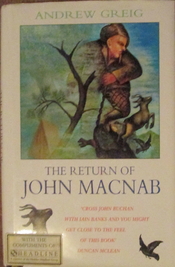
The Return of John Macnab cover

This, Greig’s second novel, takes as its template John Buchan’s John Macnab which I reviewed here. Once again three men – but this time not “gentlemen” – form an alliance to poach a salmon, a brace of grouse and a stag respectively from three different estates, Mavor, Inchallian and Balmoral, and then deliver the poached items back to the “owners”, as a challenge to “absentee landowners and the Criminal Justice Act” and as a wager to the three estates’ owners; issuing a statement to this effect in the Scotsman newspaper. The “John Macnab” here comprises at first Neil Lindores, Murray Hamilton and Alasdair Sutherland, each with his own special talent useful for the enterprise, but not long after arriving in “a small Highland town” Lindores is sussed out by local journalist Kirsty Fowler who is excited by the project and offers to help them.

Greig’s background in climbing comes to the fore in his description of the scramble needed to get to the pool for the salmon poach and his life as a poet in the sentence, “Seldom had a celebration broken up so fast, as if someone had announced an evening of performance poetry would commence in thirty seconds.”

His descriptions of landscape are loving and there is the odd reflection on the condition of Scotland. On feeling himself squeezed as at the narrow waist of an hour-glass with more past than future as the minutes ran through Neil thinks, “What a depressingly Scottish image. Its negativity was another thing that was true about his country. It went along with tholing, bearing, putting up with, and taking a certain satisfaction in the expected bad news when it came.” Yes indeed. That’s Calvinism for you. Neil does go on, though, to sense “it was a wrong picture. He was groping for another, still true but more affirmative.” At another point, “He hugged Murray. This was a first – they were Scottish, after all.”

The big problem John Macnab faces here is Balmoral. It is late summer and HRH is in residence. Consequently the place is hoaching with Special Services, Army and Police as well as the usual ghillies and gamekeepers. The authorities cannot ignore the possibility that John Macnab is merely a cover for a terrorist attempt on HRH’s life.

The text occasionally refers to Buchan’s novel, as it has to, and even critiques it in mentioning that Buchan’s women are really just chaps – though with (small) breasts. Greig’s intent is somewhat different; and his women are certainly far from chaps. Kirsty is as rounded and complex a character as you could wish (such women are a common factor in Greig’s novels) and is thoroughly involved in the poaching efforts – as are Sutherland’s and Hamilton’s wives and the former’s family – at least in the second one. Sutherland’s wife, though she has had an affair, tells Kirsty she would kill him if he were to do the same. Ellen Stobo, a policewoman attached to the security services but who finds herself coming to an understanding of John Macnab, is also well drawn. To be fair to Buchan he was writing adventure tales for a male audience in a time that was less aware. Greig is by far the better examiner of the human condition though.

The John Macnab template – while driving the events of the plot – at times gets in the way of Greig’s greater facility with personal relationships but in the end his own concerns overwhelm Buchan’s. Still, he nearly overdoes it, veering very close to the tradition of the Scottish sentimental novel (compare Iain Banks’s Espedair Street,) in the final pages. But he is too canny to yield a conventional ending.

That template means that The Return of John Macnab is not quite up there with Greig’s best – all the other novels of his I have read; see “Andrew Greig” in my categories – but for an exploration of human uncertainties, hesitations, lust for life and willingness to take risks, emotional as well as physical, it’s still pretty damn good.

Pedant’s corner:- midgies (midges – which spelling does occur in the book once but otherwise with the extraneous “i”,) swopped (swapped,) “‘but there a problem comes with it’” (but there’s a problem,) autogiro (autogyro,) hoochin’ (usually spelled – and pronounced – hoachin’,) the main work party were loading gear (the party was,) none of the computer systems were down (none was down,) a missing end quote mark.

2016 in Books

The best of what I read this year, in order of reading. 13 by men, 8 by women, 1 non-fiction, 5 SF or fantasy, 12 Scottish:-

Ancient Light by John Banville
The Secret Knowledge by Andrew Crumey
Clara by Janice Galloway
A Twelvemonth and a Day by Christopher Rush
Fergus Lamont by Robin Jenkins
In Another Light by Andrew Greig
The Quarry Wood by Nan Shepherd
The Lighthouse Stevensons by Bella Bathurst
The Scottish Tradition in Literature by Kurt Wittig
A Method Actor’s Guide to Jekyll and Hyde by Kevin MacNeil
This Census Taker by China Miéville
Revenger by Alastair Reynolds
1610: A Sundial in a Grave by Mary Gentle
The Bone Clocks by David Mitchell
The Misunderstanding by Irène Némirovsky
Europe in Winter by Dave Hutchinson
Daughter of Eden by Chris Beckett
The Cutting Room by Louise Welsh
Young Art and Old Hector by Neil M Gunn
The Vanishing Act of Esme Lennox by Maggie O’Farrell
Among Others by Jo Walton

In Another Light by Andrew Greig

Pheonix, 2004, 510 p.

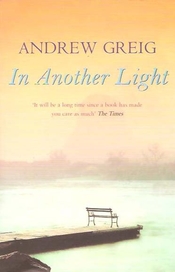
In Another Light cover

Love, sex and death again; but literature’s subject matter doesn’t get any bigger. And Greig deals with them superbly.

In In Another Light it is death which is the early preoccupation of Eddie Mackay, though love and sex do get a look in. Prior to the immediate events of the novel Eddie suffered from hydrocephalus as a result of a colloid cyst which meant fluid built up in his brain. He therefore feels the imminence of extinction everywhere, “‘Because I was nearly dead once and I’m trying to live with that.’” During his recovery from having a shunt fitted to drain the fluid from his brain to his stomach Eddie experiences the presence of his dead father, who according to Eddie’s mother had, long before she met him, been sent home in disgrace from Malaya after an affair with his superior’s wife. Eddie doubts the truth of this but sets out to find as much as he can about his father’s time in the colony. Eddie is working for a tidal generation project whose headquarters overlook Scapa Flow in Orkney. The jungle drums and the tangled relationships of Stromness become a running theme in the book. Of comments about his liaison with Mica Moar, another of Greig’s complicated female characters (a bit – but only a bit – like Kim Russell in Electric Brae) he says, “‘In my experience there’s only one way to keep a secret in a wee town’ … ‘Plant the sapling of truth in a forest of rumours.’”

This strand of the book, delivered in a first person past tense looking back over the path which brought Eddie to the final scene, with occasional present tense interludes setting that scene, is intertwined with a third person present tense narration of the voyage of his father Sandy, as he was then known, to Penang in Malaya and his brief sojourn there. Medical graduate Sandy hopes to improve the birth survival rates in Penang’s maternity hospital. The boat out is a hotbed of illicit goings on of which deeply moral Sandy is mildly contemptuous. The acquaintances he makes on the trip, US citizen Alan Hayman and the two Simpson sisters, Ann and Adele, “both beautiful, one a gazelle” the elder of whom, Adele, is married and chaperoning the younger, are fateful. A further sister, Emily, also on the boat, is still a child. Each chapter contains several sequences from both stories, generally alternating. The greeting, “‘Oh, there you are,’” bounces around the two narratives. Both strands are thick with metaphor. The descriptions of Orkney and Penang make them almost characters in themselves – particularly Orkney. Certain images also resonate between the two locations.

The text is seasoned with sly critiques of Scottish attitudes, “I was in joyous life-affirming Scottish mode that morning and no mistake.” “Scotland’s a place where everyone explains what is not possible, that it’ll all end in tears, we’re here to make the best of a bad job then die and get a good rest till we’re woken up to be informed we’re damned.” To Sandy’s traditional toast “‘Here’s tae us, wha’s like us? Gey few – and they’re aa deid’” Hayman says, “‘You guys, you can’t even celebrate without bringing death into it.’”

Eddie’s thoughts occasionally stray back to the subject of death. He raises with us the question of “How are we to live in the face of the sure and certain knowledge we will lose parents, friends, lover, the whole shebang and caboodle?” only to answer it immediately with, “Wholeheartedly. Of this one thing I am sure.” Later he tells us, “It’s such a simple and shallow thing, death, only there’s no bottom to it and no way across.”

He reflects that maturity is, “knowing you’ve more or less arrived at yourself and the world will keep changing but you won’t much, and then living with that,” while, “Pure lust, I’d noticed, eventually collapses under the weight of its own contradictions – rather like capitalism, but much quicker.” However, “We need meaning, I thought. The world might not have any, but we need it,” and, “Meaning is something we have to make.”

Greig’s numerous characters are all well drawn, their behaviour sometimes unexpected and contrary. I wouldn’t go quite so far as the cover quote (from The Times) “It will be a long time since a book has made you care as much.” Not for me. At least not since the same author’s Fair Helen. He seems to have a gift for it. Add in computer programmes for generating music from tidal movements, the compromises of secret service work in the colonies, a thoroughly worked through plot (which admittedly may be a little too neatly tied in,) the perennial failure of true love (or lust) to run smooth and the whole thing’s a delight.

Pedant’s corner:- “‘I’d left my [gas] mask back in the Mess’” (the Mess? In the trenches in WW1?) Brechin Pier (does Brechin have a pier?) “for a while neither of them speak” (neither speaks.) “Stacked alongside the reference books are a series of different coloured hardback files” (is a series,) baragraphs (barographs,) the phrase, “he was sad under his funny,” (seems to be missing a final word,) furlough (is more a USian usage,) “The Moonlight Band play foxtrots” (plays,) “a think about what the heck’s he’s getting into,” (what the heck,) sub-periphrenaic abscess (a google search for sub-periphrenaic yields only a quote from In Another Light: Andrew Greig,) whigmalerie (spelling of Scots words can be variable but this is usually whigmaleerie,) murmers (murmurs,) Theramin Dr Who electronic music (Theremin: also Dr Who’s electronic instrument wasn’t a theremin which as an instrument should be lower case,) “he scooped more peanuts down his maw” (I suppose it could mean stomach here,) “a group of macaque monkeys come running” (a group comes,) “He’s stares” (He stares,) whispy (context suggests wispy,) tweaked it it (one it is enough,) an assortment of … appear (an assortment appears,) Siouxie and the Banshees (doesn’t she spell it Siouxsie?) vocal chords (it’s cords,) Arshak Sarkies’ (Sarkies’s,) for completeness’ sake (completeness’s,) light defraction (diffraction? refraction? or is this a portmanteau word Greig has invented?) became (in a present tense narration this should be becomes.)

Live It Up 30: Dear Prudence

A reference to Siouxsie and the Banshees in Andrew Greig’s In Another Light (review to come) reminded me of the band’s treatment of this Beatles’ song.

Siouxsie and the Banshees: Dear Prudence

The Lament: A Scottish Tradition

I mentioned recently in my review of Christopher Rush’s A Twelvemonth and a Day that it fell into that long list of laments with which the Scottish novel is liberally bestowed – going back at least as far as the poem on the state of the nation written on King Alexander III’s death after falling from a cliff in Fife in 1286, but which may well be an oral tradition older still.

This sense of things lost seems to be an itch which Scottish letters is unable not to scratch.

Many of the books on the 100 best Scottish Books list fall into this tradition; of the ones I have read not only the Rush but also Iain Crichton Smith’s Consider the Lilies, Archie Hind’s The Dear Green Place, William McIlvanney’s Docherty, George Mackay Brown’s Greenvoe, Neil M Gunn’s The Silver Darlings, Lewis Grassic Gibbon’s Sunset Song certainly qualify. Arguably Jessie Kesson’s The White Bird Passes also fits the bill; its title certainly does.

Whether this dwelling on things gone by is due to a sense of lost nationhood or not is a matter for debate but the itch is played out not just in Scottish literature, the lament is a major strand in bagpiping and has a long history in song (eg The Flowers o’ the Forest.) The Proclaimers’ Letter From America – “Bathgate no more” etc – is merely a modern take on the form.

Another important strand in the Scottish novel is that of the döppelganger/the supernatural. Here James Hogg’s Private Memoirs and Confessions of a Justified Sinner, which can certainly be seen as a reflection on the duality of the Scots psyche after the Treaty of Union as well as an illustration of Scottish literature’s fascination with the Devil, is the prototypical – and arguably the finest – example though Robert Louis Stevenson’s Strange Case of Dr Jekyll and Mr Hyde is perhaps better known furth of Scotland.

On thinking about all this I realised that, despite being Science Fiction, my own novel A Son of the Rock was also such a lament (though it eschews any truck with the supernatural.) The book was certainly conceived in part as an allegory of the decline of shipbuilding on the Clyde which had occurred in my early lifetime but I had not consciously been aware of any wider resonances while I was writing it. I did though somewhat impertinently consider it as a “condition of Scotland” novel.

Perhaps Scotland’s condition has always been in decline, its writers always noticing what has been, is being, lost. I note here that Andrew Grieg’s Fair Helen is a retrospective lament for the loss of “wit and laughter, music and dance and kindliness” in the Reformation.

My 2015 in Books

This has been a good year for books with me though I didn’t read much of what I had intended to as first I was distracted by the list of 100 best Scottish Books and then by the threat to local libraries – a threat which has now become a firm decision. As a result the tbr pile has got higher and higher as I continued to buy books and didn’t get round to reading many of them.

My books of the year were (in order of reading):-
Bring Up the Bodies by Hilary Mantel
Electric Brae by Andrew Greig
The Thousand Autumns of Jacob de Zoet by David Mitchell
Station Eleven by Emily St John Mandel
Europe in Autumn by Dave Hutchinson
Traveller of the Century by Andrés Neuman
The Affair in Arcady by James Wellard
Flemington and Tales from Angus by Violet Jacob
The Book of Strange New Things by Michel Faber
Ash: A Secret History by Mary Gentle
Young Adam by Alexander Trocchi
Song of Time by Ian R MacLeod
The Gowk Storm by Nancy Brysson Morrison
The Bridge Over the Drina by Ivo Andrić
To Kill a Mockingbird by Harper Lee
Fair Helen by Andrew Greig
The Dear, Green Place by Archie Hind
Greenvoe by George Mackay Brown
The Tin Drum by Günter Grass
Europe at Midnight by Dave Hutchinson
The Cone-Gatherers by Robin Jenkins
A God in Ruins by Kate Atkinson
Go Set a Watchman by Harper Lee
Born Free by Laura Hird
We Are All Completely Beside Ourselves by Karen Joy Fowler

If you were counting that’s 25 in all, of which 15 were by male authors and 10 by women, 8 had SF/fantasy elements and 11 were Scottish (in the broadest sense of inclusion.)

Reading Scotland 2015

A lot of my Scottish reading this year was prompted by the list of 100 best Scottish Books I discovered in February. Those marked below with an asterisk are in that 100 best list. (In the case of Andrew Greig’s Electric Brae I read it before I was aware of the list and for Robert Louis Stevenson his novella was in the book of his shorter fiction that I read.)

Electric Brae by Andrew Greig*
A Sparrow’s Flight by Margaret Elphinstone
The Guinea Stamp by Annie S Swan
The Girls of Slender Means by Muriel Spark
The White Bird Passes by Jessie Kesson*
Attack of the Unsinkable Rubber Ducks by Christopher Brookmyre
Buddha Da by Anne Donovan*
Flemington by Violet Jacob*
Tales From Angus by Violet Jacob
Annals of the Parish by John Galt
The Book of Strange New Things by Michel Faber
Change and Decay in All Around I See by Allan Massie
The Hangman’s Song by James Oswald
Wish I Was Here by Jackie Kay
The Hope That Kills Us Edited by Adrian Searle
Other stories and other stories by Ali Smith
Young Adam by Alexander Trocchi*
The Gowk Storm by Nancy Brysson Morrison*
No Mean City by H McArthur and H Kingsley Long*
Shorter Scottish Fiction by Robert Louis Stevenson*
The Expedition of Humphry Clinker by Tobias Smollett*
Girl Meets Boy by Ali Smith
Fair Helen by Andrew Greig
The Dear, Green Place by Archie Hind*
Fur Sadie by Archie Hind
Greenvoe by George Mackay Brown*
Stepping Out by Cynthia Rogerson
Open the Door! by Catherine Carswell*
The Silver Darlings by Neil M Gunn*
Scotia Nova edited by Alistair Findlay and Tessa Ransford
After the Dance: selected short stories of Iain Crichton Smith
John Macnab by John Buchan
Another Time, Another Place by Jessie Kesson
Consider the Lilies by Iain Crichton Smith*
The Thirty-Nine Steps by John Buchan*
Poems Iain Banks Ken MacLeod
Mistaken by Annie S Swan
Me and Ma Gal by Des Dillon*
Tea with the Taliban: poems by Owen Gallagher
A Choosing by Liz Lochhead
The Cone Gatherers by Robin Jenkins*
Born Free by Laura Hird*
the first person and other stories by Ali Smith

That makes 42 books in all (plus 2 if the Violet Jacob and Archie Hind count double.) None were non-fiction, 3 were poetry, 2 SF/Fantasy, 19 + (4x½ + 3 doublers) by men, 13 + (3 doublers and 1 triple) by women, 2 had various authors/contributors.

John Macnab by John Buchan

Polygon, 2007, 274 p (+ v p introduction by Andrew Greig.) First published 1925. Returned to a threatened library.

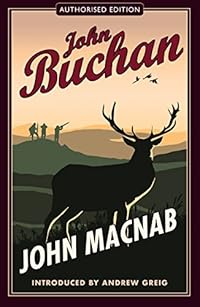
 John Macnab cover

I would not normally have picked this up but when I saw the cover and that the introduction was by Andrew Greig I realised his The Return of John Macnab (on my tbr pile) must have some relation to this original, first published in 1924.

In it, three professional men, one a Cabinet minister, all bored with their lives, get together as “John Macnab” to send out a challenge to three Highland landowners that they will poach a stag or salmon on their land, remove it, then later return it, with money for charity depending on the result either way. The book is merely the unravelling of this premise and the delineation of the incidents which occur in its prosecution. It does give a peek at the huntin’, shootin’, fishin’ brigade of the Western Highlands in the 1920s.

It is none of the three gentlemen however who is the book’s most rounded and intriguing character. That accolade belongs to Janet Raden, daughter of the owner of one of the estates to which “Macnab” issued his challenge. To their host Sir Archibald Roylance, who has fallen tongue-tiedly in love with her, she at one point says that the old aristocracy is dying because it deserves to, “We’ve long ago lost our justification.” However, in his introduction Greig says of her, “Like all Buchan’s good women she is essentially a chap,” a view to which there is more than a grain of truth.

It is not too surprising in a book concerned with field sports that descriptions of landscape should be prominent but this also places it in common with a swath of Scottish writing.

The authorial voice perhaps pokes through when we are told that “It is a melancholy fact which exponents of democracy must face that, while all men may be on a level in the eyes of the State, they will continue in fact to be preposterously unequal.” Here meaning if you’re used to ordering others – or being ordered – that affects how your actions are perceived and acted on.

To those of delicate dispositions I ought to say that – indications of the attitudes of the times in which it was written – there is more than one mention of Jews as being either fond of money or influential, an instance of the word “nigger,” and an utterance of the phrase, “I’m a white man, I am,” as an assertion of integrity.

The book is not really more than an adventure story. It will be interesting to see what Greig makes of the premise.

Pedant’s corner:- The Miss Radens (The Misses Raden.)

free hit counter script