Archives » Andrew Greig

Fair Helen by Andrew Greig

A veritable account of ‘Fair Helen of Kirkconnel Lea’ scrieved by Harry Langton.
Quercus, 2014, 368 p. Borrowed from a threatened library.

 Fair Helen cover

After all these years, all those novels, you’d think there would not be much more to say on the subjects of love, sex and death. But they are the human driving forces; or fears. There isn’t really much else to write about. And Greig has a heart and a talent to match anyone’s.

In Fair Helen Greig adds himself to that long line of Scottish authors who have illuminated the byways of the country’s history, in this case the last gasps of the Border reiving tradition. James VI – referred to as Jamie Saxt in the text – sits in Holyrude awaiting the death of “the Auld Hag” (as our narrator Harry Langton calls Elizabeth of England) to fulfil his destiny and incidentally ensure the end of the border feuds. Langton, though flawed, is an engaging guide to the times; discursive, reflective, and prone to the occasional footnote. If the setting and vocabulary were not enough (an appended “Scots Guide” defines some of the non-English words used: my favourite of these, houghmagandie, is given as sexual shenanigans but that fails to recognise the connotations of exuberance) the attentive descriptions of landscape and evocations of other works of Scottish literature, “Timor mortis conturbat me, indeed,” “a mere mouse running before the coulter blade,” “‘How can they stay sae fresh and fair?’” would anchor Fair Helen firmly. (That some of these references post-date the novel’s times only makes them the more redolent.)

Early on we have a warning about the trustworthiness of text, “What is the point of gossip and story if not to exaggerate our lives to the scale we believe they should be rather than the small affairs we fear they truly are?” – and there is that “veritable” in the strapline – yet the tale purports to be the true story of the tragedy described in the border ballad ‘Fair Helen of Kirkconnel Lea’. Greig’s choice of narrator is subtle, being none of the three main actors in the events that led to balladry. Harry was cousin to Fair Helen (Irvine) and friend of Adam Fleming, her lover, though not so close to the man whom she is contracted to marry, Robert Bell. Langton’s presence at, and contribution to, the outcome of the affair is approached via his entanglement not only with the lovers but also with the coming man, Walter Scott of Branxholme and Buccleuch. Langton notes that, “Rarely is it fortunate to come to the attention of the high heid ones.” But Helen has words of advice when, “‘I am much changed,’ I said, ‘And the world has grown ugly.’ Her hand squeezed my wrist. Her grip was strong and urgent. ‘Think that and they have won.’”

Through Langton, Greig is also overly modest. “I contemplated my Thucydides. The wars of Greek city-states did not seem so distant. If they appeared more noble, perhaps, it was just they had better writers.” The meat of his quote from Montaigne, “‘The public weal requires that men should betray, and lie, and massacre,’” is alas followed too closely to this day.

Greig has been described as a post-Calvinist author. This is explicit here in passages such as, “The rediscovered voices of Antiquity have offered a vision of a greater, kinder, more humane and playful life (scarcely in Scotland, ma foi, not till the hoodie craws of the Reformed Faith back away from the carcass of this my only true home!)” The older Langton reflects, “There is no dancing in the inn courtyards now, religious fanatics denounce and rule, witches still confess under torture and our songs are all grim or piously false as ‘Fair Helen of Kirkconnel Lea’,” and, “Women have become douce-like, modest, eyes downcast as though feart to trip on their own feet, and men are penitential. The flesh is sinful and chastity rated far higher than charity,” adding cuttingly, “It is a wonder that bairns still get born at all.” The women and men Langton knew in the borders in the far-off days of his youth, “were … otherwise.” He tells his latter day patron, Drummond of Hawthornden, (in whose library he leaves a copy of Love’s Labours Won, a gift from a strolling player in London, another knowing authorial touch,) “‘Reform may have banished corruption,” (of the church.) “It would also banish wit and laughter, music and dance and kindliness.’” And thinks to himself, “And fornication.”

As to the country itself, “Here all about lay Scotland, dark and dreich and dear. Cloud-shadow scurrying over hill and burn, cold wind and dry branch, our hard humour and hidden hurts. Here affection came wrapped in insult as sweet fruit in burnt pie-crust. Tenderness was hidden under armoured jacks, with only keening pipes and fiddle and human voice to tell the heart’s ways.”

The novel is threaded with a sense of loss. This could perhaps arise only in that the story is narrated by an old man, “My soul is an old horse-trough that lies forgot in a field, its rotting boards mottled with fungus and moss,” remembering the past – were it not that this sort of deep nostalgia is a familiar strand in Scottish literature. And the Scottish fixation with death is marked by, “The skull and hourglass we Scots inscribe on our tombs to counter any pious suggestion of the life to come.”

The hyper-critical might carp that the story is merely (merely!) a recapitulation of Romeo and Juliet – the Fleming and Irvine families are after all in feud when they first get together – but star-crossed lovers are a literary staple and here there are complications; an end to the feud is negotiated but Helen’s engagement to Bell is announced at the celebration which marks the reconciliation. Fair Helen is a delight and, despite any lack of Calvinism, still Scottish to the bone. As in That Summer and Electric Brae Greig makes you care about his main characters and portrays the others as rounded.

Pedant’s corner:- That mention of high heid ones looks odd as it is usually rendered as high heid yins. We have maw as mouth rather than stomach, hung at times (when hanged is used elsewhere,) Lucretius’ (Lucretius’s.) “As we forded the stream I look off to my left,” (looked,) Longshanks’ (Longshanks’s,) snuck in (sneaked? tucked?), their force were (was,) had began (had begun; or merely, began,) snuck (definitely sneaked.) I also thought I caught a continuity error when Langton hands Mrs Smeaton’s packages to Jed Horsburgh, who is in custody for protecting Adam Fleming.

100 Best Scottish Books (Maybe)

I came across this list a week or so ago. There are some odd choices in it. The Woolf and Orwell are surely pushing it a bit to qualify as in any way Scottish. And The King James Bible? Yes he was primarily a Scottish King but the endeavour was undertaken for reasons to do with his English realm.

Those in bold, I have read. There’s a lot I haven’t. Time to pull my socks up.

(Edited to add:- Those with a *I have now read.
Edited again to add:- I have added even more than these to the “have now read” list.)

John Galt – Annals of the Parish* (1821) I’ve read The Member and The Radical. See my review here.
Aonghas Pàdraig Caimbeul – An Oidhche Mus Do Sheòl Sinn (2003) This is written in Gaelic and hence beyond my competence.
Kate Atkinson – Behind the Scenes at the Museum – (1995) I read this years ago.
Ian Rankin – Black and Blue* (1997) I’ve not read this Rankin but I have Knots and Crosses.
Laura Hird – Born Free* (1999)
Tom Nairn – The Break-Up of Britain: Crisis and Neo-Nationalism (1977) Non-fiction
Frederic Lindsay – Brond (1984)
Naomi Mitchison – The Bull Calves (1947) Not a Mitchison I’ve read but I’ll need to catch up with more of her work. (As of May 2016 on tbr pile.)
Anne Donovan – Buddha Da* (2003)
Matthew Fitt – But n Ben A-Go-Go (2000) Science Fiction in Scots! Brilliant stuff.
Patrick MacGill – Children of the Dead End (1914)
AJ Cronin -The Citadel (1937) Cronin was from Dumbarton. I’ll need to read him sometime.
Frank Kuppner – A Concussed History of Scotland (1990)
Robin Jenkins – The Cone-Gatherers* (1955)
Thomas De Quincey – Confessions of an English Opium-Eater (1822)
Iain Crichton Smith – Consider the Lilies* (1968)
R. M. Ballantyne – The Coral Island (1858) I may have read this as a child but I cannot actually remember doing so.
Louise Welsh – The Cutting Room (2002) (tbr pile)
Robert Alan Jamieson – A Day at the Office (1991)
Archie Hind – The Dear Green Place* (1966)
James Kelman – A Disaffection (1989) I read years ago. Kelman is essential.
RD Laing – The Divided Self (1960) non-fiction
William McIlvanney – Docherty (1975) Again read years ago. Again McIlvanney is essential reading.
David Hume – An Enquiry Concerning Human Understanding (1748) Philosophy. I haven’t read this.
Andrew Greig – Electric Brae (1997) A superb first novel. See my review here.
Tobias Smollett – The Expedition of Humphry Clinker* (1771) Smollet was from Renton, which is 2 miles from Dumbarton.
Violet Jacob – Flemington* (1911)
Agnes Owens – For the Love of Willie (1998) See my review here.
Ian Fleming – From Russia, With Love (1957) Fleming? Scottish? Only by extraction it seems.
Dorothy Dunnett – The Game of Kings (1961) (tbr pile)
Denise Mina – Garnethill (1998) (tbr pile)
James Frazer – The Golden Bough (1890)
Nancy Brysson Morrison – The Gowk Storm* (1933)
Bernard MacLaverty – Grace Notes (1997)
George Mackay Brown – Greenvoe* (1972)
Alistair MacLean – The Guns of Navarone (1957) I read this many years ago. Decent enough wartime thriller.
J.K. Rowling – Harry Potter and the Philosopher’s Stone (1997)
Joseph Conrad – Heart of Darkness (1902) Conrad was the favourite author of the original Jack Deighton (my grandfather.) I’ve read The Secret Agent and always mean to get round to more. But… Wasn’t Conrad Polish?
John Prebble – The Highland Clearances (1963) Non-fiction
Ali Smith – Hotel World (2001) See my review here.
Arthur Conan Doyle – The Hound of the Baskervilles (1902)
George Douglas Brown – The House with the Green Shutters (1901) A Scottish classic; see my review.
Willa Muir – Imagined Corners (1931) (tbr pile)
Luke Sutherland – Jelly Roll (1998)
Chaim Bermant – Jericho Sleep Alone (1964) is on the tbr pile.
James Robertson – Joseph Knight (2003) Robertson is another of those very good present day Scottish authors. My review of Joseph Knight.
Various – King James Bible: Authorised Version (1611) ???? See comments above.
Alasdair Gray – Lanark (1981) Absolutely superb stuff. More essential reading.
Ronald Frame – The Lantern Bearers (1999)
James Boswell – The Life of Samuel Johnson (1791)
Bella Bathurst – The Lighthouse Stevensons* (1999) Non-fiction. I bought this for the good lady and it’s another I keep meaning to read.
George MacDonald – Lilith (1895) The Scottish tradition is to write fantasy rather than SF. I’ll need to catch up with this.
John Burnside – Living Nowhere (2003)
Anne Fine – Madame Doubtfire (1987)
Alan Spence – The Magic Flute (1990) I’ve read his Way to Go.
Des Dillon – Me and Ma Gal* (1995)
Margaret Oliphant – Miss Marjoribanks (1866)
Alan Warner – Morvern Callar (1995) I think Warner’s most recent books The Worms can Carry me to Heaven and The Deadman’s Pedal are more successful.
George Friel – Mr Alfred, MA (1972) (tbr pile)
Neil Munro – The New Road (1914)
William Laughton Lorimer (trans.) – The New Testament in Scots (1983)
George Orwell – Nineteen Eighty-Four (1949) I know it was written on Jura but Orwell? Scottish?
Alexander McArthur and H. Kingsley Long – No Mean City: A Story of the Glasgow Slums* (1935)
Alexander McCall Smith – The No. 1 Ladies’ Detective Agency (1998)
Christopher Brookmyre – One Fine Day in the Middle of the Night 1999) Brookmyre is a fun read – if a little too liberal with the violence. But this isn’t even his best book. See my review here.
Catherine Carswell – Open the Door!* (1920)
Andrew O’Hagan – Our Fathers (1999) I have yet to warm to O’Hagan. My review of this book.
A.L. Kennedy – Paradise (2004) Kennedy’s more recent Day and The Blue Book impressed me more.
Muriel Spark – The Prime of Miss Jean Brodie (1961) My review is here.
James Hogg – The Private Memoirs and Confessions of a Justified Sinner (1824) The quintessential Scots novel. The döppelganger tradition starts here.
Suhayl Saadi – Psychoraag (2004)
Nan Shepherd – The Quarry Wood* (1928)
Walter Scott – Rob Roy* (1818) Scott more or less invented the Scots historical novel but I can only remember reading Ivanhoe.
Thomas Carlyle – Sartor Resartus (1836) Anothe disgraceful omission on my part I fear.
Toni Davidson – Scar Culture (1999)
Margaret Elphinstone – The Sea Road (2000) I’ve read Elphinstone’s A Sparrow’s Flight and The Incomer; but not this. (tbr pile)
Jimmy Boyle – A Sense of Freedom (1977)
George Blake – The Shipbuilders (1935) (tbr pile)
Gordon Williams – The Siege of Trencher’s Farm (1969)
Neil M Gunn – The Silver Darlings* (1941) Of Gunn’s work I recently read The Well at the World’s End.
Ron Butlin – The Sound of My Voice (1987) I’ve not read his poetry but Butlin’s fiction is excellent. My review of The Sound of my Voice.
Robert Louis Stevenson – The Strange Case of Dr Jekyll and Mr Hyde* (1886) Following on the döppelganger tradition from Hogg. Again I can’t remember if I’ve read it or just watched adapatations on TV.
Jeff Torrington – Swing Hammer Swing! (1992)
Lewis Grassic Gibbon – Sunset Song (1932) A brilliant novel. Worth its status as a classic. See my thoughts here.
John Buchan – The Thirty-Nine Steps* (1915)
Virginia Woolf – To the Lighthouse (1927) (tbr pile)
Irvine Welsh – Trainspotting (1993)
Janice Galloway – The Trick is to Keep Breathing (1989) I fear Galloway is an acquired taste. See here.
Jackie Kay – Trumpet (1998) I read this last year.
Christopher Rush – A Twelvemonth and a Day* (1985)
Michel Faber – Under the Skin (2000)
David Lindsay – A Voyage to Arcturus (1920) In the Scots tradition of the fantastical but has a weirdness all its own.
Iain Banks – The Wasp Factory (1984) The much lauded Banks debut. I’ve come to think A Song of Stone may outrank it.
Adam Smith – The Wealth of Nations (1776) The foundation stone of Economics.
Compton Mackenzie – Whisky Galore (1947) (tbr pile)
Jessie Kesson – The White Bird Passes (1958) To be reviewed within the week!
Kenneth Grahame – The Wind in the Willows (1908) I may have read this as a child but can’t honestly remember.
Alexander Trocchi – Young Adam* (1954)
James Kennaway – Tunes of Glory (1956) (tbr pile)
John Gibson Lockhart – Adam Blair (1822) (tbr pile)

Electric Brae by Andrew Greig

A Modern Romance. faber and faber, 2002, 312 p.

 Electric Brae cover

Love, sex and death. Of the three main preoccupations of the novelistic art only the last might truly be expected from what is a deeply Scottish novel. But as its subtitle suggests, Andrew Greig’s first novel Electric Brae is a love story. And while a modern romance can also be expected to deal with sex what there is here is not graphic and is absolutely necessary to the tale.

The generally linear narrative isn’t entirely straightforward and moves from first to third person and back again, ditto from past to present tense, but does so seemingly naturally, without jarring, and also uses Scots words and phrases organically and unapologetically.

Set against a background of the transition to, and the years of, Thatcher’s premiership and the jolt to the Scottish psyche that produced, the story starts with the meeting, on a mountain in Glencoe, between Jimmy Renilson, an engineer on the rigs whose voice bears most of the narration duties, and the man who becomes his best friend and climbing partner, the committed socialist Graeme. This is before we encounter the love interest, Kim Russell (though it’s really Ruslawska,) a woman about ten years younger than Jimmy and possessed of eyes that beguile him. As these three plus Graeme’s girlfriend Lesley and others in their circle orbit round each other the course of true love – here explicitly acknowledged as an addiction – fails to run smooth. It rarely does, or else we’d have no story; and the canon of literature would be rather empty.

Kim is a troubled soul, given to self-harm and driven to produce art works that fail to assuage the core of her angst. “All art is exaggeration,” she says, “that’s the trouble with it.” But all the characters give off the air of real breathing people, except perhaps for Mick DeTerre, an anti-establishment activist, who seems too broad brush.

Significant locations in the book roam all over Scotland, ranging from Eyemouth in the Southeast, up to Aberdeen, Orkney and later Shetland, Fort William and Ben Nevis in the West, Dunbar notably, and finally Prestwick. The art of rock climbing and some individual Scottish climbs are described at various points. It is a longstanding ambition of Graeme and Jimmy that they will one day “knock off” the Old Man of Hoy, preferably together.

Without shying away from the sentimentality that can lurk beneath the reserve, the novel does however touch on the heart of Scottishness and what differentiates it from its southern neighbour, in especial the inability of the Scottish male to acknowledge “the squishy stuff” of emotion, to admit even to friendship.

It addresses too the Scots shrinking from pretentiousness. At one point Jimmy remembers Lesley telling him that, “Graeme must conclude any intelligent statement with an expletive. As if to apologise for his articulacy,” adding for our benefit, “Clinging to the wreckage Lesley calls it.” Graeme says, in contrast to Scotland about the Falklands War, [Editorial insert:- sorry; police action] “England’s gone off its heid wi this war,” and on the failure of the miners’ strike, “Everyone for themselves these days, eh? It’s no the Scottish way.”

Jimmy himself has more than a few observations about Scotland and the Scots:-
“Deferred gratification, we love it. It lets us square Calvinism with hedonism.”
“Who are we? I wondered. We don’t even speak consistently. We’ll say ‘yes’ and ‘aye’ and ‘yeah’ in the same conversation, alternate between ‘know’ and ‘ken’,1 ‘bairn’, ‘wean’ and ‘child’2 and not even know why.”
“We’re a small country with blurry boundaries.”
“Have I mentioned that good sex is wonderful, a human joy, even in Scotland?”
Of the places listed over the radio in his childhood as in danger of snow and ice, “Some places, like some people, you love before you’ve ever met,” and on being accused of sentimentality over his love of the Scottish landscape, “Someone said sentimentality is the expenditure of emotion on an unworthy object. Do you think this country’s unworthy?”
“We’re living in a banana republic that disnae even have its ain government to be corrupted.”
“Scots prefer the bludgeon of sarcasm,” (rather than use irony.)
“A culture of stoic suffering is limiting but has its uses.”

He notes after a sojourn abroad that, “while he’d been away the value of property had gone up and on the whole that of people had gone down,” and “Great to be back in Scotland, the home of constructive criticism,” along with, “Judging by the estate agent’s at the top of the wynd, where people used to have a home, now clients invested in a property.”
“Mrs Thatcher had done us one great service for she was a litmus test. Three times she dipped the UK into her solution and each time the bottom part came out blue and the top pinker than the time before. We had forgotten we were different, and that difference went deeper than a taste for haggis, Murrayfield and Hampden and an inability to take seriously anyone called Nigel.” [Editorial insert:- This last sentiment, true enough when Electric Brae was first published in 1992, has become even more apposite in the past decade.]

He complains to a later lover, the Englishwoman Ruth, “All this stuff everyone talks about these days, about taking responsibility, taking charge, taking decisions, taking on board – it sounds like too much taking to me.” “Jimmy,” she said, “you’ll never adjust to the Eighties. That’s why I live up here – because most of you still believe the dream might just work. You still seem to think we’re interdependent… You won’t find many still believe that down South.”

Jimmy also sums up the Scottish mind-set, “You’re asking me to think, to come clean at this hour in the morning, with three-hundred close-hearted, tight-lipped Protestant years sitting on my neck?” More generally he muses, “Climbing’s no dafter than roping your happiness to someone else,” and, “It was hard but nothing compared to what we do to each other.”

Though the author does let Jimmy off a large moral hook a touch too easily near the end (though not an arguably greater one) and the symbolism is at times forced, all in all this is superb stuff, about the importance of relationships and mutual dependency.

And the Electric Brae? Apart from being one of the place names in the radio snow reports it is not mentioned at all in the book except in the excerpt from A Fly Fisherman’s Guide by H O N MacCaig that is quoted as a frontispiece. The Brae itself is a hill in Ayrshire that seems to defy gravity. In this sense of disorientation it is a great descriptor for the appearance of madness that love can take.

1If you’re from the East coast.
2“bairn” and “child” if you’re from the East coast, “wean” and “child” if you’re from the West.

Pedant’s corner:- “Next weekend I’d cragging again with Graeme.” “born away on a receding tide” (borne) Lichtenstein (Liechtenstein.) “The longer you stay, bigger the bill will be when you leave.” Glamourous. “It didn’t looked played much.” “He stared back the Old Man.” Seperate. “Half of last the night.” “She hadn’t asked me too” (“asked me to” makes more sense,) Betty (Bette?) Davis, Casopeia (Cassiopeia) glaxy (galaxy,) self-centered (self-centred,) schlerosis (sclerosis,) whaft (waft,) whispy (wispy,) a whailing (wailing?) wall, smoothes.

Several Scots words appeared in unusual spellings; greit (for weep) is more usually greet, fousty (foosty or at a pinch foostie,) bisom (a rare variant of besom,) plouk (plook,) cheuchter (definitely teuchter,) wheich (definitely wheech.)

Read Scotland 2014 Overview

Twelve months gone and 29 books “Scottish” books read. (Or 30 if The Member and The Radical count as two; then again perhaps only 27 if A Scots Quair is treated as a single book.) That’s 2½ per month, give or take. And, if you discount the exceptions already mentioned, not a repeat author in the list.

2 were non-fiction; 4 outright SF/Fantasy; 18 were written by men (20 if the trilogy is separated) and 9 by women. (That gender disparity is lessened by 50% if you consider only authors still alive in 2014, though.)

I’m pleased to have caught up with John Galt and have already bought two more of his novels, delighted to have read A Scots Quair at last, made acquaintance with William Graham, Neil M Gunn, Carole Johnstone, Jackie Kay, Agnes Owens, Muriel Spark and Alan Spence and refound Naomi Mitchison. My main discovery, though, was Andrew Greig whose That Summer is the best book by a writer new to me (Scottish or not) since I first encountered Andrew Crumey.

My review of Kate Atkinson’s Life After Life is still to appear. See later this week, or even tomorrow.

There is apparently a Read Scotland Challenge 2015. I don’t think I’ll make 29 this year. I’ve got a lot of other reading to catch up on.

2014 in Books Read

The ones that stick in my mind most – for whatever reason – are:-

Signs of Life by M John Harrison
Mr Mee by Andrew Crumey
Be My Enemy by Ian McDonald
The Deadman’s Pedal by Alan Warner
A Scots Quair by Lewis Grassic Gibbon – but in especial Sunset Song
The Moon King by Neil Williamson
The Dogs and the Wolves by Irène Némirovsky
The Last of the Vostyachs by Diego Marani
HHhH by Laurent Binet
That Summer by Andrew Greig
Roadside Picnic by Arkady and Boris Strugatsky
My Name is Red by Orhan Pamuk
Way to Go by Alan Spence

Four SF/Fantasy novels, six Scottish ones (eight if the trilogy is separated) and no less than five translated works.

That Summer by Andrew Greig

faber and faber, 2000, 261 p.

That Summer cover

Scot Andrew Greig’s first book contained poetry. He has since published more poetry collections, non-fiction books on mountaineering and golf, short stories and, so far, seven novels. That Summer (also known as The Clouds Above) was his fourth novel and the first work of his I have read.

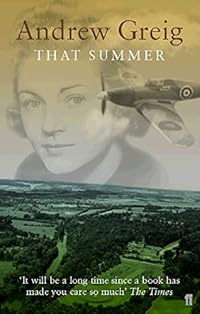
The summer of the title is the one of 1940, a fact which could be divined from the book’s cover, showing as it does a Hurricane in flight over a country landscape (with a shadowy female head in the upper background.) There is an elegiac feel to the story from the start, as, sixty years on, a reunion of sorts takes place at a long abandoned wartime airfield; yet the figures seem insubstantial, ghosts of themselves, or of those who cannot come back.

As a novel, That Summer deals with those three perennial literary concerns, love, sex and death. The narration is trifold, with all three intermingled through the book. Two are in first person – from the viewpoints of (Flight) Sergeant Len Westbourne and RDF operator Stella Gardam – and there are intermittent third person passages, some of which describe the ongoing war situation. Len’s comrade Tadeusz Polarcyk and Stella’s friend Maddy feature prominently. We are treated to the relevant narrator’s own thoughts and their perceptions of the other three. All are eminently rounded people with strengths and flaws, feeling entirely real – as do the minor characters.

The scenario could be over-familiar from all those 1950s black and white films – exercises in national myth-making – part of the long shadow which that war cast over those who experienced it (who themselves grew up in the shade of the earlier war,) “I begin to think to see why our parents had kept their war to themselves. It was too horrible yet precious, it had gone too deep,” an all too present absence passed on in turn to their children (ie my generation) but in Greig’s hands it is far from hackneyed or clichéd. He captures well the transience and randomness of air combat, the dangers of losing sharpness on leave, the arbitrariness of becoming a casualty of bombing (the mangled, eviscerated, blown-apart bodies,) the heightened perceptions, the snatching at life in the midst of death.

That Summer could have been a mere love story but the quality of the writing elevates it beyond the mundane. It is subtle of Greig to have Len flying Hurricanes rather than the more iconic and glamorous Spitfires. It somehow grounds the story, makes it real. Of the veterans it is observed that, “They were there but even they couldn’t see the true losses.” Len comes to see that, “Everything we have, we lose. So to want something, anything, someone, is the beginning of tragedy. And yet, and yet.” After a particularly gruesome kill he thinks to himself, “What have I done? Nothing. Nothing at all.” Stella realises of Evelyn, a former boyfriend whom she sees one night, “He really does love me. Me, for who I am, not what he gets from me, and with (a) slight shiver (I) knew this would always be rare in my or anyone’s life.” Later in the book she muses, “Wartime is like real life but more so,” and, “How can we love anyone, when they’re just going to die?” but “there’s nothing else to do but love, nothing to be regretted but not loving.” Her first (pre the events of the novel) lover, Roger, whom she meets again accidentally, tells her there is not much more than beauty and sacrifice, “We must take what beauty there is, and sacrifice is all around us.”

A few hints of the author’s Scottishness make themselves felt. Stella spent a couple of schoolyears in Scotland. Len’s squadron is posted to Aberdeenshire for a rest period and he spends three days walking in the Cairngorms.

For those who survived the war, its long, nigh-on six years, these were the days of their lives; what followed, a slow descent. And 1940 was the crux. (“In a way it was all rather exciting, being bombed.”) By accumulation of detail Greig shows us this and, by doing so, also shows us what it might have felt like to be alive in Britain, that summer.

free hit counter script