Archives » 2018 » May

War Memorial and War Grave, St Monans

The War Memorial stands in St Monans Church yard overlooking the sea and is a Celtic Cross surmounting a trapezoidal plinth. The inscription reads, “Erected by St Monance Parish in memory of those who fell in the Great War 1914 -1919.”

St Monans War Memorial

Great War names:-

St Monans War Memorial 4

Names for the Great War. St Monans Kirk in background:-

St Monans War Memorial 2

World War 2 Names. “Remember also the men of this parish who gave their lives in the war 1939-1945.”:-

St Monans War Memorial 3

There is one war grave in the churchyard. Deck Hand W Innes, RNR, HMS Victory, 20/3/1916, age 21. Possibly a casualty of the Battle of Jutland:-

St Monans, War Grave

St Monans

St Monans (sometimes spelled St Monance) is a seaside village in the East Neuk of Fife.

Its church, standing as it does prominently above the village and visible from the main A 917 road between Pittenweem and Elie, must be one of the most painted in Scotland certainly in Fife.

Church from village:-

St Monans Kirk From Village

From access road:-

St Monans Kirk From Access Road

From graveyard:-

St Monans  Kirk 2

Isle of May from St Monans:-

Isle of May from St Monans

Rocks at St Monans:-

Rocks at St Monans, Fife

Panorama of village and sea:-

St Monans Panorama

The Notebooks of Don Rigoberto by Mario Vargas Llosa

faber and faber, 1999, 308 p. Translated from the Spanish Los Cuadernos de Don Rigoberto by Edith Grossman

 The Notebooks of Don Rigoberto cover

A very odd piece, this. I’m tempted to add very South American; but it does focus on love and sex (especially the sex) – two of the triumvirate of big novelistic concerns.

Don Rigoberto is a legal director of an insurance company with an interest in collecting books and works of art but he never has more nor less than the same amount of either. Each new purchase must be balanced by the disposal of a previous one. Rigoberto has an extensive set of notebooks where he has inscribed his reflections on all he has seen or read. At the book’s start Rigoberto is estranged from his second wife Doña Lucrecia due to an indiscretion involving Alfonso, Rigoberto’s son from his first marriage, still a schoolboy but one who has an unhealthy fascination with the life and work of the artist Egon Schiele – to the extent he believes he may be a reincarnation.

The novel depicts sessions where Alfonso is visiting Lucrecia with a view to effecting a reconciliation between his father and stepmother, mixed in with Rigoberto’s memories and fantasies of life with Lucrecia and his notebooks’ polemics against aspects of modern life and the timid aspirations and attitudes of the general mass. One of these is a railing against pornographers, who pervert the higher aspects of love and sex, commodify the impulse and therefore desacralize the act of love and make it banal. In the same piece he absolutely nails Margaret Thatcher “not one of whose hairs moved for the entire time she was Prime Minister” (though it has to be said describing her as a delectable source of erotic desire is a perversion far too far.) Another of the Don’s reflections is an aside on the difference between a eunuch and a castrato.He also thinks, “The obligation of a film or book is to entertain me. If … I begin to nod or fall asleep when I watch or read them, they have failed in their duty and they are bad books, bad films.” By this criterion The Notebooks of Don Rigoberto could be a bad book, as I began to nod or fall asleep several times while reading it. Mind you I had been dotting about the country like a blue-arsed fly during the week when I read it and consequently was prone to tiredness. But that’s my fault, the book is still worth reading.

The Notebooks of Don Rigoberto is a consciously literary work, scenes are described from different viewpoints simultaneously, the shifting taking place from sentence to sentence, signalling a certain unreliability in narrative viewpoint (or a touch of magic realism.) Those with a prudish sensibility might want to give it a miss, though.

Pedant’s corner:- maître d’s (surely the plural of maître d’ is maîtres d’?) ambiance (x2, ambience,) a missing full stop before the quote mark at the end of a piece of direct speech x2, depilitated (x3, depilated,) corolla (x2, used in the sense of areola, but corolla is a botanical term,) Saint Vitus’s dance (x2, Vitus’s,) motorcross (motocross.) “They had know each other” ~(known,) “the American Harley-Davidson and Triumph” (implies Triumph is an American marque,) checked flag (the usual term in motor racing is chequered flag,) CD’s (there is no need for that apostrophe, there is no letter missing; CDs,) “the only anthem that can move me to tears are the sounds” (“anthem” is singular; so, is. On the other hand “sounds” is plural and the verb to be implies equivalence; so, are. Better to have something like “expresses the sounds of”,) “a sort of cowl, even, even, the head” (one of those “even”s is extraneous,) a missing end quote mark, “pubises trimmed and dyed” (the pubis is the bone, not the hair of the pubic region. Pubes is the noun to depict the region or its hair, though in English it’s liable to mispronunciation. I assume its plural is “pubes” still, compare the plural of sheep,) offpring (offspring,) a supposed newspaper report has, “A twenty-four year old teacher in New Zealand was sentenced to four years in prison for carnal relations with a ten-year old boy, a friend and classmate of her son’s” (that implies she would have given birth when she was fourteen; possible I suppose, but unlikely,) will-o’-the-wisps (wills-o’-the-wisp.)

When Galaxies Collide

“Two thousand million or so years ago two galaxies were colliding; or, rather, were passing through each other,” is the first sentence of E E ‘Doc’ Smith‘s Triplanetary, the first in his Lensman series. I read it at an impressionable young age and that sentence has stuck with me ever since, probably because the concept struck my young mind as awesome. (Awesome in the British sense and not as our USian cousins use the term, almost as a throwaway.)

Smith wasn’t the greatest stylist (he wasn’t a stylist at all) and his characterisation was rudimentary but he more or less invented space opera. About the only things I can remember about the Lensman series is that first sentence and the frequently repeated call sign (no doubt modelled on William Joyce as “Lord Haw-Haw“) “This is Helmuth, speaking for Boskone.”

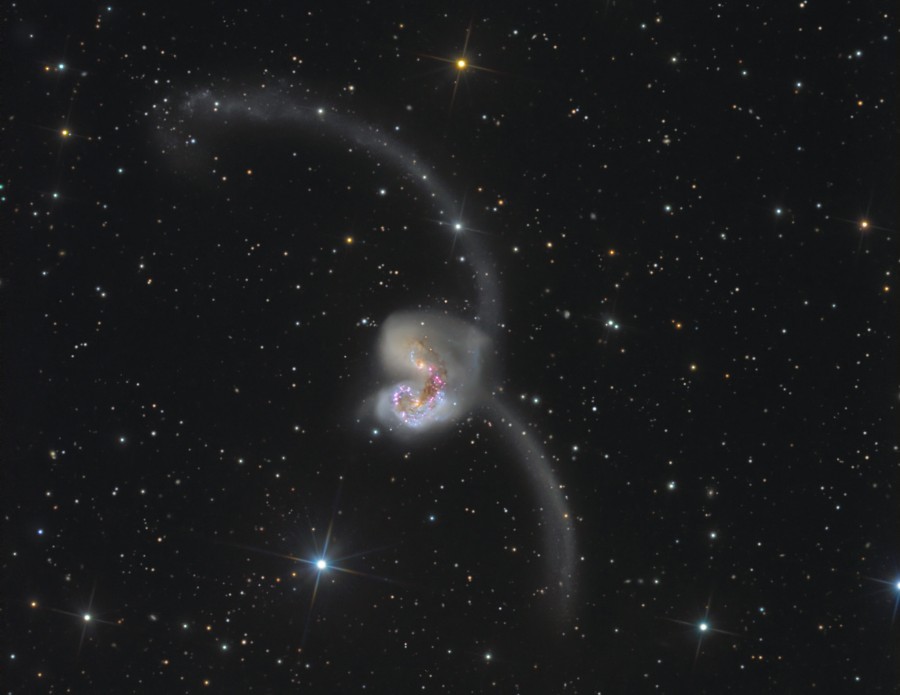
Anyway, this, from Astronomy Picture of the Day (APOD) for 23/5/18, is a picture of two galaxies (NGC 4038 and NGC 4039) colliding; or, rather, passing through each other, not two thousand million years ago but for the last 100 million at least.

The two galaxies are known as the antennae. A wider angle (which was featured on APOD on 29/4/2011) shows why.

The Antennae

War Memorials, St Athernase Church, Leuchars

Memorial altar:-

St Athernase

Leuchars was home to an RAF base for almost 100 years starting in 1916 and ending in 2015. It now hosts an army base.

The RAF had a close association with St Athernase Church. The refurbishment going on (see previous post on St Athernase) meant the memorials had been temporarily removed from the walls.

Memorial to ex-cadets of 1302 (St Andrews) Squadron Air Training Corps who died in World War 2:-

Air Cadets Memorial, St Athernase Church, Leuchars

547 Squadron Memorial:-

547 Squadron Memorial, St Athernase Church, Leuchars

Memorial to the hospitality shown by the people of Leuchars to Dutch members of the armed forces during World War 2:-

Memorial St Athernase Church, Leuchars

Kate Wilhelm

I discovered yesterday that SF author, antholgist and encourager of others through the Clarion workshops and Milford Writers’ Conference, Kate Wilhelm, died earlier this year.

She was one of the few women who published Science Fiction under her own name in those far off days of the 1960s. And she was good, nominated for many awards, winning several including the Hugo for best novel in 1977 for Where Late the Sweet Birds Sang.

The only one of her books I have featured on my blog is Somerset Dreams and Other Fictions.

Kate Wilhelm: 8/6/1928 – 8/3/2018. So it goes.

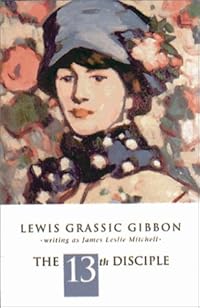
The Thirteenth Disciple by J Leslie Mitchell (Lewis Grassic Gibbon)

Black and White, 1995, 262 p, plus ix p Introduction by Jack Webster.

 The Thirteenth Disciple cover

Malcom Maudslay (yes that is the spelling of Malcom used) is a child of that north-east of Scotland which Mitchell/Gibbon wrote about so well, distilling the experiences he gained while growing up there. In this novel the life of a young child in rural Scotland in the early part of the twentieth century is evoked admirably. Like J Leslie Mitchell was himself, Malcom is of a scholastic bent, encouraged to stay on at school by both the local minister and the dominie at Leekan, whose half-French neice, Domina Riddoch, is something of a free spirit, apt to scandalise the neighbourhood with her relaxed attitude to clothing in hot weather.

Malcom more or less self-educates by reading voraciously, though his father would have been keener to see him fee’d at a neighbouring farm. Through the minister he develops an interest in archaeology (which has significance much later) but Malcom soon outgrows his teachers and secures a job in journalism in Glasgow where he meets his first lover, Rita Johnson, and takes up with socialists. He progresses quickly at the newspaper but Rita’s accidental death (there is a hint that it may not actually have been an accident) and a misuse of the paper’s funds mean he has to leave Glasgow. Not quite his usual self, he joins the Army and endures the brutal rigours of training, but his relationship with the greatest influence on his life, Sergeant Major John Metaxa, a man as educated as himself, is in itself an education. A subsequent spell in the trenches in the Great War is described in harrowing terms. There is an occasional narrative conceit whereby we are given quotes from a journal of reflections Malcom supposedly kept in adulthood.

While The Thirteenth Disciple does not reach the heights of Sunset Song (but not even its two sequels quite did that) it signals the direction in which Mitchell/Gibbon would travel and in one delicious passage the Leekan village gossip is described as passing on from Leekan “and its scandalous days and nights – no doubt to that particular hell where all folk live discreetly and unscandalously, where no juicy stories ever circulate, where all girls marry their lovers before they bed with them.” Later, in his role as editor of Malcom’s journals, our narrator tells us, “To us of the early twentieth century the detailed sex-act is still impossible in all literature but the pseudo-scientific. We are, all of us, still, too young and nasty-minded.” It has been said that Andrew Greig was Scotland’s first post-Calvinist writer. On this evidence Gibbon has a good claim to that title.

Pedant’s corner:- In the Introduction; “the age if” (of.) Otherwise; some now obsolete spellings such as Gomorrahn (Gomorran,) tabu (taboo,) juldi (jildi,) Knut Hammsen (Hamsen,) unescapable (inescapable,) Cainozoic (Cenozoic,) Thibet (Tibet,) bye-election (by-election,) unauthentic (inauthentic.) Also there were; Scottish Quarternary (Quaternary,) Jock Edwards’ (Edwards’s,) Kark Liebknecht (Karl,) Epsoms salts (Epsom’s salts,) archeology/archeologist (archaeology/archaeologist; annoyingly the spelling varies from place to place in the book,) “he could fell her breast-nipples against his chest” (breast-nipples? Is there any other kind of nipple on a human?) “Morituiri te salutant!” (Morituri,) a missing end quote mark, “whiskey advertisements” (whisky surely?) a missing start quote mark at the beginning of a quoted paragraph, “Pio Perez’ grammar” (Perez’s,) an extraneous single quote mark, pifistac (???)

St Athernase Church, Leuchars, Fife

Parts of St Athernase date back to the twelfth century. It was undergoing renovation when we visited and it looked like a long project. It seems to have reopened in March this year.

Church from the gateway:-

St Athernase

That apse is a very distinctive feature.

From path:-
St Athernase

Close to:-
St Athernase Church, Leuchars, Fife

While we were looking round its grounds the incumbent Minister, a former RAF chaplain, came up to talk to us and invited us inside.

Ancient archway. Note large crack:-

Interior St Athernase Church, Leuchars

Within the apse there are several carved heads which give the place a Viking feel:-

Carved Head, St Athernase Church, Leuchars, Fife

Second Carved Head, St Athernase Church, Leuchars, Fife

A lot of the stonework had apparently been hidden behind wooden panelling for a long time.

Stonework Detailing::-

Stonework Detailing, St Athernase Church, Leuchars

Pictorial stonework:-

Pictorial Stonework, St Athernase, Leuchars

Figural stonework:-

More Pictorial Stonewrok St Athernase, Leuchars

Carved panel:-

Carved Panel, St Athernase, Leuchars

It All Starts Again

This didn’t take long in coming round.

Not even a fortnight after the play-off final Sons now know who they will play in next season’s League Cup*.

And it’s a tough draw, with two top tier sides in the section in Kilmarnock (whom we played in the same competition last season) and newly promoted St Mirren (familiar to us from the last two seasons in tier 2) alongside Queen’s Park, just relegated to the bottom tier, and non-league Spartans.

This will be Sons’ first competitive fixture against Spartans and might be a chance for me to pick up yet another Scottish football ground I’ve not yet visited. That depends on whether the game will be at home or away. Each team only plays the other once.

*Betfred Cup if you must

Friday on my Mind 167: Captain of Your Ship

Despite the clanking bell on the intro (signalling we are probably to think of a paddle-driven river boat) and the reference to the boat leaking this always put me in mind of Science Fiction. It must have been the futuristic sounding name Reparata and that Delrons making it seem like something from Captain Scarlet.

Reparata and the Delrons: Captain of Your Ship

free hit counter script