When Galaxies Collide
Posted in Astronomy, Science Fiction at 12:00 on 28 May 2018
“Two thousand million or so years ago two galaxies were colliding; or, rather, were passing through each other,” is the first sentence of E E ‘Doc’ Smith‘s Triplanetary, the first in his Lensman series. I read it at an impressionable young age and that sentence has stuck with me ever since, probably because the concept struck my young mind as awesome. (Awesome in the British sense and not as our USian cousins use the term, almost as a throwaway.)
Smith wasn’t the greatest stylist (he wasn’t a stylist at all) and his characterisation was rudimentary but he more or less invented space opera. About the only things I can remember about the Lensman series is that first sentence and the frequently repeated call sign (no doubt modelled on William Joyce as “Lord Haw-Haw“) “This is Helmuth, speaking for Boskone.”
Anyway, this, from Astronomy Picture of the Day (APOD) for 23/5/18, is a picture of two galaxies (NGC 4038 and NGC 4039) colliding; or, rather, passing through each other, not two thousand million years ago but for the last 100 million at least.
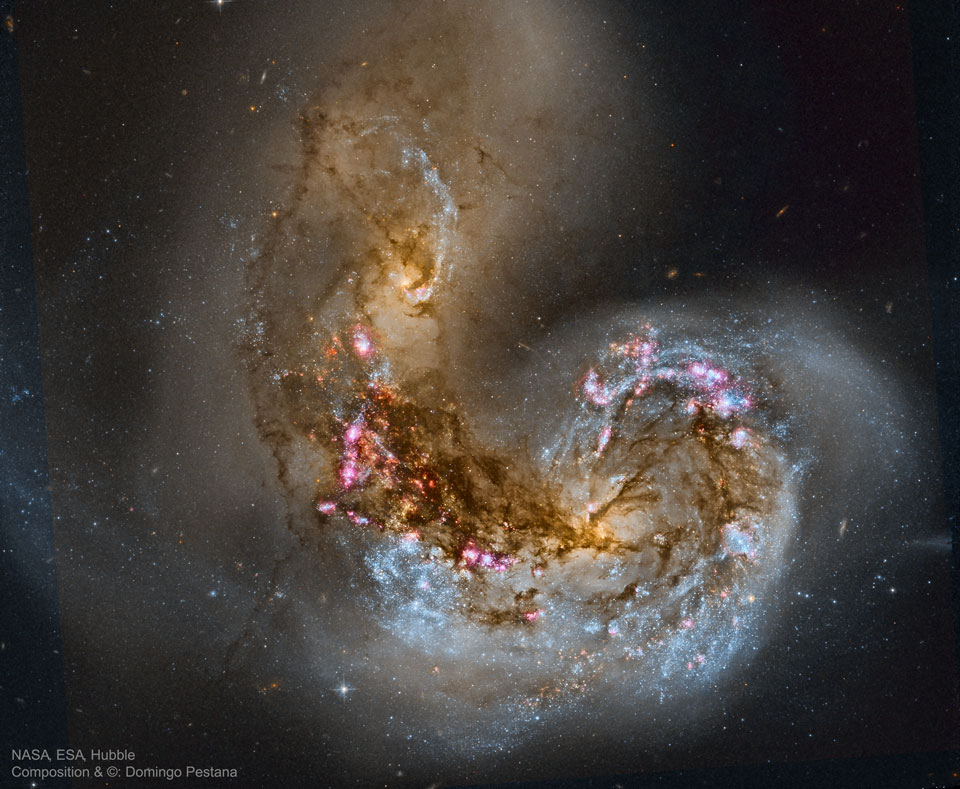
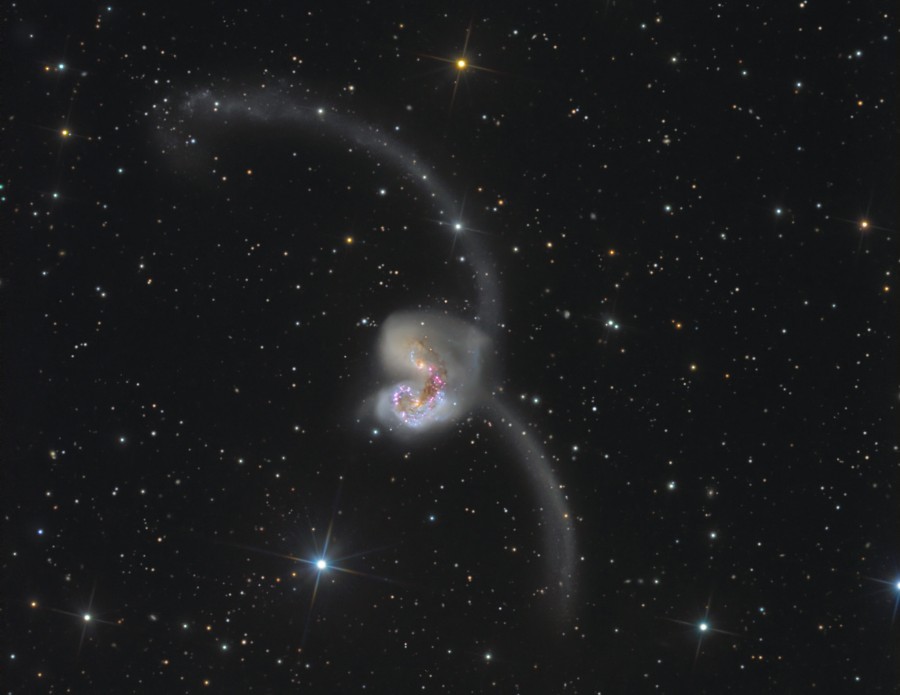
The two galaxies are known as the antennae. A wider angle (which was featured on APOD on 29/4/2011) shows why.
Tags: APOD, Astronomy, Astronomy Picture of the Day, E E 'Doc' Smith, E E Smith, Lord Haw-Haw, NGC 4038, NGC 4039, Space Opera, Triplanetary, William Joyce

DW
25 May 2025 at 19:47
Only seven years late, but Google insisted on feeding me this well-written page of yours!
What’s amusing is that EE Doc Smith’s theory was derided by scientists for decades – I remember well that the attitude was still negative while studying Astronomy & Astrophysics at University in the 1980s – and yet it now appears that he was pretty much spot on, save for his estimate of the age of our own solar system.
Per https://www.esa.int/Science_Exploration/Space_Science/Gaia/Galactic_crash_may_have_triggered_Solar_System_formation
“When we looked into the Gaia data about the Milky Way, we found three periods of increased star formation that peaked 5.7 billion years ago, 1.9 billion years ago and 1 billion years ago, corresponding with the time when Sagittarius is believed to have passed through the disc of the Milky Way”
Ditto on the awe-someness and inspiration therefrom, as with some of the other best writers in the genre such as Stapledon and Clarke (in particular, The City and the Stars with its fully immersive virtual reality roleplaying games, effective immortality through repeated “uploading” into the self-contained AI-driven city a billion years into the future, etc… written a mere 70 years ago.)
jackdeighton
25 May 2025 at 22:17
DW,
I still find astronomical data astonishing. The vast strides in observing and understanding the universe we humans have made in my lifetime is mind-boggling. Those pictures from the Hubble and James Webb telescopes; the New Horizons images of Pluto and Charon; the ones of Juoiter from Juno and of Saturn from Cassini. All were unimaginable when I was young.
And their beauty is something else.
Thanks for looking in and commenting.