Archives » Shakespeare

Uranus and its Moons (or some of them)

From Astronomy Picture of the Day for 29/12/23. This is an image of Uranus and some of its moons taken by the NIRCam (Near-Infrared Camera) on the James Webb Space Telescope. Uranus’s rings are also clearly visible. These moons are all named after characters in Shakespeare plays.


It never fails to astound me we can view such sharp images of faraway objects.

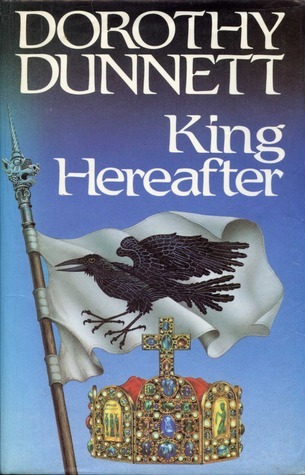
King Hereafter by Dorothy Dunnett

Michael Joseph, 1982, 725 p, plus ii p frontispiece showing the lineage of Kings of Scotland (Alba) and Northumbria, ii p backispiece (I apologise for the coinage) of rulers of Orkney, Norway, Normandy and England, iii p maps of mid Europe in the 11th century, Alba (Scotland) and Northern England in AD 1050, and of the Orkney islands and Caithness of AD 1050, and ii p lineage of Danish and Norwegian rulers.

The sparseness of the historical record for Scotland in the Dark Ages leaves something of a blank canvas for the novelist to exploit. In Dunnett’s account of the life of Macbeth MacFinlay (whom Shakespeare portrayed as a villain) she has chosen to fill that canvas by conflating him with a certain Earl Thorfinn of Orkney. (See here.)

In Dunnett’s version, Thorfinn (in the book he is rarely referred to by his Christian baptismal name of Macbeth,) although the grandson of King Malcolm II is more proud of his Orcadian heritage than his Scottish one and keener for that to be passed on to his own sons, to whom he gives Norse names.

He is not the only character to have more than one name. His wife was born in Norway as Ingibjorg Arnason, has the baptismal name Margaret but is known to him as Groa (and in Gaelic as Gruoch.) Aged fourteen she was forced into marriage to a middle-aged Mormaer of Moray, Gillacomghain, who had killed Finnlaech, our hero Thorfinn’s stepfather. When Thorfinn in his turn killed Gillacomghain to regain his lands of Moray he married the widow.

Such was life for high-born women in the Dark Ages; destined only to cement alliances and to breed. (Spoiler alert [Really? Are the outlines of the story not well-known?]: she was to suffer a similar fate when Thorfinn is killed by the man who became Malcolm III who also made her his wife.)

This was the time when the Norse kingdoms had only recently become (at least nominally) Christian and a fair bit of the narrative deals with the merits of the Celtic as opposed to the Roman Church in particular as Thorfinn is trying to unify the Kingdom of Alba’s only loosely held regions of Fife, Angus, Buchan, Caithness etc. Though Thorfin has some sway in Galloway (and Cumbria plus alliances with Ireland) the Lothians were territory disputed with Northumbria. England’s regions (Mercia, Wessex, East Anglia) likewise owed allegiance to one king but their rulers had ambitions of their own.

The novel’s main attention, though, is given to Thorfinn’s Scottish lands and those in Orkney but ranges widely over the Northern Europe of the time and has mentions of King Stephen of Hungary. Thorfinn even makes a pilgrimage to Rome to seek the Pope’s imprimatur. In his youth he had spent some time in the English court of King Canute whose wife Emma (another who had been taken as a wife by her first’s successor,) after her second husband’s death still has her matrilineal fingers spread across England and Normandy.

At times, then, the book reads more like a historical account than a novel. Shifting alliances and manoeuvrings make up most of the intrigue with the interests of the Godwinsson family and William the Bastard of Normandy (which would eventually collide at the Battle of Hastings) begin to loom large towards the book’s end.

King Hereafter can be seen as one of many attempts to rescue the historical Macbeth from the obloquy to which Shakespeare consigned him.

His periglour Sulien here says to him, “‘Men will look back and see a king who strove to build for his people. …. The name each man leaves is a small thing compared with the mark he puts on the world.’”

The book is long, with fairly small print, and paints Thorfinn and Groa’s relationship sympathetically and humanly but also serves as a primer on late 11th century history.

Pedant’s corner:- dwarved (dwarfed,) manoeuvering (manoeuvring,) unfocussed (unfocused,) aureoles (areolas- or areolae,) chorussed (chorused?) pleat (it was hair, so ‘plait’,) basalm (balsam,)

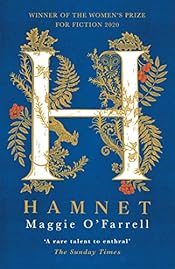
Hamnet by Maggie O’Farrell

Tinder Press, 2020, 384 p.

Is there anyone who reads who does not know that Shakespeare had a son called Hamnet, who died as a boy, a name immortalised a few years later in the play titled Hamlet? This is not a spoiler in any case as in a short preface O’Farrell tells us as much, and that Hamnet and Hamlet were the same name, entirely interchangeable in the late sixteenth and early seventeenth centuries.

In its writing this novel has echoes of Wolf Hall, whether that be because of the Tudor setting, or that Hamnet’s grandfather is quick with his fists, or a kind of linguistic obscurantism. In Hilary Mantel’s novel Thomas Cromwell was often denoted cryptically as “he,” Here characters are sometimes described simply as “a boy” or “a woman” and Hamnet’s father is never referred to by name, only as, variously, “the Latin Tutor,” “the husband,” or “the father.”

This distancing is quite deliberate on O’Farrell’s part as the novel’s focus is not on the son, (who dies two thirds of the way in anyway,) nor indeed is it on the husband and father. This is the story of the wife and mother, Agnes, pronounced Ann’yes and so liable to be misheard as Anne. It is a beautiful piece of imagining on O’Farrell’s part, evoking life in Tudor England utterly convincingly, illustrating the fluctuating balances of power within families, rescuing Agnes from the sidelines of history, revealing her as a vibrant, complex character in her own right. In it she also manages to provide a better explanation than the usual one for the playwright’s famous bequest – as an act of love.

In part I the chapters mostly alternate between the goings-on in Henley Street, Stratford, in the run-up to Hamnet contracting his fatal illness (where there is actually a fair degree of attention paid to Hamnet,) and the earlier life of his mother and father, how they met, got together, married and had three children. Despite Agnes having the gift of (second) sight, Hamnet’s twin Judith comes as a surprise, is then given up for dead on arrival after him, but subject to Agnes’s frantic efforts to keep her alive and her constant worry thereafter. Agnes is also a dispenser of herbal remedies. There is a passage written from the point of view of a hooded kestrel in an apple store which is quite beautifully done and also a diversionary chapter on the mechanism of how Hamnet may have caught bubonic plague, beginning with a flea in Alexandria, the plague bacillus eventually transferring to England via a glassmaker in Venice. Though never emphasised as such, interplay between the characters suggest the seeds for what was to come in the plays. Part II by contrast deals with the aftermath of Hamnet’s death and its chapters follow the story linearly. Grief is a difficult sense to communicate in fiction but we see its expression in all of the family and feel it through them.

Use of the present tense can be alienating but O’Farrell’s deployment of the device is superb, keeping the action contingent, reminding us that to the characters the events she shows us were happening in the here and now, there was still the possibility of an alternative outcome. It brilliantly conveys Hamnet’s distracted state of mind as he scurries about the empty house (usually so full of people) seeking help when his twin falls ill. O’Farrell is tremendous too on Agnes’s experience of childbirth. I doubt a man could ever have transmitted the sensations, feelings and worries so effectively. Throughout, the author is totally in control and the final scenes, as Agnes hurries off to London to ask her husband why he dared to use his dead son’s name in a play, are magnificent. The play, after all, has kept that name alive.

Hamnet is a wonderful novel. How it was left off the Booker Prize long- and shortlist last year is beyond me. It did, though, win the Women’s Fiction Prize and the Dalkey Literary Awards and was shortlisted for the Walter Scott Prize.

Pedant’s corner:- epicentre (used, wrongly, in the sense of absolute centre,) “the dark maw of the ground” (it was the opening of a grave; not a stomach, then, therefore not a maw,) stoved in (stove in, or, staved in,) “that all is not as it should be” (that not all is as it should be.) “She sits up nights” (she sits up at night,) hoofs (in my youth the plural was always ‘hooves’.)

The Devil’s Footprints by John Burnside

a romance. Vintage, 2008, 221 p.

 The Devil’s Footprints  cover

This is an exquisitely written novel whose title implies that it is going to be another in that long list of Scottish works of fiction which feature an encounter with the Devil, and in one sense it is, but it is also something entirely modern. I would submit, however, that it is not, as its description on the title page states, a romance – at least not in the usual sense of that word in a novelistic context – despite the narrator’s later claim.

Michael Gardiner lives with his wife Amanda just outside the seaside town of Coldhaven, where local legend has it that the Devil one night had stalked the town in the aftermath of a great snowfall, leaving his odd footprints behind. Not that the town is unused to strange events. It is also said that once a woman had given birth to a baby with two heads, one normal, the other mis-shapen and stunted. The baby had quickly died and the woman went mad.

Michael’s unravelling begins when his cleaner, Mrs K, who brings to him the town’s gossip (but only when she has verified it) tells him the details of the incident where Moira Birnie – née Gregory – and incidentally Michael’s first proper girlfriend, had dropped her fourteen year-old daughter, Hazel, off on a back road out of town before driving away and then, convinced her husband Tom was the devil, had killed herself and their two sons. The car they were found in was deliberately burned-out. This tragedy sets Michael off to wondering if Hazel is in fact his daughter, since the dates fit. It also reminds him of the bullying he had received in school at the hands of Moira’s brother Malcolm, and the secret he has kept all those years about Malcolm’s death.

Michael explains his subsequent actions with thoughts like “mostly we are creatures of chance” and that we “see ourselves from inside as we never appear to others.” He ruminates on the vagaries of marriage. “I had to wonder why anyone got married, when they had the evidence of their own parents’ lives right there in front of them.” He says marriage is a story, it needs some new event every so often, but “there is a moment when a husband begins to suspect his wife, or a wife her husband, of having another story altogether, a separate, private story, that remains, and perhaps always will remain, untold.” On the possible reasons for why his own marriage broke down he reflects that, “Things begin deep below the surface; by the time they are visible, they have a life and direction of their own. We don’t see that, so we call it destiny, or fate, or chance, when something unexpected happens.”

Coldhaven is well named, the inhabitants had never made Michael’s parents (mother a painter, father a photographer, both from down south) welcome. Such was the townsfolks’ antipathy towards the incomers that gifts of dogshit through the letterbox, anonymous letters, threatening encounters on the street, nasty phone calls were the least of it. Hence Michael is convinced his mother’s death in a road accident was a deliberate act. Most of Amanda’s friends – mainly local – had gone to college, but once back in Coldhaven, “their local accents were more pronounced than they had ever been, and you could tell they had been unhappy in their absence.” His father put up with all the harassment but Michael says, “People think tolerance is a virtue, but there are some things that shouldn’t be tolerated.”

While he acknowledges he did go, at least mildly, insane, on insanity in general Michael thinks, “Only the insane listen when the angel speaks, only the insane make wild-eyed denials and so confirm their guilt.” He also astutely remarks that, “when the devil has work to do, he makes it look like an accident …. in order to lure us into his trap, protesting mildly, if at all, but willing accomplices at the last,” which has undertones of Banquo’s speech in Shakespeare’s Macbeth. On the historical pursuit of supposed evil-doers Michael recognises that people who drowned or burned simpletons and scapegoats as witches were themselves really the ones who were afraid of being possessed, that they would find the devil touching their shoulder, that they were his chosen. In these passages Burnside is touching on the tradition of brushes with the Devil but not explicitly, since Michael’s devil is internal. (Arguably, I suppose, all the meetings with the Devil in Scottish fiction are internal.)

As to restitution, for Michael, penance “should be an everyday matter, a deliberate return from the glamour of sin.” He makes his own via a strange anabatic hundred-mile walk home to Coldhaven after his madness abates.

Through Michael, Burnside tells us a story is “not meant to be true, but it has to be real, it has to run.” In that respect The Devil’s Footprints runs, delightfully.

Pedant’s corner:- Mrs Collings’ cottage (Collings’s,) rowboat (rowing boat,) Vesalius’ (Vesalius’s,) Burntturk

The Sailor Who Fell from Grace with the Sea by Yukio Mishima

King Penguin, 1987, 141 p. Translated from the Japanese 午後の曳航 (Gogo no Eikō) byJohn Nathan.

 The Sailor Who Fell from Grace with the Sea cover

Mishima, seemingly at the height of his literary powers and success, cut short his own life by committing seppuku in 1970, apparently in protest at the erosion of Japan’s values due to Western influence.

In this short novel, the first of his I have read, Fusako Kuroda has been widowed for five years. Unknown to her, her son Noboru has discovered a hole in the wainscotting between their bedrooms through which he can witness her bedtime routines. After a visit with Noboru to a tramp merchant steamer she takes up with the sailor, Ryuji Tzukazaki, who was attentive to Noboru but who it is revealed considers sex as a secret yearning for death. Their relationship is then consummated under the eyes of a not best pleased Noboru. Noboru is also number three in a group of schoolboys who enact nefarious rituals in their secret den. Boys have always tended to the wanton; as Shakespeare well knew.

Here is set the scene for an odd tale of love, alienation, dehumanisation and revenge. Things come to a head when after a final voyage away Ryuji decides to give up sailing and marry Fusako. Noboru presents his list of charges against Ryuji to his gang’s chief.

The tension between Japan’s past and present, which Mishima felt all too keenly, is reflected in the different attitudes of the characters. Fusako, with her job in a luxury goods shop, represents modernity, Ryuji a connection to Japan’s former seafaring glories, the boys a reminder of the insular past.

Pedant’s corner:- louvered swinging doors (louvred,) an unneeded indent of one space at one new line with a larger line spacing than usual below it.

Stratford-upon-Avon

We had a trip to Stratford-upon-Avon again on our trip south in February 2018.

As well as Shakespeare’s House:-

Shakespeare's House

behind which (you have to pay to get in) were actors parading about and declaiming lines from his plays,:

Stratford-upon-Avon, Shakespeare's House

Stratford-upon-Avon, Shakespeare's House From Rear

I spotted this Art Decoish building. It’s the stepping on the roofline and I suppose the rule of three in the windows below the diamonds that gives a deco feel:-

Art Decoish Building, Stratford-upon-Avon

Time Travel, Reviews, Hame and Rebellions

In an article in Saturday’s Guardian review, James Gleick examined the history of the time travel story since H G Wells more or less invented the form in The Time Machine. It was a skate over the subject really and veered into the territory of so-called Alternative History which of course I prefer to name Altered History but worth reading all the same.

In the same section of the paper was a review of Annalena McAfee’s new novel Hame. Many reviews are interesting, some make you think “definitely not”. Very few inspire you to go out and read the book concerned. Stuart Kelly’s did just that, as indeed did his review of Kevin MacNeil’s The Brilliant and Forever which I read a few months ago after also reading the same author’s A Method Actor’s Guide to Jekyll and Hyde due to the same review. McAfee’s Hame sounds intriguing and possibly funny. Definitely one I’ll look for.

I recalled McAfee’s name. She had an article in the Guardian Review some weeks ago which I wished to post about then but at the time could not find on the Guardian website but which now pops up fourth when you search her name there. The article was about the relative importance of Robert Burns and the possible balefulness of his mythologising (Aside. Why does no-one ever question this about Shakespeare?) and the continuing battle over whether Scots is a suitable medium of expression for literature.

My take is if the author wishes to use Scots it is entirely up to her or him. It may reduce the psossible readership but that is a question for author and publisher, not reader. Myself, though not very well versed in it, my mother being the daughter of two English parents, thus hardly a native speaker and unable to expose me to its richness, I do not consider Scots – as some do – as necessarily inferior form to English. It is at times much more pithy.

I have a quibble with McAfee over a detail in that piece, though. She stated that Burns was born “two decades after the failed rebellion against the Union.” While Prince Charles Edward Stuart’s Rebellion of 1745-6 was many things, not least the last flailing gasp of a failed dynasty, and the Battle of Culloden can even be considered as in some way (if you ignore its continuation into Ireland even into the twentieth century and possibly beyond,) the last of the Thirty Years War – though admittedly that was mostly fought out in German territories – it was not primarily against the Union. It was less general then that, more personal.

Friday on my Mind 114: Rhubarb Tart Song

The B-side of The Ferret Song (see last week) had a tune based on the middle part of one of John Philip Sousa’s marches, The Washington Post, and had a lyric which became typical of the Monty Python style since the song references a slew of philosophers and artists and also includes nods to popular culture as well as Shakespeare – all wrapped around an idea of the utmost silliness.

I really like the cleverness of the rhymes with the word tart, though.

John Cleese with the 1948 show choir: Rhubarb Tart Song

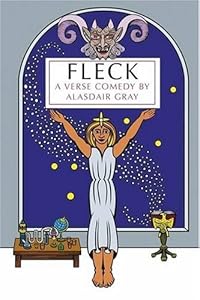
Fleck: a Verse Comedy by Alasdair Gray

A Comedy in Verse Derived from Goethe’s Tragedy of Faust. Two Ravens Press, 2008, 104 p.

Fleck cover

Gray is multi-talented; playwright, novelist, artist. A graduate of the Glasgow School of Art, he illustrates his own books (and those of others) in a distinctive style. His first novel, Lanark, instantly established him as one of the most important Scottish novelists of his or any generation. His left wing politics are not hard to discern and his enthusiasm for Scottish independence and Scottish culture has displeased some.

Fleck does what it says on the tin; reworks Faust in a modern idiom with the main character recast as a Scottish scientist, Fleck. Other characters include God, Nick and the journalists Pee and Cue. The book also includes a postscript by the author where he discusses the appearances of the devil in the Bible (there are only two,) Satan’s co-option by the established church to police sensuality, the evolution of the Faust story and its influence on Gray personally, and the drawbacks of Goethe’s version. Finally there are five Gray poems which deal with God. A packed 104 pages then.

Verse is a surprisingly good vehicle for Gray’s updated tale. (Or perhaps not surprising if you think of Shakespeare.) The rhythm of the iambic pentameter is a fine motor. And it throws up nicely judged juxtapositions, “Broadcasters think the public is a fool/ so sounding stupid is their golden rule.”

Very little that Gray has written is not worth reading. Fleck is no exception. Not just the play but the postscript and poems too.

Pedant’s corner: Labelling a year as Anus Domini looks like it may be a misprint but I wouldn’t put it past Gray to have used it deliberately. But oughtn’t tug-of-wars for supremacy be tugs-of-war? Bismark for Bismarck.

Periodic Tales by Hugh Aldersey-Williams

The Curious Lives of the Elements, Viking, 2011, 428 p.

The first thing to say is that, despite its title(s), this is not a Chemistry book. In its index there are eight references to Shakespeare (only one fewer than for the chemist Jöns Jacob Berzelius and more than for any individual scientist barring Humphry Davy, Carl Scheele, William Ramsay, Marie Curie and Dmitri Mendeleev) – four to Goethe, three each to Wagner and Van Gogh. Other seemingly unlikely name checks are given to Wilfred Owen and Barbara Hepworth, not to mention Hunter S Thompson’s novel Fear and Loathing in Las Vegas.

What it is, is a book about how Chemistry permeates our lives, not just in the biological sense – for without Chemistry our bodies could not work – but in the cultural sphere, in our day-to-day existence. (There is even a reference to Irn Bru! – in a frankly bizarre context.) As such the book ought to appeal to the general reader rather than just Chemists. But the importance of Chemistry in painting, sculpture, opera, poetry, fiction, even architecture ought not to surprise. As the back of the book reminds us, “Everything is made of them [the elements,] from the furthest reaches of the universe to this book you are holding in your hands, including you.” English words for white (apart from snow) are bound up with the compounds of calcium they embody, marble, alabaster, chalk, ivory, bone, teeth. (I object, here, that the “White Cliffs of Dover” are anything but; unless seen from a distance.) The Latin calx yields the Italian calcio for what Aldersey-Williams calls soccer, perhaps because a goal is scored by the ball crossing a chalked line. The word for railway in nearly every language except English reflects the iron from which it is constructed, chemin de fer, Eisenbahn, ferrovia, vía fería, järnväg, tetsudou. Akin to gold in its chemical unreactivity, the valuation of platinum – the only element first isolated by pre-Columbian Americans – over gold is a cultural choice; not due to rarity but snobbishness.

The book contains photographic illustrations every so often but they can at times be a little indistinct as they are reproduced only in monochrome.

Like his Swedish compatriot Carl Scheele (who has a fair claim to have discovered oxygen) Jöns Jacob Berzelius is all but forgotten – despite pioneering laboratory staples like filter paper and (the now superseded) rubber tubing for connecting laboratory equipment together, first using the words catalysis and protein, inventing chemical symbology and coming up with the idea that elements combined in fixed proportions and hence chemical formulae. If his name had been attached to these as Bunsen’s was to his – admittedly splendid – invention that might not be the case. But it seems the Swedes were/are reticent about blowing their trumpets. Due to their chemists’ wielding of an essential piece of technology – the blow-pipe – no less than seven elements – ytterbium, yttrium, terbium, erbium, holmium, scandium and tantalum – were identified from ores that came from a single mine near the town of Ytterby but there is now no trace of the mine nor is there a visitor’s centre. The Swedes may be missing a trick there.

Discovery of “new” elements has always to an extent depended on available technology. Better furnaces and higher temperatures explain the historical progression of metal extraction through the Bronze and Iron Ages and the isolation of zinc in India by the 13th century, the alkali metals, highly reactive and thus resistant to chemical extraction, were only torn from their compounds by the greater power of electricity – not harnessed till just before 1800 – the spectroscope enabled elements to be inferred from the incursion of additional lines in the resultant spectra, transuranics could only be synthesised when atom–colliding machines became available. New liquefaction techniques allowed William Ramsay in the 1890s to conjure new elements out of thin air. (Well, since it was liquefied, I suppose it was really thick air.) Ramsay populated a whole previously unknown Periodic Table Group, the noble gases – neon et al – using this method.

Aldersey-Williams has a tendency to employ the words light or heavy instead of low/high density respectively and to refer to an element when strictly it is the presence of its compounds, atoms or ions that is under discussion. Plus he infers ozone is bonded in a triangle. Its atoms may be arranged in a triangle but its bonds are not. He also says “sodium is now the colour of the city at night” as well as “our principal means of knowing this element.” My local street may be “lit from above by the sodium lamps,” but these have been largely replaced by the blueish white of mercury vapour lights on main roads.

He has however written an interesting and informative, at times quirky, book.

free hit counter script