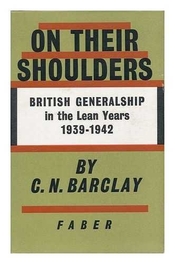
British Generalship in the lean years 1939-1942. Faber and Faber, 1964, 184 p.
The book is primarily a defence of the British generals in the early years of World War 2 who, “out-numbered, out-gunned, out-tanked and inadequately supported from the air,” nevertheless did not suffer terminal defeat and thereby bought time for sufficient numbers of men, training and decent equipment to be brought to bear. (Time too for allies belatedly to alleviate the burden.)
Barclay’s preface is at pains to point out that, “with the exception of the Great War, the British Army was a small colonial force, unsuitable for modern war. Both World Wars were begun with negligible land forces which had to hold the fort until expansion had taken place. After Dunkirk, alone, defeats were inevitable, not losing the war was about all that could be done,” and include the amazing statistic that, “The Boer War of 1899-1902 cost us more in men and material resources than the struggle against Napoleon nearly one hundred years before.” Perhaps more contentiously he states that, “the Staff College provided us in World War 2 with the best team of generals this country has ever known.” A particular handicap was that British generals’ experience of armoured warfare when the war began was theoretical as none had directed armoured troops as those forces barely exisedt. Nevertheless an armoured foray against the German advance near Arras did give the enemy cause for concern.
Barclay devotes one chapter each to Gort, Wavell, O’Connor, Wilson, Auchinleck, Cunningham, Percival and Hutton. Gort made the correct decision to retreat to Dunkirk and thereby saved not only most of the BEF, including most of the generals who would go on to victory in the latter years of the war, but also a substantial number of French troops, Wavell oversaw the victories against the Italians in East and North Africa, O’Connor directed that North African campaign and might have gone on to Tripoli if not denuded of troops for the forlorn Greek adventure but was then unluckily captured by a German patrol, Wilson helped in the planning for O’Connor’s victory and was then himself plunged into the debacle that was Greece before taking successful command of the Iraq, Syria and Persia sector, Auchinleck at least stopped Rommel’s first foray into Egypt but as an Indian Army man with no experience of armoured warfare was a strange choice for the role given to him, Cunningham swept the Italians from East Africa before being (briefly and almost certainly mistakenly) appointed to command in the Western Desert, Percival made no difference at all to the defence of Malaya and Singapore and Hutton had the impossible job of trying to save Rangoon.
While Norway, the Dunkirk campaign, the Western Desert, Greece, Hong Kong, Malaya and Burma saw defeats they were in the main retrievable. The single utter catastrophe was the fall of Malaya and Singapore (the biggest ever defeat in British military history.) This could be put down to political failure, local attitudes and dispositional necessities but General Percival did not do much to ginger things up when he arrived. It was also the only British campaign for hundreds of years in which naval support was totally absent. This was of course due to the sinkings of HMS Prince of Wales and HMS Repulse by the Japanese air force. In amongst these setbacks there were notable successes, the utter destruction of numerically much larger Italian forces in East Africa and North Africa (“two of the most resounding military victories in history”,) the elimination of the Vichy French threat in Syria and the flawed success of Operation Crusader in the Western Desert.
Barclay cites lack of high quality training as a principal contributor to defeat. Better trained, more mobile forces, even if much smaller in number, can nevertheless achieve victory. Against the Italians the British troops (whom I would submit were also better motivated) were the better trained. In Malaya, not so, even if the Japanese had in effect only the one tactic. The Germans were, of course, trained superbly.
The book is unfortunately lacking in depth. In addition, due to the overlapping jurisdictions and swapping of roles there is frequent repetition of information. We were told about ABDA at least four times.
According to Barclay the war was disastrous in its consequences, “allowing Communism into the heart of Central Europe.” In addition the colonies were lost, Britain’s prestige and influence declined. Yet the consequences of a German and Japanese victory would have been even more regrettable. And the generals discussed did prevent that.
Barclay’s somewhat Victorian/Edwardian world-view, exemplified by the Communism remark above, is emphasised by his use of the word “savages” to describe some of the native peoples against whom the British Army was used in colonial times. Fifty years after the book’s publication reading that expression came as a shock.
Pedant’s corner:- he showed mark enthusiasm (marked,) india (India,) seemed to damp enthusiasm (dampen,) and other who visited (others,) the British public have been given the impression (has been given,) Field- Marshall (Field-Marshal,) Alemein (Alamein,) non-commital (non-committal,) Iraqui (may have been the spelling in 1964; now it is Iraqi,) based on New Delhi (in, surely?) after he arrive (arrived,) Caldron Battle (Cauldron is more usual,) there were a few (was,) for an Army office his early background (officer,) military unsound (militarily,) Japanes (Japanese,) “It would be foolish to deny that there may not have been neglect in the training of the Army in Malaya” (the exact opposite is meant; “It would be foolish to deny that there may have been neglect in the training of the Army in Malaya.” It is obvious from Barclay’s previous comments that the training was very poor,) “if other councils had prevailed” (counsels,) it maybe that (may be,) “that is is no part” (that it is,) two lines are transposed on page 160, by much small bodies (such small bodies,) to a less degree (lesser degree is more usual,) acquite (acquit,) salving the bulk of the Burma Army (saving makes more sense,) miscaste (miscast,) “the programmes for units was similarly laid down” (either