Archives » Second World War

Kinross War Memorials

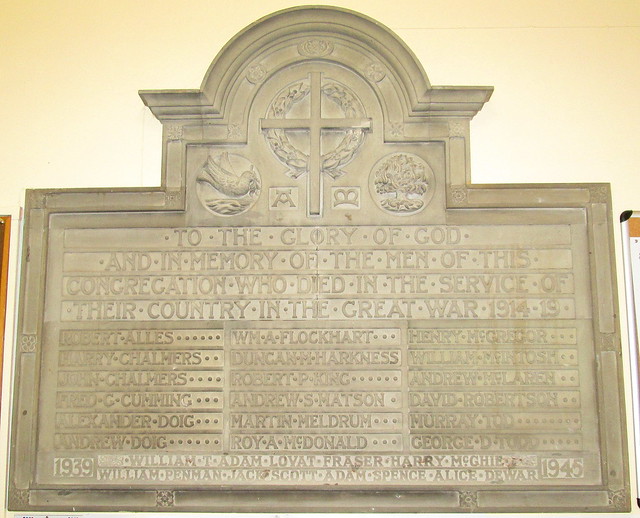
Kinross Parish Church Memorial Plaque. 1914-19; with 1939-45 added below. This is directly in front of you on the wall as you enter what was the Parish Church and is now a community hall complete with tea-room:-

Kinross Parish Church Memorial Plaque

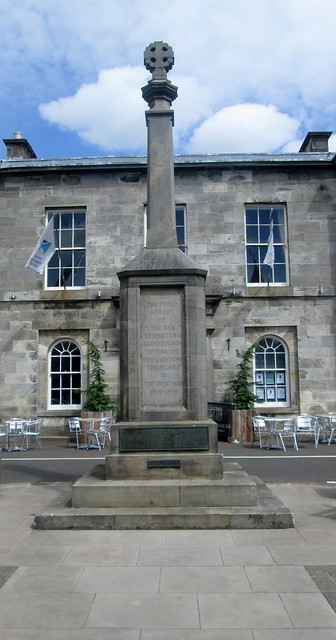
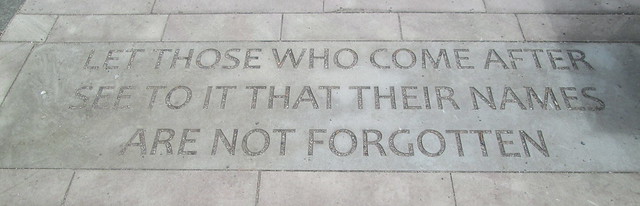
Kinross’s main War Memorial lies just left of the A 922 as you near the town centre coming from Milnathort. There is an inscription on the paving as you approach it from the main road:-

Kinross War Memorial

Full Memorial. Square base and plinth, surmounted by square column and small Celtic Cross:-

Kinross War Memorial

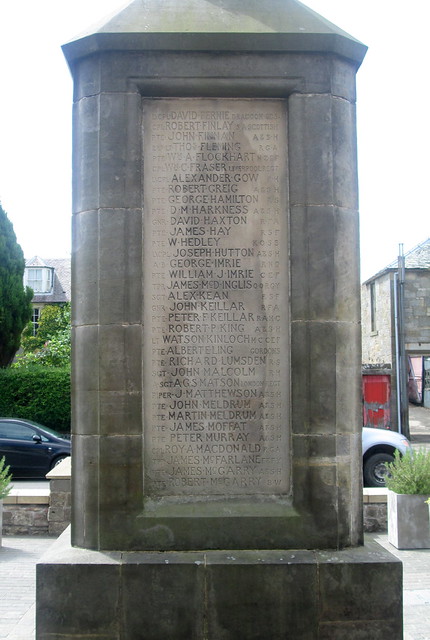
East aspect:-
Kinross War Memorial

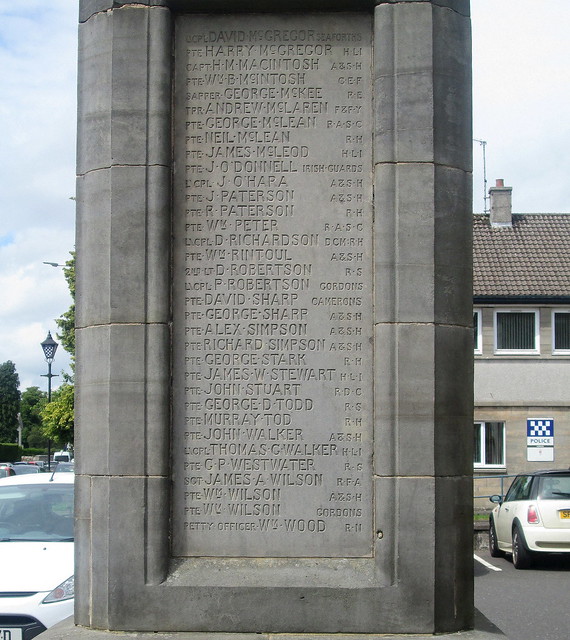
South aspect:-
Kinross War Memorial

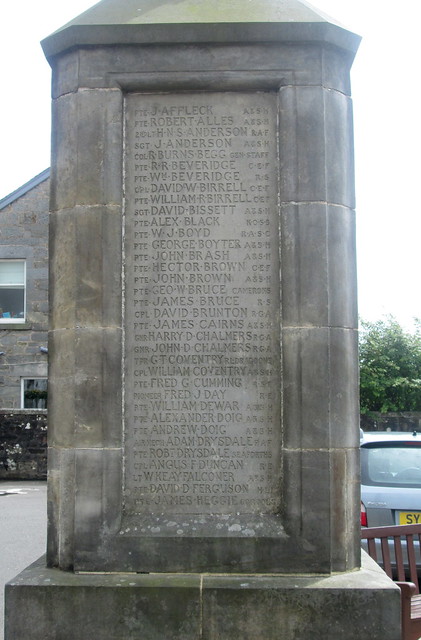
North aspect:-
Kinross War Memorial

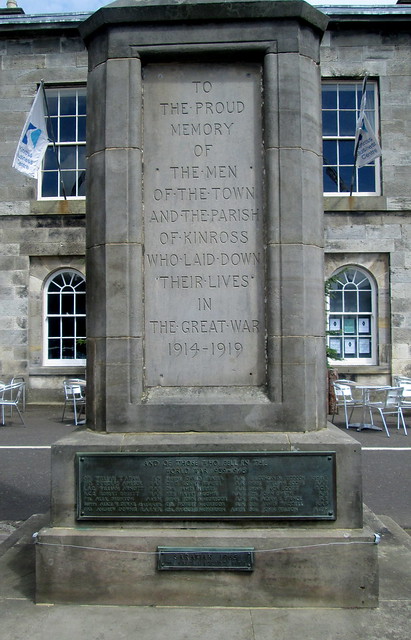
West aspect. Inscription for the Great War, lower plaque for World War 2, one for Sarawak 1965:-

Kinross War Memorial

Extra inscription for Janet McL Meldrum, ATS, World War 2:-
Kinross War Memorial

Milnathort War Memorial

Milnathort is in the county of Perth and Kinross and lies a mile or so north of Kinross itself.

Its War Memorial lies just off South Street, the main A 922 road south to Kinross, in a garden area which leads to a small park.

From main road:-
Milnathort War Memorial

Square base with extensions, tapering column, surmounted by globular feature. “In proud and grateful remembrance of the men from this parish who fell”:-
Milnathort War Memorial 2

Name plaques for the Great War (above) plus Second World War inscription:-

Milnathort War Memorial 3

Name plaques for Second World War:-
Milnathort War Memorial 4

Cloth Hall, Ypres: In Flanders Fields Museum

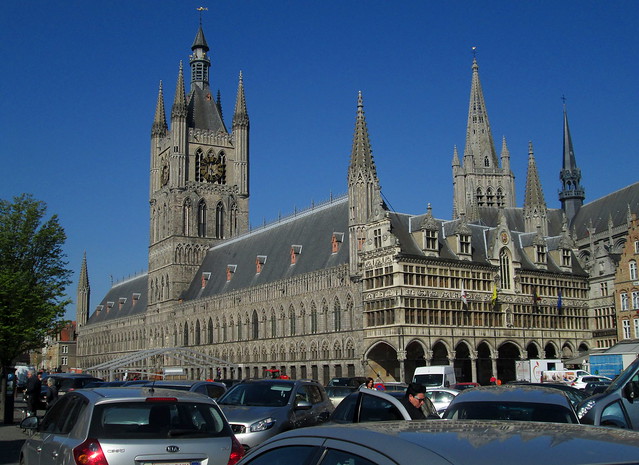
With the possible exception of Saint Martin’s Cathedral, the Cloth Hall (Lakenhalle) is the most imposing building in the city of Ypres (Ieper) in Flanders, Belgium. (The cathedral’s spire can be seen to the rear.)

Cloth Hall, Ypres

The mediæval Cloth Hall was all but totally destroyed by shelling during the Great War but lovingly restored in the years after.

There is now a lovely fountain in the paving at the front of the Hall.

Cloth Hall fountains

Flanking one of the doors to the Cloth Hall are two memorials. This one is to the French soldiers who died in defence of Ypres during the Great War:-

Ypres Memorial

And this commemorates the liberation of Ypres by Polish troops in 1944:-

WW 2 Liberation Plaque, Ypres

The Cloth Hall now houses In Flanders Fields Museum, formerly the Ypres Salient Memorial Museum:-

In Flanders Fields Museum

Thetford

Next stop after King’s Lynn was Thetford, still in Norfolk. It is the birthplace of Thomas Paine, writer of the Rights of Man and one of the inspirers of the American Revolution.

His statue is prominent in the town:-

Thomas Paine Statue,Thetford, Norfolk

This memorial to the men of the 359th Fighter Group, 8th US Air Force, was close by:-

Thetford US Air Force Memorial

On the way in we had passed this brick-built Art Deco Fire Station:-

Thetford Fire Station

Could this once have been a Woolworth’s?

Poundland, Thetford

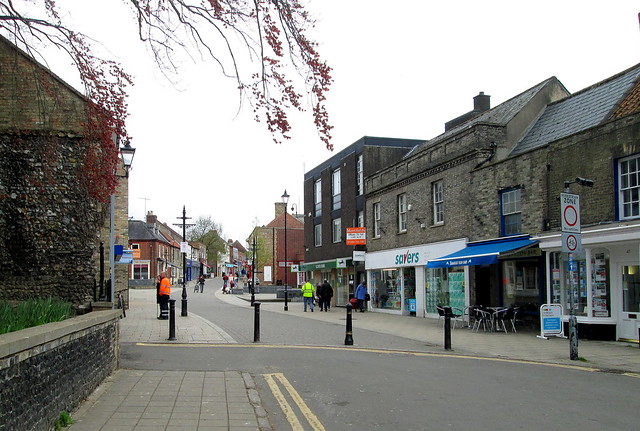
Though there were folks around we didn’t hear anyone speaking English for about ten minutes:-

Thetford 4

Someone though had been watching Dad’s Army:-

J Jones, Butcher, Thetford

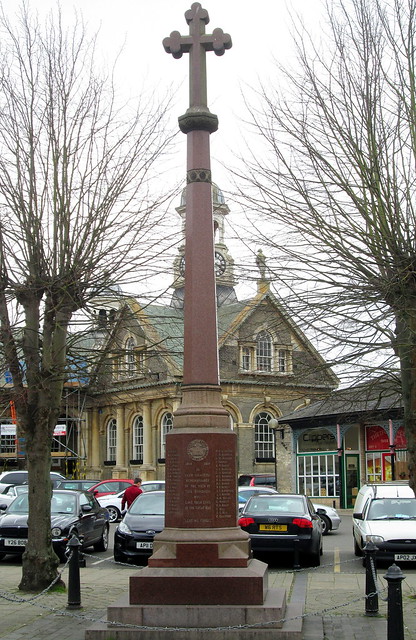
Thetford War Memorial:-

Thetford

Great War dedication:-
Thetford Great War Memorial Dedication

1939-45 dedication:-
Thetford War Memorial 1939-45

Prominent poppy above door; even more so on chimney on Royal British Legion building:-

Thetford, Royal British Legion

The Australians in Nine Wars by Peter Firkins

From Waikato to Long Tan, Pan, 1973, 524 p, including i p acknowledgements, ii p list of illustrations, i p list of maps, vi p index of military formations, xv p general index, vi p bibliography.

The Australians in Nine Wars cover

The book covers Australian soldiers’ exploits from a time when Australia wasn’t even Australia but only a collection of various separate colonies. Some of these first sent men overseas to New Zealand to assist against the Maoris, then to Sudan in the aftermath of Gordon’s death in Khartoum and to China during the Boxer Rebellion. Its military prowess came to flower in South Africa in the (Second) Boer War – during whose duration Australia as a country was constituted – where, being used to the bush, they were able to play the Boers at their own game blending in to the countryside and showed for the first time their flair for unconventional warfare. The other wars covered are of course the two World Wars, the Korean War, the “Malaysian Emergency” and Vietnam.

The book’s thrust is that the Australian fighting man is unique, forming a citizen army there to do a job and get back to normal life as soon as possible, consisting of individuals full of initiative. In it we discover that it was Australians who won in Palestine and on the Western Front in the First World War, were essential in holding Tobruk, won at El Alamein, were the first to defeat the Japanese on land in World War 2 (which General Slim wrote was an inspiration to those in Burma) and even won in Vietnam! British Generals were crap (due to the class system) and prejudiced to boot. Moreover they apparently systematically underappreciated and failed to give credit to Australian contributions and leadership due to the “Union of British Generals”. Douglas MacArthur comes in for equal criticism for being insufficiently grateful for and appreciative of their efforts.

There is considerable force to this argument when you consider General Hunter Weston’s reply to a comment at Gallipoli that a third attack on Achi Baba peak was sure to cause heavy losses. “Casualties? What do I care for casualties?” he demanded, but Firkins’s strictures do no justice to the difficulties of prevailing in an age when defence had the advantage over attack and no-one involved had sufficient experience of the problems to be overcome. He asserts that the tank was at first “used so unskilfully that the one weapon which could have ended trench warfare was frittered away as an infantry support or wasted in its unsupported success at Cambrai.” Maybe so, but where were experienced tank generals to be found? Conjured out of thin air, perhaps? This point is ironically underlined later in the book when one of Firkins’s heroes of WW2, General Morshead, is quoted as saying of his early experiences in that war, “I didn’t handle my tanks well. I should have kept them concentrated and them all together. I didn’t know enough about tanks then as I do now.” Australian generals it would seem are to be cut slack not afforded to others.

In WW1 all Australians were volunteers, most of whom saw action in the frontline. Support services were provided by the British army as a whole as was the greater part of their weapons, ammunition and supplies. In the next paragraph Firkins says their “contribution to the successes of the British army was quite disproportionate to the numbers involved” and they, along with the New Zealanders and Canadians, did not receive due credit for their deeds till late in the war. Notwithstanding their valour and the very real downplaying of their role, how much could they have achieved without support, weapons, supplies and ammunition? But they were used as the spearhead of every attack after Gallipoli. The Australian casualty rate was 68½%; double that of the British Empire’s troops as a whole. They did however develop the tactic of peaceful penetration which dispensed with the usual preliminary heavy artillery bombardment.
Australians were “accustomed to judging their officers by their personal qualities and not by their badges of rank” and gained a reputation for indiscipline among British officers, an attitude which Firkins says was a main factor in their contributions being undervalued.

The book covers the heavy Australian involvement in the all but forgotten campaign against the Vichy French in Syria in WW2 – where more men were lost than in Greece and Crete combined.

Elsewhere the author pours scorn on “Churchill’s overriding concern for British Imperial interests, to the detriment of an Australia fighting for her life,” saying it “cast a grave reflection on his judgements.” It’s an odd injunction. Churchill wasn’t Australian; he was Prime Minister of the United Kingdom. It was his responsibility to preserve British Imperial interests. Ultimately of course he failed in that, but the roots of that failure did not lie with him, they originated in the Great War, and perhaps in the tides of history. And has Australia’s subsequent cleaving to the US served it any better?

Firkins includes an illuminating aside uttered by a US liaison officer in Korea of the Australians’ former foes now allies, “When the Turks ran out of bullets they unsheathed their knives. They are as tough as their reputation. They obeyed only one order: Advance. Any other order confuses them,” and he sees the war in Vietnam as a necessary one against an enemy which perpetrated “vile cruelties and civilian slaughter” but he does predict (the book was first published in 1972) the final North Vietnamese victory when the US and its Allies‎ withdrew. He quotes approvingly Australian Prime Minister Robert Menzies’s subscription to the domino theory. An additional forty-five years perhaps yields a different perspective.

Pedant’s corner:- Bridges’ (Bridges’s,) Gavril Princep (usually Gavrilo Princip,) Saint Stephens’ (Saint Stephens’s,) Colonel Holmes’ detachment (Holmes’s,) “until there were no infantry remaining to carry on” (Firkins has previously treated infantry as a singular noun, which it is; so, until no infantry was left,) Gheluvet (Gheluvelt, this was on a map,) Smuts’ (Smuts’s,) von Sanders’ (von Sanders’s,) Cairo headquarters were laying plans, (headquarters is usually treated as a singulsr noun,) the Australians forward positions (Australians’,) Larisa (Larissa,) Churchill’s staff were not enthused (staff was?) twleve (twelve,) Churchillean (usually Churchillian,) Mohne and Ede dams (Eder,) “it was estimated … about 5,000 Japanese had landed… In fact it was considerably less” (fewer,) Clowes’ (Clowes’s,) Potts’ (Potts’s,) of an enemy who were swarming past (was,) Japanese force with numbered more than (which numbered,) had showed (shown,) no more that a form flitting through foliage (than a form,) Mindano (Mindanao; on a map,) the rest were (was,) this area included……. and covers … (keep the tense the same.)
King’s Lynn War Memorial

This stands in Greyfriars Gardens opposite the headquarters of Norfolk Police and near to Greyfriars Tower.

King's Lynn War Memorial  1

The Memorial itself is a simple cross surmounting a pillar on an octagonal base and plinth. The inscription is for the Great War though the Memorial contains the names of the dead from both World Wars.

King's Lynn War Memorial 2

Each of the slimmer hexagonal elements of the base lists battles/campaigns of the Great War.

Engagements at sea:-

King's Lynn War Memorial 3

Overseas campaigns:-
King's Lynn War Memorial 5

Western Front battles:-
King's Lynn War Memorial 6

Mainly Middle-East campaigns but not exclusively so:-
King's Lynn War Memorial 6

Dedication to post 1945 conflicts:-
King's Lynn War Memorial 7

There is a separate Memorial Stone dedicated to the Burma campaign 1941-45:-
King's Lynn War Memorial 8

There is a further Memorial stone table, flanked by two inscribed tablets:-
King's Lynn War Memorial 9

This photograph of the inscription on the top comes from King’s Lynn Roll-of-Honour:-

Memorial tablet laid by various commemorative organisations:-
's Lynn War Memorial 10

Tablet dedicated to 50th anniversary of end of World War 2:-
King's Lynn War Memorial 11

Boston War Memorial (ii)

I didn’t photograph all the plinths lining the avenue leading towards Boston War Memorial as there were about forty of them, some of which commemorated lesser known conflicts or aspects of large ones.

Arctic Convoys, 1941-45:-
Boston War Memorial Plinth 1

Cyprus Veterans’ Association, 1955-58:-
Boston War Memorial Plinth 2

Falklands War 1982:-
Boston War Memorial Plinth 3

Suez, 1945-56:-
Boston War Memorial Plinth 3

Dunkirk Veterans. (My father was one of the evacuees from Dunkirk):-Boston War Memorial Plinth 5

Dieppe, 1942:-
Boston War Memorial Plinth 6

Battle of Jutland, 1916:-
Boston War Memorial Plinth 7

Gallipoli 1914-16:-
Boston War Memorial Plinth 8

Battle of the Somme, 1916:-
Boston War Memorial Plinth 9

Battle of Amiens 1918:-

Boston War Memorial Plinth 10

Boston War Memorial (i)

The War Memorial in Boston, Lincolnshire, is one of the most appealing to the eye I have seen. It has a lovely approach, a swan-neck topped pseudo archway, avenue of poppy-wreath-bedecked plinths:-

Boston War Memorial 1

Approach pathway and plinths:-
Boston War Memorial 2

The War Memorial itself is a simple cross set atop a pillar surmounting a square pedestal.
The inscription round the Memorial reads, “To the Glory of God and in Memory of the People of Boston who Died in Two Wars 1914-19 and 1939-45.”
Boston War Memorial 3

Detail from south:-
Boston War Memorial 4

Detail from east:-
Boston War Memorial 5

Detail from north:-
Boston War Memorial 6

Just beside the Memorial proper is this one to the man and women of the merchant and fishing fleets who “gave their lives but have no grave but the sea”.
Boston War Memorial 7

War Graves, Markinch Cemetery

Markinch is the small town nearest to where we now live, though parts of Glenrothes are closer.

Its cemetery is on the eastern approaches to the town over the railway line from the station. It has a Commonwealth War Graves sign on its gates.

I found six graves.

L Sjt R S Turner, Royal Artillery, 30/10/1944:-

Markinch War Grave 1

Sergeant R Duff, Air Gunner, RAF, 31/10/1944, aged 23:-
Markinch War Grave 2

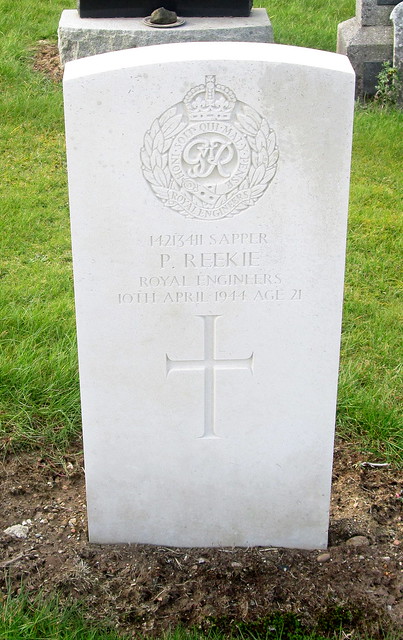
Sapper P Reekie, Royal Engineers, 10/4/1944, aged 21:-
Markinch War Grave 3

Sergeant Pilot T C Murray, 21/7/1942, aged 19:-
Markinch War Grave 4

Private J H Drummond, Seaforth Highlanders, 10/1/1918, aged 18:-
Markinch War Grave 5

This one is unusual, given the date of death and the age of the deceased.
Sergeant David Kirk, Intelligence Corps, 16/12/2000, aged 51:-
Markinch War? Grave 6

Cardross Old Parish Church

The church lies just off the main A 814 road through the village.

View from the road:-
Cardross Church Ruin

View from the churchyard:-

Church Ruin in Cardross

I was drawn to the churchyard as there was a Commonwealth War Graves sign on the gates. I found three graves.

Gunner G W Graham, RA, 6/5/1941, aged 32:-

War Grave, Cardross

Sergeant Pilot A G Dunbar, RAF, 23/9/1940, aged 23:-

Cardross War Grave 2

Gunner W McManus, RA, 27/9/1941, aged 19:-

Cardross War Grave 3

free hit counter script