More of Arbroath. (Scotland’s Art Deco Heritage 37)
Posted in Art Deco, Seaside Scenes at 12:00 on 2 May 2026
Posted in Art Deco, Seaside Scenes at 12:00 on 2 May 2026
Posted in Kirkcaldy, Seaside Scenes at 12:00 on 11 October 2021
In June we took a walk along the seashore of the Firth of Forth from Kirkcaldy towards Seafield Tower. There’s always some wildlife around.
This cormorant was sunning itself against the background of old sea wall blocks:-

Panorama of rocks and seals:-

Basking seals:-

On the way back the tide had come in a bit:-


“Do not disturb” sign. It’s a bit sad that there is felt to be a need to put up a sign like this:-

Video:-

On this video you can hear the seals’ howls:-

Posted in Bridges, Norway Cruise, Seaside Scenes, Trips at 12:00 on 30 June 2021

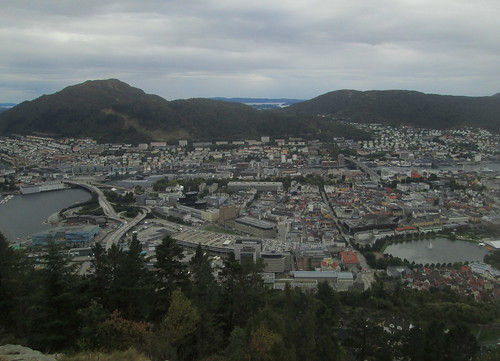

This one shows the ship we were travelling on (extreme right):-

Close up on lake with fountain:-

A road bridge in central Bergen from Mount Fløyen:-

Part of Bergen with sea inlets beyond:-

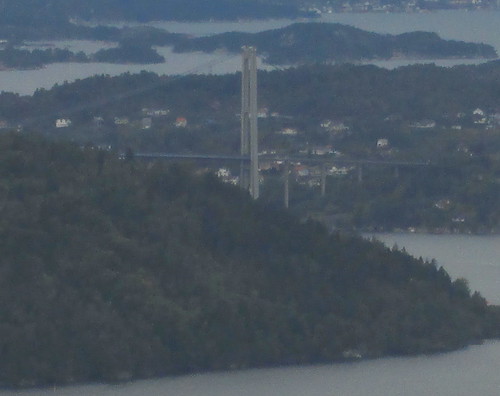
A distant suspension bridge (photo is fuzzy due to zoom function.) Due to its sovereign wealth fund – a legacy of the oil boom – Norway is festooned with infrastructure like this:-
Posted in Architecture, Seaside Scenes, Trips at 12:00 on 18 July 2020
On the way back up from Northeast England last June we took a trip over the causeway (having looked up the tide-tables beforehand) to Lindisfarne, or Holy Island, a place I’d always wanted to visit but somehow had never seemed to find the time before.
It’s an odd experience driving over the causeway – it feels quite long – but the trip was worth it. There was more to Lindisfarne than I’d imagined. Not just the castle and Priory.
Lindisfarne Castle from Approach Road:-

Closer view:-

From the road there’s a good view over the sea to Bamburgh Castle:-

I thought the objects in the next photo were a bit odd, but obviously with some age to them. Only when I got home and looked them up did I find they were Guile Point obelisks and lighthouse. (When lined up the obelisks indicate the safe channel into Lindisfarne harbour.) As seen from Lindisfarne:-

They can be seen again in the background here beyond Lindisfarne’s foreshore with these wooden stumps:-

There is a small village on the island (where lie the remains of Lindisfarne Priory) and a harbour.
Lindisfarne Harbour, Village and Priory from road to Castle:-

Posted in Architecture, Baltic Cruise, Sculpture, Trips at 12:00 on 17 June 2020
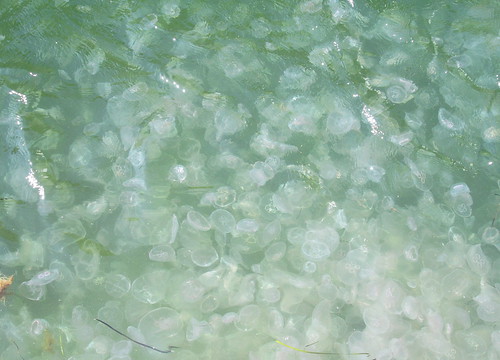
Jellyfish in Limfjord:-

The eastern side of Aalborg has some striking modern architecture:-


A water-skier was practising in this inlet:-

Modern Buildings and older tower:-

Posted in Baltic Cruise, Trips at 12:00 on 10 June 2020
This isn’t the sort of view normally associated with fjords. The word usually conjures up images of steep, almost mountainous sides and a narrow waterway.
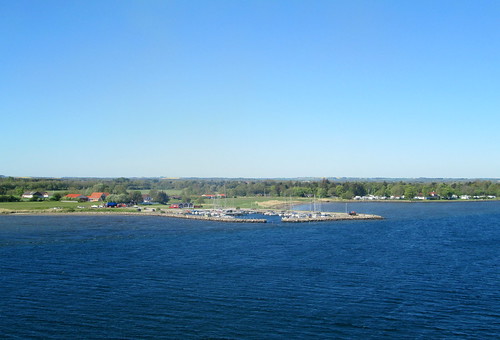
This however is the Limfjord, which cuts Jutland in Denmark in two. And the countryside by its banks is flat. I thought that perhaps in Danish the word fjord just means inlet. (It seems it does, if you type ‘fjord’ on the ‘Danish’ side of this link. In all the other Scandinavian languages ‘fjord’ translates as ‘fjord’.)

We sailed up the easternmost bit of the Limfjord on our approach to the last stop on the trip, Aalborg, Denmark’s fourth largest city.

Posted in Seaside Scenes, Trips, War Memorials at 12:00 on 27 October 2019
Isle of Whithorn is not to be confused with Whithorn. It is about three miles further south and is one of the most southerly villages in Scotland. The locals refer to it simply as, “the Isle.” It is said to be the place at which St Ninian first made landfall in Scotland.
Harbour. This is where the Drummullin Burn enters the Solway Firth:-

A chapel dedicated to St Ninian was erected here in the 13th century. Its ruins lie very close to the sea.


The village has a War Memorial to the right of the road entering it. A Celtic Cross on a square plinth. Great War names here:-

Dedications, ‘In honour of the men from the village and district who fell in the Great War 1914-1918. “Lest We Forget.” 1939-1945,’ and World War 2 names:-

Edited to add: I meant to say above that the Isle was where part of the cult horror film The Wicker Man was filmed.


