Archives » Fantasy

The Little Snake by A L Kennedy

Canongate, 2018, 137 p.

This is part of a departure for Kennedy. Her earlier books were short story collections and novels intended for adults. However in 2017 she started producing a series of children’s stories about featuring Uncle Shawn and Badger Bill – and llamas. The Little Snake is another diversion. On one level it is a children’s story, on another a fable, and on a third a meditation on death.

Mary is a girl living in a strange city where kites are flown from rooftops. One day she feels a strange sensation and observes a golden circlet round her ankle. This is the little snake Lanmo. Usually he is the angel of death, but with Mary he forms a friendship. Lanmo comes and goes many times throughout her life seeing her grow up, fall in love and mature while her (nameless) city becomes less and less hospitable as time goes by and war encroaches on its inhabitants.

Lanmo tells her of his sense of oddness that humans spend so much of their time contriving so many different ways to kill each other when their lives will end in any case. Selflessly he helps her escape to a better life but is in turn changed by her.

This is a book coloured by intimations of the modern world, the shadow of war, the necessity of migration, the kindness of strangers, the acceptance of death at the end of a life well lived.

For such a short book it carries quite a punch.

Pedant’s corner:- remarkably – even though the book is short – there is nothing to report here.

Michael Bishop

I was sad to read in the Guardian on Thursday of the death of Science Fiction writer Michael Bishop.

He was one of my favourite SF writers of the 1970s and 1980s.

I have read eleven of his books including two short story collections and the novel he co-wrote with British SF author Ian Watson.

His was always a humane approach to writing SF.

He had a knack for memorable story titles. From my early days reading the Magazine of Fantasy and Science Fiction his story The White Otters of Childhood stood out as demanding to be read.

Then who could not be intrigued by And Strange at Ecbatan the Trees? (This story is also known as Beneath the Shattered Moons. So good he named it twice.)

And there is his novel Philip K Dick is Dead Alas.

Michael Lawson Bishop: 12/11/1945 – 13/11/2023. So it goes.

Luka and the Fire of Life by Salman Rushdie

Vintage, 2011, 220 p.

This is a companion piece to Rushdie’s earlier book Haroun and the Sea of Stories, written for his son, but also as a defence of the art of story-telling. Like that novel this one could be described as a children’s book but there is plenty to delight the adult reader.

The hero this time is not Haroun but his younger brother Luka. Their father, Rashid Khalifa, is renowned for his storytelling abilities and known as The Shah of Blah from his ability to draw inspiration from what he calls the Ocean of Notions.

But Rashid has fallen ill and to save him Luka must seek out and bring back The Fire of Life that burns at the top of the Mountain of Knowledge. In his quest he is accompanied by Dog the bear and Bear the dog and a spirit presence calling himself Nobodaddy who is Rashid’s double and whose appearance becomes more transparent the more Rashid’s life wanes.

He it is who tells Luka, “Man is the story-telling animal.” In stories are his identity, his meaning and his lifeblood. By way of emphasis Nobodaddy asks, “‘Do rats tell tales? Do porpoises have narrative purposes? Do elephants ele-phantasise?’” This is typical of Rushdie’s style here of free association, word play and allusion. In a riff on time-travel stories there are mentions of the clock-bearing rabbit in Alice’s Adventures in Wonderland, intimations of Doctor Who, Time Bandits, Back to the Future, and A Connecticut Yankee at the Court of King Arthur.

Luka’s journey through the Magic Land up the River of Time takes him to the land of Oh-Tee-Tee (Ott,) where everything is done to excess, and whose Queen is referred to as the Insultana. All sorts of weird and wonderful things happen by way of P2C2E, Processes Too Complicated To Explain. Luka picks up other companions along the way, among them Elephant Birds (fearful of losing their memories in the Mists of Time they pass through,) and the great Native American mythological character Coyote. We also encounter an arid expanse of land called The Waste of Time.

Whether you can be doing with all this punnery depends upon your toleration of exuberant word play. Myself, I found it delightful.

The Magic Land of Luka’s journey is Rashid’s creation and Luka reminds its inhabitants that if they prevent him from restoring the fire of life to his father they will disappear along with him.

On returning home (Spoiler: this is a children’s tale after all, of course Luka returns home) Rashid admits to Luka he stole the idea of the few particular children who can defy Time’s power just by being born , and make us all young again, from his wife, Luka’s ma. “‘If you’re going to be a thief,’” he says, “‘steal the good stuff.’”

Well, you could say Rushdie has.

Pedant’s corner:- Pythagoras’ Theorem (Pythagoras’s,) “the stink of sulphur dioxide” (this is supposedly the result of rotting eggs. However the gas they give off is hydrogen sulphide, H2S; not SO2,) “reached a terrible crescendo” (No: the crescendo is the climb, not its end,)

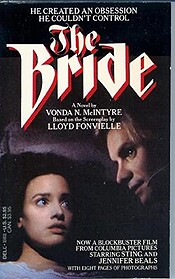
The Bride by Vonda N McIntyre

Star, 1985, 188 p. Based on the screenplay by Lloyd Fonvielle.

Film tie-in novelisations are not my usual reading matter but this was written by Vonda N McIntyre, whose back catalogue I have been trying to catch up with.

The premise is that Charles Frankenstein has promised to create a companion for his creature – a female companion. The book begins on the night when Frankenstein and his assistant await the arrival of the electrical storm which will animate her. She is of course beautiful, her only flaw a slight discolouration at the wrists. She is brought to life ignorant of the world and its ways. When introduced to Frankenstein’s earlier creation she instinctively shies from it though. (I shrink from that ‘it’. The “monster” is never less than a creature worthy of sympathy – even empathy.) The creature is angered but not totally surprised by this. He is used to being reviled.

It is here that McIntyre made an authorial decision which elevates the narrative above where it might have lain. Most of the text is related in third person (this is of course how a viewer experiences cinema) but the creature’s thoughts are given to us in his first-person viewpoint. That night, the creature’s rage results in a fire in Frankenstein’s castle and the creature resolves to flee. Later in the book, once he has taken up with a dwarf called Rinaldo, with whom he forms an effective pair, Rinaldo decides to call him Viktor. (I also wondered why, here, Frankenstein the creator had been given the name Charles rather than Victor.)

Charles calls his new ward Eva, after the biblical first woman, and sets out to educate her, not only in the normal sense but in the ways of society. She at first scandalises the housekeeper Mrs Baumann by her feral habits, especially where food is concerned, but soon more considerate behaviour becomes her hallmark. She notices the different attitude Charles has to her and his social equals as compared to the servants and takes one of them, Hannah, from the kitchen to be her personal maid. She is also confused by the manners and customs of Charles’s acquaintances.

In the meantime after various ignominies suffered on the road, Viktor and Rinaldo become a great success as a circus act (Rinaldo is particularly adept on the trapeze.)  This leads to jealousy on the part of the circus owner and his chief employee and a tragedy, whereupon Viktor is left to his own resources again.

Gradually Eva becomes aware that the tale Charles told her of her origin is false and she seeks to find her true self elsewhere. He has of course come to consider she is his alone and is unwilling to let her go.

This all written in a much better way than the rather corny premise itself merits. Not great literature but enjoyable enough.

Pedant’s corner:-  delibertely (deliberately,) “lingered on her body longer than they need” (longer than they needed,) an unindented new paragraph (x 2,) “on the try” (on the tray,) “snatched t a third piece” (snatched at,) “who’ll heave to clean it up” (who’ll have to,) “in the underbush” (underbrush?) “and let myself dissolved back” (dissolve back,) “put one handon” (hand on,) a missing full stop between two sentences (x 2,) creature (creature,) Thucidides (Thucydides,) “‘Is that you idea of’” (your idea,) Rinald (elsewhere always Rinaldo,) a missing opening quote mark before a piece of direct speech (x 2,) “Rinaldo siad” (said,) a capital letter on a word in the middle of a sentence, “‘hat you’ve got the feel of it’” (that you’ve got,) “‘If you trust mer’” (trust me,) ounging (lounging,) “and showed Magar and straps” (showed Magar the straps,) glard (glared,) “make them laughed at me” (laugh at me,) “‘get out of her’” (of here,) emtpy (empty,) peddler (pedlar.) Wht (What,) cuatiously (cautiously,) “the serving women” (woman,) “but be more more could have climbed down thatn he could fly” (but he no more could have climbed down than he could fly.) Evan (elsewhere always Eva,) “it was no unpleasant” (not unpleasant.) “‘You must take note to town for me’” (take a note,) rached (reached.) “She slide her hands up his back” (slid her hands.) “‘Make you own way’” (your own,) “pocked the key” (pocketed,) “the last dangling plan from its hinges” (plank.) Frankenstin (Frankenstein.)

Reading Scotland 2023

Thirty four Scottish books read this year; equally divided between female and male authors. Fiction, Poetry, Science Fiction, Fantasy, Non-fiction, Football. I have linked to my reviews if they have appeared here.

No Dominion  by Louise Welsh

Hieroglyphics by Anne Donovan

For the Good Times by David Keenan

Wild Geese by Nan Shepherd

Paper Cup by Karen Campbell

The Christmas Truce by Carol Ann Duffy

A Would-Be Saint by Robin Jenkins

Something Like Happy by John Burnside

The Mandelbaum Gate by Muriel Spark

The Dark Remains by William McIlvanney and Ian Rankin

Scotland’s Lost Clubs by Jeff Webb

The Oath Takers by Naomi Mitchison

Vinland by George Mckay Brown

Beethoven’s Assassins by Andrew Crumey

Chimera by Alice Thompson

Hester by Mrs Oliphant

Antimacassar City by Guy McCrone

The Marriage Portrait by Maggie O’Farrell

The Philistines by Guy McCrone

Fishnet by Kirstin Innes

A Gift From Nessus by William McIlvanney

Sea-Green Ribbons by Naomi Mitchison

Companion Piece by Ali Smith

Night Boat by Alan Spence

Europa Deep by Gary Gibson

Murder in the Merchant City by Angus McAllister

O Caledonia by Elspeth Barker

The Puritans by Guy McCrone

King Hereafter by Dorothy Dunnett

Escape From Hell by Hal Duncan

The Pearl-fishers by Robin Jenkins

The Bachelors by Muriel Spark

Klaus by Allan Massie

Early in Orcadia by Naomi Mitchison


Best of 2023

These are in order of reading; 18 in total, 9 by women, 10 by men, 8 by Scots (italicised,) 4 translations, 1 SF/Fantasy. The links are to the reviews on here:-

Paradise Reclaimed by Halldór Laxness 

The Women of Troy by Pat Barker 

For the Good Times by David Keenan

The Infinities by John Banville

Wild Geese by Nan Shepherd  

Paper Cup by Karen Campbell

A Would-Be Saint by Robin Jenkins 

Master of the Crossroads by Madison Smartt Bell 

Beethoven’s Assassins by Andrew Crumey  (my review was published in ParSec 8 and will appear here in due course.)     

The Marriage Portrait by Maggie O’Farrell 

The Liar’s Dictionary by Eley Williams

Fishnet by Kirstin Innes 

The Gaze by Elif Shafak

Dancing Lessons for the Advanced in Age by Bohumil Hrabal

Utopia Avenue by David Mitchell 

O Caledonia by Elspeth Barker 

Cybele, with Bluebonnets by Charles L Harness

Of Love and Other Demons by Gabriel García Márquez

My present read (Luka and the Fire of Life by Salman Rushdie) may be an addition to this list (but then again it may not.)

Sorcerer’s Son by Phyllis Eisenstein

Grafton, 1991, 444 p.

After Lady Delivev of Castle Spinweb turns down his offer of marriage, fellow sorcerer Lord Rezhyk of Castle Ringforce, ever one to think the worst of people, believes she wishes ill on him. He conceives a plan utilising his enslaved demon Gildrum to go to Spinweb, disguised as a knight called Mellor, to seduce Delivev and make her pregnant as under those conditions she will not feel Rezhyk weave for himself a protective covering of metal. Neither he nor Gildrum ever thought that she would go on to bear the child or that Gildrum would fall in love with her (a fact which Gildrum conceals from his master.)

Delivev’s special power is affinity with spiders and snakes. She can use spiders’ webs as a means to see far and wide across the world as they spin a sort of screen for her to witness what they see and hear. (Though the screens are temporary this is a literal world-wide web, but of course on first publication in 1979 no-one would have thought of it in those terms.)

The child she bears is the Sorcerer’s Son of the book’s title since, as a demon, Gildrum could not have provided the necessary procreative material, which came from Rezhyk. The child is named Cray Ormoru.

As he grows up, despite being close to his mother, he does not want to become a sorcerer but instead to find his father so he goes on a quest to discover the knight, whose shield bore three pink crossed lances on a white ground; a quest doomed to failure.

Deceived by Gildrum – through Rezhyk’s instructions – into believing his father is dead (Gildrum has a way with manipulating matter and appearances) Cray decides the only way he can find out who his father was is to conjure a demon himself and so must seek apprenticeship. Rezhyk wants the true situation to remain unknown to Cray but invites him to learn the arts but with the intention of misleading Cray. Many years of fruitless endeavour ensue until Gildrum reveals to Cray Rhezyk’s duplicity.

As with many such fantasy tales we are presented with a society having mediæval value systems and hierarchies, only here with sorcerers replacing Lords as the ruling class. This default fantasy setting I find irritating. I suppose they are trying to represent less enlightened times but can fantasy writers not eschew such lazy backgrounding? The effect is made worse here by the dialogue being couched in cod mediæval language.

The summoning of demons is presented as being akin to alchemy, with gold extraction its most important aspect. Again this seems somewhat lacking in imagination. Still, this sort of thing is not read for its newness of treatment. It slips down easily however.

There is a sequel, The Crystal Palace, and a third in the sequence which was never published.

Pedant’s corner:- “‘none of them ever know’” (none of them ever knows,) callouses (calluses.) “‘I an not one’” (I am not one.)

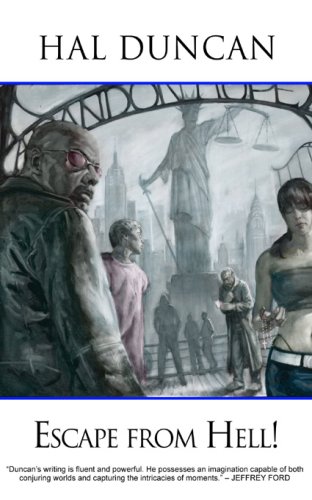
Escape From Hell! by Hal Duncan

Monkey Brain Books, 2008, 147 p.

In the Prologue we are treated to the more (or less) graphic deaths of our four agonists, Seven, Belle, Eli, Matthew. As they must, given the book’s title, all four arrive in Hell which, as depicted here, seems like a version of a modern US inner city complete with its own low-lifes, its own cops (corrupt, obviously,) its own TV station with its star Trent Knightly – reporter for the allusively named Vox News.

Immersed in various nightmare scenarios particular to each, in their own ways they attempt to escape and eventually come together. There are tales of a way out: but this is Hell, maybe these are only rumours. In Hell of course the only way out is down. At its centre they come upon Lucifer, trapped there for four thousand years, and discover the real power behind this infernal place, the one who consigned them all there in the first place. (Traditional religious believers will not look kindly on this revelation.)

Duncan’s story is related in a necessarily urgent present tense and the text contains copious amounts of swearing. Plus one instance of the n-word. With scenes not for the squeamish. It is set in Hell after all.

Pedant’s corner:- 250 mils (the plural of the abbreviation ‘ml’ is ‘ml’,) “there’s no buttons, no switches” (there are no buttons, no switches,) “wet canvass” (canvas,) discernable (discernible.) “Belle whisper a response he misses” (Bell whispers a response,) “a dark maw of a doorway” (a maw is a stomach, not an entrance,) later “a dark maw at its base” (ditto,) “Matthew and Eli skidding round a corner, Belle and Eli close behind” (one of those Elis should be a Seven.) “There’s no tears in Belle’s eyes” (There are no tears.)

Utopia Avenue by David Mitchell

Sceptre, 2021, 567 p.
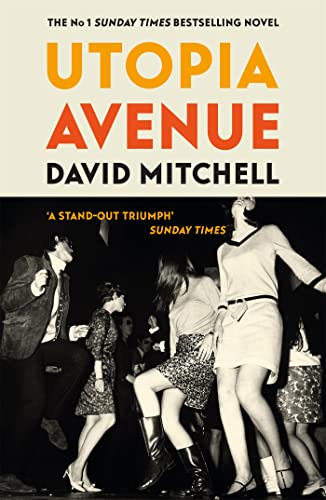
Mitchell has form with unusual novelistic structures. In Cloud Atlas he embedded several stories physically one within another. Here, in a book about the history of a briefly flaring sixties band (the Utopia Avenue of the title,) he doesn’t go as far but has set his novel out as if its sections were tracks on their three LPs. Each of its six main sections is prefaced by an image of the supposed label of one side of an album and its chapters focus on the lives of the writers of its songs, bassist Dean Moss, ex folk singer Elf Holloway and virtuoso guitarist Jasper de Zoet. The group’s drummer, Peter ‘Griff’ Griffin, didn’t compose but gets one writing credit for devising a drum pattern for one of Elf’s songs. Occasional scenes are seen from other viewpoints but these are rare.

All three main viewpoint characters are beautifully inhabited, living, breathing creatures, each replete with flaws and doubts. Dean had a troubled upbringing and his connections with old friends from Gravesend add complications he could do without, Elf’s family background was safe and secure but she harbours questions about her sexuality (incidentally her initial boyfriend here, the Australian, Bruce – perhaps a little too programmatically named – is a perfect evocation of the selfish misogynist,) Jasper’s connection to the de Zoets comes from a wrong side of the blanket liaison during World War 2. The relatively minor characters are agreeably nuanced.

Mitchell also has a habit of incorporating in his work cross-references to previous novels. Among others here Jasper’s surname is a nod to The Thousand Autumns of Jacob de Zoet, and indeed he turns out to be descended from that gentleman. There is a mention of The Cloud Atlas Sextet, a musical piece which featured in Mitchell’s third novel and once again we encounter the enigmatic Dr Marinus, a character whose absence from a Mitchell book would now be more noteworthy than his appearance.

It is a trifle odd to say it for someone who lived through the times depicted but since Mitchell was born in 1969 this is technically a historical novel. The text is peppered with encounters with sixties names – Sandy Denny, a pre-fame David Bowie, Steve Marriot, Syd Barrett, Joohn Lennon, Francis Bacon, Steve Winwood, Kaith Moon, Marc Bolan, Brian Jones, Rick Wakeman, Jerry Garcia, Crosby, Stills and Nash, Joni Mitchell, Leonard Cohen, Jackson Browne, Allen Ginsberg, Frank Zappa, Cass Elliott, Jimi Hendrix, Janis Joplin, and Jim Morrison, not to mention a certain peroxide-haired Top of the Pops presenter. However, the dialogues these real people engage in with the novel’s characters are sometimes not entirely convincing. The way Mitchell ties it in to his wider œuvre means the book can also be classified as a fantasy.

Jasper’s mental peculiarity (he hears knocking no-one else can and experiences another mind within his) is explicitly linked to his de Zoet history as in that previous book and provides the fantastical and speculative elements of this one – Marinus carries out psychosurgery on him – but could be read simply as psychotic episodes if fantastical speculation is not to your taste. Then again, readers of Mitchell ought to be used by now to his flights of fancy.

The band’s adventures include a brush with Italian police corruption followed by a tad unlikely UK tabloid support and eventually taking the US by storm. Their USian promoter sounds off about the violent history of the United States, “We need war like the French need cheese. If there’s no war we’ll concoct one,” and adds a warning, “Here in the land of the free, you’ll meet some of the gentlest, smartest, wisest people who ever lived. But when violence comes it’s merciless. Without warning.” All too true, then and now.

In Utopia Avenue Mitchell has worked his magic again. It is by degrees warm, tragic and affirmative: like all the best of literature, capturing the human condition.

Pedant’s corner:- a missing comma before a piece of direct speech (x 2,) “Eric Burden’s intro on the Animals’ version” (it was Hilton Valentine who played the intro on the Animals’ recording of House of the Rising Sun,) “Sergeant Pepper’s” (no-one in Britain in the sixties – and for about fifty years afterwards – ever said Sergeant Pepper’s, that LP’s title was always abbreviated to just Sergeant Pepper.) “A producer told them that Elf’s the first woman ever to ‘play’ an instrument on Top of the Pops” (so had he – or is it perhaps Mitchell – never heard of Honey Lantree? Or do drums not count as an instrument?) “the hairdressers” (the hairdresser’s,) “the audience are clapping out the rhythm” (the audience is clapping out,) “Andy Williams’ company” (Williams’s,) “the callous on his hand” (callus,) “or he would have thrown Jasper arranged in a list the SS Arnhem on the crossing from Harwich.” (I can’t make any sense of this at all,) “the band drop away” (the band drops away,) “on his next LP.A coloured model” (needs a space between the full stop and the ‘A’ – LP. A coloured.) “The tennis players’ skin turns first albino-milky” (the tennis players’ skins turn first.)

Three for ParSec

You may have noticed on my sidebar that I am reading Stephen Baxter’s Creation Node. This is his latest novel and I will be reviewing it for ParSec.

In the same package Mindbreaker by Kate Dylan arrived. I’ll get onto that next. The author is new to me.

In a subsequent list of potential review books I couldn’t resist asking for My Brother’s Keeper by Tim Powers. This is a fantasy centred round the Brontë family and also awaits a read.

free hit counter script