Archives » Fantasy

The Moon and the Sun by Vonda N McIntyre

Pocket Books, 1997, 422 p, plus ii p Major Characters and v p Afterword
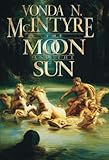
I’m not quite sure how to categorise this. I’ve seen it described as Alternate/Alternative History (what I prefer to call Altered History) but I can’t see any change in actual history in it. It has no discernible Jonbar Point, no ramifications for its future. Yes, it’s set in the reign of the Sun King, Louis XIV of France, but it’s not a purely historical novel either, though that aspect of the novel is very well executed. What it does have – and what tends to make it more of a fantasy than anything else – is a “sea monster,” a mermaid-like creature which turns out to be near human, brought to Louis’s court to provide him with immortality by eating a part of its flesh. (The first part of this premise – the human-like sea creature – is not really too far-fetched. There has been scientific speculation that humans spent part of their evolutionary history as aquatic creatures.)

Our viewpoint character is Marie-Josèphe de la Croix, lady in waiting to Mademoiselle Elisabeth Charlotte d’Orleans, Louis XIV’s niece. Marie-Josèphe was brought up in Martinique and her relationship to the court is, to begin with, opaque. She is an innocent, (she has not heard the word ‘whore,’ has never drunk wine, nor encountered the idea of homosexuality,) sent to a convent when her parents died and subjected to its repressive strictures. Her brother Yves is the Jesuit priest and enthusiast for scientific enquiry who was instrumental in capturing two sea-monsters and bringing them to Versailles. One of the monsters is dead and Yves is to carry out an autopsy on it. Questions of protocol and the need for the king’s presence tend to delay this though.

Marie-Josèphe finds herself sensitive to the creature. She can hear it sing, feel its pain, discern its meaning, and ends up relating its stories of persecution by humans to the court.

Coincidentally, Pope Innocent XII is on a diplomatic mission to Versailles (as a kind of rapprochement with the King) but he is keen for the live sea creature – which due to its tale-telling soon comes to be called Sherzad – to be taken back to Rome for study.

Other historical notables to appear in the text include Philippe, Duc d’Orléans, (Louis’s brother and Mademoiselle’s father,) Charlotte (Philippe’s Duchess,) the Chevalier de Lorraine (Philippe’s male lover,) James VII (II of England) and his wife Mary of Modena (in exile due to the so-called “Glorious Revolution.”)

Marie-Josèphe is talented, not only does she sketch the dissection of the dead sea-creature, she also composes music. This latter outrages the Pope, who insists – using Biblical references – that women ought to be silent. She is not short of enemies at the court but also forms friendships. Her relationship with her slave Odolette is complicated and develops in a way more attuned to modern sensibilities than those of the seventeenth century.

The writing is accomplished throughout and the interpersonal relationships depicted tend to strike true.

Pedant’s corner:- Yves’ (Yves’s. Since the ‘s’ of Yves is not pronounced then without an ‘s’ after the apostrophe then the possessive’s sound is not signalled by the spelling. All the possessives of names ending in ‘s’ are treated like this, Chartres’, Louis’, etc) “the duke and duchess d’Orleans” (these are specific titled people, not merely an unspecified member of a class. Their titles are proper nouns. So, “the Duke and Duchess d’Orleans. McIntyre generally tended to adopt a similar practice of using lower case whenever specific titles were used, even for mademoiselle de la Croix. Note in English she would be Miss de la Croix, not miss de la Croix,) perruke (innumerable times, peruke,) “His Holiness’ route” (His Holiness is singular, so, ‘His Holiness’s route’,) “she kept her own council” (counsel, is council a US usage in this context?) “her royal mistress’ ridicule” (mistress’s,) “Father de la Croix’ medal” (again, no ‘s’ is sounded at the end of Croix, it needs an ‘s’ to render the possessive accurately, ‘de la Croix’s medal’,) “her left aureole” (areola,) “and has sense of humour failed him” (and his sense of humour,) “a hareem” (x 2, usually spelled ‘harem’.)
Another for ParSec

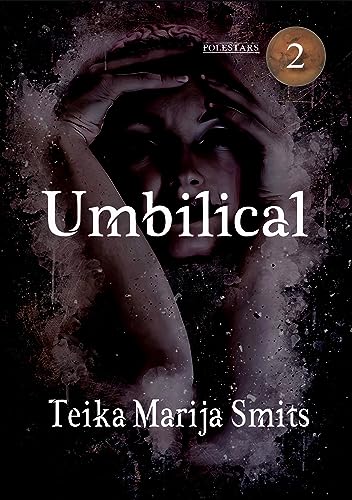
It’s not appeared on my sidebar yet but I am at the moment working my way through the first collection of stories by Teika Marija Smits for a review to be published in ParSec.
 

The book is titled Umbilical and contains twenty-one stories, covering various speculative fiction genres, plus one poem.

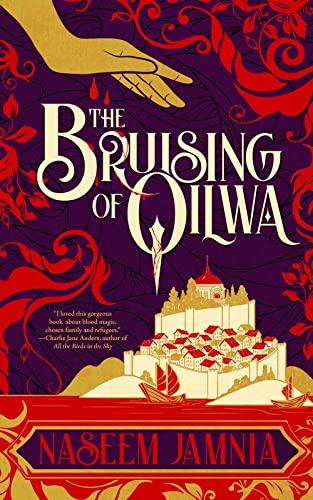
The Bruising of Qilwa by Naseem Jamnia

Tachyon, 2022, 177 p, plus 5 p Afterword and 4 p Acknowledgements.  $15.95. Reviewed for ParSec 5.

Qilwa is an island lately having become independent of the mainland Queendom of Dilmun after previously being conquered by Sassanid, which in its turn was taken over by Dilmun. A plague has been raging through Qilwa, blamed unofficially (but with nods and winks from the authorities) on an influx of refugees of Sassanian heritage from Dilmun, fleeing both from the depredations of the sky-borne Homa bird and the fear by Qilmunis of Sassanian blood magic. The flight has been such that during the novel the last Sassanian people that were left in Dilmun arrive in Qilwa.
Viewpoint character Firuz-e Jafari, a user of blood magic, has not been in Qilwa long and still cannot get used to the local failure to designate chosen pronouns on being introduced to someone. When meeting a local healer, Kofi Nadifa, a man who is also able to control breezes, he says, “I’m they-Firuz” and throughout the book is described by the pronouns they, them and themself. When Firuz rescues another Sassanian, she introduces herself to them as she-Afsoneh. We never see other characters, like Firuz’s brother Parviz, and his friend Ahmed, or indeed any Dilmunis, barring Kofi, introduced. Except for the occasional other pronouns such as zhe, zher and hu, usually used for incidental characters, those whom Firuz interacts with are designated either by name or the more traditional singular pronouns.

In Dilmun, Sassanians are definitely second-class citizens, kept more or less segregated. In this fantasy world, as in the real, colonialism exerts a dark shadow. Kofi tells Firuz, “It’s said when your people took ours over they made a pact with a dark god to gain powers over life,” a phrase which has echoes of the blood libel. Firuz’s family at first had to live in an area known as the Underdock before his work at Kofi’s clinic allows them to move to a slightly better neighbourhood and such is the fear in which blood magic is held that Firuz has to keep their abilities secret. They worry in particular about Afsoneh, who has an innate facility for blood magic but is totally untrained and thus a danger not only to anyone she might try to heal but to herself and her associates. Firuz agrees to train her and says, “‘Really all magic works on this principle, pulling energy from a source in order to manipulate it. But for us, for blood magic users, we have to pull from our own life force.’” Blood magic users are practiced in the science, those in training or without the control are adepts.

Some healing magic is acceptable in Dilmun, though. Environmental magic involves equivalent exchange (akin to the First Law of Thermodynamics,) and structural magic uses runes or words to channel energy.

When cases of blood-bruising begin to arise, brought to their clinic’s attention by a local undertaker showing them bodies strangely preserved after death, Firuz is at first baffled by the phenomenon but its possible ramifications for Sassanians in Qilmun after the only recently subsided plague are not lost on them. It takes a while for them to work out its possible cause, bone marrow increasing its output of blood cells to an unsustainable level. This faulty blood, leading to lack of clotting and subsequent bruising, its lack of oxygen carrying capacity giving unwarranted fatigue, is redolent of someone searching for blood that attacks illness and wipes it out without a trace by magical means instead of natural. Firuz’s suspicions initially fall on Afsoneh who is covertly attempting to carry out an alignment, a redistribution of tissue to other areas or a breakdown of tissue for the body to repurpose, on Parviz before Firuz prevails on her to stop. The true culprit for the altered blood is more surprising.

The background colouring to the story (the author is the child of Persians who emigrated to the US) is out of the ordinary for modern fantasy but not too unfamiliar historically. However, this is Jamnia’s first novel and sometimes that shows. Relationships tend to be sketched rather than fleshed out, the concept of the Homa bird is sorely underdeveloped and the climactic scene feels rushed. Then there is the use of the somewhat coy “muck” or “mud” as expletives. The prejudice in Qilwan society is mostly mentioned rather than shown and sits a little uneasily with the book’s other elements. In scenes where more than one person is present that usage of plural pronouns for Firuz is liable to be misread.

Twice it is emphasised that “Magic is mostly a working of the will.” Jamnia’s will is strong but perhaps their magic isn’t quite fully controlled as yet. Overall, though, The Bruising of Qilwa is an interesting read.

Pedant’s corner:- Afosneh (elsewhere Afsoneh.) “It annoyed Firuz to no end” (no, it did not annoy Firuz ‘for no purpose,’ it annoyed Firuz no end, ie it annoyed Firuz immensely, “the warm towel with the runes sewn into them” (sewn into it.) “Had he been in a chair, Ahmed would have likely sunk into it. As it were, he cradled his head in his hands.” (As it was, he cradled,) “the minutia of the shifts” (this read as plural, minutiae,) “on the governor’s behest” (at the governor’s behest,) sunk (sank.) “This would make the day to day of running of the clinic” (no need for the ‘of’.) “It was so nice someone around their age to talk with” (so nice to have someone,) sprung (sprang.) “a density separator” (a centrifuge to give it its proper name,) “a yellowish-clear layer” (implies a yellow liquid cannot be clear; it can: ‘a clear [pale?] yellow layer’,) “Afsoneh squirmed of reach” (out of reach.) In the Afterword; “the storming of the White House” (the Capitol,) “to use my background a scientist” (as a scientist,) “the people from whom my parents came from” (has one ‘from’ too many.)

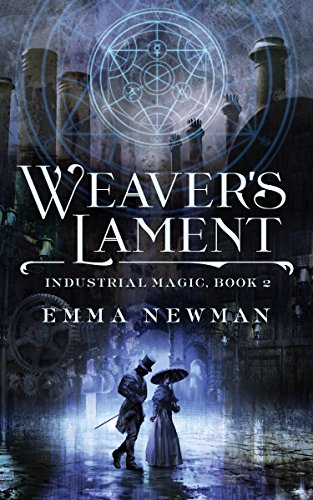
Weaver’s Lament by Emma Newman

Tor, 2017, 180 p.

This is the second in Newman’s Industrial Magic series set in a Victorian era where magic, overseen by The Royal Society of the Esoteric Arts, is the major power source which made Britain pre-eminent. The first, Brother’s Ruin, I reviewed here.

Heroine Charlotte Gunn still wishes nothing more than to be an illustrator and (perhaps) to marry her fiancé, George, but her magical ability, which must be kept concealed or normal life will be lost to her forever, is a curse (as well as a boon.) To control it she is being tutored in secret by Magus Thomas Hopkins, whom she finds almost irresistibly attractive, but as a magus he is of course forbidden to marry.

The plot centres around the mill in Manchester which her apprentice magus brother Ben helps to run. Machines are being destroyed mysteriously and he suspects (shock! horror!) socialists are to blame and asks her to go undercover there to find out who is responsible since his failure may cause his rival trainee magus, Paxton, to oust him from the post or even to be prosecuted.

With some reluctance Charlotte agrees but this plan also coincides with Magus Hopkins’s hopes to expose the mill’s owner and Royal Society adept Ledbetter (the baddie from Brother’s Ruin) as a crook.

The conditions Charlotte finds in the mill are appalling. The noise is atrocious, the atmosphere hot and humid, the food dreadful, enough to turn anyone socialist. She can barely get through each day. It soon transpires, though, that the damage to the machines is not due to sabotage but to esoteric causes. Moreover, the working of the machines themselves is having a deleterious effect on the life force of the workers.

All diverting enough but no more. It is, though, a YA book.

The Body Library by Jeff Noon

Angry Robot, 2018, 380 p.

The first sentence of this novel sets the action in 1959. But it’s not the 1959 of our world. Though the tale proper starts off in a noirish way a prologue chapter has already revealed to us an apparently dead man on a library floor whose skin is covered in words; not tattoos, since they’re moving. A man covered in stories.
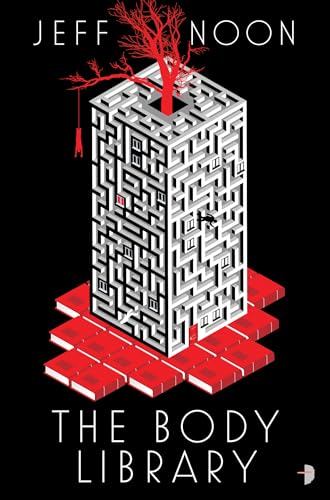
For we are in Storyville. A city run by a Narrative Council. A city whose suburbs and streets are named after writers – Lower Shakespeare, Rabelais Walk, Calvino Road, Plath Lane etc. There’s even a Bradbury Avenue, plus an Asimov reference. A pivotal location is the Melville Estate, particularly Melville Tower Five.

Our protagonist is Nyquist, a private investigator whose current case involves following a man called Patrick Wellborn. Inside Melville Tower Five Wellborn attacks him with a knife and Nyquist kills him in self-defence. Ramifications ripple out from this act. A woman named Zelda Courtland was to meet Welborn in the Tower and becomes embroiled with Nyquist. This brings them both into conflict with a heavy called Dreylock whose body is criss-crossed with scars, liable to open at any moment and pour blood everywhere. Bee-like creatures known as alphabugs, each marked with a glowing letter, – though never an ‘x’ – occasionally flit about. Partway through the novel we discover Melville Tower Five has a tree growing up through its floors – all the way to the roof and beyond. Whether this is meant to refer to the Yggdrasil legend is not entirely clear (though seems likely) but it nevertheless comes over as a bit gratuitous.

Referentiality or self-referentiality is a recurring emblem. Nyquist is a character in a book who comes to think of himself as a character in a book – or is at least reading about “himself.” He encounters pages from The book – called The Body Library, fragments written in midnight’s ink. The pages of the book can be burned and the smoke inhaled. Later we read, “The night had been cut up into pieces, sliced by a blade into strips, and then glued back together in the wrong order.”

In his search for the lost Zelda Nyquist comes across the place where she is said to have been executed. A boy witness says to him, “‘All the stories, mister …. all the lousy, unwanted, lonely, disgusting, forgotten stories, all the tales that no-one wants in the city, they flow through the pipes, they get flushed clean away and they get pumped out, right here, in the mud and the dirt and the shit.’”

Dreylock tells Nyquist, “‘The Body Library is a novel, a book, and a rather special one at that.’” Made of extracts of cut-ups and splinters. “‘Everything that happens in this tower’” says Dreylock ,…“‘happens because of The Body Library.’” The book contained the city, it was the city. For the people whose skins are covered in words midnight’s ink makes them believe they’re inside a story. “‘Words make us, and keep us. Words embrace us. Words save us from our true selves, covering us in story. Words deliver us from everyday life.’” A woman called Daisy says, “‘Zelda was scared to death of words.’” Storyville’s Grand Hall of Narrative Content, where the city’s inhabitants’ stories are being written down, is an instrument of control.

The whole thing of course is a metaphor for reading – even a pleading for the necessity for story. But it’s slightly misplaced. However much an author may try to steer the reader to a certain point or conclusion he or she is not in sole charge. The reader brings his or her own experiences to the enterprise, makes his or her own judgement while they are reading. Sometimes that means concluding the author has gone too far. In literature, less can be more.

Pedant’s corner:- Written in USian. Otherwise; “femme fatales” (fatale is an adjective here – even in English. The noun is ‘femme’, its plural is ‘femmes’ hence we should have ‘femmes fatales’.) “‘So why don’t you sit down and tell me.’” (Is a question and so requires a question mark at its end.) “He hardly noticed when one of the screws worked itself free” (a page earlier he had been panicking as this started to happen.) “‘Who it is?’” (‘Who is it?’)


Necessity by Jo Walton

Tor, 2016, 332 p, including ii p Thanks.

This is the last of Walton’s “Thessaly” trilogy in which the author examines the ramifications of implementing Plato’s philosophy in a restricted setting. This is also a scenario in which the ancient Greek Gods are real and can interfere in human affairs. I reviewed the first volume, The Just City, here and the second The Philosopher Kings here.

Necessity takes place in the 26th century on the planet Plato to where Zeus removed the people of the Just City at the end of The Philosopher Kings. As in that second book there are twelve cities in all to cater for people’s various preferences. The climate on Plato is colder than the Greece from which most of the humans now living there were derived. Nevertheless their habitual attire is the kiton. As well as humans, the planet is home to some aliens known as Saeli who have immigrated there and are accepted as full members of society. Contact has also occurred with another set of aliens known as Amarathi. Many tasks on Plato, as in the Just City, are carried out by Workers, sentient robots accorded human rights. One of these, Crocus, has narration duties, as do the humans Jason and Marsilia and the god Apollo. Jason is a fisherman whose crew includes the Saeli, Hilfa, and the present consul Marsilia. He has an unrequited yen for Marsilia’s sister Thetis.

The book starts on the day when Pytheas, the human incarnation of Apollo and grandfather of one of our narrators, Marsilia, dies and a spaceship containing humans (from the planet Marhaba) arrives in orbit round Plato. This last, the reader might have thought, would provide the main thrust of the intrigue/plot but in fact not much is made of it. Instead the thread that is followed is a search for Apollo’s sister Athene who has ventured outside time, to study Necessity, and what Chaos is, and how time began. Necessity is later referred to as a great force that binds all thinking beings. Zeus, the father of both Apollo and Athene, would apparently be displeased if he knew Athene had done this – at least once his attention had been drawn to it – but despite him knowing everything no consequences will ensue if she can be brought back before it comes to his attention.

The human interactions are something of a sub-plot. Marsilia has an eight-year-old child, Alkippe, whom she had conceived with someone calling himself Panodorus. He appears at a gathering but does not recognise her and everyone else sees he is Apollo’s brother Hermes. (Yet even this is another disguise as he is in fact the Saeli god, Jathery.) His failure to recognise Marsilia is because in his time he has not yet met her. This is a potentially disastrous situation since if he does not step outside time then Alkippe may not ever have existed. Again, not as much is made of this situation as might be expected.

Walton it seems is more interested in philosophical speculation than interpersonal (or god to human) conflict. Her writing is fine, though – she can pull you along – and she brings out her characters’ attributes well, but in the end Necessity is a touch disappointing.

Pedant’s corner:- kiton (the spelling chiton displays its Greek origin more clearly,) “we were back on in the peaceful glade” (no need for the ‘on’,) “on a women’s body” (a woman’s.)

BSFA Awards Booklet 2022

British Science Fiction Association, 2023, 64 p.

BSFA Awards Booklet 2022

This is the usual annual BSFA booklet containing the nominated art works and the nominated works of short fiction – including those in the younger readers category.

All of the adult fiction nominees’ stories must have been too long to reproduce fully here as we are given only extracts – as was also true for the younger readers category.

Of Charms, Ghosts and Grievances by Aliette de Bodard is a fantasy featuring a dragon kingdom and ghosts. The extract is well written byt such stuff doesn’t really grab me.

Sellers’ Remorse by Rick Danforth is narrated by Sheytl, a door-to-door salesman – for a god.

Luc by Or Luca has a content warning at the beginning. The extract contains Chapter 5 and a part of Chapter 6. Our female protagonist feels that she is surrounded by water – complete with parrotfish. Her psychoanalyst even tells her, “It seems like you’re drowning.” The extract is too short to allow judgement on whether this is an actual physical phenomenon (thus making the story a fantasy) or she is suffering from delusions/hallucinations.

Ogres by Adrian Tchaikovsky seems to be set in a fantasy Dark Ages except the feudal overseers are ogres. What we read here is the story’s set up.

The extract from A Moment of Zugzwang by Neil Williamson is the beginning of a detective tale where protagonist Stina investigating what she thinks is a suspicious death confronts her suspect, Dimitra Klimala, a woman with no publicly available information about her, over a game of chess.

The non-fiction nominees were:-

“Too Dystopian for Whom? A Continental Nigeria Writer’s Perspective” by Oghenechovwe Donald Ekpeki which criticises the Western slant on dystopias, partly by arguing that dystopia is always somewhere in the world; circumscribed lives are common in non-Western societies. (I would add that that is also true of most of them as well.)

“The Critic and the Clue: Tracking Alan Garner’s Treacle Walker by Maureen Kincaid Speller takes issue with early reviews of the book concerned since it requires a deeper analysis.

“Management Lessons from Game of Thrones: Organisation Theory and Strategy in Westeros” by Fiona Moore appears to be an attempt to explain management theory and its applications in the real world by reference to Game of Thrones (seemingly via the TV version rather than George R R Martin’s “Song of Ice and Fire” books.) As such its actual connection to SF and fantasy looks to be peripheral (except in so far as fiction reflects the times in which it is written.)

“Preliminary Observations from an Incomplete History of African SFF” by Wole Talabi and the ASFS does what it says on the tin – complete with graphs.

“Terry Pratchett: A Life with Footnotes” by Rob Wilkins is the author’s account of his time as Terry Pratchett’s PA.

Pedant’s corner:- “‘when she were angry’” (when she was angry,) “to not” (x 3, not to,) “off of” (just ‘off’; no ‘of’,) “look like a twats” (either ‘twats’ or ‘a twat’,) “bowed his hand in respect” (it’s usually heads which people bow in respect.) She lays in her toxic fumes” (She lies in her toxic fumes.) “There’s also the nightmares” (nightmares requires a plural verb form; ‘There are also’.) “She walks over to her bike, still in their usual place” (its usual place, surely?) “Luca’s eyes are stapled to her thighs” (that must be extremely painful,) “outside of” (x 2, just ‘outside’; no ‘of’,) a paragraph break in the middle of a sentence (x 2.) “Luca Looks over” (Luca looks over.) “Let’s say this time is was the apples you couldn’t resist” (it was the apples,) “to go eat apples” (to go to eat,) (to go apologise” (to go to apologise,) “til spring” (till spring,) “so that he an take” (he can take,) Robe’s (Roben’s,) “he’s tried to impose upon you the serious burden of the work” (to impress upon you would be more usual,) “the cavalcade and retinue arrive” (arrives,) another “outside of,” “by similar practices … that has” (practices …. that have,) “too cliché” (too clichéd,) “incred ibility” (incredibility,) “and unpublished typescript” (an unpublished,) epicentre (it wasn’t an earthquake so ‘centre’, or, if you feel the need to emphasise its centrality, hypocentre would be more appropriate.)

BSFA Awards for 2022

The BSFA Awards for 2022 were announced on Saturday at this year’s Eastercon (Conversation) held in Birmingham.

The winners were

Novel:- City of Last Chances by Adrian Tchaikovsky

Short Fiction:- Of Charms, Ghosts and Grievances by Aliette de Bodard

Best Book for Younger Readers:- Unraveller by Frances Hardinge

Non-Fiction:- Terry Pratchett: A Life with Footnotes by Rob Wilkins

I’ll be posting my thoughts on this year’s BSFA AWards Booklet tonight.

Recent Arrivals

The Annual BSFA Awards booklet came yesterday.

A couple of days before that The Chinese Time Machine, a collection of short fiction by Ian Watson, had come through the letter box. This is for review in ParSec.

Lots of reading to do then.

The Magazine of Fantasy and Science Fiction, November 1970

Edited by Edward Ferman Mercury Press

In this issue the normal Book Review column is missing but Baird Searles reviews various films with an SF/fantasy connection. In his SCIENCE: But How? Piece, Isaac Asimov discusses the need, as he saw it, for birth control since the imperative to have children which obtained in history’s tribal societies no longer pertains in the modern age. As a result he mentions various non-harmful but also noon-child -producing sexual practices not normally to be found in the pages of a mid-twentieth century SF magazine.
There is also a cartoon by Gahan Wilson

In the fiction:-
The Mayday by Keith Roberts is one of his “Anita” stories. Here his perky witch is called through her crystal ball to rescue a young mermaid (she calls them Jennifers) captured by humans and kept in a cage. Roberts’s writing is always well executed with precise descriptions and well observed human behaviours.
Starting From Scratch by Robert Sheckley reminded me a little bit of Brian Aldiss’s Heresies of the Huge God except the premise is more or less reversed. A man is disturbed from his dream by a call for help from a creature whose world has been disturbed by a huge incursion from the sky.
Reading The Throne and the Usurper by Christopher Anvil it’s as if the New Wave of the 1960s never happened. The writing is perfunctory and heavy with exposition, the viewpoint character has it all too easy. The plot is about the megalomania of a telepath.
Where The Misfortune Cookie by Charles E Fritch is going to end up becomes obvious, if not from the title then from when the narrator’s first fortune cookie message comes true. The premise is followed logically but to modern readers the story usage (twice) of the word “coolie” jars more than a little.
With Time Dog by Richard A Lupoff, again the title gives the game away somewhat and again the narration is of its time. A sick child, Janet, blames a mysteriously appearing and disappearing dog she calls Soapy for taking her inhaler away. As her condition slowly worsens, Soapy brings her an advanced toy, another dog performs similar tricks and a obviously wrongly (to Janet’s father) dated comic book is left, plus an apparently identical inhaler.
In a reprint of The Venus of Ille by Prosper Mérimée, translated from the French by Francis B Shaffer, a traveller in southern France encounters a recently unearthed statue which may be of Roman origin. The statue it seems is capable of independent action. Unfortunately, the translation uses a number of US colloquialisms at odds with both the tone of the piece and its setting.
Alpha Bets by Sonya Dorman is one of the author’s stories featuring Roxy Rimidon of the Planet Patrol. The main focus is on a kind of future competitive Games with dangerous elements. Roxy organises the replacement of her brother’s injured team mate by a man from off-planet.

Pedant’s corner:- Lucas’ (Lucas’s,) Roberts’ (x 4 Roberts’s,) an unnecessarily italicised “Gafonel,” an opened parenthesis that is never closed, “social pressure were in favour” (either, ‘pressures’, or, ‘was in favour’,) sandas (sandals.)

free hit counter script