Archives » 2024 » May

Rijksmuseum, Amsterdam (iii) Paintings

One of the downstairs rooms in the Rijksmuseum held paintings that weren’t perhaps as famous as The Night Watch or Vermeer’s Milkmaid.

Two were by by Hendrick Avercamp, both reminiscent of the work of the Breughels.

Ice Entertainment Near a City :-

Hendrick Avercamp Painting, Rijksmuseum, Amsterdam

Winter Landscape with Skaters:-

Hendrick Avercamp Painting, Rijksmuseum, Amsterdam

Self portrait by Betsy Westendorp-Osieck:-

Betsy Westendorp Painting, Rijksmuseum

Self Portrait by Emile Bernard:-

Painting by Emile Bernard, Rijksmuseum

van Gogh Self Portrait:-

van Gogh Self Portrait, Rijksmuseum


Therese Schwartze Self Portrait:-

Therese Schwartze Self Portrait, Rijskmuseum

Portrait of Theresia Ansingh (Portret van Sorella) by Therese Schwartze. Also known as Woman Wearing a Hat. A better picture than mine is here:-

Portrait by Therese Schwartze

The Night School by Gerard Dou. An illustration of depiction of light. (Again better to see here):-

The Night School by Gerard Dou, in Rijksmuseum

An unusual Mondrian. Painting of a Windmill:-

Painting of a Windmill by Mondrian, Rijskmuseum


Friday on my Mind 230: Dance (with the Guitar Man.) RIP Duane Eddy

As I mentioned last week, Duane Eddy, the man who inspired so many electric guitarists of the 1960s, has died. He conjured a distinctive twang from his instrument.

This 1959 track, Peter Gunn, written by Henry Mancini for a TV series, might have been the inspiration for the theme tunes of all those 1960s spy movies. It certainly suited Eddy’s style.

Duane Eddy: Peter Gunn

DJ Johnnie Walker loved Eddy’s tune Because They’re Young (1960) so much that it became Walker’s signature tune.

Duane Eddy: Because They’re Young

But it is perhaps this track which is most appropriate for this post.

Duane Eddy: Dance (with the Guitar Man)


Duane Eddy: 26/4/1938 – 30/4/2024. So it goes.

Dumbarton 2-1 Stirling Albion

SPFL Tier 3 Play-off, Semi-final, First leg, The Rock, 07/04/24.

A pretty nerve-racking 90+ minutes all in all.

Unlike in the past two seasons’ play-offs we came out of the blocks quickly. Kalvin Orsi and Carlo Pignatiello were all over their left hand side and it was from their combination that Orsi put over a cross for Jinky Hilton to bury. We really ought to have gone on from there.

However, an attempted clearance by their left back bounced up onto his hand and fell for him to pass it up the wing. When their forward cut in I just knew he was going to score and he did indeed put it past Jay Hogarth’s right hand at the near post. Hogarth went down like the proverbial sack of potatoes. Were we too busy waiting on the handball call? (As I undertood the rules any touching of the ball by an attacker’s hand in the lead-up to a goal counted as handball. But who knows the handball laws these days?) Whatever, Manager Stevie Farrell was booked for his protest.

The first half from then on was a slog, noticeable only for Finlay Gray twice being chopped down – once off the ball which the ref and both linos completely missed, though the other was punished by a yellow card – and Kalvin Orsi suffering a set of studs high on his leg – an incident also somehow missed by the officials.

The second was also a slog. Towards the end James Graham came on and injected a bit of pace which resulted in a penalty being awarded to us. I was too far away to tell if it was justified. Comments on Pie & Bovril suggest it was. Whatever, the ref perhaps owed us one.

Tony Wallace kept his cool through the Stirling keeper’s almost Emiliano Martinez levels of sh**housery and out it away.

So, a slender lead to take into Saturday’s second leg at Forthbank.

Another nervy 90 (or even 120) minutes no doubt.


Creation Node by Stephen Baxter

Gollancz, 2023, 443 p, including 3 p Afterword. Reviewed for ParSec 9.
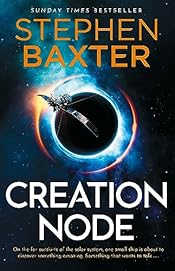
In 2255 humanity has recovered from the ravages of climate change on Earth and extended into the Solar System. Earth is dominant, with a stranglehold on the Lunar Consortium’s expansionary plans and its helium-3 extraction exports via control of the supply of nitrogen needed as a buffer gas. However, schemes are in hand for Earth to mine the gas giants for helium-3 to fuel a nuclear fusion engine which will cut journey times across the Solar System from decades to years. A third group called Conservers does not wish to deplete the Solar System’s resources but has sent out the Shadow, a ship powered by solar sails, to the Oort Cloud to investigate the possibility of Planet Nine orbiting there.

Planet Nine, as found, could fall into the venerable SF category of Big Dumb Object, except it’s not big – it’s an apparent black hole, ten times Earth-mass – and it’s not dumb. Salma, a teenager born on the voyage, discovers its Hawking radiation harbours patterns. It is sending out a message. As soon as the Shadow’s crew echoes the signal back, the Hawking radiation changes form and the galaxy’s central core simultaneously turns red from a quasar emanation. As coincidences go this would be an almighty one but how could a signal sent in the here and now cause an event to have occurred thousands of years ago so many light years away? The quasar’s red light bathes the whole Solar System and starts to increase the temperatures of every orbiting body within it, slowly but inexorably. This, however, is a challenge which is nothing but background for most of the book.

Standing off some distance away, the Shadow’s crew then sends the second pattern back to the object. It expands immediately to a larger size and forms a surface with one Earth standard gravity. And on that surface lies a cylindrical container. The three crew members sent down to the surface find it has an alien inside, an alien which resembles a bird but with human resemblances. This is swiftly dubbed Feathers. Creation Node is not just a BDO novel, then, but also a first contact one. Communication with Feathers is almost impossible except by gesture so who, or what, she is, is a mystery. Both the Earth authorities and the Lunar Consortium decide it is imperative to send missions to Shadow’s location as soon as possible.

A lot of the earlier part of the book (sometimes spoiled by information dumping of the ‘she knew’ variety and intermittent references to several of the characters wearing black pendants; a decorative choice never fully explained) is taken up with Earth’s preparations of its fusion powered ship, Cronus, to launch from Saturn orbit and the Lunar Consortium’s unannounced mission to join it. This is something of a drag on the ongoing story in the Oort cloud (albeit with a set piece collision in space to be described.) We could charitably interpret this longueur as Baxter trying to convey the time scale involved. Even with the new drive the joint mission to the changed black hole takes eleven years.

The climax of the novel is almost literally (but not quite, since Baxter tips us the wink to its existence in earlier short chapters) a deus ex machina, the manifestation of a creature with god-like powers which can move both itself and our humans between universes and across space and time. Both Planet Nine and the quasar are under its control, the details of which I’ll leave to the reader to discover. It presents a dilemma to the humans at the site, though.

Baxter’s immersion in SF shines through, Creation Node contains more than a few nods to Arthur C Clarke – sunjammers, space elevators, an enigmatic object that eventually provides a path to elsewhere in the universe – to please longstanding SF buffs. Its invocations of other universes and the vastness of time tickle the sense of wonder but the humans its tale is fashioned around are not its primary focus. Ideas are the thing here. This is good old SF for the good old SF reader.

Pedant’s corner:- “to the second. Hawking set” (has no need of that full stop,) Feathers’ (several times; Feathers’s) “‘when we first found here’” (found her makes more sense,) “had managed to assemble of fair-sized heaps of the stuff” (doesn’t need the ‘of’ before fair-sized,) “desertification was increasing such places as the Sahel” (was increasing in such places,) “seemed to rise to a crescendo” (the crescendo is the rise, not its climax,) “nothing remained to be sucked out” (it wasn’t sucked out, it was pushed out into a vacuum – which Baxter implicitly acknowledges two lines later with “after the initial plume of lost air had pushed stuff out into space,) a missing open quote mark before a piece of direct speech, “‘these are all stones are deep black’” (either ‘these are all stones which are deep black’ or these stones are all deep black’,) “twenty thousand years of emitted a galaxy core heat” (doesn’t need that ‘a’.)

Rijksmuseum, Amsterdam (ii) The Night Watch

The centre piece of the Rijksmuseum’s Great Hall is Rembrandt’s masterpiece The Night Watch.

Imagine our disappointment when we entered the room in which it is displayed to see this:-

Rembrandt's Night Watch, Rijksmuseum

It was cordoned off and we therefore could not see it properly. Apparently minor air movements make the canvas flex, potentially damaging it, and they were measuring just how large the movements were so that they can prevent any future deterioration.

However there was a painting of a similar subject (well, lots of Dutch burghers) just to The Night Watch’s right as you look at it, which I had to take two photos of to get it all and then stitch:-

Long Painting, Rijksmuseum, Amsterdam

Vermeer’s milkmaid was also in the Great Hall but the lighting conditions weren’t good and my photo came out blurry.

Also nearby was this still life. Still Life with Cheese by Floris Claesz Van Dijck:-

Still Life with Cheese by Floris Claesz Van Dijck, Rijksmuseum, Amsterdam

ParSec Keeping Me Busy Again

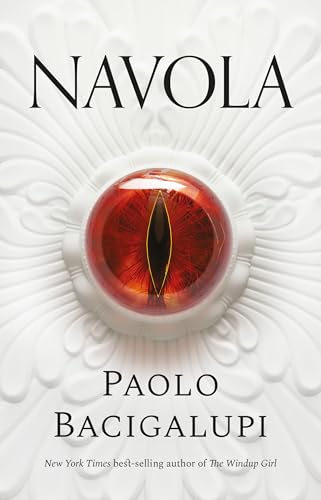
This time with Navola by Paolo Bacigalupi.
I’ve not read the blurb yet.

However, Bacigalupi is an author I have read before. See here and here.

But not for some time.


ParSec 10


ParSec 10 became available for purchase yesterday.

This issue contains my reviews of the short story collection Elephants in Bloom by Cécile Cristofari and the novel Floating Hotel by Grace Curtis.

Rijksmuseum, Amsterdam (i)

One of the reasons for our trip to Amsterdam was to visit the Rijksmuseum. Entry isn’t cheap (now it’s €22.50) especially if you’re used to free British Museums but it’s a very good museum indeed.

Building:-

Rijksmuseum, Amsterdam

The Great Hall is on the first floor (second floor if you’re USian.)

It has a nicely painted ceiling:-

Great Hall Ceiling, Rijksmuseum, Amsterdam

with illustrations on the areas above the side halls:-

Rijksmuseum, Amsterdam, Great Hall Ceiling 2

and stained glass windows to the front:-

Rijksmuseum, Amsterdam, Great Hall Stained Glass

Great Hall Stained Glass, Rijksmuseum, Amsterdam


Solution Three by Naomi Mitchison

Warner Books, 1975, 140 p.

In this sometime future, humankind has suffered many emergencies – among them a population crisis. Eventually, due to contributions from two people now known only as Him and Her, it settled on what is called Solution Three. To filter out aggression, heterosexual reproduction has been replaced – at least in the mega-cities – by clones of Him and Her. Clone Mums look after these children until they are old enough for strengthening, a process intended to replicate the stresses and strains of the lives of Him and Her and meant to lead the children to wisdom but about which they afterwards do not speak.

In this society, overseen by The Council, heterosexual sex is regarded as an obscenity except for within a group known as the Professorials and for those living in remote communities.

As one character explains, before Solution Three “Inter-sexual love, resulting in the birth of children, had been necessary. When it not only ceased to be necessary, but was seen as a menace, then the logic of history made itself felt. That age-old sexual aggression changed to non-aggressive love of man for man and woman for woman, overt aggression dropped” in the same curve as population did.

Further science-fictional gloss is provided by references to spray-on clothes but for trips outwith the mega-cities fabric ones are to be preferred.

What plot there is centres around a problem with cereal crops in Asia. Use of particular strains to the exclusion of others means that the food production system may not be robust. This leads to some of the characters beginning to question whether relying on the clones for the future of humanity may not be altogether wise.

As in Mitchison’s only other foray into SF which I have read, Memoirs of a Spacewoman, (and in contrast to her historical and Scottish fiction) there is again too much telling and not enough showing. Another of her SF works, Not by Bread Alone, is on my tbr pile. Will it suffer similarly?

Pedant’s corner:- “certain funguses” (fungi,) “Monte Video” (is this an old spelling of Montevideo?) “koala bears” (now called koalas, since they’re not bears,) “bath rooms” (bathrooms?) a missing end quote mark. chupatties (now spelled chapattis.) “Jean murmured, You’re forgetting’.” (Jean murmured, ‘You’re forgetting.’) “For a minute of two” (a minute or two,) elment (element,) “been dealth with” (dealt with.)

Not Friday on my Mind 82: A Simple Game. RIP Mike Pinder

No sooner had I heard the news on the radio that Duane Eddy had died (and Richard Tandy of ELO too) than I opened the Guardian’s obituary page to find that Mike Pinder of the Moody Blues has made his final voyage.

Pinder was the last of the original five members of the Moody Blues still standing. Now only Justin Hayward and John Lodge remain of the later classic line-up.

Pinder’s contribution to that classic line-up was immense. It is fair to say that without his ability on the mellotron (an instrument he personally brought to the attention of The Beatles) The Moody Blues would not have sounded as they did, nor had the same success.

His piano solo on the original group’s biggest hit Go Now was no small part of its effectiveness.

This song written by Pinder was the B-side to Ride My See-saw but later appeared on the odd album Caught Live + Five. It was later a hit for The Four Tops but as usual Levi Stubbs shouted his way through it.

The Moody Blues: A Simple Game

This is another of my favourite Pinder songs:-

The Moody Blues: The Best Way to Travel (from In Search of the Lost Chord)

I always loved the piano ending to this track which was sandwiched between Have You Heard Part 1 and Have You Heard Part 2 on the LP On the Threshold of a Dream.

The Moody Blues: The Voyage

Michael Thomas (Mike) Pinder: 27/12/1941 – 24/4/2024. So it goes.


free hit counter script