NewCon Press, 2022, p. Reviewed for ParSec 5.
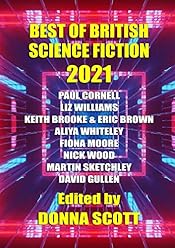 In her introduction to this collection of twenty-three stories taken from various sources, editor Donna Scott wonders about the shadow the Covid pandemic will cast over Science Fiction. Though few of the submissions to her had addressed it directly she sees its influence as being present in subtler ways – isolation being one of the themes. The book’s contents cover a relatively wide spectrum of SF tropes (the generation starship seems to be making a comeback, though time travel continues to be somewhat out of vogue.)
As to the stories themselves….
In ‘Distribution’ by Paul Cornell a local authority operative investigates a man who has divided his consciousness among parts of himself that he now keeps in tubes.
‘Stealthcare’ by Liz Williams focuses on an insurance assessor investigating possible fraud in a future where health is expensively monitored by interactive wrist band.
‘Down and Out Under the Tannhauser Gate’ by David Gullen centres on an old soldier eking out her existence by the interstellar gate where she was the only human survivor of the last battle and waiting for her chance to pass through to its imagined delights.
The superbly written ‘Me Two’ by Keith Brooke and Eric Brown is a poignant tale relating the connection, from first awareness(es) to death, of a consciousness switching daily between Danny Madison in London and Cristina Velásquez in Barcelona.
In Tim Major’s ‘The Andraiad,’ Martin is the andraiad replacement for a man who committed a violent crime, and is determined to be a better person than his predecessor.
The action of ‘Bloodbirds’ by Martin Sketchley occurs after the Qall have come, used humanity as humans had used other animals, and then gone again, leaving inside people cells which will form Qall embryos, emerge with little warning, and devastate their erstwhile host. Nikki is an Angel, part of the Vanguard who hunt down these surrogates. Then she meets a possible surrogate man who treats her kindly.
In ‘Going Home’ by Martin Westlake a Russian scientist is in effect conscripted to investigate mysterious fragments found in the area where Tunguska was struck by a meteorite . Or was the devastation there caused by a conflict between angels?
Spookily atmospheric, ‘Okamoto’s Lens’ by A N Myers centres on the eponymous lens which acts a bit like Bob Shaw’s slow glass, only in reverse. It can capture images of the future.
Set in Leith, ‘Love in the Age of Operator Errors’ by Ryan Vance explores the illicit use of memory technology to access the experiences of the narrator’s lost boyfriend.
‘Stone of Sorrow’ by Peter Sutton combines two new technologies, an experimental system for regenerating farm soil and a top secret army transportation system in a story whose focus doesn’t stray from concern for its characters.
Bearing some tonal resemblances to Daniel Keyes’s Flowers for Algernon, ‘Henrietta’ by T H Dray features a retired plastic-eating artificial life-form which wants to see a sunrise.
The light-hearted ‘A History of Food Additives in 22nd Century Britain’ by Emma Levin does what its title promises. The entry for 2150 is especially sardonic.
‘The Trip’ by Michael Crouch has a professor and a newly qualified former student undertake an archaeological expedition on a new planet, where they make a mind-expanding discovery.
‘The Ghosts of Trees’ by Fiona Moore. A plant researcher working in the Nevada desert on plants suitable for use on Mars sees the ghosts of trees, specifically the trees in the footage of 1950s nuclear test explosions.
Russell Hemmell’s ‘The Opaque Mirror of Your Face’ is narrated by a faceless cyborg, part of a human spinal fluid harvesting team, who steals – down to the seventh dermal level – the face of a young woman to use as his own. Her revenge is not what you might expect.
Aliya Whiteley’s ‘More Sea Creatures to See’ features aliens who, unbeknownst to humans, are slowly replacing them in order to turn Earth into a theme park.
Remarkably effective at evoking memories for those of a certain age, ‘The End of All Exploring’ by Gary Couzens is a hymn both to all those unrecorded 1960s TV moments forever lost to the ether and to the man who comes back in time to record them.
David Cleden’s ‘How Does My Garden Grow?’ is set on a generation starship whose occupants are obsessed with keeping the recycling ratio as high as possible.
‘Girls’ Night Out’ by Teika Marija Smits relates an experience of “bottled” memories by hybrids who are used to do the unpleasant jobs necessary for wider society to function.
‘Bar Hopping for Astronauts’ by Leo X Robertson finds a former astronaut who has been locked into his space suit for twenty years having to come to terms with the modern world.
‘In Aeturnus’ by Phillip Irving sees a man trapped in a never-ending cycle of regeneration and disposal.
Emma Johanna Puranen’s ‘A Spark in a Flask’ is set in a moonbase abandoned to robot caretakers supervising a series of experiments set up to engender life. The protocols are not set to cater for the project’s success.
A tale about the survivor of an airlock accident having to overcome her fears, the elegantly allusively titled ‘A Pall of Moondust’ by Nick Wood references other SF stories set on the Moon as well as the Arthur C Clarke story its title echoes.
In summary, there is nothing remarkably new here but all are good examples of the genre, many illustrating what it is best suited to explore, the human condition under stress.
Pedant’s corner:- In the Introduction: Smits’ (Smits’s,) Myers’ (Myers’s.) Otherwise; “its” (it’s,) “steps back down them with he sees Shan hasn’t followed” (when he sees Shan hasn’t,) WID (elsewhere WIS, for Wehlberg’s Inflammatory Syndrome,) missing start quotation marks. “‘She said she’d always has this one’” (always had this one.) ‘I thought about it. “some women too.”’ (either; no full stop but a comma; or; ‘Some women too’,) ‘Dumass” brigade’ (Dumas’s brigade,) ;the aliens” stillness’ (the aliens’ stillness,) no capital letters on a new piece of direct speech (x 2,) “you ‘ve done it” (you’ve done it,) “as they set of up the steps” (set off,) “I ‘ll come back” (I’ll come back,) “three Cytheran” (Cytherans,) Louis’ (x 3, Louis’s.) “The nine on the lower deck” (in the previous paragraph we are told there had been sixteen on the lower deck, nine on the upper,) unfocussed (unfocused,) whiskey (x 2. This is set in Birmingham [and not the one in Alabama]: whisky,then,) camelia (x 2, camellia,) Chris’ (Chris’s,) “leaving for her sisters’” (her sister’s.) “The receptionist clicks their tongue” (the receptionist had previously been described as a man; so; ‘clicks his tongue’,) “set him at odds to” (at odds with,) whiskey (in Leith it’s whisky,) “the civil war” (Civil War,) span (x 2, spun,) “porch swing” (for a story set in England a farm having a porch swing is unlikely.) “I acknowledge that the growing inefficiency of my mouth-parts, gut and legs necessitate precautionary measures” (the growing inefficiency ….. necessitates precautionary measures,) McVities’ (McVitie’s,) “meeting up with the one that got away after twenty years ago” (either ‘the one got away after twenty years’ or, ‘the one got away twenty years ago.) “‘That is what you we’re thinking’” (you were thinking,) a paragraph break in the middle of a sentence (x 2.) “The only thing I can seem to see in sharp focus are little bursts of light” (the only thing …. is little bursts.) “There are a mix of colours” (there is a mix,) “the cushioning effect of mycelial layers on the floor become more apparent” (the cushioning effect … becomes more apparent.) “Fungi can eat rock and absorb the mineral content into its own being” (fungi is a plural word; so; ‘into their own being’,) “eager to see what else lay beyond” (the rest of the paragraph is in present tense; ‘what lies beyond’,) “into the gaping maw of the passage entrance” (a maw is a stomach, not a mouth,) “neither of us were in a state” (neither of us was,) “Hangar is just passed the check point” (just past.) “Whatever ripe human muscles a human body owns is at risk” (ripe human muscles …. are at risk.) “‘Healthy for what I can see from a superficial reading’” (Healthy from what I can see,) “he began (rest is in present tense; begins,) “concentrated in listening to” (concentrated on,) “it has the excitement of the novelty” (of the novel,) “as he has done a while ago” (as he had done,) “or we careful avoid developing one” (carefully,) “I’m incapable to get rid of both” (it’s not ‘incapable to’ it’s ‘incapable of’; incapable of getting rid.) “I have to be contented in touching her lips” (contented with touching,) “for what it’s going to happen” (what is going to happen.) “‘Since the first time you’ve screwed me’” (the first time you screwed me,) Woolworth’s (Woolworths,) “<em>TV Time</em>” (<em>TV Times</em>; correctly titled lower down the same page,) “whom I met once I week” (once a week.) “I could day more” (say more?) “He turned to face m.” (to face me.) “I was furious at have been lied to” (at having been.) “I hurried down the stars” (stairs.) “‘I’m the one they’ve come from’” (they’ve come for,) “‘has involved us with us in this matter’” (no need for that ‘with us’,) “photograph if a bride and groom standing hand in hand” (of a bride and groom,) “the fading purple of chive flowers are hung with melancholy” (has something syntactically wrong about it. ‘The fading purple … is hung with melancholy’ is more grammatical but odd. ‘The fading purple chive flowers are hung with melancholy’ just about works,) smartglass’ (smartglass’s,) “open doorways loom dark like maws” (maws are stomachs, not mouths,) descendent (descendant,) “wide as a monster’s maw” (it’s a stomach, not a mouth.) “‘Do we need to titrate your medication and increase your dose?’” (titrate is not the correct verb here,) Baines’ (x 2, Baines’s,) knobkierie (Afrikaans spelling of knobkerrie.)


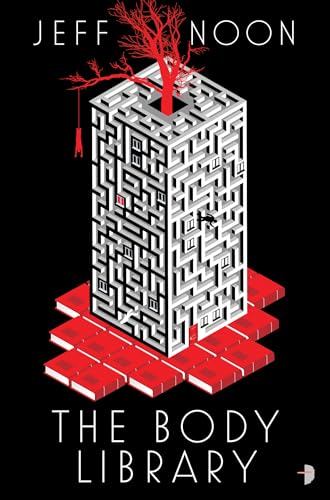 The first sentence of this novel sets the action in 1959. But it’s not the 1959 of our world. Though the tale proper starts off in a noirish way a prologue chapter has already revealed to us an apparently dead man on a library floor whose skin is covered in words; not tattoos, since they’re moving. A man covered in stories.






 While we’re on literary matters.